---
title: "Create a custom content element type (CType)"
manual: "TYPO3 Explained"
version: "main"
permalink: "https://docs.typo3.org/permalink/t3coreapi:adding-your-own-content-elements@main"
source: "ApiOverview/ContentElements/AddingYourOwnContentElements.rst"
modified: "2026-09-15T19:16:38+00:00"
---
# Create a custom content element type (CType)
This page explains how to create your own custom content element types. These
are comparable to the predefined content element types supplied by TYPO3. They
are used from extensions like [`typo3/cms-fluid-styled-content`](https://packagist.org/packages/typo3/cms-fluid-styled-content) .
See [fluid_styled_content](https://docs.typo3.org/c/typo3/cms-fluid-styled-content/main/en-us/Index.html)
A content element can be based on fields already available in the `tt_content`
table.
It is also possible to add extra fields to the `tt_content`
table, see [Extending tt_content](https://docs.typo3.org/permalink/t3coreapi:configurece-extend-tt-content@main).
The data of the content element is then passed to a TypoScript object, in most
cases to a [FLUIDTEMPLATE](https://docs.typo3.org/m/typo3/reference-typoscript/main/en-us/ContentObjects/Fluidtemplate/Index.html#cobj-fluidtemplate).
Some data might need additional [Data processing](https://docs.typo3.org/permalink/t3coreapi:configurece-dataprocessors@main). Data
processors are frequently used for example to process files
([files data processor](https://docs.typo3.org/m/typo3/reference-typoscript/main/en-us/DataProcessing/FilesProcessor.html#FilesProcessor)) or to fetch related records
([database-query data processor](https://docs.typo3.org/m/typo3/reference-typoscript/main/en-us/DataProcessing/DatabaseQueryProcessor.html#DatabaseQueryProcessor)).
A data processor can also be used to convert a string to an array,
as is done for example in the *table* content element (`tt_content`) with the field `bodytext`.
In these cases Fluid does not have to deal with these manipulations or transformation.
You can find the examples below in the TYPO3 Documentation Team extension
[`t3docs/examples`](https://packagist.org/packages/t3docs/examples).
## Prerequisites
The following examples require an extension like the system extension
[`typo3/cms-fluid-styled-content`](https://packagist.org/packages/typo3/cms-fluid-styled-content).
It can be installed via Composer with:
```console
composer req typo3/cms-fluid-styled-content
```
## Use an extension
We recommend to create your own extension for new custom content element types.
The following example uses the extension key `examples`.
Here you can find information on how to
[create an extension](https://docs.typo3.org/permalink/t3coreapi:extension-create-new@main).
## Register the content element type
First we need to define the key of the new content element type. We use
`myextension_basiccontent` throughout the simple example.
Next the key needs to be added to the select field `CType`. This will make it
available in the **Type** dropdown in the backend.
The following call needs to be added to the file
[`Configuration/TCA/Overrides/tt_content.php`](../../ExtensionArchitecture/FileStructure/Configuration/TCA/Index.md#file-extension-configuration-tca-overridessomefile-php).
**EXT:my_extension/Configuration/TCA/Overrides/tt_content.php**
```php
'Example - basic content',
'value' => $key,
'group' => 'default',
],
'textmedia',
'after',
);
// Configure the default backend fields for the content element
$GLOBALS['TCA']['tt_content']['types'][$key] = [
'showitem' => '
--palette--;;headers,
bodytext,
',
];
```
Now the new content element is available in the CType selector and the
"New Content Element" wizard.
> [!NOTE]
> In plain Core native plugins you need to call
> `ExtensionManagementUtility::addPlugin`instead of
> `ExtensionManagementUtility::addTcaSelectItem`.
### Display an icon
If you define no icon a default icon will be displayed.
You can use an existing [icon from the TYPO3 core](https://typo3.github.io/TYPO3.Icons/icons/content.html) or register your
own icon using the [Icon API](https://docs.typo3.org/permalink/t3coreapi:icon@main).
**EXT:my_extension/Configuration/TCA/Overrides/tt_content.php (excerpt)**
```diff
ExtensionManagementUtility::addTcaSelectItem(
'tt_content',
'CType',
[
'label' => 'Example - basic content',
'value' => $key,
+ 'icon' => 'examples-icon-basic',
'group' => 'default',
],
'textmedia',
'after',
);
+$GLOBALS['TCA']['tt_content']['ctrl']['typeicon_classes'][$key] = 'examples-icon-basic';
```
## The new content element wizard
New content elements added via TCA are automatically displayed in the
**New Content Element** wizard.
**EXT:my_extension/Configuration/TCA/Overrides/tt_content.php**
```php
'Example - basic content',
'value' => $key,
'group' => 'default',
],
'textmedia',
'after',
);
// Configure the default backend fields for the content element
$GLOBALS['TCA']['tt_content']['types'][$key] = [
'showitem' => '
--palette--;;headers,
bodytext,
',
];
```
The values in the array highlighted in the code example above are used for the
display in the **New Content Element** wizard.
It is also possible to define a description and an [icon](https://docs.typo3.org/permalink/t3coreapi:addingce-icon@main):
**EXT:my_extension/Configuration/TCA/Overrides/tt_content.php (excerpt)**
```diff
ExtensionManagementUtility::addTcaSelectItem(
'tt_content',
'CType',
[
'label' => 'Example - basic content',
'value' => $key,
+ 'icon' => 'examples-icon-basic',
+ 'description' => 'examples.db:basic_content.description',
'group' => 'default',
],
'textmedia',
'after',
);
```
The content element wizard configuration is described in detail in
[New content element wizard](https://docs.typo3.org/permalink/t3coreapi:content-element-wizard@main).
## Configure the backend form
Configure the backend fields for your new content element in
the file [`Configuration/TCA/Overrides/tt_content.php`](../../ExtensionArchitecture/FileStructure/Configuration/TCA/Index.md#file-extension-configuration-tca-overridessomefile-php):
**EXT:my_extension/Configuration/TCA/Overrides/tt_content.php**
```php
'Example - basic content',
'value' => $key,
'group' => 'default',
],
'textmedia',
'after',
);
// Configure the default backend fields for the content element
$GLOBALS['TCA']['tt_content']['types'][$key] = [
'showitem' => '
--palette--;;headers,
bodytext,
',
];
```
In line 27 a custom [palette](https://docs.typo3.org/m/typo3/reference-tca/main/en-us/Palettes/Index.html#palettes) with the header and related
fields is displayed. This palette and its fields are defined in
[EXT:frontend/Configuration/TCA/tt_content.php (GitHub)](https://github.com/typo3/typo3/blob/main/typo3/sysext/frontend/Configuration/TCA/tt_content.php).
In line 28 a predefined field, `bodytext` is added to be displayed in the
form of the new content element type.
## Configure the frontend rendering
The output in the frontend gets configured in the setup TypoScript. See
[Add TypoScript to your extension](https://docs.typo3.org/m/typo3/reference-typoscript/main/en-us/UsingSetting/AddTypoScriptWithExtensions.html#extdev-add-typoscript) about how
to add TypoScript.
In the `examples` extension the TypoScript can be found at
`Configuration/TypoScript/CustomContentElements/Basic.typoscript`.
The Fluid templates for a custom content element will be saved in the
extension. Therefore we need to add the path to the
[templateRootPaths](https://docs.typo3.org/m/typo3/reference-typoscript/main/en-us/ContentObjects/Fluidtemplate/Index.html#cobj-fluidtemplate-properties-templaterootpaths):
**EXT:my_extension/Configuration/Sets/MyExtension/setup.typoscript**
```typoscript
lib.contentElement {
templateRootPaths.200 = EXT:my_extension/Resources/Private/Templates/ContentElements/
}
```
You can use any index (`200` in this example), just make sure it is unique.
If needed you can also add paths for partials and layouts.
Now you can register the rendering of your custom content element:
**EXT:my_extension/Configuration/Sets/MyExtension/setup.typoscript**
```typoscript
tt_content {
myextension_basiccontent =< lib.contentElement
myextension_basiccontent {
templateName = BasicContent
}
}
```
The `lib.contentElement` path is defined in file
[EXT:fluid_styled_content/Configuration/TypoScript/Helper/ContentElement.typoscript (GitHub)](https://github.com/typo3/typo3/blob/main/typo3/sysext/fluid_styled_content/Configuration/TypoScript/Helper/ContentElement.typoscript).
and uses a [FLUIDTEMPLATE](https://docs.typo3.org/m/typo3/reference-typoscript/main/en-us/ContentObjects/Fluidtemplate/Index.html#cobj-fluidtemplate).
We reference [fluid_styled_content](https://docs.typo3.org/c/typo3/cms-fluid-styled-content/main/en-us/Index.html)
`lib.contentElement` from our new content element and only change
the Fluid template to be used.
The Fluid template is configured by the
[templateName](https://docs.typo3.org/m/typo3/reference-typoscript/main/en-us/ContentObjects/Fluidtemplate/Index.html#cobj-fluidtemplate-properties-templatename) property as
`NewContentElement`.
This will load a `BasicContent.fluid.html` template file from the path
defined at the `templateRootPaths`.
In the example extension you can find the file at
`EXT:examples/Resources/Private/Templates/ContentElements/BasicContent.fluid.html`
`tt_content` fields can now be used in the Fluid template by accessing them via
the `data` variable.
The following example shows the text entered in the text field. New lines are
converted to `
` tags.
**EXT:examples/Resources/Private/Templates/NewContentElement.fluid.html**
```html
Data available to the content element:
{_all}
Output
{data.bodytext}
```
All fields of the table `tt_content` are now available in the variable
`data`. Read more about [Fluid](https://docs.typo3.org/permalink/t3coreapi:fluid@main).
> [!TIP]
> During development you can output all available variables in a Fluid
> template by adding `{_all}`.
>
> Even more convenient:
> `{_all}`
> lets you easily turn debugging on or off, depending on whether you
> fill in "1" or "0" for *condition*.
>
> **Example lines**
>
> ```html
> {settings}
> {data}
> {current}
> ```
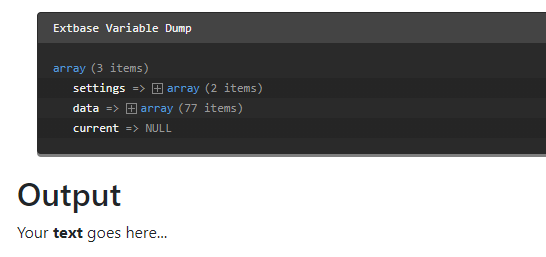
Below you can see the example output of the new content element and a
dump of all available data:
## Extended example: extend tt_content and use data processing
You can find the complete example in the TYPO3 Documentation Team extension
[`t3docs/examples`](https://packagist.org/packages/t3docs/examples). The steps for
creating a simple new content element as above need to be repeated. We use the
key *myextension_newcontentcsv* in this example.
We want to output comma separated values (CSV) stored in the field bodytext.
As different programs use different separators to store CSV we want to make
the separator configurable.
### Extending tt_content
If the available fields in the table tt_content are not sufficient you can add
your own fields. In this case we need a field `tx_examples_separator` from
which to choose the desired separator.
#### Extending the database schema
First we extend the database schema by adding the following to the file
[`ext_tables.sql`](../../ExtensionArchitecture/FileStructure/ExtTablesSql.md#file-extension-ext-tables-sql):
**EXT:my_extension/ext_tables.sql**
```sql
CREATE TABLE tt_content (
myextension_separator varchar(255) DEFAULT '' NOT NULL,
myextension_reference int(11) unsigned DEFAULT '0' NOT NULL,
);
```
> [!TIP]
> Do a database compare in the **System > Maintenance** module
> after changing the database schema (system maintainers only). Or call the
> console command:
>
> **Composer-based installation**
>
> ```bash
> vendor/bin/typo3 extension:setup
> ```
>
> **Classic mode installation (no Composer)**
>
> ```bash
> typo3/sysext/core/bin/typo3 extension:setup
> ```
#### Defining the field in the TCA
The new field *tx_examples_separator* is added to the TCA definition of the table *tt_content* in the file
[`Configuration/TCA/Overrides/tt_content.php`](../../ExtensionArchitecture/FileStructure/Configuration/TCA/Index.md#file-extension-configuration-tca-overridessomefile-php):
**EXT:my_extension/Configuration/TCA/Overrides/tt_content.php**
```php
[
'exclude' => 0,
'label' => 'examples.db:tt_content.myextension_separator',
'config' => [
'type' => 'select',
'renderType' => 'selectSingle',
'items' => [
['Standard CSV data formats', '--div--'],
['Comma separated', ','],
['Semicolon separated', ';'],
['Special formats', '--div--'],
['Pipe separated (TYPO3 tables)', '|'],
['Tab separated', "\t"],
],
'default' => ',',
],
],
];
ExtensionManagementUtility::addTCAcolumns('tt_content', $temporaryColumn);
```
You can read more about defining fields via TCA in the [TCA Reference](https://docs.typo3.org/m/typo3/reference-tca/main/en-us/Index.html#start).
Now the new field can be used in your Fluid template just like any other
tt_content field.
Another example shows the connection to a foreign table. This allows you to be
more flexible with the possible values in the select box. The new field
`myextension_reference` is a reference to another table of the extension
called `tx_myextension_mytable`:
**EXT:my_extension/Configuration/TCA/Overrides/tt_content.php**
```php
[
'exclude' => 0,
'label' => 'my_extension.db:' .
'tt_content.myextension_reference',
'config' => [
'type' => 'select',
'renderType' => 'selectSingle',
'items' => [
['None', '0'],
],
'foreign_table' => 'tx_myextension_mytable',
'foreign_table_where' =>
'AND {#tx_myextension_mytable}.{#pid} = ###PAGE_TSCONFIG_ID### ' .
'AND {#tx_myextension_mytable}.{#hidden} = 0 ' .
'AND {#tx_myextension_mytable}.{#deleted} = 0 ' .
'ORDER BY sys_category.uid',
'default' => '0',
],
],
];
ExtensionManagementUtility::addTCAcolumns('tt_content', $temporaryColumn);
```
#### Defining the field in the TCE
An individual modification of the newly added field `myextension_reference`
to the TCA definition of the table `tt_content` can be done in the
TYPO3 Core Engine (TCE) page TSconfig. In most cases it is necessary to set the page
id of the general storage folder. Then the examples extension will only use
the content records from the given page id.
**EXT:my_extension/Configuration/page.tsconfig**
```typoscript
TCEFORM.tt_content.myextension_reference.PAGE_TSCONFIG_ID = 18
```
If more than one page id is allowed, this configuration must be used instead
(and the above TCA must be modified to use the marker `###PAGE_TSCONFIG_IDLIST###`
instead of `###PAGE_TSCONFIG_ID###`):
**EXT:my_extension/Configuration/page.tsconfig**
```typoscript
TCEFORM.tt_content.myextension_reference.PAGE_TSCONFIG_IDLIST = 18, 19, 20
```
> [!NOTE]
> As we are working with pure Fluid without Extbase here the new fields can
> be used right away. They need not be added to a model.
### Data processing
Data processors can be used for data manipulation or fetching before the
variables get passed on to the template.
This is done in the
[dataProcessing](https://docs.typo3.org/m/typo3/reference-typoscript/main/en-us/DataProcessing/Index.html#cobj-fluidtemplate-properties-dataprocessing)
section where you can add an arbitrary number of data processors.
You can see a complete list of available
[data processors in the Typoscript Reference](https://docs.typo3.org/m/typo3/reference-typoscript/main/en-us/DataProcessing/Index.html#cobj-fluidtemplate-properties-dataprocessing) or write a [custom
data processor](https://docs.typo3.org/permalink/t3coreapi:content-elements-custom-data-processor@main).
Each processor has to be added with a fully qualified class name and optional
parameters to be used in the data processor:
**EXT:my_extension/Configuration/Sets/MyExtension/setup.typoscript**
```typoscript
tt_content {
myextension_newcontentcsv =< lib.contentElement
myextension_newcontentcsv {
templateName = DataProcCsv
dataProcessing.10 = TYPO3\CMS\Frontend\DataProcessing\CommaSeparatedValueProcessor
dataProcessing.10 {
fieldName = bodytext
fieldDelimiter.field = myextension_separator
fieldEnclosure = "
maximumColumns.field = imagecols
as = myTable
}
}
}
```
You can now iterate over the variable `myTable` in the Fluid template, in this
example `Resources/Private/Templates/ContentElements/DataProcCsv.fluid.html`
**EXT:examples/Resources/Private/Templates/ContentElements/DataProcCsv.fluid.html**
```html
Data in variable "myTable"
{myTable}
Output, {data.imagecols} columns separated by char {data.tx_examples_separator}
```
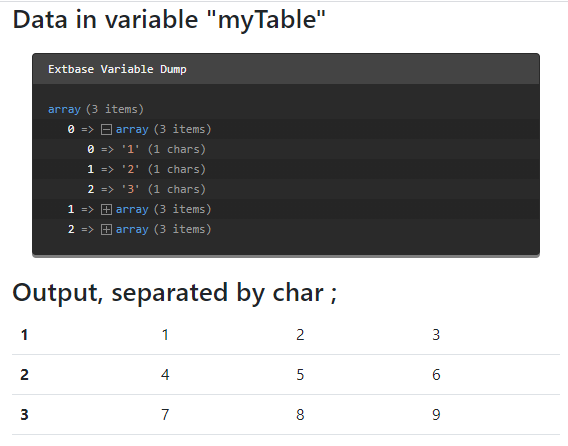
The output would look like this (we added a debug of the variable `myTable`):