lex_notifications brings the power, extensibility, and flexibility of Laravel's notification system to the TYPO3 ecosystem.
Any PHP code — a controller, a plugin, a service, a domain model or a php file — can send
a notification to any object that uses the Notifiable trait, through any
combination of channels (email, database, Slack, …). The recipient can be a
frontend user, a backend user, a domain model, a POPO, or even an anonymous inline
class: if it uses Notifiable, it can receive notifications.
A ready-to-use backend module is included. It lets editors send messages to
frontend users and serves as a practical code sample for dispatching batch
notifications.
Use the table of contents in the left panel to navigate.
Introduction
What Does It Do?
If you are familiar with the Laravel framework, you already know how flexible,
robust, and modular its notification system is. With dozens of community and
official channels available (Slack, Teams, Push, SMS, VoIP, and more), Laravel
empowers applications to send notifications across a vast network.
lex_notifications brings this exact power, extensibility, and flexibility
directly into the TYPO3 ecosystem.
The core idea is simple: any PHP object that uses the Notifiable trait can
receive a notification. Any PHP code — a controller, an Extbase plugin, a
domain service, a Scheduler task, a middleware — can send one. The two sides
are decoupled through a Notification class that describes what to send
and how to format it for each delivery channel.
There is no constraint on the direction of communication:
A frontend user can receive a notification when they place an order.
A backend user can be alerted when a content workflow step requires
their approval.
An email address (represented by a class or even a lightweight inline class) can receive
a transactional email without any database record.
Any custom domain model becomes a notification recipient with a single
use Notifiable; declaration.
Built-in delivery channels:
Email channel — sends styled HTML/plain-text emails using TYPO3's mail
system and Fluid templates.
Database channel — persists notifications in a database table so they
can be retrieved and displayed as an in-app notification centre.
Both channels are extensible. Implement ChannelInterface to add Slack,
push notifications, SMS, webhooks, or any other transport — the channel is
automatically registered with no configuration required.
The included backend module (Web > Notifications) is a ready-to-use tool
for editors who need to compose and send messages to frontend users. It also
acts as a reference implementation showing how to dispatch batch notifications
to a resolved list of Notifiable recipients.
When Should You Use It?
Use lex_notifications whenever you need to decouple the act of triggering
a notification from the act of delivering it. Typical scenarios:
E-commerce — order confirmed, shipment dispatched, invoice available.
Workflow / approval — content submitted for review, approved, rejected.
Account events — registration, password reset, login from new device.
System alerts — an extension notifies a backend user when a background
job fails.
Cross-user messaging — a frontend user triggers a notification to
another frontend user (e.g. a collaboration platform).
Editorial broadcasts — backend editors send announcements to groups of
frontend users via the included module.
Any programmatic trigger — if something happens in your TYPO3
application and someone needs to know about it, this extension handles the
delivery.
Core Concepts
Notifiable
Any PHP object that uses the Notifiable trait. It gains notify()
and notifyNow() methods and can be passed as the recipient of any
notification.
Notification
A PHP class extending Lex\Notifications\Notification. It declares
which channels to use (via()) and how to format the payload for each
channel (toMail(), toDatabase(), toSlack(), …).
Channel
A delivery mechanism implementing ChannelInterface. A channel receives
a notifiable and a notification, extracts the relevant payload, and delivers
it (sends an email, writes a DB row, calls a webhook, …).
NotificationDispatcherInterface
The central dispatcher. Inject it anywhere in your TYPO3 code to send
notifications without depending on concrete implementations.
ShouldQueue
A marker interface. When a notification class implements it, dispatching
goes through Symfony Messenger so delivery happens asynchronously in a
CLI worker — keeping your HTTP responses fast.
Notifications flow from any caller through the NotificationManager,
which delegates to the channels declared in the notification's via()
method. Each channel knows how to format and deliver the payload for its
transport. The recipients can be any combination of objects using the
Notifiable trait.
Screenshots
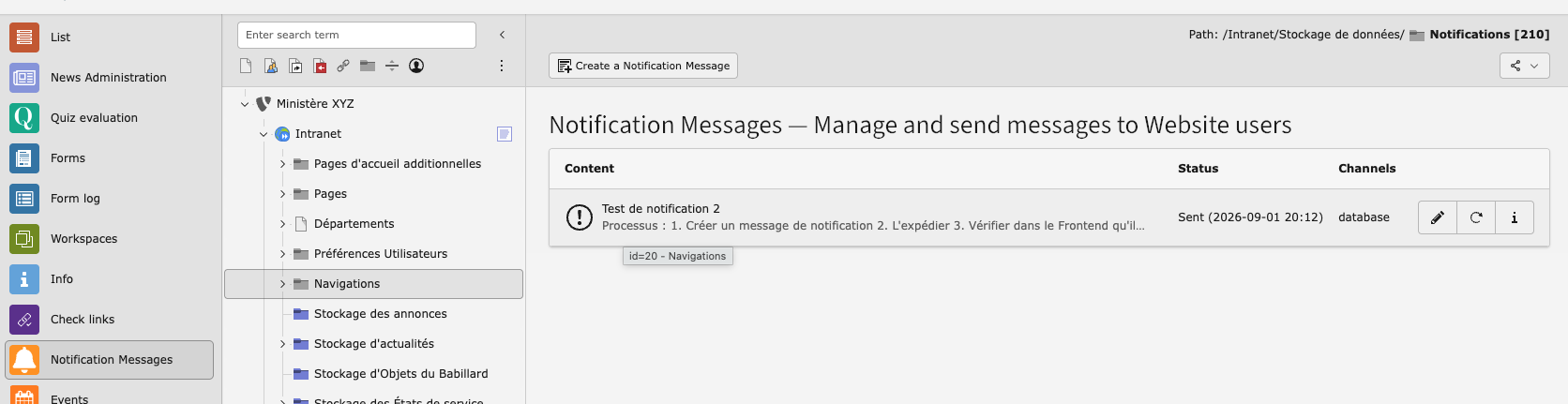
The included backend module lists all composed messages with their send
status, level indicator and action buttons.
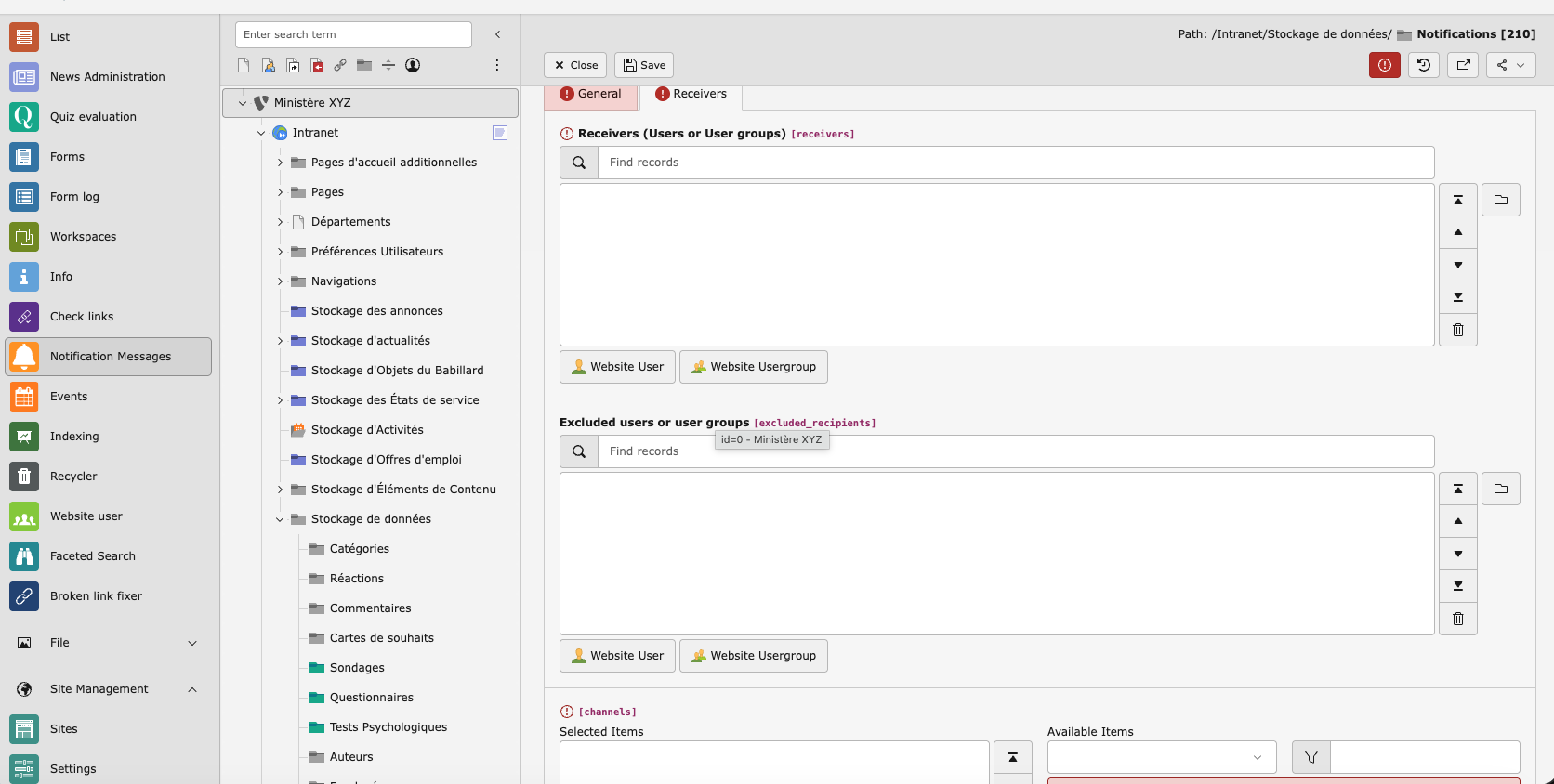
The create form lets editors write a message, select severity level,
target recipients (individual frontend users or groups) and pick delivery
channels.
Tip
Use the table of contents in the left panel to navigate.
Non-Composer installations are supported but not recommended for new
projects. Ensure the third-party packages listed above are available via
your autoloader.
Upload and install it via Admin Tools > Extensions.
Run Admin Tools > Maintenance > Analyze Database Structure to
create the required tables.
Post-Installation Steps
No configuration needed. Login in the backend, and verify that the module Notification Messages is present.
Database Tables
The extension creates two tables:
Table
Purpose
tx_lexnotifications_domain_model_notification
Stores in-app (database-channel) notifications for frontend
users. Each row represents one unread or archived notification.
tx_lexnotifications_domain_model_message
Stores messages composed in the backend module, including
recipient lists, delivery channels and send status.
Tip
Use the table of contents in the left panel to navigate.
Configuration
Extension Configuration
The extension does not currently expose options in the TYPO3 Extension
Configuration panel (Admin Tools > Settings > Extension Configuration).
All behaviour is controlled through TypoScript or PHP configuration.
TypoScript
The extension ships with empty constants.typoscript and
setup.typoscript templates. These are reserved for future frontend plugin
configuration. No TypoScript is required for the backend module or the
developer API.
Symfony Messenger (Queue Configuration)
The BackendUserSentMessageToFrontendUser notification implements the
ShouldQueue interface, which means it is dispatched via the Symfony
Messenger component by default.
To process the queue, configure a transport and run the messenger worker:
vendor/bin/typo3 messenger:consume
Copied!
Refer to the TYPO3 Core documentation on Symfony Messenger for full
transport configuration options (Doctrine, Redis, AMQP, etc.).
If you want to send notifications synchronously (without a queue worker),
call notifyNow() instead of notify() — see Developer Reference.
Backend Module Access
The Web > Notification Messages module is registered under the web module
group. Access is controlled via TYPO3's standard backend user/group
permissions.
To grant a backend user group access:
Go to System > Backend Users and edit the relevant user group.
Under Access Lists > Modules, tick Web > Notification Messages.
Custom channels are automatically registered by implementing
Lex\Notifications\Channel\ChannelInterface — no Services.yaml entry
needed. See Adding Custom Channels for the full pattern.
Tip
Use the table of contents in the left panel to navigate.
Backend Module: Web > Notification Messages
Note
The backend module is one built-in application of the notification
system, not the primary feature. For sending notifications from PHP code,
see Developer Reference. The module source code
(Classes/Controller/Backend/NotificationController.php) is also a
useful reference implementation of how to dispatch batch notifications
to a resolved list of Notifiable recipients.
After installation, navigate to Web > Notification Messages in the TYPO3 backend.
The module lets editors compose messages and deliver them to frontend users
(individuals or groups) via email and/or database notifications.
Listing Messages
The module overview displays all composed messages in a paginated list
(50 per page). Each row shows:
Sent at — timestamp of last send, or "Not sent" if pending
Actions — Send / Resend buttons
Use the filter bar at the top to narrow results by level.
Composing a Message
Click the Create button (pencil icon) in the module button bar.
Field
Required
Description
Level
Yes
Severity of the notification (Info, Notice, Warning, …).
Displayed as a badge in both the backend list and the
notification email.
Subject
Yes
Short title of the message (max 255 characters).
Message
Yes
Full message body. Supports basic HTML.
Link
No
Optional URL or internal TYPO3 page link displayed as a
call-to-action button in the notification.
Recipients
Yes
Select one or more frontend users or frontend user
groups. All members of selected groups will receive the
notification.
Excluded recipients
No
Frontend users to exclude from delivery (useful to target a
group but skip specific members).
Channels
No
Select one or more delivery channels: Mail and/or
Database. If left empty, both channels are used.
Click Save to store the message without sending it.
Sending Messages
After saving (or from the list view), click the Send button. The module
will:
Resolve all recipient UIDs from the selected users and groups, minus any
excluded recipients.
Remove duplicates.
Load NotifiableFrontendUser objects for each resolved UID.
Instantiate a BackendUserSentMessageToFrontendUser notification.
Call $dispatcher->send($recipients, $notification) — the same call you
would make from your own PHP code.
Record the sent_at timestamp on the message record.
Display a flash message confirming how many recipients were notified.
Note
BackendUserSentMessageToFrontendUser implements ShouldQueue, so
actual delivery is handled by the Symfony Messenger worker. If no worker is
running, messages sit in the queue until it is started. To bypass the queue,
call sendNow() — see Developer Reference.
Resending Messages
Click Resend to dispatch a message again to the same recipients and
channels. The sent_at timestamp is updated. Useful when delivery failed
or you want to send a reminder.
Using the Module as a Code Sample
The backend module is deliberately simple so that its source code is easy
to read. If you need to send batch notifications from your own extension,
study NotificationController::sendAction() — it shows the full pattern:
// Simplified version of what the module does:

$recipients = $this->resolveRecipients($message);   // returns Notifiable[]

$notification = new BackendUserSentMessageToFrontendUser(
    subject:  $message->getSubject(),
    message:  $message->getMessage(),
    level:    $message->getLevel(),
    link:     $message->getLink(),
    channels: $this->parseChannels($message),
);

$this->notificationDispatcher->send($recipients, $notification);
Copied!
Replace BackendUserSentMessageToFrontendUser with your own
Notification subclass and $recipients with any collection of
Notifiable objects to adapt this pattern to your use case.
Tip
Use the table of contents in the left panel to navigate.
The Notifiable trait is the only requirement for a class to receive
notifications. Add it to any PHP object — Extbase entity, plain PHP class,
anonymous class — and that object immediately becomes a valid notification
recipient.
useLex\Notifications\Domain\Model\Ability\Notifiable;
classMyModel{
useNotifiable;
}
// That's it. Now you can do:
$instance = new MyModel();
$instance->notify(new SomeNotification());
Copied!
There is no registry, no database table for recipients, no configuration.
Any object with the trait can be passed to the dispatcher.
Making a Model Notifiable
For email delivery, also add HasRouteNotificationForMail. This trait
provides the routeNotificationForMail() method, which the email channel
calls to resolve the recipient's email address:
useLex\Notifications\Domain\Model\Ability\HasRouteNotificationForMail;
useLex\Notifications\Domain\Model\Ability\Notifiable;
useTYPO3\CMS\Extbase\DomainObject\AbstractEntity;
classFrontendUserextendsAbstractEntity{
useNotifiable;
useHasRouteNotificationForMail;
// // Retrieve from the class properties, database or other sourcepublicfunctiongetEmail(): string{ return$this->email; }
publicfunctiongetFirstName(): ?string{ return$this->firstName; }
publicfunctiongetLastName(): ?string{ return$this->lastName; }
}
Copied!
The Notifiable trait exposes two methods:
// Dispatches via Symfony Messenger if the notification implements ShouldQueue
$user->notify(new OrderConfirmed($order));

// Always sends immediately, ignoring ShouldQueue
$user->notifyNow(new OrderConfirmed($order), ['mail', 'database']);
Copied!
Who Can Be a Recipient?
Because the only requirement is the Notifiable trait, the recipient can
be anything. Here are common patterns.
Frontend user notifies another frontend user
A collaboration feature where one user shares content with another:
// In a frontend plugin action
$sender = $this->notifiableFrontendUserRepository->findByUid($senderUid);
$recipients = $this->notifiableFrontendUserRepository->findByUids($recipientUids);
$this->notificationDispatcher->send($recipients, new ContentSharedWithYou($page, $sender));
Copied!
Extension notifies a backend user
A Scheduler task or service that alerts an admin when a background job fails:
// An inline class wrapping a backend user record — no persistent domain model needed
$admin = newclass($backendUserRecord['email'], $backendUserRecord['realName']) {
useNotifiable;
useHasRouteNotificationForMail;
protected string $firstName;
protected string $lastName;
publicfunction__construct(protected readonly string $email, string $fullName){
$parts = explode(' ', trim($fullName), 2);
$this->firstName = $parts[0] ?? '';
$this->lastName = $parts[1] ?? '';
}
publicfunctiongetEmail(): string{ return$this->email; }
publicfunctiongetFirstName(): ?string{ return$this->firstName; }
publicfunctiongetLastName(): ?string{ return$this->lastName; }
};
$admin->notifyNow(new SchedulerJobFailed($taskName, $errorMessage));
Copied!
Inline / anonymous notifiable (no database record needed)
Send a one-off notification to any email address without a domain model:
Multiple recipients of different types in one call
The dispatcher accepts an array of notifiables — they do not need to be the
same class:
 $team = [$teamMemberA, $teamMemberB, ...]

$this->notificationDispatcher->send(
    $team,
    new ImportantAnnouncement($text),
);
Copied!
Each recipient's via() result can differ, so the notification class can
adapt channels based on the notifiable type:
publicfunctionvia(object $notifiable): array{
// Only store in-DB for actual frontend user recordsif ($notifiable instanceof NotifiableFrontendUser) {
return [NotificationChannel::CHANNEL_MAIL, NotificationChannel::CHANNEL_DATABASE];
}
return [NotificationChannel::CHANNEL_MAIL];
}
Copied!
Creating a Notification
Extend the abstract Notification class and implement the methods for each
channel your notification uses:
namespaceMyVendor\MyExtension\Notification;
useLex\Notifications\Notification;
useLex\Notifications\NotificationChannel;
useLex\Notifications\NotificationLevel;
useTYPO3\CMS\Core\Mail\MailMessage;
finalclassOrderConfirmedextendsNotification{
publicfunction__construct(
private readonly Order $order,
){}
/**
* RFC 5424 severity level for this notification.
* Optional - Only if you want to specify a notification level different from INFO
*/publicfunctiongetLevel(): int{
return NotificationLevel::LEVEL_INFO;
}
/**
* Which channels to use. Receives the notifiable so you can adapt
* the channel list per recipient type/preference.
*
* @return string[]
*/publicfunctionvia(object $notifiable): array{
return $notifiable->prefers_sms ? ['vonage'] : [NotificationChannel::CHANNEL_MAIL, NotificationChannel::CHANNEL_DATABASE];
}
/**
* Optional - Payload for the email channel.
* Build your own MailMessage if you want.
*/publicfunctiontoMail(object $notifiable): MailMessage{
return (new MailMessage())
->subject('Order #' . $this->order->getNumber() . ' confirmed')
->html('<p>Thank you! Your order is being processed.</p>')
->to($notifiable->getEmail());
}
/**
* Optional - Payload for the database channel.
* Returned array is JSON-encoded and stored as-is.
*
* @return array<string, mixed>
*/publicfunctiontoDatabase(object $notifiable): array{
return [
'level' => $this->getLevel(),
'subject' => 'Order #' . $this->order->getNumber() . ' confirmed',
'message' => 'Your order has been received and is being processed.',
'order_id' => $this->order->getUid(),
];
}
/**
* Custom channel - Payload for the Slack channel.
*/publicfunctiontoSlack(object $notifiable): SlackMessage{
return (new SlackMessage)
->...
->...
->...;
}
}
Copied!
Only implement the channel methods you actually use. If your notification only
sends email, there is no need for toDatabase().
Queuing Notifications
Implement the ShouldQueue marker interface to have your notification
dispatched asynchronously via Symfony Messenger:
useIlluminate\Contracts\Queue\ShouldQueue;
finalclassOrderConfirmedextendsNotificationimplementsShouldQueue{
// No extra methods needed — the interface is a marker only.
}
Copied!
When ShouldQueue is implemented, calling notify() wraps the
notification in a NotificationQueued Messenger message. A CLI worker must
be running to process the queue:
Call notifyNow() or sendNow() to bypass the queue and deliver
immediately regardless of ShouldQueue.
Using the Dispatcher Directly
Inject NotificationDispatcherInterface into any service, controller, or
plugin. This is the recommended approach when you do not have a direct
reference to a notifiable object, or when you need to send to multiple
recipients:
useLex\Notifications\NotificationDispatcherInterface;
finalclassOrderService{
publicfunction__construct(
private readonly NotificationDispatcherInterface $notifications,
private readonly FrontendUserRepository $userRepository,
){}
publicfunctioncompleteOrder(Order $order): void{
$buyer = $this->userRepository->findByUid($order->getBuyerUid());
// Dispatches via Messenger queue if ShouldQueue is implemented$this->notifications->send($buyer, new OrderConfirmed($order));
// Forces immediate delivery$this->notifications->sendNow($buyer, new OrderConfirmed($order));
}
}
Copied!
Send to a batch of recipients in one call:
$subscribers = $this->frontendUserRepository->findByNewsletterGroup($groupId);

$this->notifications->send(
    $subscribers->toArray(),
    new MonthlyNewsletter($content),
);
Copied!
The dispatcher iterates each notifiable independently, so a failed delivery
for one recipient does not block the others.
You can also target a single specific channel for one call using channel():
// Deliver only via the database channel, regardless of what via() returns$this->notificationDispatcher->channel(NotificationChannel::CHANNEL_DATABASE)
->send($user, new InvoicePaid($invoice));
Copied!
Practical Use Cases
Workflow approval alert to a backend user
// In a DataHandler hook or custom service
$responsible = newclass('editor@example.com') {
use \Lex\Notifications\Domain\Model\Ability\Notifiable;
use \Lex\Notifications\Domain\Model\Ability\HasRouteNotificationForMail;
publicfunction__construct(protected readonly string $email){}
publicfunctiongetEmail(): string{ return$this->email; }
publicfunctiongetFirstName(): ?string{ returnnull; }
publicfunctiongetLastName(): ?string{ returnnull; }
};
$this->notifications->sendNow(
$responsible,
new ContentPendingReview($pageUid, $submitter),
);
Copied!
Frontend user triggers a notification to another frontend user
// In a frontend plugin action (e.g. a messaging feature)
$sender   = $this->notifiableFrontendUserRepository->findByUid($senderUid);
$receiver = $this->notifiableFrontendUserRepository->findByUid($receiverUid);

$receiver->notify(new NewMessageReceived($sender, $messageText));
Copied!
Extension notifies multiple channels for different severity levels
finalclassPaymentFailedextendsNotification{
publicfunctionvia(object $notifiable): array{
// Critical failures go to mail + database + Slackreturn [
NotificationChannel::CHANNEL_MAIL,
NotificationChannel::CHANNEL_DATABASE,
'slack',
];
}
}
Copied!
Sending to a plain email without any domain model
$contact = newclass('customer@example.com') {
use \Lex\Notifications\Domain\Model\Ability\Notifiable;
use \Lex\Notifications\Domain\Model\Ability\HasRouteNotificationForMail;
publicfunction__construct(protected readonly string $email){}
};
$contact->notifyNow(new OrderReceiptEmail($order));
Copied!
Reading Database Notifications
Inject DatabaseNotificationRepository to query stored notifications
for the currently logged-in frontend user:
Returns all notifications for a notifiable UID, ordered
by creation date descending.
markAllAsReadForNotifiable(int $uid)
Sets read_at to the current timestamp for every unread
notification belonging to that UID.
removeAllForNotifiable(int $uid)
Permanently deletes all notifications for that UID.
DatabaseNotification Model
Each stored notification exposes:
Getter
Type
Description
getType()
string
Fully-qualified notification class name.
getLevel()
int
RFC 5424 severity level.
getData()
string
Raw JSON payload as stored by toDatabase().
getDataAsArray()
array
Decoded payload as a PHP array.
getReadAt()
\DateTime|null
Read timestamp, or null if unread.
getCreatedAt()
\DateTime
Creation timestamp.
getDiffCreatedAtForHumans()
string
Human-readable relative time (e.g. "3 minutes ago").
markAsRead()
void
Sets readAt to the current date/time.
Adding Custom Channels
Step 1 — implement the interface
namespaceMyVendor\MyExtension\Notification\Channel;
useLex\Notifications\Channel\ChannelInterface;
useSymfony\Component\DependencyInjection\Attribute\AutoconfigureTag;
useLex\Notifications\Notification;
#[AutoconfigureTag('notifications.channel')]finalclassSlackChannelimplementsChannelInterface{
publicfunction__construct(
private readonly SlackClient $slack,
){}
/**
* Optional. Provides a short string key used in via().
* When omitted, the fully-qualified class name is used as the key.
*/publicfunctiongetName(): string{
return'slack';
}
publicfunctionsend(object $notifiable, Notification $notification): void{
$payload = $notification->toSlack($notifiable);
$this->slack->post($notifiable->getSlackWebhookUrl(), $payload);
}
}
The NotificationManager resolves the channel by its key at send time.
If getName() is not defined, use the fully-qualified class name as the
key in via():
Dependency injection works normally. Declare constructor arguments as
usual and they will be autowired by the Symfony DI container.
Channel key lookup order:
getName() — if the method exists on the channel class.
Fully-qualified class name — as a fallback.
To ensure a custom channel is properly detected and registered into the manager's iterator, you must assign the notifications.channel tag to your class.
You can achieve this in one of three ways:
Option A: Declaration inServices.yaml
Add your concrete channel class manually with the required tag in your extension's Configuration/Services.yaml:
Option B: Using#[AutoconfigureTag]in the channel class (Recommended)
Keep your YAML file clean by adding the Symfony attribute directly above your class definition:
useLex\Notifications\Channel\ChannelInterface;
useSymfony\Component\DependencyInjection\Attribute\AutoconfigureTag;
#[AutoconfigureTag('notifications.channel')]finalclassTeamsChannelimplementsChannelInterface{
// ... Your channel logic
}
Copied!
Option C: Using#[Autoconfigure]in the channel class
If you need to change other service options (like visibility) while registering the tag, you can pass the tags directly into the #[Autoconfigure] attribute:
Override them in your site package by adjusting the Fluid template paths.
The built-in templates receive these variables:
Variable
Type
Description
{level}
int
Notification severity level.
{subject}
string
Message subject/title.
{message}
string
Message body (may contain HTML).
{link}
string|null
Optional call-to-action URL or typolink string.
For your own Notification subclasses you can use a completely different
template — simply return the rendered HTML from your toMail() method using
whatever rendering approach fits your extension.
Tip
Use the table of contents in the left panel to navigate.
Changelog
1.3.0
[FEATURE] Custom channels implementing ChannelInterface can now
be registered via a Symfony DI tag
(notifications.channel).
[FEATURE] Optional getName(): string method on channel classes.
When present, its return value is used as the channel key in via().
When absent, the fully-qualified class name is used as the key.
[FEATURE]NotificationManager now collects channels through
#[AutowireIterator('notifications.channel')] and stores live service
instances — channels benefit from full DI, including scoped services.
[BREAKING]NotificationManager::channel() now resolves from the
injected service map instead of calling GeneralUtility::makeInstance().
Custom channels previously registered only as public services must add the
notifications.channel tag (or implement ChannelInterface so the
_instanceof rule picks them up automatically).
[FIX]?array $channels = null parameter type corrected across
NotificationDispatcherInterface, NotificationManager,
NotificationSender, and the Notifiable trait.
[FIX] TCA: removed deprecated interface key (dropped in TYPO3 13),
cruser_id ctrl field (removed in TYPO3 13), and eval => 'trim' /
eval => 'int' validators (removed in TYPO3 13).
[FIX]notifiable_id TCA field changed from type=input to
type=number.
[FIX] SQL schema: removed int(11) display width, added missing
link column in tx_lexnotifications_domain_model_message.
1.1.0 — 2024-01-01
[FEATURE] Added Symfony Messenger queue integration via
ShouldQueue marker interface.