This document is published under the
CC BY 4.0 license.
Rendered
Thu, 13 Aug 2026 07:19:51 +0000
Shared AI foundation for TYPO3. Configure LLM
providers once — every AI extension uses them.
Supports OpenAI, Anthropic Claude, Google Gemini,
Ollama, and more.
The Admin Tools > LLM backend module.
Getting started
📘 Introduction
Learn what nr-llm is, which providers are
supported, and what problems it solves.
📦 Installation
Install nr-llm via Composer and activate it.
For administrators
Set up and manage AI providers, models, and
configurations through the TYPO3 backend module.
🛠️ Administration guide
Step-by-step: add providers, fetch models,
create configurations and tasks. Includes
screenshots of every screen.
✨ AI-powered wizards
Setup wizard, configuration wizard, and
task wizard — let AI generate your config
from a plain-language description.
📋 Configuration reference
Complete field reference for providers,
models, configurations, TypoScript settings,
security, and caching.
🔐 Permissions & editor access
Grant editors exactly two capabilities —
run prepared tasks and approve suspended
runs — through the dedicated AI Tasks
module. Nothing is open by default.
For developers
Build your TYPO3 extension on nr-llm — three lines
of dependency injection, no API key handling.
🚀 Integration guide
Step-by-step tutorial: add AI capabilities
to your extension in five minutes.
💻 Developer guide
LlmServiceManager API, streaming, tool
calling, and custom providers.
⚙️ Feature services
Translation, vision, embeddings, and
completion — ready to inject and use.
📚 API reference
Complete class and method reference for
all public services and response objects —
with a documented @api stability
promise, frozen in a snapshot test.
🏗️ Architecture
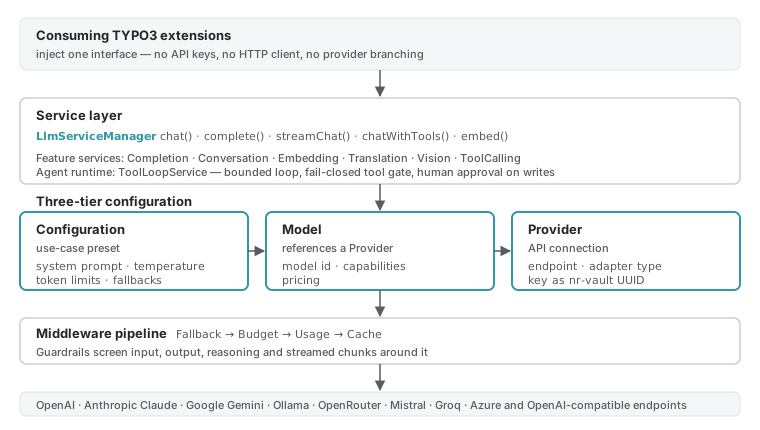
Three-tier configuration hierarchy,
provider abstraction, and design decisions.
✅ Testing
Test infrastructure, mocking LLM services,
and CI configuration.
[n] A Netresearch extension
Professional TYPO3 development, AI integration,
and enterprise consulting since 2002.
nr-llm is the shared AI foundation for TYPO3.
It lets administrators configure LLM providers
once in the backend — and every AI-powered
extension on the site uses them automatically.
For extension developers, it eliminates the
need to build provider integrations, manage API
keys, or implement caching and streaming. Add AI
capabilities to your extension with three lines
of dependency injection.
For administrators, it provides a backend module tree to manage all AI
connections, encrypted API keys, and provider configurations — plus a
dedicated AI Tasks module in the Web area where editors run prepared
tasks and decide pending approvals, gated by explicit permissions. Switch from OpenAI to Anthropic
without touching any extension code.
For agencies, it means consistent AI architecture across client projects, no
vendor lock-in, and a local-first option via
Ollama for data-sensitive environments.
The extension enables developers to:
Access multiple AI providers through a single, consistent API.
Switch providers transparently without code changes.
Leverage specialized services for common
AI tasks (translation, vision, embeddings).
Cache responses to reduce API costs and improve performance.
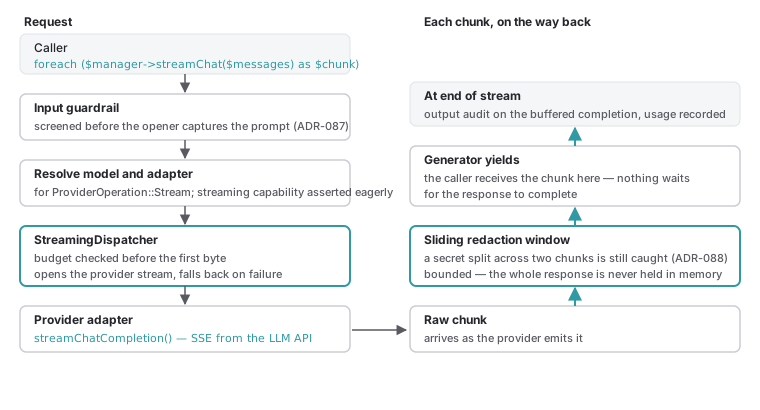
Stream responses for real-time user experiences.
Store API keys securely as nr-vault
identifiers (envelope encryption).
All providers implement a common interface, allowing you to:
Switch between providers with a single configuration change.
Test with different models without modifying application code.
Implement provider fallbacks for increased reliability.
Example: Using the provider abstraction layer
// Use database configurations for consistent settings
$config = $configRepository->findByIdentifier('blog-summarizer');
$adapter = $adapterRegistry->createAdapterFromModel($config->getModel());
$response = $adapter->chatCompletion($messages, $config->toOptions());

// Or use inline provider selection
$response = $llmManager->chat($messages, ['provider' => 'openai']);
$response = $llmManager->chat($messages, ['provider' => 'claude']);
Copied!
Specialized feature services
High-level services for common AI tasks:
CompletionService
Text generation with format control (JSON, Markdown) and creativity presets.
EmbeddingService
Text-to-vector conversion with caching and similarity calculations.
VisionService
Image analysis with specialized prompts for alt-text, titles, descriptions.
TranslationService
Language translation with formality control,
domain-specific terminology, and glossaries.
Structured outputs
Schema-validated JSON from every provider:
completeStructured() takes a JSON schema from a named strict
subset, enforces it provider-natively where the provider can (OpenAI
json_schema, Gemini responseSchema, Ollama format, a forced
tool on Claude), validates the response strictly and repairs a mismatch
with one controlled round-trip. See ADR-126: A named JSON-Schema subset, enforced strict and ADR-128: Provider-native structured output.
Streaming support
Real-time response streaming for better user experience:
Example: Streaming chat responses
foreach ($llmManager->streamChat($messages) as $chunk) {
    echo $chunk;
    flush();
}
Copied!
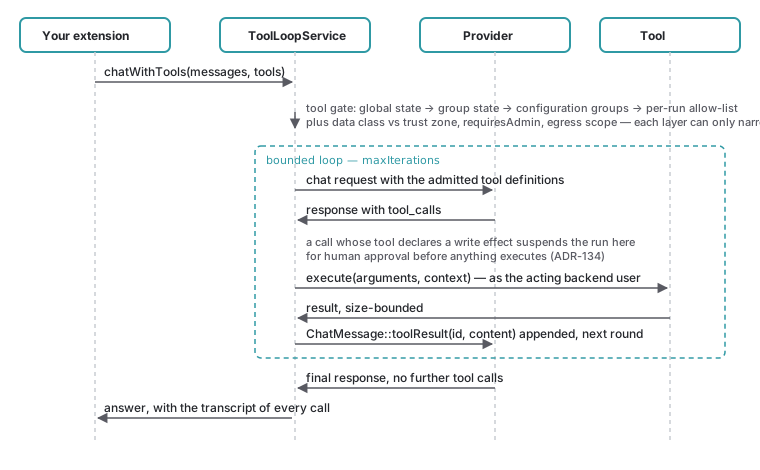
Tool/function calling
Execute custom functions based on AI decisions:
Example: Tool/function calling
$response = $llmManager->chatWithTools($messages, $tools);
if ($response->hasToolCalls()) {
    // Process tool calls
}
Copied!
Intelligent caching
Automatic response caching using TYPO3's caching framework.
Built with the assistance of modern AI development tools and following TYPO3
coding standards and best practices.
Installation
Quick start
The recommended way to install this extension is via Composer:
Install via Composer
composer require netresearch/nr-llm
Copied!
After installation:
Activate the extension in Admin Tools > Extension Manager.
Configure providers and API keys in
Admin Tools > LLM > Providers.
Define available models in Admin Tools > LLM > Models.
Create configurations in Admin Tools > LLM > Configurations.
Clear caches.
Composer installation
Requirements
Ensure your system meets these requirements:
PHP 8.2 or higher.
TYPO3 v13.4 LTS or v14.3 LTS.
Composer 2.x.
netresearch/nr-vault
^0.14.0 (required for
API key encryption; installed automatically via
Composer).
Installation steps
Add the package
Install via Composer
composer require netresearch/nr-llm
Copied!
Activate the extension
Navigate to Admin Tools > Extension Manager
and activate EXT:nr_llm.
Configure API keys
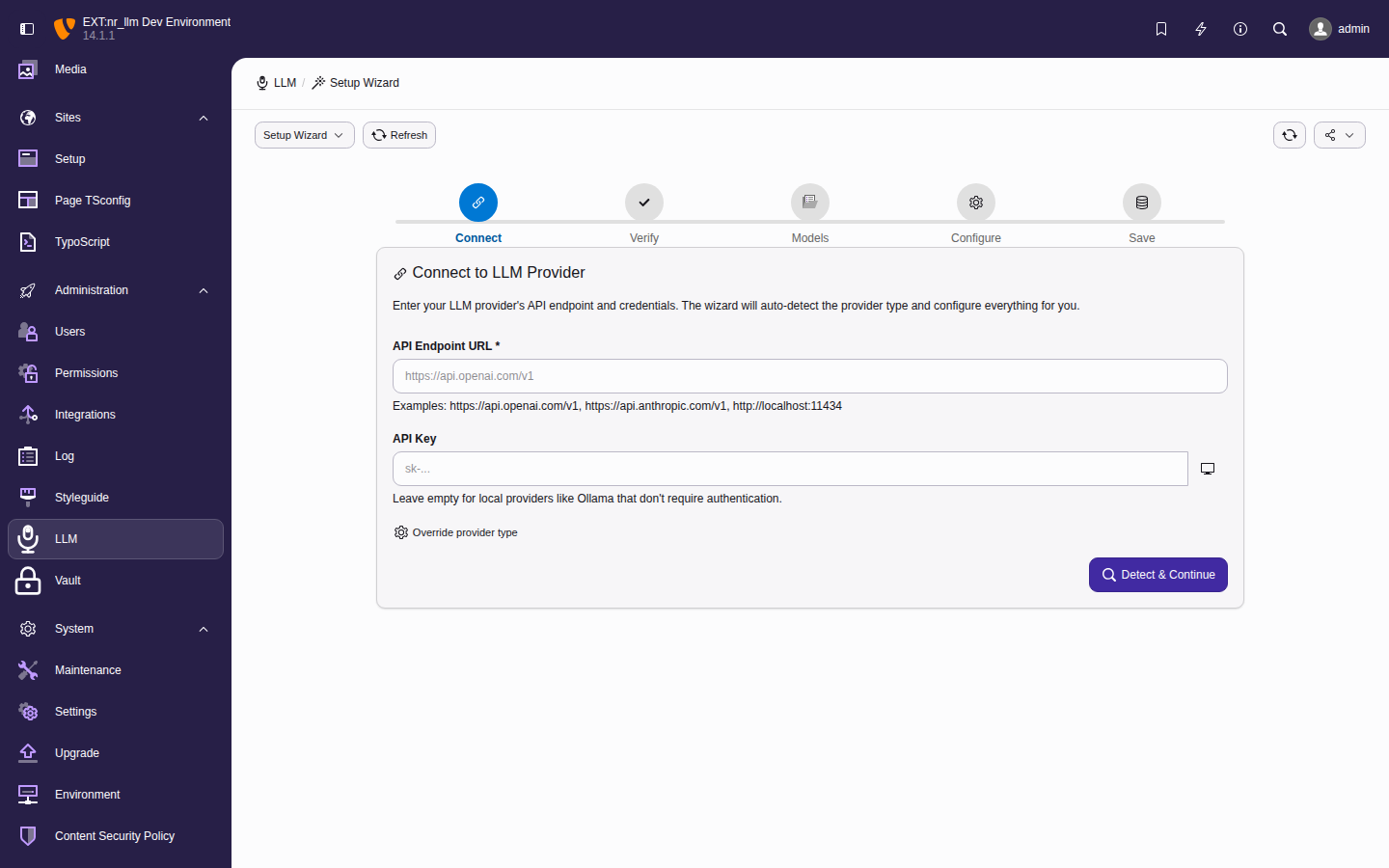
Use the setup wizard at
Admin Tools > LLM > Setup Wizard
to auto-detect your provider and discover models.
The setup wizard guides you through provider
connection, model discovery, and configuration.
Tip
Not sure which provider you need? Admin Tools > LLM > Get
Started asks what you want to do first — editorial assistance,
translation, metadata, media accessibility, agent workflows, developer
integration — and can install a use-case pack for it: a configuration,
tasks and prompt snippets, created only after you confirm the list. The
Editorial Starter pack is the one currently shipped. The setup wizard
stays the technical route and is linked from every screen there.
The plan you confirm also states the three things an install changes that
are not new records: the snippet tags it adds to the pack's own
configuration, any existing configuration that already selects one of
those tags and would therefore compose the pack's snippets into its
prompts too, and any existing snippet carrying one of those tags, which
the added tags compose into the pack's configuration. See
Get Started: use-case packs.
The extension creates the following database tables automatically:
Table
Purpose
tx_nrllm_provider
Stores API provider connections with encrypted credentials.
tx_nrllm_model
Stores available LLM models with capabilities and pricing.
tx_nrllm_configuration
Stores use-case-specific configurations with prompts and parameters.
tx_nrllm_task
Stores one-shot prompt tasks for common operations.
tx_nrllm_prompttemplate
Stores reusable prompt templates with versioning
and performance tracking.
tx_nrllm_service_usage
Tracks specialized service usage (translation, speech, image).
Run the database compare tool after installation:
Set up extension database tables
vendor/bin/typo3 extension:setup nr_llm
Copied!
Cache configuration
The extension uses TYPO3's caching framework. Cache
configuration is set up automatically — no backend
is hardcoded. TYPO3 uses your instance's default
cache backend, so Redis, Valkey, or Memcached work
transparently if configured.
To override the cache backend specifically for nr-llm:
Remove any TypoScript includes referencing the extension.
Administration
This guide walks you through managing AI providers,
models, configurations, and tasks in the TYPO3
backend. It also covers the AI-powered wizards that
automate most of the setup.
The LLM backend module
All AI management happens in
Admin Tools > LLM; editors run prepared tasks and decide
approvals in the separate Web > AI Tasks module
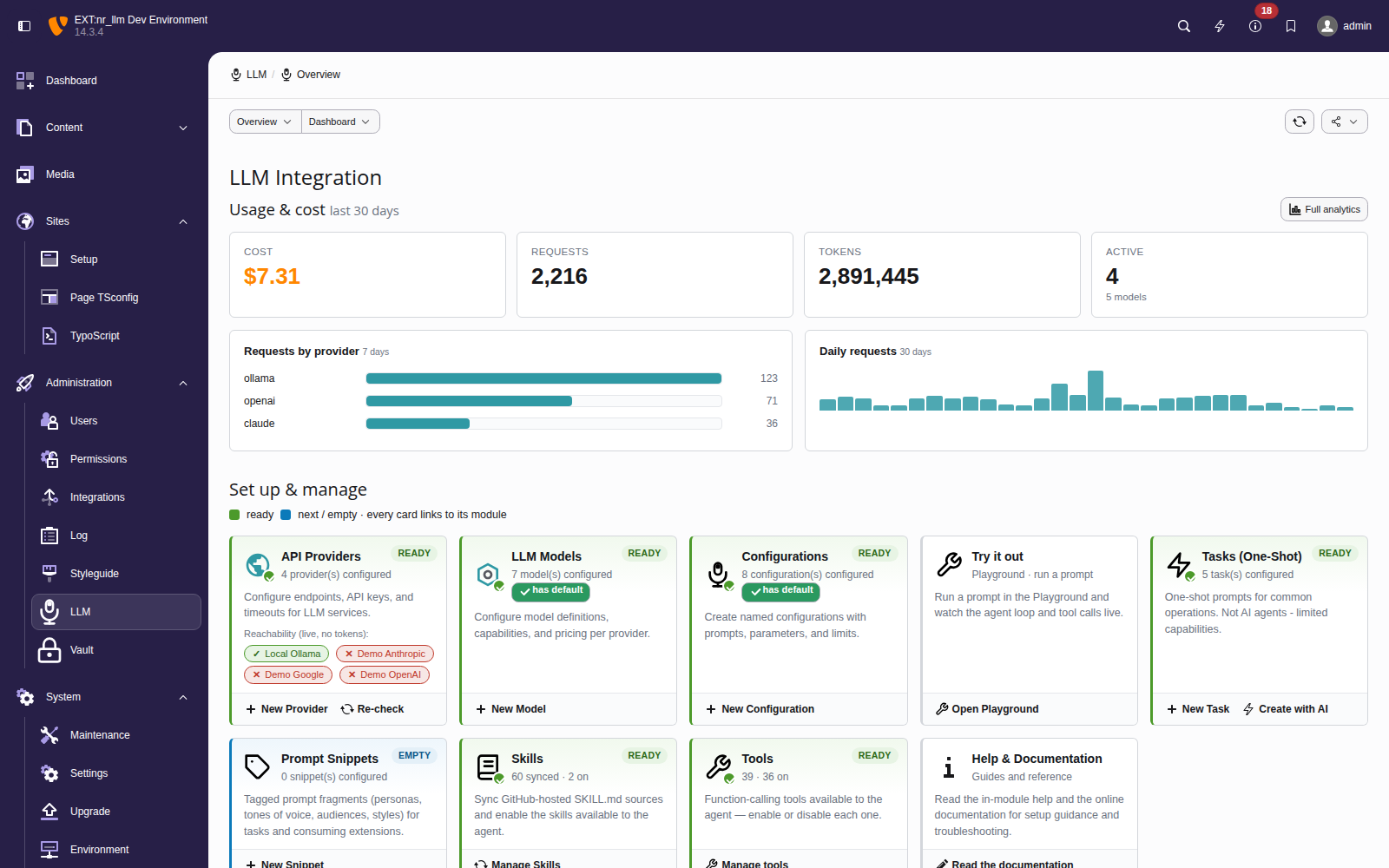
(Backend user permissions). The Overview is a guided starting point:
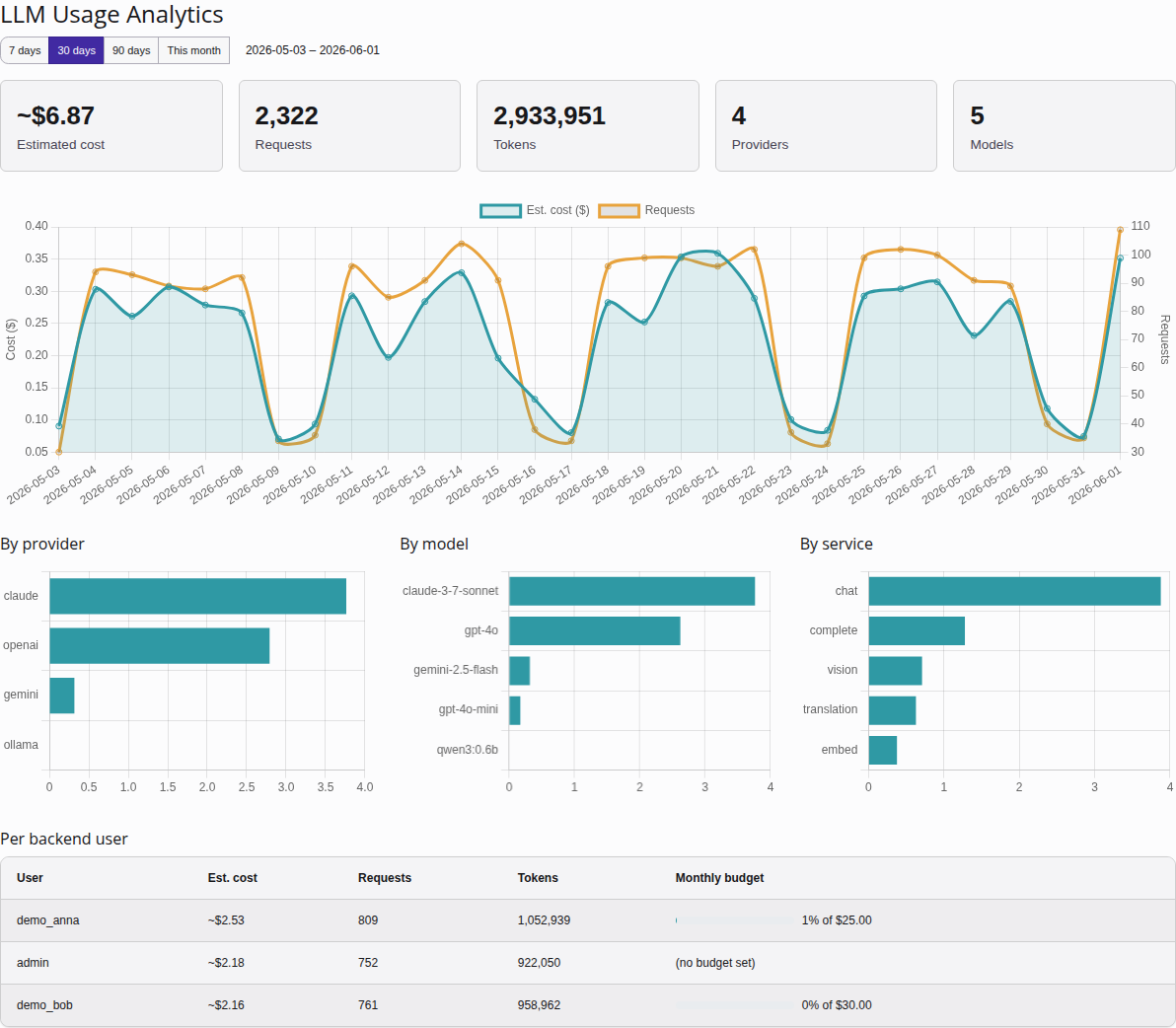
a usage & cost band across the top — 30-day cost, requests and tokens,
the per-provider request mix, and a daily-requests sparkline (empty until the
first request);
a unified Set up & manage grid where each module card carries its own
setup state — green when it is configured, a blue Next flag on the single
recommended step, and Empty on an optional module with no entries yet — so
the next action is always visible without a separate wizard. Each card links
to its module;
the Providers card shows a live, token-free reachability indicator per
configured provider (a model-list/health ping, never a completion);
a For developers section showing how to call the same configuration from
PHP via LlmServiceManager.
The Overview's docheader carries a Governance tab — the read-only
effective policy readout (ADR-140). It lists the four
governance keys that carry a decision (privacy.level,
privacy.retentionDays, tools.dataClassEnforcement,
skills.minTrustLevel) with the value the runtime applies right now and the
class that resolved it. Two things it deliberately does not do: it never
changes a value — instance-wide keys are set in the Install Tool under
Settings > Extension Configuration > nr_llm — and it never shows a
value it did not get from a resolver, so a row that cannot be answered reads
unknown rather than a default. Because the reads go through the runtime
resolvers, the tab shows what is in force: a mistyped
tools.dataClassEnforcement reads enforce, because the gate is
fail-closed (ADR-113). The keys, their fallbacks and
recommended settings are documented under Effective policy.
Two rows say more than their value alone:
tools.dataClassEnforcement = observe is annotated as applying to built-in
tools only. Tools reached through an MCP server are always enforced against
the trust-zone ceiling (ADR-115), so an MCP tool can be
dropped while this row reads observe.
Every privacy.retention.<category> override that deviates from
privacy.retentionDays gets its own row underneath it. Categories left at
0 resolve to the global window and are not listed — see
Data retention & purge for the full set.
The LLM Overview: the usage & cost band, the state-coloured
Set up & manage grid, and the For developers
section.
The admin module tree has fourteen sections accessible from the
left-hand navigation:
Overview — guided dashboard: usage & cost, per-module setup state, and
the developer guide
Providers — API connections
Models — available LLM models
Configurations — use-case presets
Tasks — one-shot prompt templates
Snippets — tagged reusable prompt fragments
Get Started — pick a use case and install a matching pack of
configuration, tasks and snippets (admin-only)
Setup wizard — guided provider, model and configuration setup (admin-only)
Providers represent connections to AI services.
Each provider stores an API endpoint, encrypted
credentials, and adapter-specific settings.
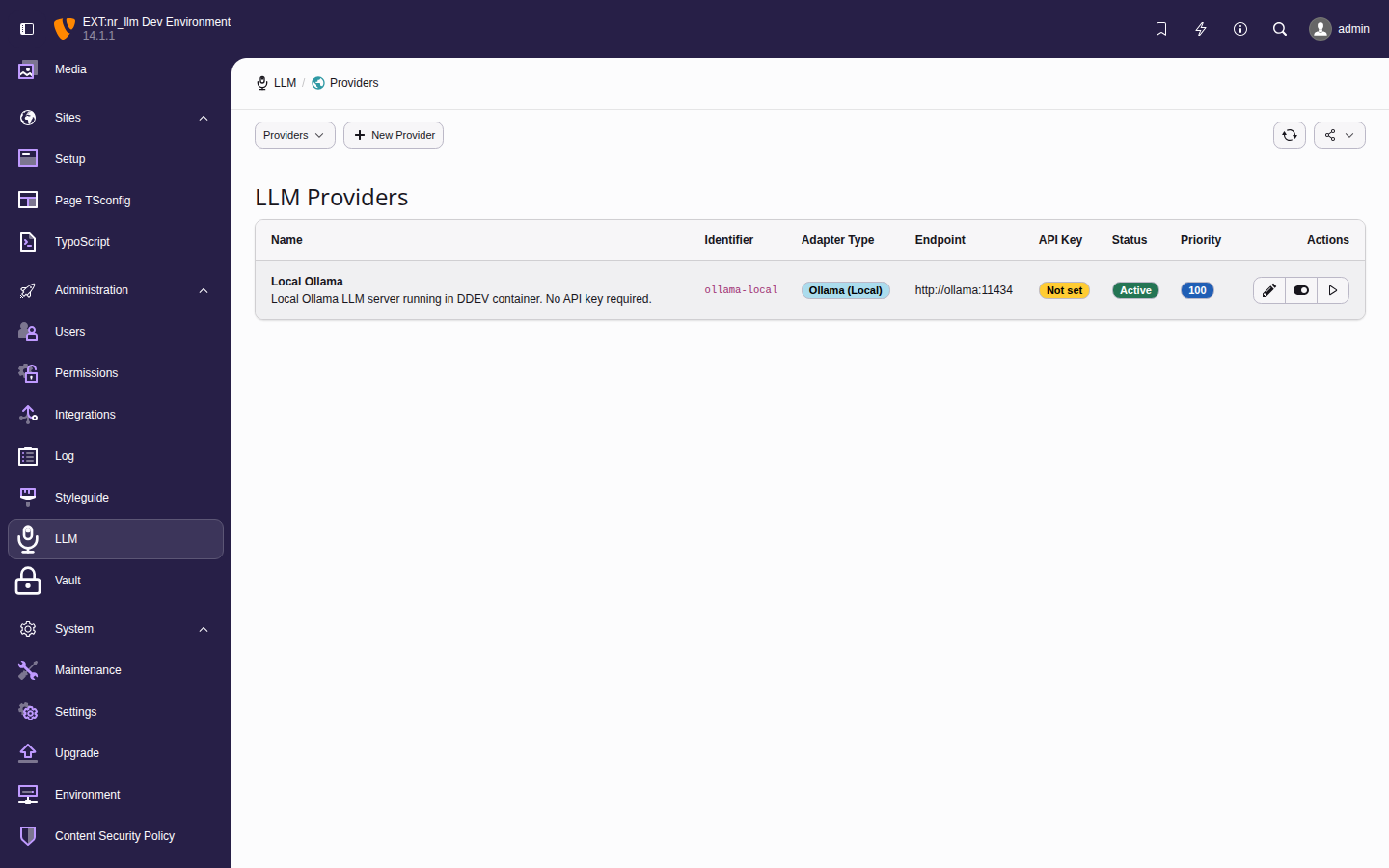
The provider list with connection status
indicators and action buttons.
Adding a provider
Navigate to Admin Tools > LLM >
Providers.
Click Add Provider.
Fill in the required fields:
Identifier
A unique slug for programmatic access
(e.g., openai-prod, ollama-local).
Name
A display name for the backend
(e.g., OpenAI Production).
Adapter Type
Select the provider protocol. Available
adapters: openai, anthropic,
gemini, ollama, openrouter,
mistral, groq, azure_openai,
custom.
API Key
Your API key. Stored securely via
nr-vault
envelope encryption. Leave empty for local
providers like Ollama.
Optionally set the endpoint URL, organization
ID, timeout, and retry count.
Click Save.
Tip
Use the Setup wizard for guided
first-time setup — it auto-detects the provider
type from your endpoint URL.
Setting the key from the command line
An unattended install cannot operate the
wizard.
nrllm:provider:set-key
does the
same job for a provider record that already
exists, reading the key from STDIN:
The key is never accepted as an argument — that
would put it in the process list and the shell
history. A terminal is refused rather than read,
so a provisioning script fails visibly instead of
hanging on a prompt.
Running it again for the same provider replaces
the stored key and keeps the identifier, so
anything already referring to that identifier —
including
providers.openai.apiKeyIdentifier in the
extension configuration, which the speech and
image services read — keeps working. See
ADR-124.
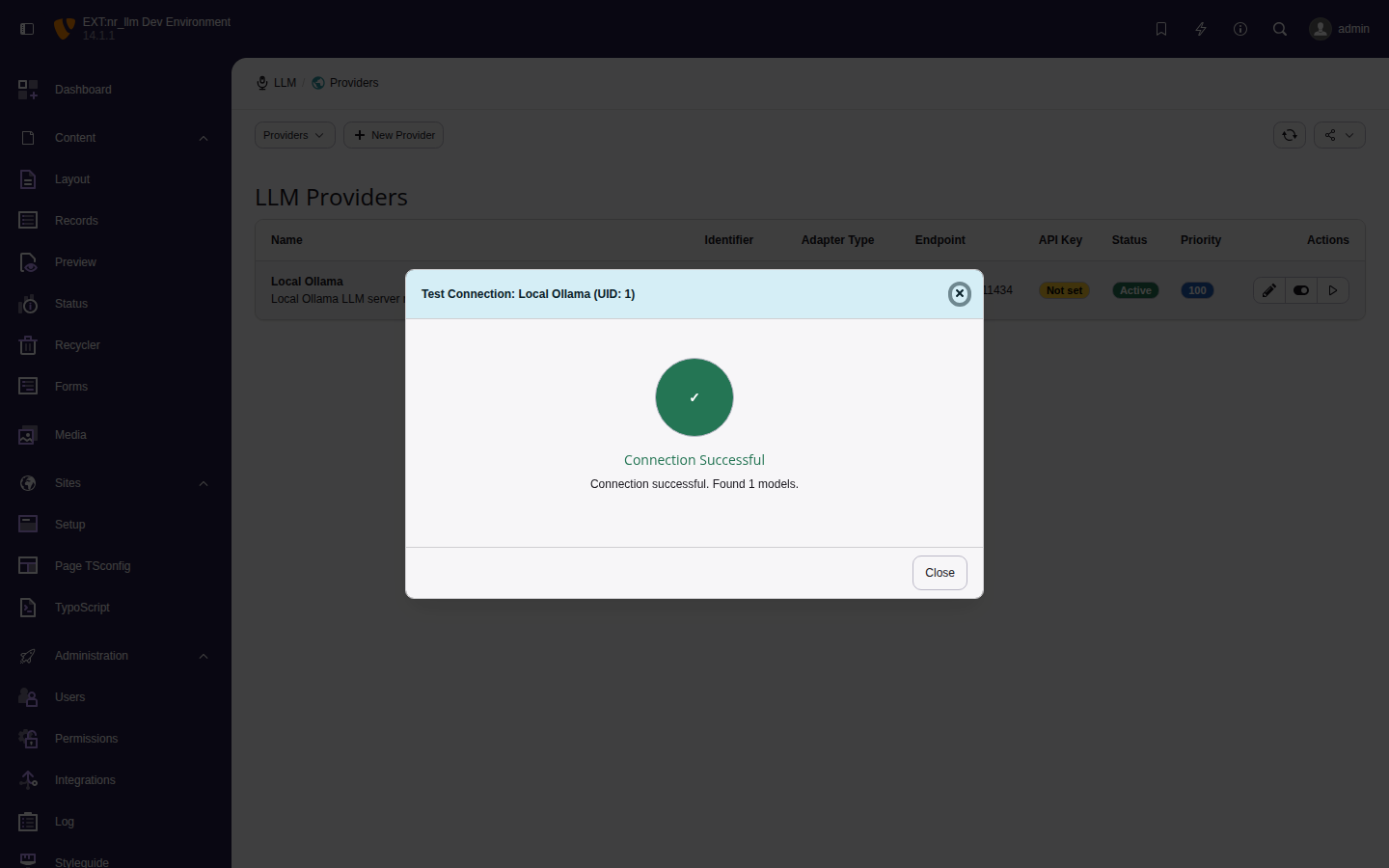
Testing a connection
After saving a provider, click
Test Connection to verify the setup.
The test makes an HTTP request to the provider API
and reports:
Connection status (success or failure).
Available models (if the provider supports
listing).
Error details on failure.
Successful connection test for the Local Ollama
provider.
Note
Self-hosted endpoints (such as Ollama) reached through a hostname
that resolves to a private or loopback address are subject to the
SSRF protection built into nr-vault's HTTP client. If a connection
test fails with a "disallowed IP range" error, add the endpoint
host to the TYPO3 HTTP allowlist:
The request-time allowlist is honored by nr-vault 0.6.1 and later.
Endpoints given as an IP literal (for example
http://127.0.0.1:11434) are not affected.
Editing and deleting providers
Click a provider row to edit its settings.
Use the Delete action to remove a
provider. Models linked to a deleted provider
become inactive.
Managing models
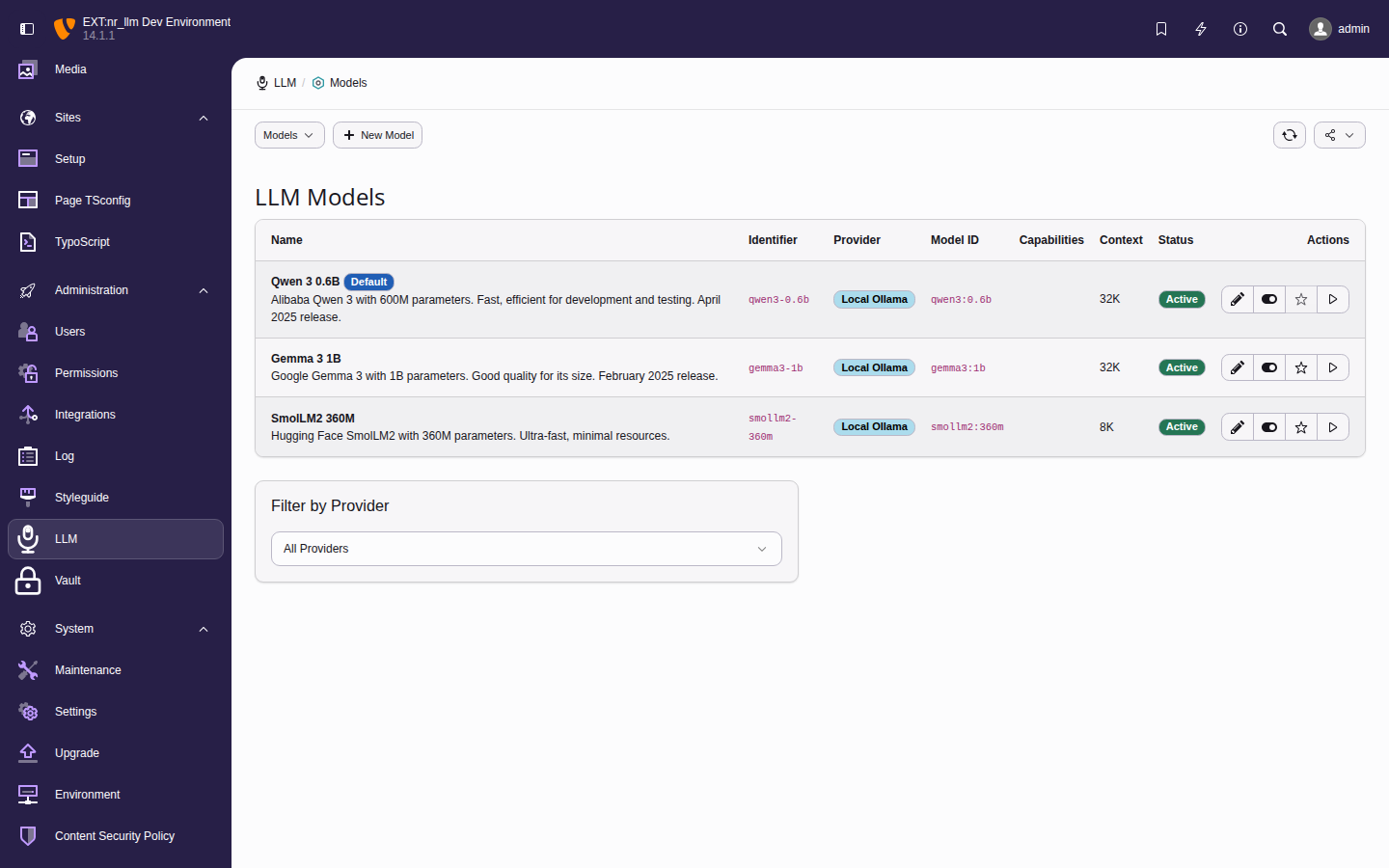
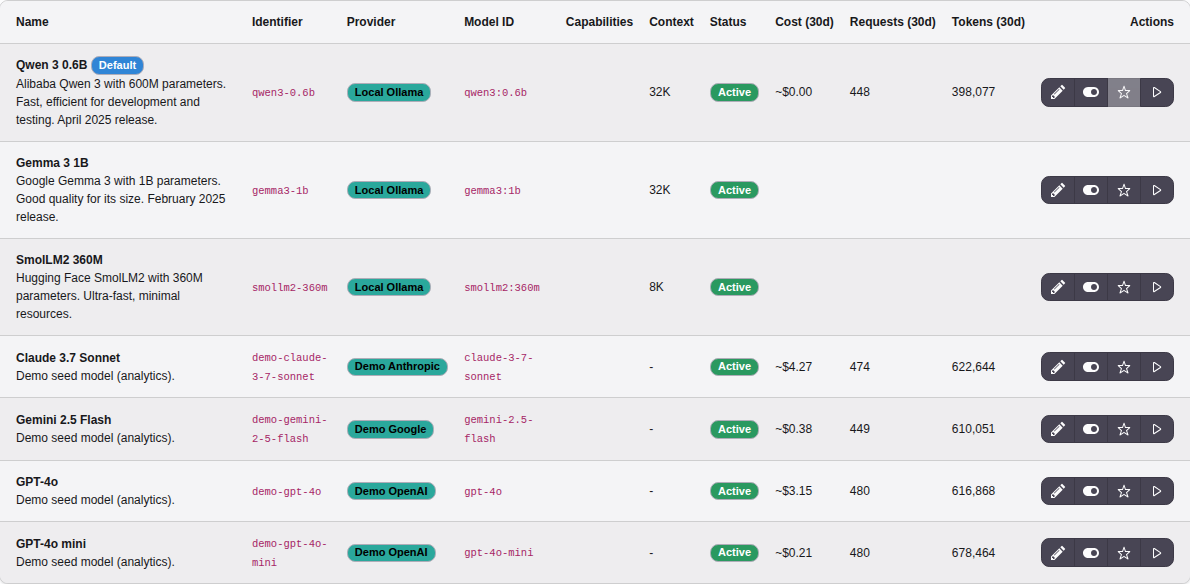
Models represent specific LLM models available
through a provider (e.g., gpt-5,
claude-sonnet-4-6, llama-3).
The model list with capability badges, context
length, and cost-per-token columns.
Adding a model manually
Navigate to Admin Tools > LLM >
Models.
Click Add Model.
Fill in the required fields:
Identifier
Unique slug (e.g., gpt-5,
claude-sonnet).
Name
Display name (e.g., GPT-5 (128K)).
Provider
Select the parent provider.
Model ID
The API model identifier as the provider
expects it (e.g., gpt-5.3-instant,
claude-sonnet-4-6).
Optionally set capabilities (chat,
completion, embeddings, vision,
streaming, tools), context length,
max output tokens, and pricing.
Click Save.
Fetching models from a provider
Instead of adding models manually, use the
Fetch Models action to query the
provider API and auto-populate the model list:
Ensure the provider is saved and the connection
test passes.
On the model list or model edit form, click
Fetch Models.
The extension queries the provider API and
creates model records with capabilities and
metadata pre-filled.
This is the recommended approach — it ensures model
IDs match the provider exactly and keeps your
catalogue current as providers release new models.
Which capabilities the provider actually confirmed
A capability badge in the model list says that the
model has the capability, not who said so. Those
are different claims, and the list separates them.
A grey badge means a live answer from the provider's
own model endpoint declared that capability, and the
row says when. A yellow badge with a question mark
means nobody confirmed it: either an administrator
ticked it by hand, or it came from the static model
catalogue bundled with the extension. Hover the
badge for the reason.
Expect the yellow badge for OpenAI, Anthropic, Groq
and the Gemini models the extension knows by name,
even against a reachable API. Those model endpoints
list model ids and no capabilities, so the tokens
come from the bundled catalogue on a live run
exactly as on an unreachable one, and the badge says
so rather than borrowing the provider's authority.
Mistral, OpenRouter, Ollama and Gemini releases
newer than this extension do report capabilities per
model, and those confirm to grey.
Use the Confirm capabilities row action
to ask the provider. It runs the same discovery the
wizard uses, records what came back, and refreshes
the confirmation date. A model the provider does not
list is reported as such — that is not a
confirmation, so nothing is stored.
Confirming never edits what you declared. A
capability you ticked that the provider does not
advertise stays on the model and simply stops
borrowing the provider's authority for it. That
matters most for a model created from the bundled
catalogue: nothing about it was ever checked against
the live API until you confirm it.
The three underlying fields — what was confirmed,
when, and whether the answer was live or from the
catalogue — are also visible read-only on the
Capabilities tab of the model record.
Routing does not use this. Eligibility below still
reads the declared capabilities, confirmed or not:
making it depend on confirmation would silently drop
every model an administrator declared by hand.
Which model a criteria-mode configuration picks
A configuration set to Dynamic (Criteria) names no
model. One is chosen per call from the models that
are active, in two steps that never mix.
Eligibility is a hard yes or no. A model is
considered only if it declares every capability the
criteria require, uses a permitted adapter type,
meets the minimum context length, stays within the
cost ceiling, and — for the operation being run —
does not declare capabilities that exclude it. A
model refused here cannot come back: nothing about
its speed, price or quality is even looked at.
Ranking orders what is left. The provider
Priority you set decides first, always.
Below it, the extension configuration option
Routing policy (category routing)
chooses what else counts:
Provider priority
The default. Nothing beyond your priority, the
default-model flag and the sorting order, plus
cost where the criteria set prefer lowest cost.
This is what the extension has always done.
Balanced, Quality, Economy
Add measured signals — evaluation quality scores
and recent provider health — weighted differently.
Economy also weighs cost when the criteria did
not ask for it.
The measured modes are opt-in on purpose: they change
which model serves a call, so an upgrade never
switches them on for you. Two rules make them safe to
try. Your provider priority is never overruled by a
measurement — a priority is an instruction, a score
is evidence. And a model nobody has measured is not
punished for it: an absent signal is skipped, not
counted as zero.
If a criteria-mode configuration selects nothing, the
cause is usually that every matching model declares
it cannot serve that operation. The extension says so
explicitly rather than letting the provider fail with
an opaque error.
Managing configurations
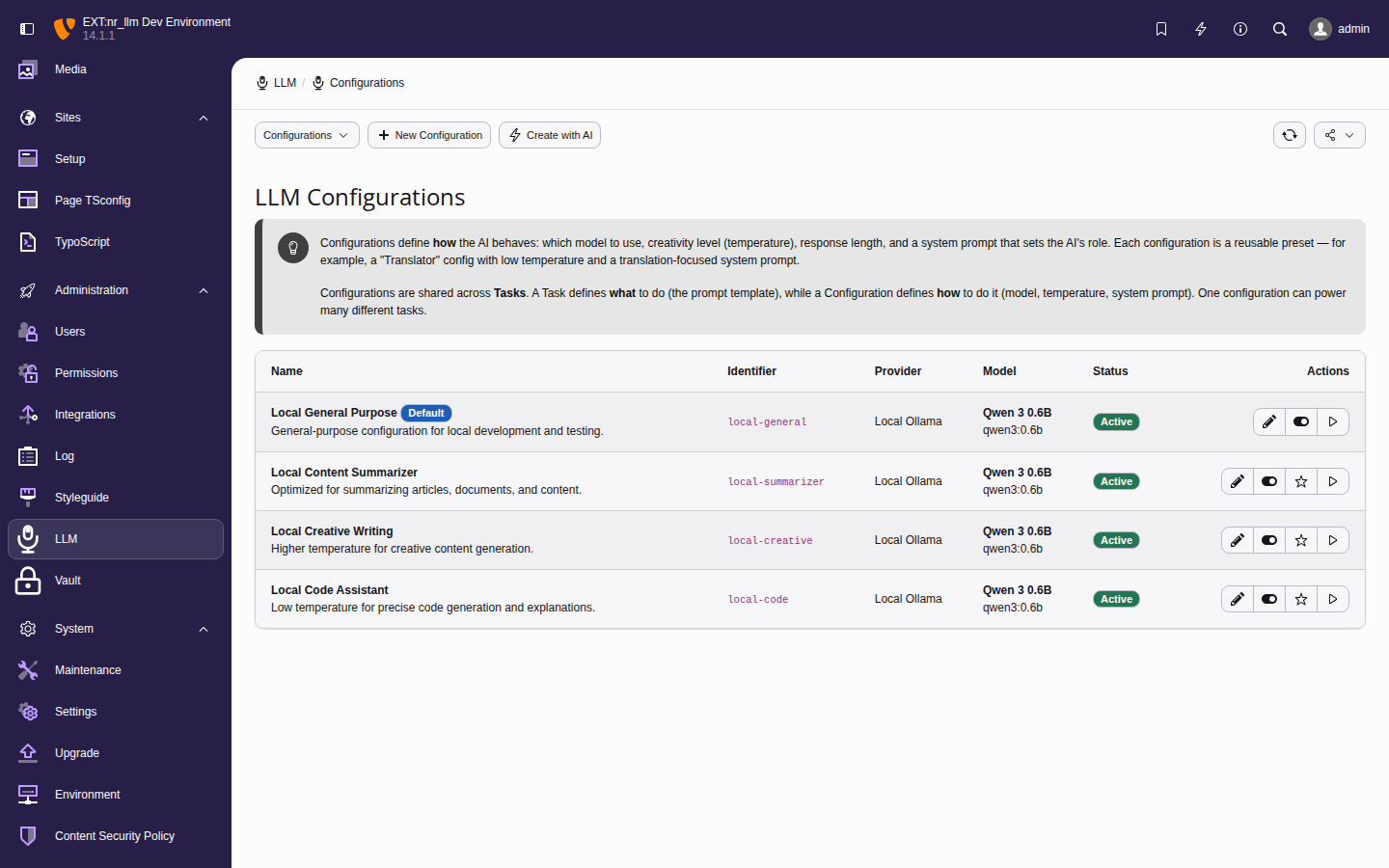
Configurations define use-case-specific presets that
combine a model with a system prompt and generation
parameters. Extension developers reference
configurations by identifier in their code.
The configuration list showing each entry's
linked model, use-case type, and key parameters.
Adding a configuration manually
Navigate to Admin Tools > LLM >
Configurations.
Click Add Configuration.
Fill in the required fields:
Identifier
Unique slug for programmatic access
(e.g., blog-summarizer).
Name
Display name (e.g., Blog Post Summarizer).
Model
Select the model to use.
System Prompt
The system message that sets the AI's behavior
and context.
Prompt snippet tags
Optional. Active prompt snippets
carrying any ticked tag are appended to the
system prompt of every request made with this
configuration.
Optionally adjust temperature (0.0-2.0), top_p,
frequency/presence penalty, max tokens, and
use-case type (chat, completion,
embedding, translation).
Click Save.
Tip
Use the Configuration wizard to generate all
fields from a plain-language description of your
use case.
Importing configuration presets
Extensions consuming nr_llm can declare the
configurations they need as presets
(ADR-056). When at least one
declared preset has not been imported yet, the
configuration list shows a Pending
presets panel above the records.
Each pending preset row shows the preset's name,
identifier, description, and a requirement check:
Satisfiable — an active model currently
matches the preset's requirements; the model
that would be used right now is named. Click
Import to create the configuration
record with one confirmation.
Not satisfiable — no active model matches;
the first missing requirement is named. The
Import button stays disabled until
you configure a matching provider and model.
Imported records are normal criteria-mode
configurations: the model is resolved at runtime
from the providers and models you configured, and
you can edit or delete the record like any other.
The panel disappears once no presets are pending.
If a consuming extension later changes its preset
declaration, the imported configuration is flagged
with a Preset changed badge in the
list. The record is never updated automatically.
Next to the badge, Review update opens
a dialog that lists, field by field, the record's
current value against the changed declaration.
Confirming with Apply update overwrites
those record fields with the declared values and
clears the badge. Your own settings are preserved:
whether the configuration is active or the default,
its backend-group assignment, and its fallback chain
are never changed. If you switched the configuration
to fixed model selection, or the changed
requirements no longer match any active model, the
update is refused with the reason shown.
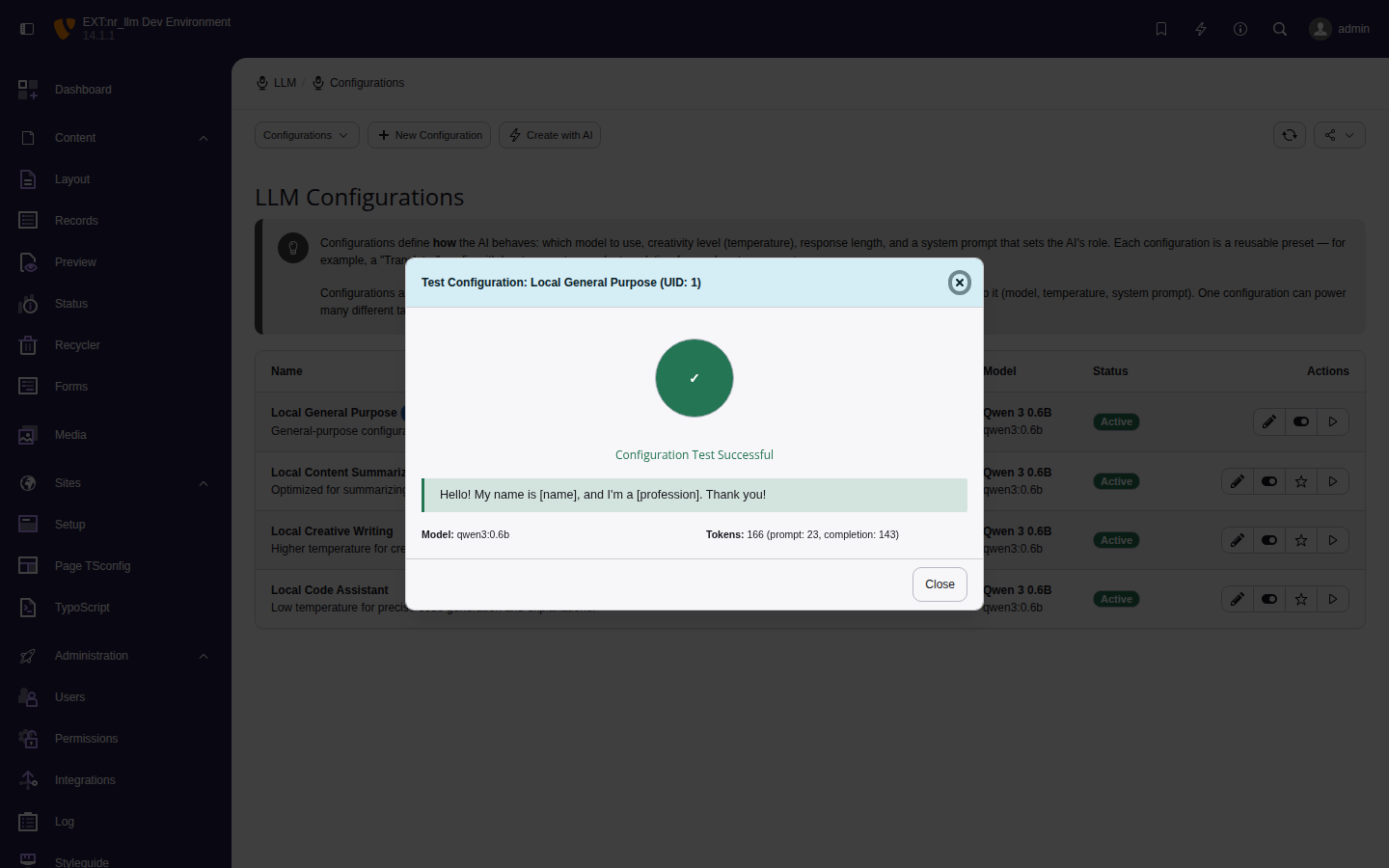
Testing a configuration
Click Test Configuration on any row.
The test sends a short prompt to the model and shows
the response, model ID, and token usage.
Successful configuration test with token count.
Editing configurations
Click a configuration row to edit. Changes take
effect immediately for any extension code that
references this configuration's identifier — no
code deployment needed.
Managing tasks
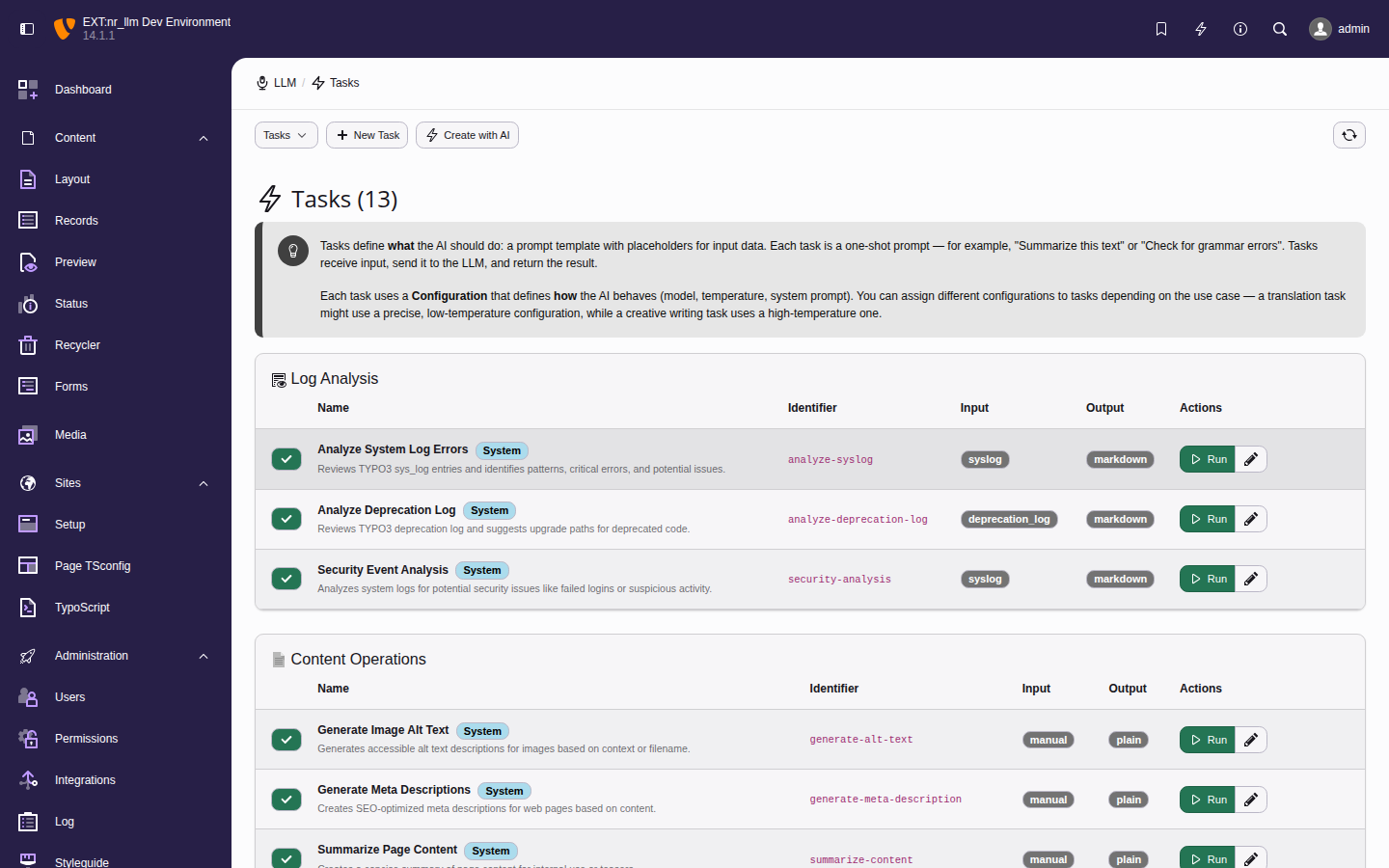
Tasks are one-shot prompt templates that combine a
configuration with a specific user prompt. They
provide reusable AI operations that editors or
extensions can execute with a single call.
The task list with each task's assigned
configuration and action buttons.
Adding a task manually
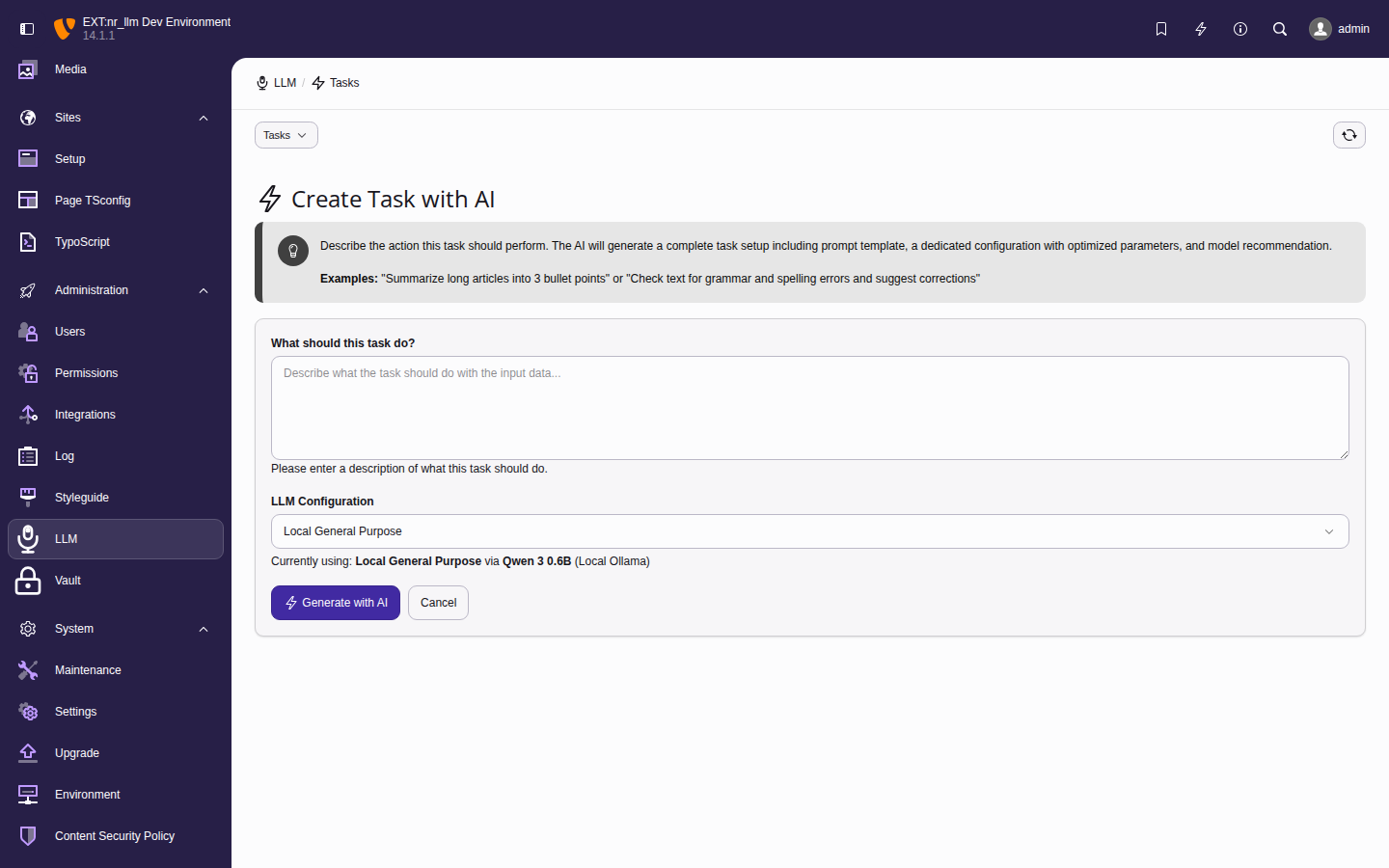
Navigate to Admin Tools > LLM >
Tasks.
Click Add Task.
Fill in the required fields:
Name
Display name (e.g., Summarize Article).
Configuration
Select the LLM configuration to use.
User Prompt
The prompt template. Use {placeholders}
for dynamic values.
Add a description so other admins understand
what the task does.
Click Save.
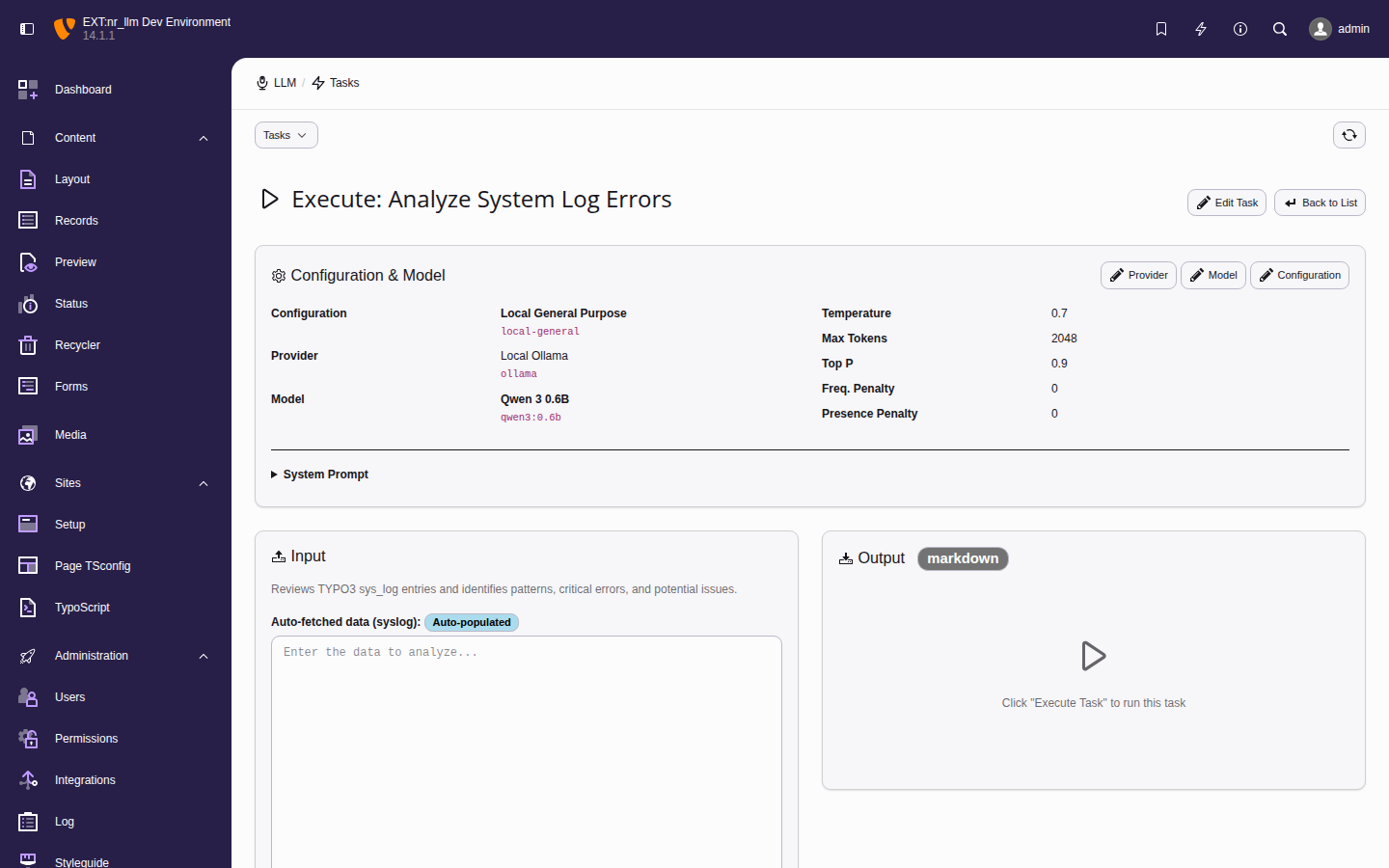
Executing a task
Click Run on any task to open the
execution form. It shows the configuration, model,
parameters, input field, and prompt template.
The task execution form for "Analyze System Log
Errors" with the Ollama provider and Qwen 3 model.
Example tasks:
Summarize content — condense long articles.
Generate meta descriptions — SEO optimization.
Translate text — one-click translation.
Extract keywords — pull key terms from content.
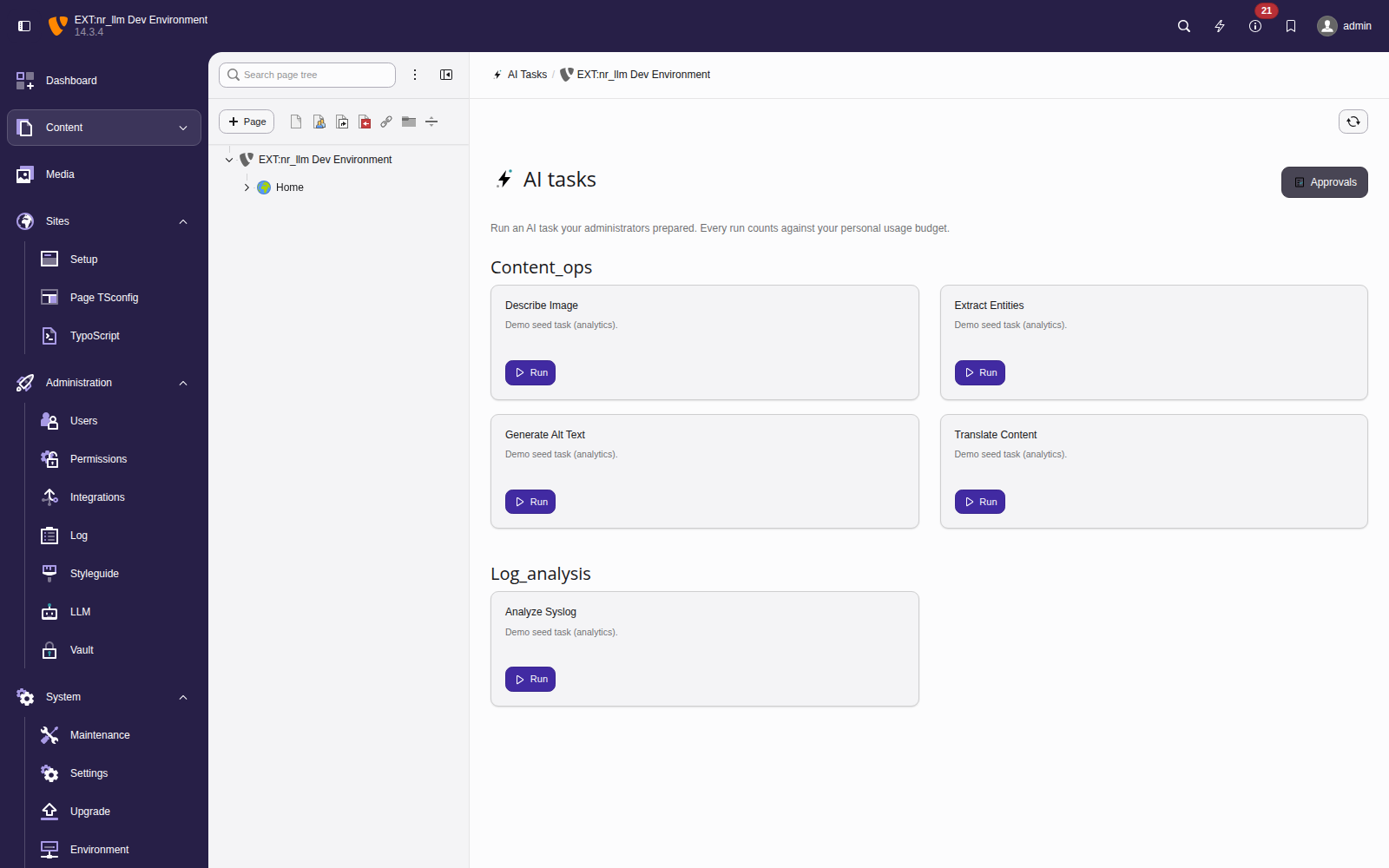
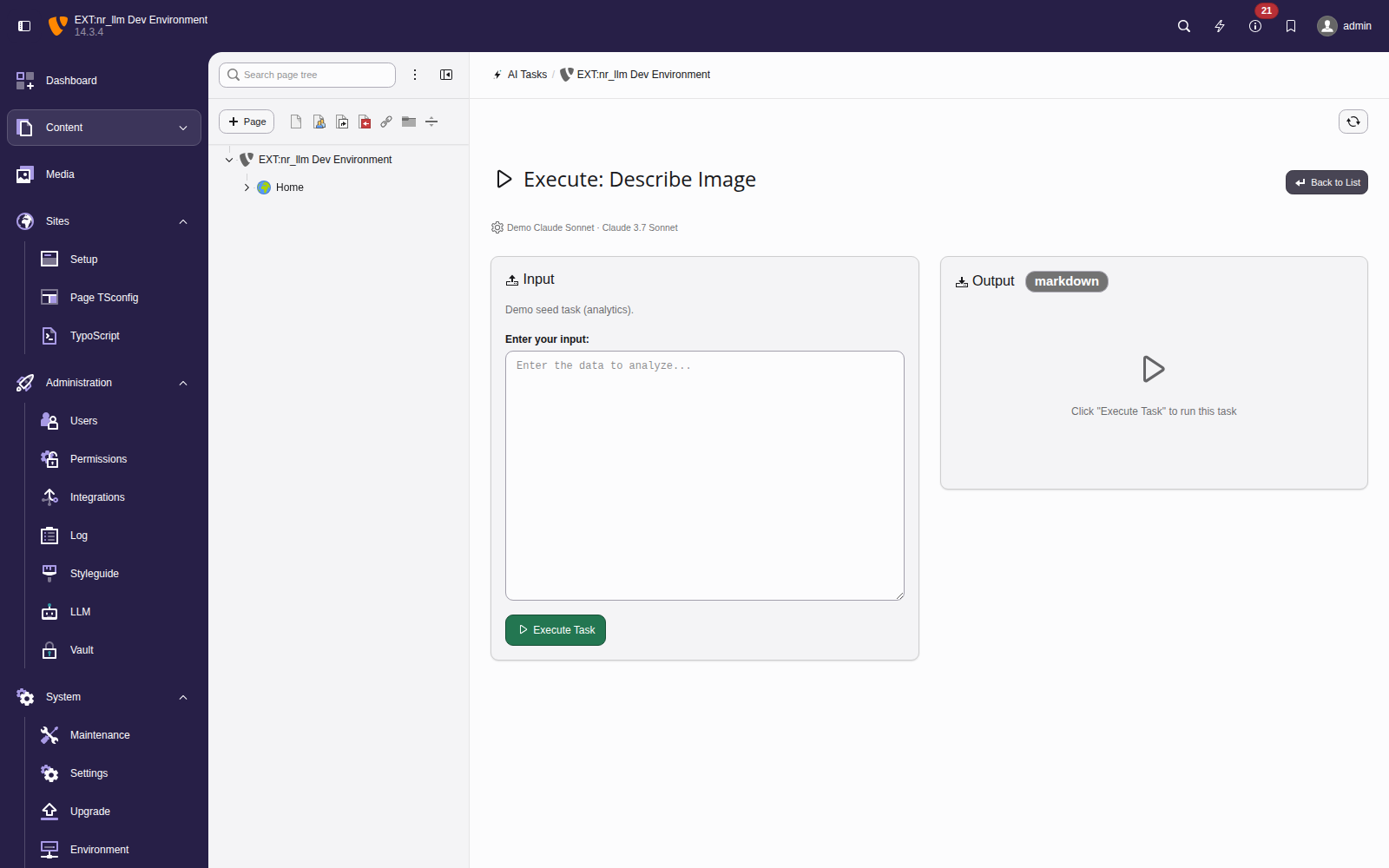
The editor module
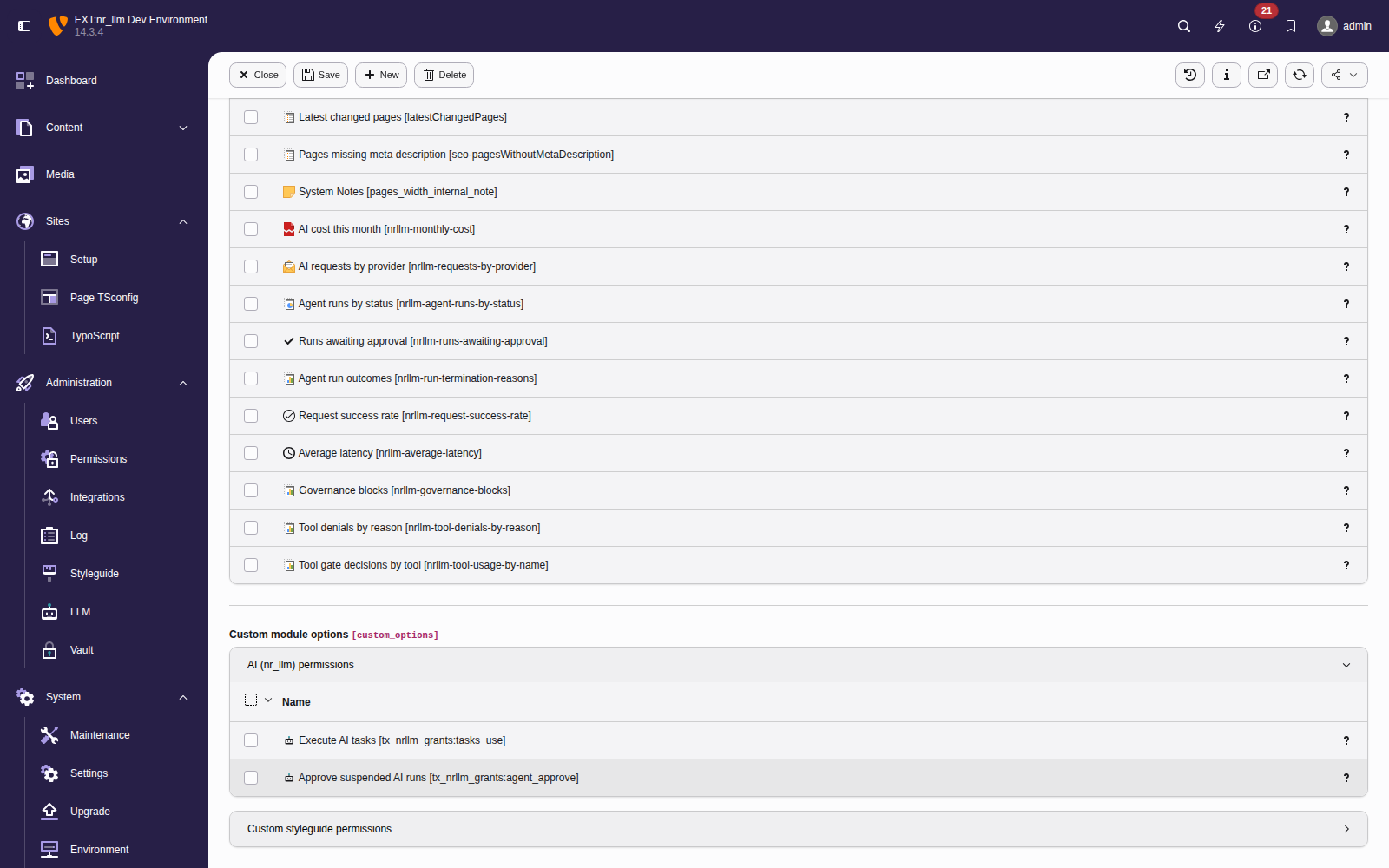
Editors do not need backend administrator rights to run tasks: the
dedicated Web > AI Tasks module (ADR-131)
lists every active task and opens a slim run form — without any of the
management affordances of this admin module. Access takes both switches
described under Backend user permissions: the module permission
on the backend group AND the Execute AI tasks grant. Every run is
pre-flighted against the user's own usage budget. Tasks with the table input type are
not offered to editors — their database record picker stays admin-only.
The AI Tasks module as an editor sees it: runnable tasks grouped by
category, plus the Approvals shortcut for users holding the approval
grant.
The editor run form: input, execute, output — the configuration is
shown as a read-only summary line.
Tip
Use the Task wizard to generate
a complete task (including a new configuration)
from a plain-language description.
Managing prompt snippets
Prompt snippets are small named prompt fragments —
personas, tones of voice, target audiences, image
styles, layouts — that editors manage centrally.
Consuming extensions (for example nr_repurpose)
query snippets by tag and compose them into their
prompts.
Snippets are deliberately not prompt templates:
a prompt template is a complete,
versioned prompt with model parameters, while a
snippet is a reusable building block without any
model binding.
Comma-separated tags consuming extensions
search for (see below).
Snippet text
The prompt fragment itself.
Metadata (JSON)
Optional JSON object with extra settings.
Click Save.
Tag convention
Tags are free-form, comma-separated strings. There
is no fixed vocabulary — consuming extensions agree
on tags with the editors. Matching is exact per tag
and case-insensitive: the tag style does not
match a snippet tagged lifestyle.
Established tags so far:
Tag
Used for
audience
Target audience descriptions
tone_of_voice
Tone-of-voice instructions
persona
Writing/speaking personas
layout
Layout instructions (e.g. for slides)
style
Image / visual style descriptions
Persona snippets may carry a voice hint in their
metadata so speech features can pick a matching
text-to-speech voice:
Metadata of a persona snippet
{"voice": "nova"}
Copied!
Attaching snippets to a configuration
A configuration can select snippets by tag. Every
request made with that configuration then carries
them — chat, single-prompt completion, streaming and
agent runs alike — without any extension code.
Navigate to Admin Tools > LLM >
Configurations and edit a configuration.
Open the Parameters tab.
Tick the wanted tags under Prompt
snippet tags. The list offers the tags the
snippet records actually carry.
Click Save.
The active snippets carrying any ticked tag are
appended to the configuration's
System Prompt, each as a NAME: block
separated by a blank line, in the order the tags are
listed. A snippet carrying two ticked tags is added
once. A tag no snippet carries adds nothing — there
is no error, matching the free-tag model above.
Effective system prompt of a configuration with the tags persona and tone_of_voice
You are a helpful assistant.

Nova persona:
You are Nova, a friendly expert.

Formal tone:
Use a formal, professional tone of voice.
Copied!
Two limits are worth knowing:
Only active snippets are composed; hiding a
snippet removes it from every configuration that
selects its tag.
A caller that supplies its own system message
replaces the configuration's system prompt for
that call, and with it the snippet block. This is
the documented per-call precedence and predates
this field.
Using snippets from an extension
Query snippets by tag through the public
PromptSnippetRepository and compose the
selected fragments with the
PromptSnippetComposer:
composeSections() renders each non-null
snippet as a LABEL: block followed by the
snippet text, joined by blank lines. Null entries
and empty snippets are skipped.
findActiveByTag() filters on is_active
only — like every repository here it ignores the
enable fields, so hidden records are part of
its result. Configurations drop them when they
compose their prompt; an extension that queries
directly has to skip isHidden() snippets
itself if it wants the same behaviour.
Admin Tools > LLM > Get Started asks what you want to do before it
asks anything technical — editorial assistance, translation, metadata, media
accessibility, agent workflows, developer integration — and answers with a
use-case pack: a named bundle of one configuration, several tasks and
several prompt snippets, plus the governance posture and the tool groups the
pack was written for.
The module is admin-only. The records it creates are ordinary records an
administrator could create by hand; nothing marks them as pack-owned.
Editorial Starter is the only pack currently shipped. The other five use cases
are listed with a "no pack yet" note and a link to the
setup wizard, which stays the technical
route and is linked from every screen here.
What an install creates
Pick a use case, then a pack, and the plan screen lists every record the pack
declares with its identifier and its current state — Would be created or
Already there. Nothing is written until you press
Create the missing records.
Editorial Starter declares:
Record
What it is
Configuration nr_llm.editorial_starter
Low temperature, room for a medium-length article, requires nothing but
the chat capability — so it installs against a local Ollama as
readily as against a hosted provider. It sets no tool group restriction
of its own.
Four tasks
Summarise for a teaser, rewrite for clarity, proofread, suggest
headlines. Each takes the text through {{input}}.
Two snippets
House style (tag tone_of_voice) and Target audience (tag
audience). Both are meant to be edited — they are the pack's
placeholders for your own voice.
The pack's configuration is a configuration preset, not a
second kind of record, so it also appears in the Configuration module's
Pending presets card and can be imported there instead.
The snippet-tag link, and what it pulls in
A configuration composes the active snippets carrying any of its tags
(ADR-031). Installing therefore adds the pack's snippet
tags to its configuration's selection — without them the pack's snippets would
exist and be read by nothing. Tags you selected yourself are kept; nothing is
removed, and a tag already selected is written again by no install.
Because selection is by tag and not by owner, that link reaches in two
directions, and the plan screen names both before you confirm:
Outwards
Existing configurations that already select one of the pack's tags compose
the pack's new snippets into their prompts as well. They are listed by name
and identifier.
Inwards
Existing snippets that already carry one of the added tags are composed into
the pack's configuration. They are listed with their data class,
because that is the part that can stop the configuration from working: input
context is classified by the strictest data class among the composed
snippets, so one confidential snippet raises the whole configuration, and an
enforcing input-context gate then refuses every send through it.
To keep a snippet out, deactivate it or remove the tag from it before
installing. To keep another configuration unchanged, edit its snippet-tag
selection first, or rename the pack's tags afterwards.
What a pack recommends but never applies
Governance posture. The pack names the posture its content was written
for (Editorial Starter: controlled cloud). Installing changes no governance
value; the screen links to the governance readout where the posture in force is shown.
Tool groups. The pack names the groups its tasks benefit from
(Editorial Starter: content). Enabling a tool group stays an
administrator decision in the Tools module.
Nothing about providers or API keys. The pack states model
requirements. When no active model satisfies them, the plan says which
requirement is missing and links to the setup wizard.
A pack installs no skills. A skill carries provenance and a trust level
from the source it was synced from, and a pack can produce neither; add a
skill source instead.
Installing again
"Already installed" means a record with that identifier exists — nothing more.
The installer never overwrites and never compares contents, so:
A task you renamed or whose prompt you rewrote is left exactly as it is.
A record you disabled still counts as installed, so a second install
cannot quietly resurrect what you switched off.
A tag the configuration already selects is not written again.
A second install therefore reports records created: 0. The one case where it
still has work is a configuration created by importing the preset in the
Configuration module: its records exist but its snippet-tag selection does not
yet include the pack's tags, so the confirm button stays offered and the
success message names the tags it added.
A pack cannot be uninstalled. Nothing marks a record as pack-owned — that is
what makes the installed records ordinary — so removing them is deleting
records, one by one, like any other.
Skills are GitHub-hosted SKILL.md files — a YAML front-matter block
with a name and description plus a markdown body — that nr-llm can
ingest, review, and (from Plan 1b) inject into prompts. You add a skill
source that points at GitHub, sync it, and then enable the individual
skills you want.
Skill management is admin-only. It lives in
Admin Tools > LLM > Skills and is not delegated to other
backend groups: a skill body becomes prompt context, so the two skill
tables are treated as a privilege-escalation surface.
Note
Ingest — adding sources, syncing and reviewing — is described by
ADR-035. Attaching enabled skills to tasks and
configurations and injecting them into text-generation prompts is
described by ADR-036 and the
Attaching skills section below.
Source types
A source has one of three types:
single_file
One SKILL.md at a fixed path in a repository. A single, explicit
admin act — its skill may default to enabled.
repo
A whole repository. Every SKILL.md under the repo root,
skills/<name>/, .claude/skills/<name>/ or
<plugin>/skills/<name>/ is discovered. Discovered skills arrive
disabled for review.
marketplace
An Anthropic marketplace.json index that lists plugins pointing at
further repositories. Each entry is expanded with the repo flow.
All discovered skills arrive disabled.
Adding a source
Navigate to Admin Tools > LLM > Skills.
Click New Skill Source.
Fill in the fields:
Title
Display name for the source list.
Type
single_file, repo or marketplace (see above).
URL
The GitHub URL the type expects (the SKILL.md URL, the
repository URL, or the marketplace.json URL).
Ref
A branch or tag (for example main or v1.2.0). It is
resolved once to an immutable commit SHA at sync time; all
bodies are then fetched by that SHA, never by the moving branch.
Click Save.
The pinned_sha, sync_status, sync_error and last_synced
fields are managed by the sync run and shown read-only.
GitHub token and rate limits
Unauthenticated GitHub API access is limited to 60 requests per hour,
which is quickly exhausted by a repo or marketplace sync. Add a
personal access token (a read-only, public-repo token is enough) to raise
the limit and to read private repositories.
The token is set through the Set token action on a source,
not typed into a FormEngine field. It is stored as an nr-vault UUID
(envelope-encrypted), mirroring provider API-key storage — never as
plaintext in TCA, YAML or the database.
When a sync hits the rate limit (HTTP 403 with no remaining quota), the
source is set to sync_status = error carrying the reset time; state
is not partially corrupted. Add a token and re-sync.
Host-allowlist prerequisite
nr-llm enforces an app-level GitHub allowlist on every skill request:
the scheme must be https and the host must be one of github.com,
raw.githubusercontent.com, api.github.com or
codeload.github.com. This is separate from, and in
addition to, the nr-vault SSRF guard.
On hardened instances that restrict outbound HTTP through the global
HTTP/allowed_hosts SSRF setting, those four GitHub hosts must be on
that list, otherwise every sync fails closed. This is a deliberate
prerequisite — nr-llm never silently bypasses the SSRF guard.
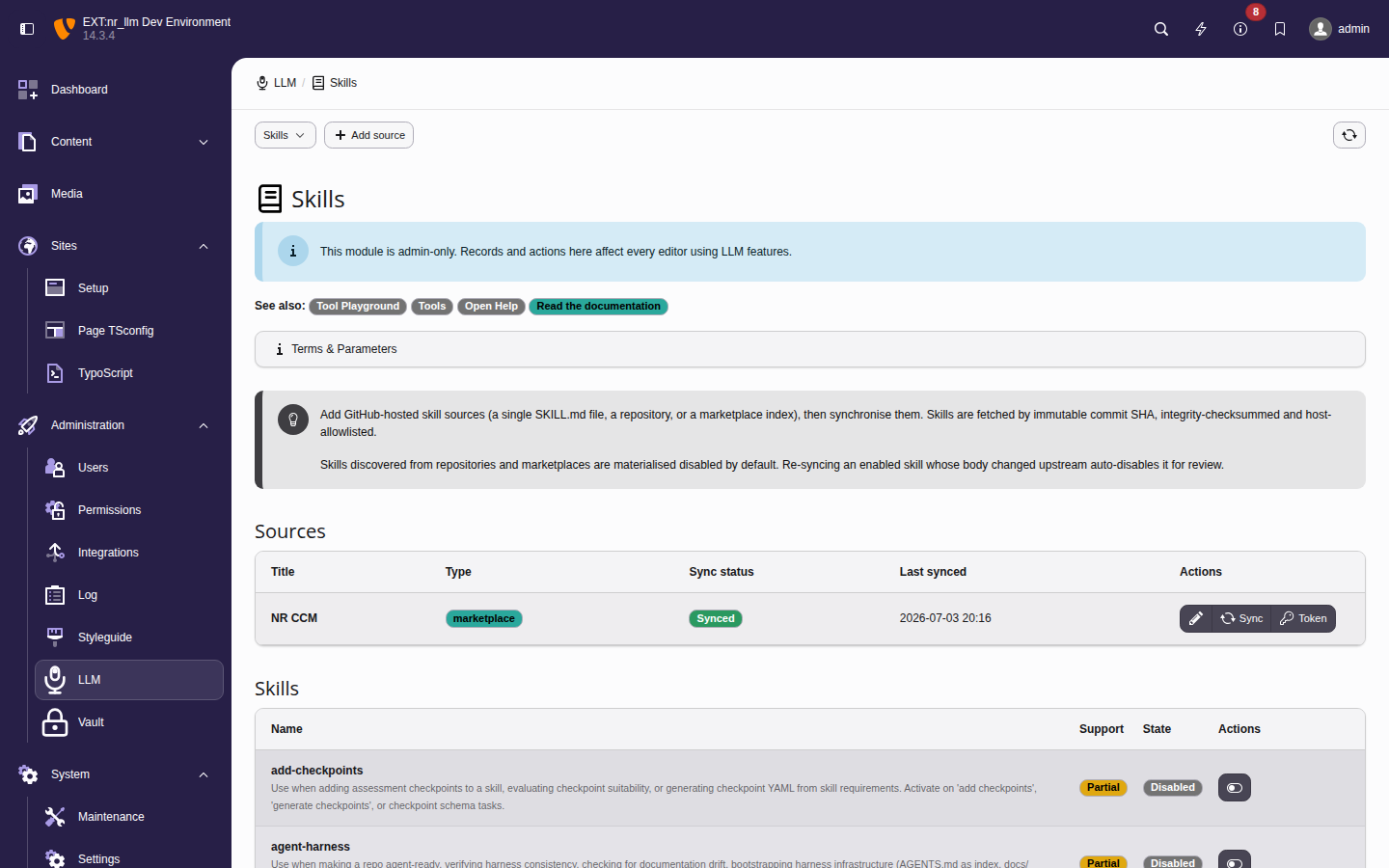
Syncing and the review flow
The Skills module — the Sources table (type, sync status,
last synced, per-source actions) above the discovered Skills
with their partial / full support badge and enabled state.
On a source, click Sync. The source moves through
never_synced → syncing → ok / partial / error.
The syncing state also acts as a lock: a second concurrent sync on
the same source is refused.
partial means the per-sync file-count or wall-time bound was
reached (large marketplaces); the skills fetched so far are stored.
Discovered skills from repo and marketplace sources are
created disabled by default. Review each one, then toggle it on
with Enable.
Re-sync never silently changes an enabled skill. If a re-sync
recomputes a different body_checksum for an enabled skill, nr-llm
auto-disables it and surfaces a diff (Review changes)
so you re-confirm before it is used again. Accepting the diff re-pins
the SHA atomically.
A skill that disappeared upstream is marked orphaned and disabled,
never silently dropped, so attachments (Plan 1b) do not vanish.
Deleting a source cascade-deletes its skills.
The partial support badge
Each skill carries a support badge:
full
The skill is plain front-matter and prose.
partial
The body or front-matter references scripts, references/,
assets/ or an allowed-tools declaration.
Warning
partial is not a "safer content" badge. It only signals that
the referenced scripts and assets are not executed by nr-llm
(which is true for every skill in this release). The prose itself is
fully untrusted regardless of the badge. Asset references are stripped
from injected prose purely to avoid dangling instructions, not as a
security control.
See ADR-035 for the full design and security rationale.
Attaching skills and injecting them into prompts
Enabled, non-orphaned skills can be attached to a Task and/or an
LLM configuration via the Skills field on those records
(only enabled skills are offered). At execution time, for text-generation
operations only — completion, translation and task execution; never
embeddings, vision or speech — nr-llm composes the attached skills into a
delimited block and prepends it to the user prompt. The configuration
system_prompt is never modified.
Note
Injection is eager and complete, not on demand. The whole skill
body — the entire SKILL.md prose after the front-matter, not just
the name/description — is written into the prompt before the model
runs. Unlike a tool, a skill is not
something the model calls or fetches when it decides it needs it: there is no
runtime round-trip that loads a skill's body, and none that loads its
references/ / scripts/ / assets/ (those lines are stripped from
partial skills, and the files are never executed). An attached skill
therefore always costs its full body in tokens on every run (subject to the
budget below).
Planned direction (not in this release): a progressive-disclosure mode
that injects only the description and lets the model pull the full body
or a referenced file on demand — the same shape as the tool runtime.
Executing a skill's bundled scripts or assets is a separate, harder step and
is not on the near-term roadmap.
Composition rules:
Precedence. Configuration skills are the baseline, task skills are
additive; the set is the union deduped by source + identifier (the
configuration wins on a duplicate). The configuration block renders
first.
Budget. The block is bounded by a conservative character budget;
when it is exceeded, task-additive skills are dropped before
configuration-baseline skills and each drop is logged.
Integrity. Each skill's body checksum is re-verified at injection
time; a mismatch (tampering or a stale row) drops that skill — it is
never injected.
Untrusted output. Skill prose is third-party text; output produced
under its influence is treated as untrusted and escaped/sanitized where
it is stored or rendered. Message role is defense-in-depth, not a trust
boundary.
On top of the SHA-pin and checksum controls above, each source and skill
carries the isolation controls introduced in ADR-061.
Publisher trust level. Every source is classified — untrusted (the
default, for anonymous public GitHub content), community, verified or
first_party (operator-controlled). This is provenance, independent of the
partial support badge. Each synced skill denormalises its source's level, so
re-classifying a source takes effect on the next sync. The instance-wide floor
skills.minTrustLevel (extension configuration, default untrusted) gates
use: a skill below the floor is dropped from both prompt injection and the
allowed-tools union. Raising the floor to verified therefore hides every
community/untrusted skill without deleting it. Trust is separate from the
enabled = false default — an untrusted skill still needs an explicit
enable. An unreadable or mistyped floor falls back to untrusted; the value
actually in force is shown under Effective policy.
Skill-block byte budget.skills.maxBytes (extension configuration,
default 24000) caps the composed block that is prepended to the user
prompt. The measure is bytes, not tokens — a deliberate over-estimate, since no
tokenizer is available. When the block exceeds the budget, skills are dropped
from the tail first: task-additive skills go before the configuration baseline,
and every drop is logged as a warning. Lower the value to reserve more of the
model's context window for the conversation itself; raise it if a large
configuration baseline is being trimmed. An empty, non-numeric or zero value
falls back to 24000 — the cap cannot be switched off, so an emptied field
never puts an unbounded block on the wire. The budget is instance-wide and
independent of the model's context window; the per-request window bound is
handled separately by the context-window manager (ADR-107).
The budget bounds the prompt block only, not the allowed-tools union
(Gating tools). The union is computed
over the effective skills before the block is assembled, so a skill dropped
for the budget still grants its tools while its usage rules stay out of the
prompt. That is deliberate — a budget-aware union would widen the gate,
because dropping the last declaring skill removes the restriction entirely.
Watch the drop warnings when lowering the value: they name every skill whose
prose stopped shipping while its tools kept being offered.
Manifest fingerprint (optional). A source may declare an
expected_fingerprint: the sha256 its whole skill set must hash to. When set,
the digest is recomputed at sync and verified before anything is materialised; a
mismatch fails closed (no skill is imported, the source goes to error) and
leaves the last known-good skills untouched. Leave it empty to rely on the
commit-SHA pin alone. This binds the reviewed bytes to a publisher-declared
identity beyond "these bytes from this URL"; it is a declared digest, not a
public-key signature.
Prompt-injection scan. Each body is scanned at ingest for known injection
signatures. A high-confidence jailbreak marker (e.g. "ignore all previous
instructions", role reset, chat-template control tokens) force-disables the
skill at import — even a single-file source that would otherwise default
enabled — and must be re-reviewed before enabling. Lower-confidence findings are
recorded on the skill (Injection scan findings) for review without blocking.
Immutable audit trail. Every ingest, enable, disable and fail-closed
rejection is written to tx_nrllm_skill_audit with who / when / source / SHA /
checksum / trust level / scan result. The trail is append-only — the application
never updates or deletes a row — so the provenance of any skill that can reach a
prompt is reconstructable after the fact.
Running tools
Tools are small, admin-curated PHP functions the model may call
mid-generation. Where a normal completion answers in one shot, a tool run
is a bounded agent loop: the model may ask to call a tool, nr-llm executes
it, feeds the result back, and re-asks — until the model answers or an
iteration cap is reached. The v1 consumer is the interactive
Tool Playground.
The Tool Playground — the only
surface that runs the agent TOOL loop — is admin-only (editors run
one-shot tasks and decide approvals in Web > AI Tasks, which
never executes tools directly). The runtime itself
applies a two-tier gate: each tool declares requiresAdmin(), and
ToolLoopService drops admin-only tools when the acting backend user is
not an administrator. Most built-in tools require admin because a tool runs
with full TYPO3 privileges, has no per-record authorization, and its return
value egresses both to the configured LLM provider and to the rendered
backend output; only a few read-only, scope-limited tools are offered to
non-admin users.
Note
The runtime design and its security and cost rationale are recorded in
ADR-038. Skill ingest and injection — which can steer
which tools a run may use and what arguments the model chooses — are
ADR-035 / ADR-036 and the
Managing skills guide.
The built-in tools
nr-llm ships forty-one read-only tools and five writing tools. Each is a
reference implementation of the security contract: model-chosen arguments are
validated and scoped, volumes are capped, and secret-bearing output is either
redacted or gated behind a separate _raw variant. Thirty-eight ship
enabled; the three unredacted _raw variants (get_env_raw,
get_php_info_raw and list_be_users_raw) and all five writing tools
(update_page_metadata, set_file_alternative_text,
move_content_element, create_content_element_draft,
create_translation_draft) ship disabled and
must be enabled deliberately.
Many require admin; the read-only structure, content
and file tools (get_pagetree, get_tca, get_full_tca,
get_table_schema, get_flexform_schema, fluid_resolve,
search_records, get_page_content, read_records,
get_record_history, resolve_url, validate_tca,
list_fal_storages, browse_fal_folder, search_fal_files,
get_fal_references, find_missing_files) are offered to
non-admin backend users — those self-enforce the acting user's TYPO3
permissions (page-show rights, tables_select) inside the tool, so a
non-admin only ever sees what the backend already grants them (see
ADR-042).
The two tools below are the fullest illustrations of the contract:
fetch_logs
Returns the most recent sys_log entries, newest first, with an
optional PSR level filter and a limit (default 20, hard-capped
at 50). Personally-identifying fields — the client IP, the backend user
id and the serialized payload — are redacted by omission, because the
result egresses to the external provider.
read_fal_asset_meta
Returns read-only metadata (file name, MIME type, size, title, alternative
text) for a single managed file (sys_file) by its uid. The uid is
model-chosen and therefore injection-steerable, so the lookup is
storage-scoped (default: the default storage). A uid in a non-permitted
storage returns the same neutral "not found or not permitted" string as a
missing uid — the model cannot enumerate arbitrary files.
The remaining tools follow the same pattern:
list_fal_storages
The file storages this run may touch (uid, name, driver, status flags).
The effective set is the configured allow-list, intersected for
non-admins with their file mounts; the server-side base path is never
part of the output.
browse_fal_folder
One FAL folder: subfolders (with file count), then files with size and
MIME type. Storage-relative identifiers only; anything unresolvable
collapses into one neutral denial. Capped at 100 entries.
search_fal_files
Substring search over file name and metadata title/alternative within
the accessible storages. %/_ in the query match literally;
missing files are excluded.
get_fal_references
Where a file is used: sys_file_reference rows as `table:uid
(field)`, hidden references marked. Soft references (RTE links, plain
URLs) are not tracked — stated in the output so "no references" is
never read as "safe to delete". Non-admins only see references from
tables they may read.
find_missing_files
sys_file records whose physical file is gone (missing = 1) —
the "broken image" diagnosis. The total count is always reported next
to the capped listing.
get_env / get_env_raw
Process environment variables. get_env redacts secret-looking values
(password, token, key, secret, salt, DSN, …); get_env_raw returns them
unredacted (database password, encryption key) and ships disabled.
get_php_info / get_php_info_raw
PHP runtime configuration. get_php_info is redacted; get_php_info_raw
returns the full, secret-bearing phpinfo detail and ships disabled.
get_pagetree
The backend page tree (uid, title, doktype) as a depth-indented outline;
deleted and hidden pages are excluded — structure only, no content.
get_tca
The TYPO3 TCA schema: with no argument it lists the configured table names;
with a table argument it returns that table's field definitions.
list_be_groups
The backend user groups (uid, title).
list_be_users / list_be_users_raw
Backend users. list_be_users omits credentials (password hashes and MFA
secrets are never included); list_be_users_raw returns the full
non-credential profile columns and ships disabled.
search_records
Full-text search across the tables that define TCA searchFields.
Returns compact table:uid hits with a short excerpt around the match.
Credential and nr-llm configuration tables are never searched; non-admins
are limited to their tables_select tables and to hits on pages they
may show.
get_page_content
One page's header data plus its content elements in column/sorting order
(uid, colPos, CType, header, a short bodytext excerpt). Non-admins need
page-show permission; only admins see hidden elements (marked
[hidden]).
read_records
Generic equality-filtered read of one TCA table — never raw SQL. Fields
are validated against the TCA and credential-like columns are silently
dropped; the same table gates as search_records apply.
get_record_history
One record's change history from sys_history, newest first: when,
which backend user, which action, and per modification the changed
fields as old → new values. Values of credential-like fields are never
rendered — only the fact that they changed. Same table gates as
read_records, and non-admins additionally need page-show access on
the record's page.
resolve_url
Map a URL (or path) of this instance to the page that serves it: site,
language, page uid/title/slug and route arguments. Routing only — no
request is sent; foreign hosts cannot match by construction. Non-admins
need page-show permission on the resolved page.
get_typoscript
The resolved frontend TypoScript (setup or constants) effective on a page,
with a dotted path drill-down and capped output. Admin-only —
constants routinely carry API keys — and credential-like values render as
[redacted] on top of that.
get_tsconfig
The rootline-merged Page TSconfig effective on a page, with the same
path drill-down, output cap and redaction as get_typoscript.
Admin-only.
get_last_exception
The newest exception/error from the TYPO3 file logs with its parsed
stack trace and the surrounding source lines of the project frames
inlined. index steps back through older errors, search filters
by message, class or component. Admin-only.
read_source
A line-numbered range of one project source file. Paths must resolve
inside the project root; dotfiles, var/* (except var/log),
config/system, settings.php/additional.php, key material
and credential paths are structurally unreadable. Admin-only.
search_code
Literal-substring (or opt-in regex) search across the project's source
files, returning path:line hits. Vendor, var and dot
directories are never searched; matched credential lines are
value-redacted. Admin-only.
probe_url
One GET against a URL of this instance: status, key headers, timing
and a short body excerpt — and on a 5xx the matching exception from the
TYPO3 logs is appended automatically. Foreign hosts and non-http(s)
schemes are denied; redirects are reported, not followed. Admin-only.
get_full_tca
The TCA index: the names and titles of all accessible tables, each with a
pointer to get_table_schema. A navigation aid so the model can traverse
the schema without the whole (multi-megabyte) TCA being sent at once. The
same table gates as get_table_schema apply. Optional filter and
extension narrow the list.
get_table_schema
One table's schema in a readable form: control settings plus, per field,
its type and — for relational fields — the foreign table and relation kind
(the value over get_tca). Sensitive tables are denied for every user;
credential-like columns show name and type only.
get_flexform_schema
The data structure of a TCA FlexForm field, rendered as sheets and fields.
When the field selects one of several structures by a pointer, the
available keys are listed so a follow-up call can pass ds_pointer. Same
table gates as get_table_schema.
fluid_resolve
Which physical Fluid file backs a template, partial or layout name in an
extension: the candidate paths in override order with an exists flag and
the winning path — to debug a wrong or missing template. Paths only.
(Resolves an extension's own Resources/Private paths; TypoScript
override root paths need a live rendering context and are not reflected.)
validate_tca
Structural TCA checks: ctrl.label/ctrl.type naming undefined
columns, foreign_table references to unknown tables, showitem
entries referencing undefined columns or palettes. One table or all
accessible tables; findings name schema keys, never record data.
check_typoscript
Scans the TypoScript effective on a page (constants and setup) for
syntax errors — invalid lines, unbalanced braces, @import matching no
file — using the same core scanner as the backend's TypoScript module.
Reports source and line number only, never the offending line's content
(a constants line may carry an API key). Admin-only.
list_extensions
The installed (active) extensions: key, version, composer name and
title — no package paths. Admin-only.
get_site_config
Without arguments the configured sites (identifier, base, root page);
with identifier that site's configuration flattened to dotted
key: value lines. Credential-like keys (camelCase included, e.g.
apiKey) render as [redacted]. Admin-only.
list_scheduler_tasks
The scheduler tasks with next execution, disabled flag and a
last-run-failed marker. The serialized task object is never
unserialized; degrades gracefully when EXT:scheduler is absent.
Admin-only.
get_system_status
One compact block: TYPO3/PHP/database versions, application context,
composer mode, OS family, timezone — no paths, no hostnames. Admin-only.
list_deprecations
The newest distinct messages from the deprecation log, deduplicated with
a ×count suffix and project paths relativized — the upgrade work list.
Admin-only.
list_middlewares
A PSR-15 middleware stack (frontend or backend) in execution order with
identifiers and classes. Admin-only.
site_rag_query
Curated evidence about the website's own public content for a
question: source id, title, URL and match excerpt per source, retrieved
from the best available search index — EXT:solr, ke_search,
indexed_search or a database fallback — and labelled with the answering
backend (ADR-049). Index-level filtering is always
public-only (what the anonymous visitor could read).
site_fetch_source
The full indexed text behind a site_rag_query source id, capped at
8000 characters — for reading a promising source beyond its excerpt.
The writing tools
Five tools change anything at all: update_page_metadata,
set_file_alternative_text, move_content_element,
create_content_element_draft and create_translation_draft. All five
write through the TYPO3 DataHandler, as the acting backend user, in the live
workspace only, on exactly one record per call (ADR-135,
ADR-146).
What holds for all of them:
They ship disabled, sit in their own editing group, and are not
offered until both the group and the tool are enabled.
Every call pauses for a human decision (ADR-134). The
approval card names the record and the values, together with the values the
write would REPLACE (ADR-136); nothing is written until
somebody presses Approve, and the approver must themselves be permitted to
run the tool (ADR-133).
Permissions are enforced twice: the tool checks the acting user's own rights
first, and the DataHandler enforces its own rules on top. A non-admin
therefore writes only what the backend already lets them write.
A field the user lacks the "exclude field" grant for is dropped by the
DataHandler without an error. Every one of them re-reads the record
afterwards and reports that as a failure rather than as a successful write.
A call the tool would refuse is refused whole rather than applied in
part, and a record the acting user may not reach is refused with the same
words as a record that does not exist — so a refusal never confirms that a
uid exists.
update_page_metadata
Sets a fixed set of descriptive fields on one page. Editable: title,
subtitle, nav_title, abstract, description, keywords
and — when EXT:seo is installed — seo_title, og_title,
og_description, twitter_title, twitter_description. Anything
else (slug, hidden, doktype, fe_group, perms_*,
no_index, the image relations …) is refused. Authorised by the acting
user's page-edit right; the DataHandler then enforces tables_modify and
the field-level grants.
set_file_alternative_text
Sets the alternative text (sys_file_metadata.alternative) of one managed
file, identified by its sys_file uid — the accessibility gap an editor
most often leaves behind. It writes that one field and nothing else.
Authorised by the same storage allow-list and file mounts as the read-only
FAL tools; core's own file-metadata permission check (a writable file
mount) then applies inside the DataHandler, so a read-only mount is refused
there.
Two limits worth knowing before enabling it:
It never creates a metadata record. A file that carries none is
refused, in the same words as a file the user may not reach — so the
model cannot tell "not yours" from "not indexed".
It writes the live, default-language record only and takes no
language argument. A translation, and a draft version of the same record
in a workspace, are both left alone. Translated alternative texts stay a
backend job (ADR-135).
An empty string is accepted and is the correct value for a decorative
image.
move_content_element
Moves one content element to a page and a column. The element keeps its uid,
its content, its language, its history and its references — only its place
changes, which is what makes it the least committal write in the set.
Both ends are authorised: the acting user needs content-edit rights on the
source page as well as on the target, because moving an element out of a
page edits that page's content too. An after_content_uid anchor must sit
on the target page and in the same language; a wrong anchor is refused
rather than silently corrected.
The destination column is always stated explicitly on the wire, so the
element lands where the approval card said it would even when the anchor
element sits in a column the caller did not expect.
create_content_element_draft
Creates one content element on a page — the first tool that brings a record
into being. Three things bound it:
It is always hidden. There is no argument to switch that off:
publishing is a separate act with a separate audience, and the approval
that let the tool run approved a draft.
The content type is an allow-list (header, text, textmedia,
bullets) intersected with what the installation's TCA actually
declares. Types whose payload is configuration rather than prose — list
(a plugin), html, shortcut — are out of reach.
The field set is fixed: headline, body text, column, language, position.
This is not a generic record API.
bodytext reaches the DataHandler and its RTE transformation exactly as an
editor's input does. It is bounded in length and not otherwise filtered — an
editor may write the same markup by hand, and a tool enforcing a stricter
rule than the CMS would be enforcing a rule that does not exist.
create_translation_draft
Translates one page or content element into another language by running
core's own localize command, so connected-mode translations, inline
children and every localisation hook behave exactly as they do in the
backend.
The result is hidden, which is the part core does not do: localize
copies the source's visibility, so a translation of a live page would go live
the moment it was created.
An existing translation stops the call and is named in the refusal. The
overwrite argument is the only way past it: it deletes that
translation first — recoverably (deleted = 1) and in sys_log — and
the approval card says so on its own line. Whether the target language exists
for the record's site is core's check, not a second implementation here.
Registering a tool
A tool is a PHP class that implements
Netresearch\NrLlm\Service\Tool\ToolInterface:
getSpec(): ToolSpec
Returns the declaration the model receives — a name, a description, and a
JSON-Schema parameters block. Build it with
ToolSpec::function($name, $description, $parameters).
execute(array $arguments): string
Runs the tool with the model-provided arguments and returns a plain
string that is fed back into the conversation as a tool turn.
getGroup(): string
The tool's group — a short, stable identifier used to enable or disable
whole families of tools at once. Built-ins use content, editing,
structure, system, accounts and configuration; third-party
tools declare their own group (recommended: the providing extension's key).
See Tool groups.
The interface carries #[AutoconfigureTag('nr_llm.tool')], so a class is
auto-registered simply by implementing it — no central registration file
to edit. ToolRegistry collects every tagged tool through a DI iterator
and indexes it by spec name; two tools with the samename is a
developer error and fails fast at container build.
When you write a tool, honour the security contract: treat $arguments as
attacker-influenced (the model is steerable by injected skill prose),
validate and scope every input (cap volumes, scope identifier lookups),
and never return secrets — the result leaves the instance.
Managing tools
The Admin Tools > LLM > Tools module lists every registered tool
with its global enable state and lets an admin toggle it. A disabled tool
is refused on every run, everywhere — the runtime gate is fail-closed, so a
disabled tool can never be offered to the model regardless of a skill's
allowed-tools or the per-run selection in the playground. Some built-in
tools (for example get_env_raw and get_php_info_raw) ship disabled
by default because they return unredacted, secret-bearing output; enable
them only deliberately.
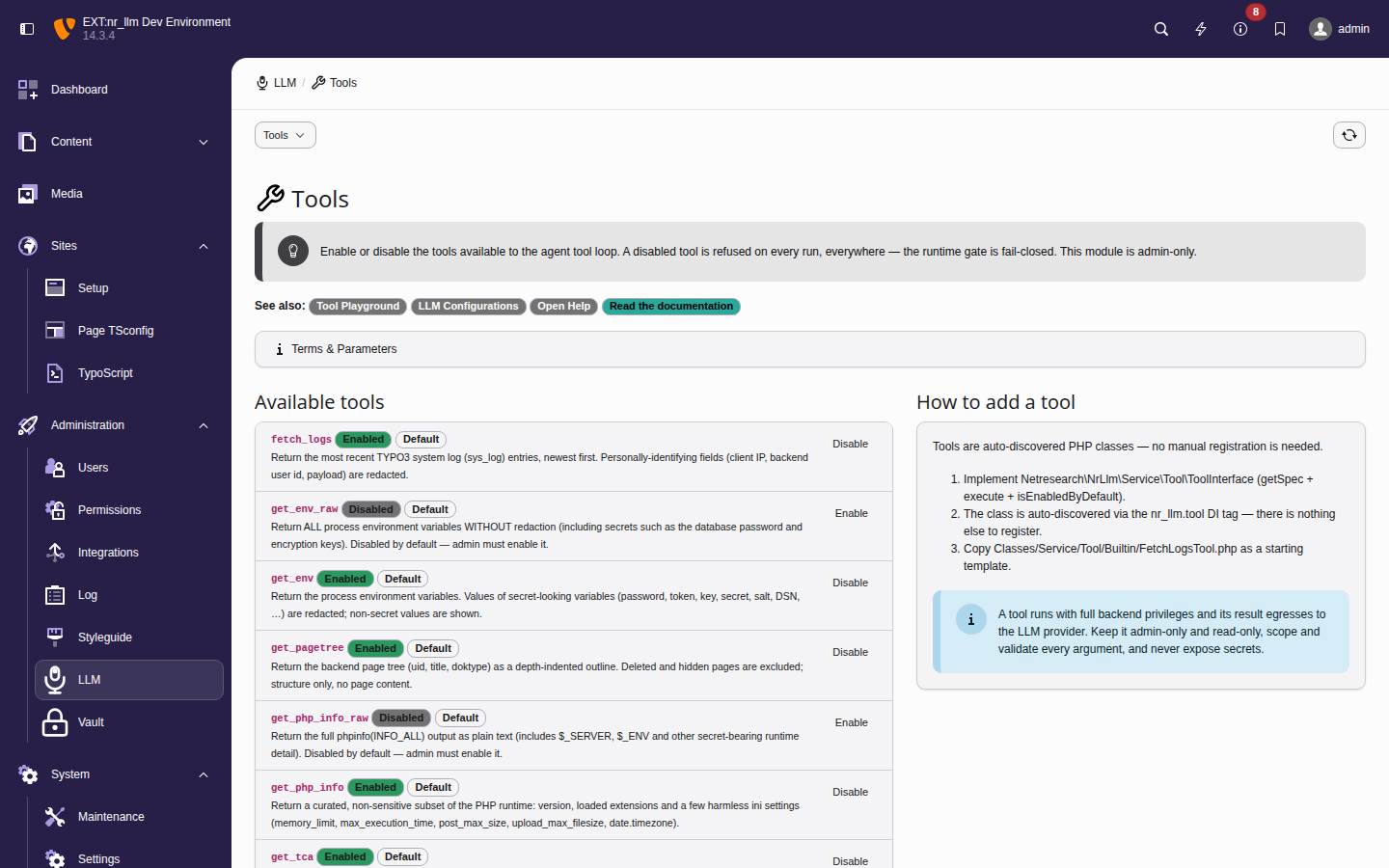
The Tools module — each registered tool with its global enable state and a
toggle. The _raw variants show as Disabled, the redacted
tools as Enabled; the Default badge marks a tool
sitting at its shipped state.
A tool that carries an editor action declaration
(ADR-152) reads differently in that list: it shows an icon,
its translated name, one sentence written for a human, and the record types it
addresses — instead of the wire name and the description written for the
language model. All five writing tools declare one, and the wire name stays
visible as the technical detail the toggle acts on. A read-only tool is
unchanged.
The declaration is presentation only. It does not decide whether a tool writes
— that is the tool's declared effect — and it changes nothing about how a call
is fenced, approved or audited.
What editors see
The declaration is what the Editor Action Center
(ADR-158) renders. It lives in the editor module
Web > AI tasks and appears in two places: as an AI
actions catalogue reachable from that module, and as an AI actions
entry in the context menu of a record — a page or a content element — which
opens the catalogue narrowed to the actions that address that record.
An editor is offered an action only when all of the following hold, and every
one of them is an administrator's decision:
the writing tool is enabled in this module (all five ship disabled);
its group — editing — is enabled, and where the default LLM
configuration restricts tool groups, editing is among them;
the tool's data class is within the configured provider's trust-zone ceiling;
the backend user holds tasks_use and has the module ticked in their
group;
the backend user may use the default LLM configuration itself — where that
configuration restricts Allowed backend groups, the user is in
one of them (see Backend user permissions).
That last point is checked again when the action is started, so an editor
outside those groups cannot start a run by naming the action directly either.
Starting an action creates an ordinary agent run restricted to that one tool.
Because the tool declares a write, the run suspends before it touches anything
and the change appears on an approval card with its preview — the editor is
redirected straight to that inbox. Nothing is written until someone approves.
The record an action is offered on is the record its arguments name, which is
not always the record it writes: Create content element draft is
offered on a page, because the page is what it must be told, and the
element it creates is the result. Where an action needs something the selected
record cannot supply — Move content element needs a target page —
the editor names it in the note, and the approval card shows the destination
that was resolved from it.
Files have no context-menu entry yet: the file list identifies a file by its
combined identifier rather than by uid, so Set alternative text is
listed in the catalogue but has no per-record entry point.
Several records at once
Once a record is selected — that is, when the catalogue was opened from a
record's context menu — each action there also offers Run this on
several records (ADR-162). The catalogue opened from the
module menu has no record and therefore no bulk entry point either; an action
needs a subject, and this module picks none. That page takes a list of record
numbers from the same table, seeded with the record that was selected, and
shows, before anything starts, which of them the action can run on, which are
skipped and why, and what the batch is expected to cost in requests, tokens and
money.
At most 100 entries of that list are read at all. A longer paste is cut there
and the page says so, because everything past the cut would otherwise become a
table row and a record number in a message no one can read.
Starting it creates one ordinary run per record. There is no bulk mode: each
record gets its own approval card with its own preview, and an approver decides
them one at a time. At most 20 records are started in one press, because the runs
execute inside the one backend request.
The AI budget is checked once per run, so a batch can run out of budget partway
through. When that happens the batch stops and names the records the stop kept
from starting — the record it stopped on was run, and is reported separately.
Nothing is left half-written: the runs that did start are proposals awaiting
approval, not changes.
Runs that ended for some other reason are reported by kind — failed, stopped by
a guardrail, cancelled, or simply finished without proposing a change — so a
batch in which everything failed does not read like one in which nothing needed
changing.
The estimate on that page is deliberately rough and says so: it does not count
the system prompt and skills the runtime adds, and its upper price assumes every
request returns the configured token ceiling. It shows no price range at all
unless the model record carries both an input and an output price and the
configuration sets an output ceiling — an absent range means "unknown", which
0.00 would not. Treat it as an order of magnitude, not an invoice.
Tool groups
Every tool belongs to a group (its getGroup() value). The built-in
groups carry a translated name in the module header beside their identifier; a
group a third-party extension brings has no translated name and shows its
identifier alone. The built-in taxonomy:
update_page_metadata, set_file_alternative_text,
move_content_element,
create_content_element_draft,
create_translation_draft — the only WRITING group
Groups can be switched on three levels, and the result cascades
fail-closed — a tool is offered only when every level permits it:
Centrally in the Tools module: each group header carries an
Enable/Disable group toggle. A disabled group refuses all of its tools —
including same-group tools installed later — and a per-tool override can
not re-enable a tool inside a disabled group (predictable,
fail-closed). Per-tool toggles keep working but take effect only once the
group is enabled again.
Per configuration: the Allowed tool groups field on an
LLM configuration restricts agent runs with that configuration to tools of
the selected groups (empty = all groups). This intersects with a skill's
allowed-tools declaration.
Per run in the playground: the tool checkboxes are grouped, and each
group checkbox (de)selects its children.
Third-party extensions declare their own group per tool; the recommended
value is the extension key, so an admin can disable an extension's whole
tool family with one toggle. The design is recorded in
ADR-043.
Network egress policy per group
Network egress is governed per tool group and is fail-closed
(ADR-061). Each group has a declared egress scope; a group
with no declaration may make no outbound request:
Scope
Meaning
none
No outbound network request (the default for every group).
own_site
Only the instance's own configured site hosts, resolved
through SiteFinder — the exact allow-listing probe_url
applies, now lifted to the group boundary.
Only the system group (which carries probe_url, the one built-in that
fetches over the network) is granted own_site; every other group is
none. There is no "any host" scope, so a newly installed or mis-declared
tool group can never egress to an arbitrary target. The diagnostics tools that
share the system group (get_env, fetch_logs …) never make a network
request, so the grant does not loosen them.
Using the Tool Playground
The playground lives in Admin Tools > LLM > Playground and is
admin-only. It is a sibling of the Tools management module: the playground runs the
loop, while the Tools module governs which tools exist and are enabled.
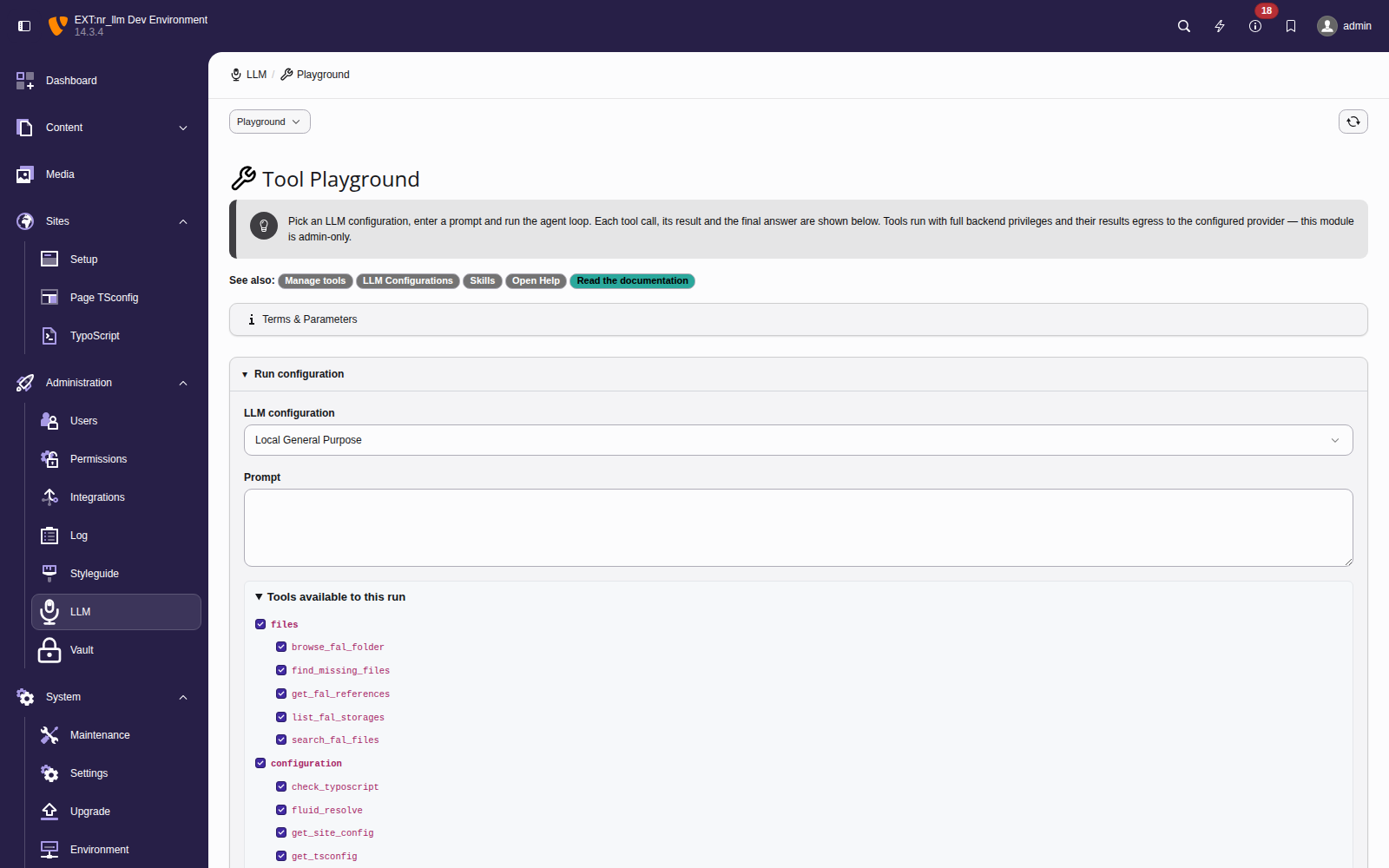
The playground shell — the configuration picker, prompt box and the
Tools available to this run panel, which lists every
registered tool with the default-enabled ones pre-checked and the
disabled _raw variants unchecked.
Tip
Small local models work best with a narrow tool set. With every
group enabled, the model is offered every enabled tool declaration at
once (several dozen). Small models such as the seeded qwen3:4b
often fail to pick the right tool from a set that large, or reason
past the token budget without calling any. Untick the groups that are
irrelevant to the question — restricted to one or two groups, the same
model picks the right tool. Larger hosted models cope with the full
set.
Pick an LLM configuration from the dropdown. Its vault-stored API key,
model, temperature and system prompt are what the loop actually runs on —
the playground never falls back to a default model.
Type a prompt. Optionally open the override panels to force-inject
skills (added on top of the configuration's own), force-add snippets
(inserted as leading system messages), override the system prompt, cap
the max rounds, or tick capture raw provider response.
Click Run — or Dry run to assemble the prompt and
inspect exactly what would be sent without calling the model.
Read the inspector — live from the moment you click Run. A summary
strip reports rounds, tool calls, the prompt/completion token split,
estimated cost, wall time and status. The step list is the nr_llm ↔ LLM
dialog in order: each round opens with a Context budget step,
then its outbound request (the messages sent and the tools offered)
appears the instant it goes out, a waiting indicator shows while the model
works, then the response and each tool execution stream in. Select a
step to open its detail — requests carry Messages sent and
Tools offered; responses carry Structured,
Raw JSON and Thinking. The model's final answer
closes the run.
The Context budget step says where the window went for the round
that follows it, so you can act on the component that is yours to change
rather than only learn that history was dropped. It has two tabs:
Where the window went
The window, the output reserve, the safety margin and the resulting
budget, then four component lines — transcript, tool schema, system
prompt (incl. snippets) and skills — that sum to the estimated total,
plus what is left. On this surface the system-prompt line always reads
counted in the transcript and the skills line always reads 0: the agent
loop builds both into the transcript before the fit measures it, so their
content is already on the transcript line. The table says so under the
figures. A send whose reserve exceeds the whole window is handed to the
provider unmeasured, and the step reports no accounting instead of a
window of zero.
Injected context
Every snippet and skill this run injects, by name only, with the data
class it declared (ADR-144) or not classified, and the
strictest class across all of them. The list covers the snippets and
skills you force-injected for this one run as well as the
configuration's own — the input-context gate itself still answers for the
configuration alone, so a forced source is shown here and is not gated.
A completed run — the summary strip (rounds, tool calls, token split, wall
time, status), the ordered step list of the nr_llm ↔ LLM dialog, and the
selected step's detail: here round 1 requested the list_be_users tool,
whose result is fed back so round 2 can answer.
The Tools available to this run list lets you narrow a single run
to a subset of the globally-enabled tools (the full list and the global
enable/disable controls live in the Tools module). Raw-response capture is off unless you
tick it, so ordinary runs never retain the provider's raw payload. Every
displayed string — tool arguments, tool results (which may include
sys_log content), and the final answer — is rendered escaped; HTML is
only ever shown inside a sandboxed preview, never injected into the page.
Each run is bounded by the iteration cap (default 5) and, when the
configuration's backend user has a budget, by the per-iteration budget
pre-flight. If the cap is hit with tools still pending, a final tool-free
completion synthesises a closing answer and the run is marked truncated.
The aggregated token usage is reported; the monetary cost is recorded in
the usage table by the middleware pipeline.
Ollama model-capability dependency
Tool calling depends on the model, not just the provider. For Ollama,
only function-calling-capable models — for example llama3.1,
mistral, qwen2.5 — return tool calls. A model without function-calling
support simply answers the prompt directly and never calls a tool; the
loop ends gracefully on the first plain answer. If a configured Ollama model
never seems to use the available tools, verify it is one of the
function-calling models for your Ollama version.
Gating tools with allowed-tools in a skill
A skill's SKILL.md front-matter may carry an allowed-tools key that
gates which tools the skills attached to a configuration (or task) grant for a
run. The resolution is fail-closed on declaration, computed over the
configuration's effective skills (enabled, non-orphaned, at or above the
instance trust floor, deduped):
Absent (no skill declares allowed-tools) — no opinion; all
registered tools are offered.
Declared list — the union of the declared lists across the effective
skills; only those tools are offered (intersected with what is actually
registered, so an unknown name is dropped).
Declared empty (allowed-tools: []) — declares zero tools; if no
other effective skill widens the set, the run gets no tools and is a single
plain completion.
A disabled or orphaned skill never grants tools. The allow-list is enforced
both when the tools are offered to the model and again when a tool call is
executed, so a prompt injection cannot reach a tool the skills did not grant.
The effective set is not the same as what ends up in the prompt. The
skill-block byte budget (skills.maxBytes, see
Managing skills) is applied after the
allow-list has been computed, while the block is assembled. A skill dropped
for the budget therefore still contributes its allowed-tools, but its
usage rules never reach the model. That order is deliberate: a budget-aware
union would let the drop of the last declaring skill collapse the allow-list
to "no restriction" — every registered tool — which is a looser gate, not a
tighter one. Keep skills.maxBytes above the composed size of the skills
you rely on if you want their prose to arrive alongside the tools it
describes; every drop is logged as a warning.
See ADR-038 for the runtime design and security rationale.
MCP servers
The MCP Servers module (admin-only) connects agent runs to
tools offered by an external Model Context Protocol server — a translation service, a
ticket system, any MCP-speaking backend.
How it works
Configure a server — endpoint, authentication, the class of data
its tools may see, and whether its tools need human approval. A server
that declares no data class supplies nothing: there is no default
anybody silently inherits (fail-closed, ADR-113).
Import its catalogue — an explicit action that fetches the tools
the server advertises. Import is the only network call that happens
outside an agent run; nothing talks to the server just because a page
rendered. Tool input schemas are normalised into the supported subset
on import; a tool whose schema cannot be expressed is skipped rather
than silently weakened.
Enable individual tools — imported tools start disabled and are
switched on one by one, exactly like the builtin tools in the
Tools module.
Is the server alive?
Test connection performs the MCP handshake and reports what came
back: how long it took, which protocol revision the server chose and what the
server calls itself. The report appears on the server's card and stays there
until you leave the page — only the latency is stored, so the rest would be
lost to a page reload, and this is the one action in the module that therefore
does not reload. It writes no catalogue — no tool is added, removed or
orphaned, and the import status and the last import error stay exactly as they
were. Use it to check a server before enabling it, and to tell "the server is
down" from "the server is fine and this tool is gone".
Each server card also shows Last successful contact. That is the last time
this installation completed any round trip against the server — a tool call,
an import or a connection test — together with how long that round trip took.
It is deliberately not the same as Last import: a server that has
been answering tool calls all month can still show an import from six weeks
ago, and previously there was no way to see the difference.
A failed connection test replaces the report on the card with its reason, and
is stored nowhere. Only a success moves the contact date.
Guard rails
Remote tools always require an administrator, and count as
non-idempotent writes — unconditionally, whatever the server's
catalogue says about them: they are never replayed on a retry, and
never waved through the trust-zone gate in observe mode. That the
classification cannot be argued down from the far side is what makes
the setting below the only place the question is answered.
Requires approval decides whether an agent run stops and
waits for a person before it calls any tool of this server. It is on
for a newly configured server: what a remote tool actually does cannot
be inspected from here, and the server's own annotations do not get to
answer the question about themselves (ADR-134). Switch
it off per server once you know what its tools do. This holds for every
server, including one configured before the setting existed: an update
leaves it requiring approval, and nothing switches that off on your
behalf.
The number of remote calls one run may make is bounded (default: 20)
— a remote call crosses the network while a backend user waits, and
nothing else limits how many a model asks for at once.
What a remote answer can contain
An MCP server may answer a tool call with several typed blocks: text,
images, embedded resources. This client reads text only. When a
server sends anything else, the blocks are dropped and the answer opens
with a line saying how many were dropped and of which type — so a model
reading a partial answer is told it is partial, and a run whose tool
returned only an image is not told the tool returned nothing. The line
comes first because a long answer is shortened before the model sees it,
and a note at the end would be the part that is cut. If you need the
image itself, the tool is not usable from here yet.
A call that fails does not fail the run. It comes back as a failed tool
result naming the server, the model is told, and the run carries on.
This covers both ways a call fails: the server not answering usefully —
it is down, it refuses the credential, it sends something that is not
JSON-RPC — and the server answering that the tool itself failed, which
is the ordinary case of a missing page or a rejected argument. Both are
recorded as failures in the run's event stream, so a server that is
flaky is visible without reading transcripts.
See ADR-116 for the design rationale,
ADR-154 for what liveness is measured on and why the
connection test writes nothing, and ADR-161 for the
conformance suite every supported connection is held to — including the
one thing it does not do: cancelling a call that is already in
flight. Cancelling a run stops it at the next step, but an outstanding
remote call still runs to its 15-second timeout.
AI-powered wizards
The extension includes AI-powered wizards that use
your existing LLM providers to generate
configurations and tasks automatically. This reduces
manual setup to a minimum.
Setup wizard
The setup wizard guides first-time configuration in
five steps:
Connect — enter your provider endpoint and
API key.
Verify — test the connection.
Models — fetch available models from the
provider API.
Configure — create an initial configuration
with system prompt and parameters.
Save — run a test prompt to confirm
everything works.
The setup wizard walks through provider creation,
connection testing, model fetching, configuration,
and a test prompt in five steps.
Access it from the Dashboard when no
providers are configured, or via the setup wizard
link at any time.
Configuration wizard
The configuration wizard generates a complete LLM
configuration using AI. Instead of filling in each
field manually, describe your use case in plain
language and the wizard generates everything.
Navigate to Admin Tools > LLM >
Configurations.
Click Create with AI.
Describe your use case (e.g., "summarize blog
posts in three sentences").
The wizard generates: identifier, name, system
prompt, temperature, and all other parameters.
Review and click Save.
The configuration wizard generates all fields
from a natural-language description.
Task wizard
The task wizard creates a complete task setup — a
task and a dedicated configuration — in one
step.
Navigate to Admin Tools > LLM >
Tasks.
Click Create with AI.
Describe the task (e.g., "extract the five most
important keywords from an article").
The wizard generates: a task with prompt template,
a configuration with system prompt and parameters,
and a model recommendation.
Review and click Save.
The task wizard generates a complete task and
configuration from a description.
Model discovery
On the model edit form, use the
Fetch Models button to query the
provider API. This auto-populates available models
with their capabilities, context length, and
pricing metadata.
What the capability checkboxes are seeded with
Discovery writes only the capabilities the provider's
own response states. How much that is differs per
provider:
chat, tools, vision, embeddings (/api/show,
Ollama 0.6 and newer)
Gemini
chat, streaming, embeddings
(supportedGenerationMethods); vision and
tools come from the built-in table for known
model ids
Anthropic
chat, vision, tools, streaming for every model
the listing returns — it returns Claude chat
models only, and they all have them
OpenAI
from the built-in table, keyed by model id; an
id outside it is seeded from its prefix
(dall-e-, tts-, whisper-) and
otherwise chat alone
Groq
chat only — the listing carries no capability
field at all
Where the API reports nothing, the record is seeded
with the narrowest true statement rather than a
guess. Check the capability checkboxes after
discovery and tick what the model actually does:
the field is yours to edit, and configurations that
select models by criteria match against it.
Note
Models discovered by an earlier version carry
capabilities that were partly guessed from the
model name. Run Fetch Models again
after upgrading, or correct the checkboxes by
hand — an upgrade cannot tell an operator's
deliberate edit from a stale seed, so it does not
overwrite either.
Recommended workflow
For a fresh installation:
Run the Setup wizard from the dashboard
to create your first provider, fetch models,
and test a configuration.
Use the Configuration wizard to create
additional use-case configurations (one per
use case in your extensions).
Use the Task wizard to create reusable
prompt templates for editors.
Share configuration identifiers with your
extension developers — they reference them
in code via
$configRepository->findByIdentifier('...').
For ongoing maintenance:
Add providers when you need additional
AI services or separate prod/dev keys.
Fetch models periodically to pick up new
models from providers.
Edit configurations to tune prompts and
parameters — changes take effect immediately
without code deployment.
Per-user AI budgets
The tx_nrllm_user_budget table caps per-backend-user AI spend
independently of the per-configuration daily limits on
tx_nrllm_configuration. A user request must clear BOTH layers:
any limit on the preset they chose AND any limit on their personal
budget record.
What a budget caps
Each row in tx_nrllm_user_budget binds to exactly one
be_user and defines six independent ceilings. 0 on any axis
means "unlimited on this axis".
Field
Unit
Reset cadence
Max Requests/Day
count
Every day at 00:00 server-local time.
Max Tokens/Day
count
Every day at 00:00 server-local time.
Max Cost/Day ($)
USD
Every day at 00:00 server-local time.
Max Requests/Month
count
First of the month, 00:00 server-local time.
Max Tokens/Month
count
First of the month, 00:00 server-local time.
Max Cost/Month ($)
USD
First of the month, 00:00 server-local time.
Usage is aggregated on demand from tx_nrllm_service_usage — the
same table the UsageTracker already writes to per request — so there
is no second write per request and no way for a separate counter to
drift away from the source of truth.
Creating a budget
Budget records have rootLevel = -1, so admins can create them at
the TYPO3 root (pid = 0) or on any regular page. Keeping them at
the root is the convention because budgets are site-wide admin
concerns, not page-scoped content; the recipe below follows that
convention.
Open Web > List in the root (page UID 0) — or on the
page where you keep other cross-site configuration records.
Click Create new record.
Choose LLM User Budget.
Pick the backend user, set the ceilings, toggle
Enforce this budget on.
Save.
Note
Only one budget row per backend user. The be_user column
is unique. Re-editing the existing row is the correct way to
tighten or relax limits.
How the check runs
Before dispatching a request the consuming extension calls
NetresearchNrLlmServiceBudgetService::check(). The service:
Returns allowed when the user has no budget record, when
Enforce this budget is off, or when every ceiling
is 0.
Aggregates today's usage and this month's usage in a single
database roundtrip.
Evaluates the daily window first; the monthly window only if the
daily window passes.
Adds +1 request and +plannedCost to the usage figures
before comparing, so a user at exactly the limit is still
allowed one more call.
The returned BudgetCheckResult names which bucket was tripped
(exceededLimit as a stable machine key, plus a human-friendly
reason string suitable for log output or caller-side wrapping).
Important
The check is best-effort, not a transactionally-safe gate.
Two concurrent requests for the same user can both pass
check() before either updates
tx_nrllm_service_usage, temporarily allowing a one-request
overshoot. Full serialisation would hot-path every AI request.
If strict enforcement matters, layer a per-user lock on top.
Budgets vs. configuration limits
Both layers persist but cap different things:
Axis
Configuration daily limits
Per-user budgets
Bound to
a preset (tx_nrllm_configuration)
a backend user (tx_nrllm_user_budget)
Question answered
"Can ANY editor keep using this preset today?"
"Can THIS editor keep spending this month?"
Windows
daily
daily AND monthly
Dimensions
requests, tokens, cost
requests, tokens, cost
Both must pass
yes
yes
See ADR-025: Per-User AI Budgets for the full design rationale, including the
alternatives (counter table, group-level budgets, auto-throttling)
we considered and why they were rejected.
Backend user permissions
nr_llm is administrator-only by default: every module and every AJAX
action denies non-admins, and nothing changes at update time. Access for
non-admin users is opened per capability grant (ADR-130), never wholesale.
Assigning grants
Grants are ordinary TYPO3 custom permission options. In the
backend group record (Access Lists tab, section
AI (nr_llm) permissions), tick the grants the group should
hold. Notes:
Grants are group-scoped — a backend user without groups cannot hold
a grant.
Administrators hold every grant implicitly.
Revoking a grant takes effect with the user's next request.
The two grants in the backend group form (Options tab,
collapsible section "AI (nr_llm) permissions"), below the dashboard
widget permissions.
Available grants
Execute AI tasks (tasks_use)
Run existing AI tasks and refresh their input data. What a task may
read and which model and configuration it uses is defined by whoever
manages the task — that is the trust boundary: task managers define,
grant holders execute. Every run is pre-flighted against the user's
own usage budget and attributed
to them.
Since ADR-158 the same grant opens the Editor Action
Center in that module. It does not decide which actions appear there:
that is the tool gate's answer plus access to the default LLM
configuration — a user outside its Allowed backend groups is
offered nothing and can start nothing — and every writing tool is disabled
until an administrator enables it. Starting an action always suspends for
approval before anything is written.
Approve suspended AI runs (agent_approve)
Approve, deny or answer agent runs suspended for a human decision —
including runs started by other users. Without this grant a user
can only ever decide their own runs. Deliberately part of no
recommended preset: granting it is an explicit trust decision.
Recommended presets
Roles are named grant bundles, not code:
Preset
Grants
AI editor
tasks_use
AI operator
tasks_use — identical to AI editor on purpose: a
management grant still awaits a management surface
(ADR-131 adds none)
Approval (agent_approve) sits in no preset — add it deliberately
where the organisation wants non-admin approvers.
Current reach
Grant holders work in the dedicated AI Tasks module (web group,
ADR-131). Reaching it takes BOTH switches: the module
must be ticked in the group's module list (access => user) AND the
grant must be held — the module switch alone never grants execution.
Tasks with the table input type are not offered to editors (their
record picker has no read boundary yet and stays admin-only).
Everything else — configuration, providers, models, the playground,
record browsing — remains administrator-only regardless of grants.
Verifying the specialized services
Translation, image generation and speech are not configured as records. Each
one reads a nr-vault identifier from the Extension Configuration, and until a
consuming extension calls it, nothing tells you whether that identifier
resolves to a working credential.
The test page — LLM > Overview > Test — answers that directly for
translation and image generation.
Which setting belongs to which service
Setting
Used by
translators.deepl.apiKeyIdentifier
DeepL translation
image.fal.apiKeyIdentifier
FAL image generation
providers.openai.apiKeyIdentifier
DALL·E images, Whisper transcription and text-to-speech — all three
share this one identifier and cannot be configured separately
Translation
Enter a text and a target language. Leaving the source language empty makes the
service detect it.
The translator picker lists every registered translator and marks the ones
without a usable credential. Leaving it on LLM (default) runs the
LLM path, which needs a working provider but no specialized key — useful to
confirm the page itself works before pointing at DeepL.
Selecting a translator routes to that one, which is the case worth running
after entering its vault identifier. The result names the translator that
answered, the detected source language, and either the characters billed
(specialized translators) or the tokens used (the LLM path).
Image generation
Enter a prompt and pick OpenAI (DALL·E) or FAL. Each
service applies its own default model and size; the result reports which were
used, and DALL·E additionally reports the prompt it rewrote yours into.
Note
The generated image is not stored. It is rendered from what the
provider returned — a URL for FAL, an inline data URI for OpenAI — and is
gone when you reload. Putting an image into the file storage, attaching it
to a record or reusing it is the job of the extension that consumes
nr_llm; this page only proves the credential works.
Reading the result
A missing or unresolvable credential is reported as such, naming the Extension
Configuration — that is the failure this page exists to surface. Any other
failure of an otherwise-configured service is reported generically, with the
detail in the system log, so that provider responses never reach the browser.
Both endpoints are admin-only and spend real provider quota on every run.
Speech
Transcription and text-to-speech have no test surface. Transcription needs an
audio upload and synthesis returns binary audio, which raises the same storage
question the image test declines to answer, with less to gain from answering
it. Their credential is the shared OpenAI identifier above, so a successful
DALL·E test also confirms the key those two use.
Usage analytics
The Analytics submodule turns the per-request data in
tx_nrllm_service_usage into an at-a-glance view of what your AI
spend and usage look like over time — cost and request trends,
breakdowns by provider, model, and service, and per-user consumption
against this month's budget.
The Analytics dashboard: KPI summary tiles, the cost/request trend,
the provider / model / service breakdowns, and per-user consumption
against each user's monthly budget.
Opening the module
Open Admin Tools > LLM > Analytics. The submodule sits next
to the other LLM sections in the left-hand navigation and is
admin-only, like the rest of the module.
Choosing a date range
A range switcher at the top of the page selects the reporting window.
The range is a plain ?range= link, so changing it is an ordinary
page reload — there is no AJAX. Four presets are available:
Preset
Window
7d
The last 7 days (today and the six preceding days).
30d
The last 30 days. This is the default — any unknown range
value falls back to 30d.
90d
The last 90 days.
month
From the first of the current calendar month to today.
KPI tiles
A row of tiles summarises the selected range:
Total cost — the summed estimated cost across the window.
Total requests — the number of AI requests recorded.
Total tokens — prompt plus completion tokens consumed.
Providers — how many distinct providers were used.
Models — how many distinct models were used.
These are totals for the chosen range, not all-time figures.
Cost and requests trend
A line chart plots daily estimated cost and daily request count across
the range. Days with no usage are filled in as zero so the line is
continuous rather than skipping gaps.
Breakdown charts
Three bar charts split the window's usage along different axes:
By provider — cost and requests per service_provider
(OpenAI, Anthropic, Ollama, …).
By model — cost and requests per model. This dimension is new:
it relies on the model_uid / model_id columns added to the
usage table, so it only reflects usage recorded after that change.
By service — cost and requests per service type (chat, vision,
translation, speech, image).
Per-user table
A table lists usage grouped by backend user, ordered by cost. Each row
shows the user's request count, token total, and estimated cost for the
selected range, plus a monthly-budget bar that visualises how much
of their per-user budget (see Per-user AI budgets) they
have consumed.
Note
The budget bar always reflects the current calendar month,
regardless of the date range selected above. The other columns
follow the selected range; the budget bar does not, because a
budget is a monthly ceiling.
Requests made without an authenticated backend user (CLI, scheduler,
be_user = 0) are grouped under a system row.
Fallback rescues
A table lists the runs a different configuration answered after the
requested one failed — each line is one request the configuration you
configured did not serve. It shows what was requested and what answered,
each with its provider and model, how many configurations were tried, and
how long the whole run took.
Unlike the rest of this module the list is read from the telemetry log
(tx_nrllm_telemetry), not from the usage table, so it also covers
runs that produced no billable usage.
Two things it deliberately does not show:
Runs nobody served. A chain that was tried and exhausted names no
serving configuration — it is a failure, not a rescue, and appears in
the provider health scores instead.
Runs recorded before this feature existed. Rows written by an
older version carry no serving configuration and are left out rather
than guessed at.
At most the 200 newest rescues of the period are listed. The limit counts
rescues, not failed attempts, so a long outage — which writes one row per
request — cannot push the rescues out of the list.
A configuration appearing here repeatedly is the signal to look at: its
calls are being answered by a sibling, which may use a different provider,
model and price than the one you selected.
Provider health and circuits
A table lists every provider that is either configured and active or named
by a run in the telemetry window, with its health score, the number
of samples the score is based on, the window those samples were taken
over, and the state of its circuit breaker.
Health and circuit state are both keyed by adapter type, not by
provider record — two provider records on the same adapter share one score
and one circuit, because it is the provider that is unhealthy, not the
record.
Note
Direct calls with a pinned provider are not in this table.chat(), complete(), embed() and their siblings
called with a provider option skip the default configuration
entirely and run against a transient one carrying no model. Such a run
records no provider in the telemetry log, and its circuit is kept
under the call's own identifier (ad-hoc:chat:openai, one per
operation) rather than under openai. An openai row here
therefore reports the circuit of the configuration-backed calls only;
a circuit opened for direct pinned calls is not shown anywhere on this
page. Route traffic through a configuration if you need it covered.
How many runs the score was computed from. Read it before the
score: 0.90 over two calls and 0.90 over two thousand are
different statements.
Success rate
Share of runs the provider served itself. A run a fallback
rescued counts as a failure of the requested provider.
Avg latency
Mean end-to-end time of the self-served runs. A provider whose runs
in the window were all rescued by a fallback has no self-served
run to measure: the cell says the latency was not measured instead
of showing 0 ms. Its score and success rate are real — the
first attempt did lose.
Circuit
closed (normal), open (failing fast for the cooldown) or
half-open (cooldown elapsed, one probe due), plus the current
consecutive-failure streak.
Unlike the rest of this module the table ignores the date range selected
above. Scores come from a rolling telemetry window (15 minutes by
default, named on the page) and circuit state is live cache state — neither
can be re-cut to a 90-day report period.
Important
A score only changes something when you switched it on.Health-Aware Fallback Reorder (health.reorderFallback
in the extension configuration) is off by default. While it is
off, the scores are diagnostic only: the fallback chain keeps the
order you configured. The page states which of the two positions the
switch is in, above the table. The circuit breaker
(circuitBreaker.enabled) is on by default, and the page says so
when it is not.
A provider with no telemetry in the window shows no data — not a score
of zero. It was not called; that is not the same as failing.
A note on cost
All cost figures are estimated. They are computed from the model
pricing you configured (cents per 1M tokens, applied to the recorded
prompt/completion token split), not billed back from the provider.
Treat them as a planning and trend signal, not as an invoice. Costs are
captured at call time, so they reflect the pricing in effect when each
request ran. See ADR-029: Usage Analytics Dashboard for the design rationale.
Specialized services (DALL·E, text-to-speech, Whisper, DeepL) still
record their requests and units, but their cost is currently shown as
0 — token-based pricing does not apply to them yet. Streaming
responses are not recorded at all, because chunked output has no single
terminal token count to price.
Usage columns in the list views
The Providers, Models, Configurations, and Tasks list views each carry
three extra columns — Cost (30d), Requests (30d)
and Tokens (30d) — summarising the last 30 days of usage for
that row, so you can spot the heavy hitters without leaving the list.
The Models list with the 30-day usage columns. Models with no usage
in the window show blank cells; free local models show ~$0.00.
Two attribution notes:
The Providers column aggregates by adapter type (the value stored
on each usage row), not by individual provider record — two providers
that share an adapter therefore show the same figures.
The Tasks column relies on per-task tracking: each task execution
records its task_uid so usage rolls up to the task that triggered
it. Calls made outside a task (direct API/service use) are not
attributed to any task row.
Demo data for local development
To populate the module with something to look at during local
development, run the dev-only DDEV command:
ddev seed-usage
Copied!
It generates roughly 90 days of realistic historic usage across
providers, models, services, and users so the trend line, breakdown
charts, and per-user table all have content. This command is for local
DDEV environments only — do not run it against production data.
Agent runs
An agent run is one execution of the tool-calling agent loop. A run can
pause and wait for a human before it continues: to approve a tool call it
wants to make, or to supply a piece of typed input it asked for. The
Agent Runs module is the inbox where you make those decisions and
review runs that have finished.
The admin inbox lives in Admin Tools > LLM > Agent Runs;
the same actions are also reachable through the editor module
Web > AI Tasks (ADR-131). Visibility is
actor-scoped: an administrator or a holder of the Approve suspended AI
runs grant sees every run, everyone else only the runs they started.
Approving continues the run under its owner's identity; the deciding
backend user is recorded for audit. The page works fully with JavaScript off (JavaScript only adds focus and
a deny confirmation).
The inbox
The module shows two lists:
Awaiting your decision — runs paused for an approval or for input, each
rendered as a card with the controls to resolve it.
Recent runs — a read-only table of the most recently finished runs
(configuration, status, created, finished, cost when non-zero, and — on the
runs you may open — a Timeline link to the run's detail page).
If the store cannot be read, the page shows a warning box rather than a
silently empty inbox — an empty list therefore means "nothing waiting", not
"load failed".
The run timeline
Timeline opens one run end to end, read-only. It shows the run's
summary — correlation, status and why it ended, configuration, rounds, tokens,
cost — and below it a single time-ordered list of everything the run produced:
Step — a recorded loop step (a request, a model answer, a tool execution).
Provider call — a telemetry row: which provider and model served it, how
long it took, whether a cache hit or a fallback was involved, and the error
class when it failed. These are joined to the run because since
ADR-153 every provider call a run makes carries the run's
uuid as its correlation id.
Governance — a decision taken during the run: a tool the gate withheld, a
guardrail block, an approval requirement, an injected-context refusal.
You can only open your own runs; an administrator can open all of them. The
approval grant lets you decide another user's waiting run, but not read its
timeline — the Timeline link is therefore offered only on the rows
you may open. Reaching a run you may not read directly by URL is
indistinguishable from reaching one that does not exist: both send you back to
the list.
Note
The timeline is metadata only. Prompts, model answers, reasoning, tool
arguments and tool results are never rendered here, whatever
privacy.level is set to, and neither is the verbatim resumable state of a
waiting run. What you see are counts, sizes, names, timings and token
figures. For live prompt and answer inspection use the playground.
A run started before this extension version has steps but no provider calls:
its calls were traced individually and cannot be attributed retroactively.
Approving a tool call
A run pauses for approval (status WAITING_FOR_APPROVAL) when the agent
wants to call a tool that opts in to human approval, or when a guardrail
demands it. The card lists every tool call in the pending turn — the tool name
and, in a collapsible Arguments block, the exact arguments the
model proposed. A call whose tool is no longer registered is flagged.
One Approve or Deny covers the whole pending turn,
not a single call. Denying ends the run.
Warning
The decision is bound to the exact turn you are looking at. If the run has
moved on since the page loaded — for example another admin already decided,
or the turn changed — the approval is refused with a warning. Reload the
inbox to see the current state and decide again. This prevents authorising a
turn you never actually saw.
Providing input
A run pauses for input (status WAITING_FOR_INPUT) when the agent asks for
typed data against a declared schema. The card renders a form with one field
per schema property (text, number, integer or checkbox, with the field
description shown). Submitting validates and coerces the values against the
current schema; invalid input re-renders the form in place, keeping what you
typed and pointing at the error, rather than losing the run.
Running queued runs asynchronously
By default a queued run executes in-process, synchronously, with no setup —
suitable for interactive and small workloads. For genuinely asynchronous
execution, route the queue message to the Doctrine transport and run a
consumer:
Once you route the message to doctrine you must run a consumer.
Without one, queued runs are never picked up, and the stale-run reaper below
has no worker to hand reclaimed runs back to.
Reclaiming stale runs
When a run is executed asynchronously, the worker holds a 15-minute lease that
it renews at every step. If the worker dies, the run is left RUNNING with a
lease nobody renews. The reaper reclaims those runs — it puts them back on the
queue, or, after three failed attempts, dead-letters them so they stop
occupying the running set:
vendor/bin/typo3 nrllm:agent:reap
Copied!
--limit (default 50) bounds how many stale runs one invocation handles.
Schedule it from cron or the scheduler's Execute console commands
task. It only concerns asynchronous runs — interactive runs hold no lease — and
does nothing useful without a running consumer.
Note
Interactive runs abandoned by a dying client are not reaped here; they are
cleaned up by age through the retention purge below.
Retention and privacy
A waiting run stores the transcript it needs to resume — the pending tool
calls and the conversation so far — verbatim, so it can pick up exactly
where it paused. Unlike the per-step event log, this resumable state is kept in
full regardless of the configured privacy level, and is cleared when the run
settles to a terminal status.
Nothing is deleted until a purge runs. Finished runs are removed on the
privacy.retention.agentRun window; runs still waiting for a decision use
the separate, deliberately longer privacy.retention.approval window, so a
purge never destroys work an approver has not got to yet. Set the approval
window generously if approvers may take days.
See Data retention & purge for the retention settings and the
purge command that covers agent runs along with every other content-bearing
table.
Data retention & purge
The extension writes several kinds of row that can carry request content:
conversation transcripts, agent-run event payloads, evaluation output, the skill
audit trail and provider telemetry. All of them are governed by one central
privacy policy (ADR-064): what is stored at all, and for how
long.
What is stored
The extension configuration setting Content Privacy Level
(privacy.level) decides how much request content is persisted:
none / metadata (default)
Content payloads are dropped. Metadata — timings, token counts, cost, tool
names, sizes, error class — is kept. Agent-run steps are stored in this
reduced form too, so persistence does not quietly build a prompt archive.
redacted
Content is stored with obvious credentials and email addresses masked and the
length capped. A heuristic, not a guaranteed PII scrubber.
full
Content is stored verbatim. Choose this deliberately — for an agent run it
means the whole transcript, including tool arguments and results.
Conversation messages are the exception: their content is the feature. A session
replays its own history on every turn, so the transcript is always stored — and
therefore governed by retention rather than by the level.
How long it is kept
privacy.retentionDays (default 30) is the window for every category. Each
category can override it under privacy.retention.* — set 0 to keep the
default:
Setting
Covers
privacy.retention.conversation
Conversation sessions and their message transcripts
privacy.retention.agentRun
Finished agent runs and their event payloads
privacy.retention.approval
Agent runs that never reached a terminal status, above all runs suspended
for a human approval
privacy.retention.telemetry
Provider pipeline metadata (no prompts, no responses)
privacy.retention.evaluation
Graded evaluation output
privacy.retention.skillAudit
Skill scan findings
privacy.retention.governance
Tool-gate denials and guardrail blocks (no prompts, no responses)
A zero, negative or non-numeric value never means "delete immediately" — it
means "no override". When to set one at all, and how to read the window that
is in force, is covered under
The seven retention overrides.
Runs awaiting a decision are deliberately separate. A run suspended for an
approval carries the state needed to resume it, so it is only deleted on the
approval window. Give it a longer value than agentRun if approvers may
take days.
Running the purge
Nothing is deleted until a purge runs. Schedule the central command — it covers
every content-bearing table in one pass:
vendor/bin/typo3 nrllm:privacy:purge
Copied!
It reports the window applied and the rows deleted per category. --days=N
overrides every category at once, which is useful for a one-off cleanup:
vendor/bin/typo3 nrllm:privacy:purge --days=7
Copied!
Two single-table variants exist for operators who want separate schedules. They
read the same policy, so they cannot drift from it:
All three appear in the scheduler's Execute console commands task —
no extra registration is needed.
Note
Usage rows (tx_nrllm_service_usage) are not purged: they are the
billing ledger the budget limits and the Analytics module report on. They
hold no prompt content, only counts, cost and the acting backend user.
Effective policy
Four extension configuration keys decide what an installation allows: how
much request content it stores, how long it keeps it, whether the tool gate
removes an over-ceiling tool or only records it, and which skills may reach
a prompt. They sit in three different sections of the Install Tool and are
read by three different services at runtime. The Governance tab
puts the values in force on one page.
Where the values are shown
Admin Tools > LLM > Overview, docheader tab
Governance (admin-only, like every other nr_llm admin surface).
The table has three columns: the setting, the value the runtime applies
right now, and the class that resolved it.
Two properties matter when reading it:
The value is what happens, not what is stored. Each row is read
through the same resolver the runtime uses, so the tab cannot drift from
behaviour. A mistyped tools.dataClassEnforcement reads enforce,
because that is what the gate applies to the next run.
A row that cannot be answered readsunknown. It is never filled in
from a shipped default. On a working installation every row is answered;
the guarantee exists so a value shown here is always one the runtime would
apply.
The tab changes nothing. All four keys are instance-wide and are set in
Settings > Extension Configuration > nr_llm
(why).
The four keys
privacy.level (default metadata)
How much request content is written to the log tables — none and
metadata drop the payload, redacted masks and caps it, full
stores it verbatim. Read by
Service\Privacy\PrivacyPolicy, which every content sink asks
before it writes. An unrecognised or unreadable value resolves to
metadata: the installation stores less than you asked for, never
more. See What is stored.
privacy.retentionDays (default 30)
The window after which nrllm:privacy:purge deletes a row. Read by
the same PrivacyPolicy. Empty, zero, negative or non-numeric
falls back to 30 days — a window of 0 never means "delete
immediately". Nothing is deleted until the purge command actually runs
(Running the purge).
tools.dataClassEnforcement (default enforce)
Whether a tool whose data class exceeds the trust zone of the provider a
run can reach is removed from that run (enforce) or still offered
and merely recorded (observe). Read by
Service\Tool\DataClassEnforcementResolver — the same object the
gate itself asks. Only a literal observe observes; leading and
trailing whitespace and letter case are ignored, everything else
enforces (ADR-113).
skills.minTrustLevel (default untrusted)
The publisher-trust floor a skill's source must meet before the skill is
injected into a prompt or may grant tools: untrusted, community,
verified or first_party. Read by
Service\Skill\SkillComposerFactory, which builds every skill
composer. A missing, unreadable or unrecognised value resolves to
untrusted — the lowest floor, at which every enabled skill passes.
See Isolation controls: trust, fingerprint, injection scan, audit.
Two keys, opposite fallbacks
tools.dataClassEnforcement and skills.minTrustLevel react to a
broken value in opposite directions, and the difference is deliberate:
Key
On a broken value
Effect
tools.dataClassEnforcement
enforce
Strictest
skills.minTrustLevel
untrusted
Most permissive
Both fall towards the outcome that cannot cause damage, but "safe" points
the other way in each case. A broken enforcement value must not switch a
security control off, so it enforces. A broken trust value must not raise
a bar nobody set, because that would silently hide working skills from
prompts with no error anywhere — so it drops to the floor at which nothing
is hidden. Raising enforcement never grants a tool; raising the trust floor
only ever removes skills.
For an operator this has one practical consequence: do not infer one key
from the other. A typo in either key leaves the tab showing a plausible
value, but a different one in each case:
The tab reads enforce although you set observe — the stored value
is mistyped, and the gate is removing tools.
The tab reads untrusted although you set verified — the stored
value is mistyped, and every enabled skill is passing.
In both cases the tab is right and the Install Tool field is wrong. Fix the
field; the tab follows on the next request.
The seven retention overrides
privacy.retentionDays has seven per-category overrides
(privacy.retention.conversation, .agentRun, .approval,
.telemetry, .evaluation, .skillAudit, .governance). They are
not on the tab: all seven ship as 0, which means "no override", so
on an untouched installation eleven rows would repeat the global window
eight times.
0 never means "delete immediately" — neither does a negative or
non-numeric value. Each category simply uses privacy.retentionDays
until you give it a window of its own.
Set an override when one category genuinely needs a different window:
Conversation transcripts are the most sensitive rows the extension
stores, and unlike everything else their content is kept regardless of
privacy.level. A shorter window here is the usual first override.
Runs awaiting a decision (approval) need a longer window than
finished runs. A run suspended for a human approval carries the state
needed to resume it; purging it destroys work in flight. Give it more days
than approvers realistically need.
Telemetry and governance events carry no prompts or responses —
only counts, reasons and the acting user. Keeping them longer than content
rows buys capacity trends and denial evidence at no content risk.
Skill audit is the append-only provenance trail for everything that
reached a prompt. Keep it for as long as you may have to reconstruct that.
What changes against the default: rows are gone within a week and
conversation transcripts within three days, while runs waiting for an
approver survive a month; skills below verified are dropped from prompt
injection and from the allowed-tools union without being deleted, so
re-classifying a source brings them back.
privacy.level stays at metadata on purpose. none is not stricter:
both drop the content payload and keep the metadata, and no code path treats
them differently. Only redacted and full write content at all — pick
either deliberately, and never on an installation that must not hold request
content.
Warning
Switching tools.dataClassEnforcement from enforce to observe
turns the data-class axis off instance-wide — every configuration,
every run, every user. Over-ceiling tools are offered again and only
recorded. It is a diagnostic mode, not a setting to leave in place.
Two things stay strict regardless: the other gate axes (unregistered
tool, disabled tool, admin-only tool, the configuration's allowed tool
groups) always enforce, and tools from an
MCP server never observe — a remote
tool above the ceiling is removed even in observe mode.
After an upgrade from a version that predates enforce
An upgrade wizard exists to keep such an installation on observe, so
the changed default does not strip tools from a working setup
(ADR-115). It only takes effect if you run it —
Admin Tools > Upgrade > Upgrade Wizard, or
vendor/bin/typo3 upgrade:run — and only while the installation still
qualifies: at least one provider configured, and no enforcement mode stored
yet.
The second condition expires on its own, often before anyone opens the
wizard list. TYPO3 writes the shipped defaults of an extension into
settings.php when extension:setup runs and again whenever an admin
enters the Install Tool. That write stores enforce, and a stored value
is what the wizard reads as "the operator already chose". From then on it
reports nothing to do and disappears from the list.
So do not assume the pin happened. Open the Governance tab
after the upgrade and read the row:
observe
The wizard ran, or the value was already stored — from an earlier
explicit choice, or from the default the older version shipped. Either
way your runs are unchanged: over-ceiling tools are offered and
recorded.
Work through Telling whether it works, fix what
enforcement would remove, then set enforce.
enforce
Nothing preserved the old behaviour. The gate has been removing
over-ceiling tools from every run since the update, without an error
anywhere a user would see. The removals are recorded, so you can read
what was lost instead of guessing — see
Telling whether it works. Two ways forward: fix those
configurations and stay on enforce, or set observe while you
work through them and switch back afterwards.
Telling whether it works
The gate records every denial — and every observe-mode flag — as a
governance event carrying the tool name, the reason, the trust zone and the
ceiling. Two places show them:
The Tool denials by reason dashboard widget. The
Trust zone ceiling bar is the data-class axis. It counts a
rolling 30 days and has no mode filter: an observe-mode flag and a real
removal are the same row, with the same reason. Only the event's
detail column separates them (observedOnly=1 marks a flag), and
no view reads that column.
The Governance blocks widget for the wider picture, including
guardrail blocks and approvals.
The bar therefore answers "how often did the data-class axis fire in the
last 30 days", not "how many tools would enforcement remove". Use it to see
that the axis fires. Take the number you act on from the table.
The list you actually need is one row per configuration and tool, and it
comes from tx_nrllm_governance_event:
What the data-class axis did, per configuration and tool
observedOnly=1 gives you what enforcement would remove;
observedOnly=0 gives you what it did remove. crdate is Unix time
— set it to the moment the period you care about started, the switch to
observe or the upgrade.
Each row names one configuration and one tool the axis acted on, and that
pairing is what you fix. Three ways to change it: raise the trust zone on
the provider record, remove an external fallback that drags the
configuration's reachable zone down to the external ceiling, or drop the
tool from the configuration's allowed groups.
So moving a long-running installation to enforce goes like this: note
the time, set observe, let a representative workload run, run the query
for the observation window, fix the configurations it names, set
enforce again. The bar is at its least trustworthy during exactly this
procedure — while you observe it still carries the enforce-mode removals of
the preceding 30 days, and after you switch back it carries the observe
flags for another 30. The query is unaffected, because it filters on both
the flag and the window.
Governance events are purged on privacy.retention.governance — make
sure that window is longer than your observation period, or the evidence is
gone before you read it.
Would this be allowed?
Pick a configuration, a tool and — optionally — a backend user, then press
Simulate. The tab runs that call past the four gates listed below
and reports one verdict plus each gate's own answer
(ADR-157).
The verdict is one of three:
Allowed
All four gates permit the call and it would run unattended.
Allowed, after a human approves
All four gates permit the call, and the tool is approval-bound
(ADR-134): the run suspends and waits for a decision
before it executes. Folding this into Allowed would hide the axis at
exactly the moment it decides, so it is its own outcome.
Blocked
At least one of the four refuses. The table says which.
Four gates are asked, each through the service the runtime itself calls:
Only one axis is actor-scoped, and the table says so. Routing reads the
model catalogue with enable-fields ignored and no user context, the
input-context gate compares a configuration against a trust zone, and the
approval requirement is a property of the tool's own declaration. A picker
that implied four per-user answers where there is one would be worse than no
picker.
Three things that can stop a real call are not asked here, so Allowed
does not promise them.
Configuration access (ADR-070) is the one the picker makes
easy to miss. ConfigurationResolver refuses a configuration whose backend
groups the acting user is not a member of. The configuration selector lists
every active configuration and applies no such filter. So a group-restricted
configuration paired with a non-member reads Allowed on this tab and is
refused at runtime. It is the second axis that reads the user's groups, and it
is the one the tab does not ask.
The other two are the budget check and the guardrail pipeline. Both decide on
the call itself — the remaining spend, the text of the prompt — and a picker
supplies neither.
The actor picker is not impersonation. The selected backend user is
resolved read-only through the same seam a queue worker uses to authorise for
the user who queued its work (ADR-083): the uid is looked up,
the fresh database record supplies the permission surface, and the gates are
asked. No session is switched, nothing executes as that user, and nothing is
written. Privilege comes from the record, so the picker cannot grant rights
the account does not have — and a uid that no longer resolves, because the
account was deleted or disabled, produces a stated refusal rather than a
silent fall back to your own rights.
A simulation is not recorded. The runtime writes a governance event when
it blocks a call; a simulation blocks nothing, so writing one would put rows
into the audit for calls that never happened. The trade is deliberate and it
has a cost: "who checked what, and when" cannot be answered from the audit.
See ADR-157.
Observe mode is visible on both gates. A configuration the input-context
gate refuses while tools.dataClassEnforcement is observe is reported
as permitted and refused: the send proceeds and the refusal is recorded.
Reading only "no exception" would have called that allowed.
Why this model?
The same tab answers the other question an operator asks about a
configuration: which model would actually serve a call through it, and why
not one of the others. Pick a configuration, optionally the operation the
call runs, optionally a policy mode to try, and press
Explain (ADR-148).
The answer comes from Service\Routing\RoutingDecisionService — the
decision point the runtime itself uses, not a second implementation of the
ranking. It reports:
the selected model, and the eligible candidates in the order they were
ranked, each with its score and the per-signal values behind it;
every refused candidate with the reason it was refused — a missing
capability, an excluded adapter type, a context window below the minimum,
a cost above the ceiling, or a declared capability set without the one the
operation needs;
the effective policy mode, and whether the operation-capability axis is
enforcing or only observing.
Three things are worth knowing before reading it:
A fixed-mode configuration is not a decision. If the configuration names
its model, nothing is chosen at call time. The tab says so instead of
presenting the named model as the winner of a one-candidate ranking — there
are no criteria to debug in that case.
A signal without data is not a zero.no data means nothing was
measured for that model. It neither promotes nor demotes: the score is the
weighted mean over the signals that do have data
(ADR-142). In Provider priority mode no signal
is collected at all, and the ordering falls through to provider priority and
the established tiebreaks.
Trying a policy mode changes nothing. The mode selector evaluates a
hypothetical for that one page view. routing.policyMode in the Install
Tool is not written and not affected — the same read-only rule the rest of
the tab follows.
Only operations that actually constrain the decision are offered. The others
map to no required capability, so they would add nothing to the answer.
Leaving the selector on No operation is answered as exactly that —
the axis was not applied — and not as an operation that requires nothing.
An empty result is reported in two distinguishable ways, because they need
opposite fixes: No candidates at all means the catalogue holds no
active model, while a populated Refused, and why table means the
criteria and the model records disagree.
Calls that were routed
The readout above answers a hypothetical. Calls that were routed
answers the same question about calls that already ran: the last seven days
of runs whose model was chosen automatically, newest first, twenty at a time
(ADR-156).
Each row names when the call ran and against which configuration, which model
answered it, and the decision behind that: the policy mode, how many
candidates were considered, which measured signals actually moved the ranking,
and the distinct reasons that refused the rest.
Fixed-mode calls are absent, and that is the point. Nothing was chosen for
them, so there is no decision to show. If the table is empty on a busy
installation, the likely reasons are that every configuration names a fixed
model, or that telemetry.enabled is off in the Install Tool.
"Signals used" means the signal moved this decision, not that the mode
weighs it and not that the ranking collected it. A quality decision over a
catalogue nobody has scored shows no signals used and ranks exactly as
Provider priority would — the weights only apply to signals that
have data. A signal the mode weighs at zero is not listed either: quality
weighs cost at zero, so Prefer Lowest Cost on a quality
configuration shows no cost signal, even though it still breaks ties between
models that scored equally.
The candidate models are not stored per call. Which models exist and which
lost is a catalogue question; read it off the live catalogue with the readout
above. The row keeps the count and the reason set, which is what varies from
request to request.
Rows are purged with the rest of the telemetry table by
nrllm:telemetry:purge; a window shorter than your observation period
deletes the evidence before you read it.
The complexity columns are observed, not applied
The same rows carry a measurement of how involved each request was: a 0-100
structural score, the request shape (a single question, a conversation, or a
tool-assisted transcript), the number of tool schemas on the wire, the payload
size in bytes, the token estimate and how much of the model's context window it
filled.
You see them for routed calls only. The measurement is taken on every
configuration-driven send, fixed-mode ones included, but it is stored on the
telemetry row and the table above shows only rows whose model was chosen
automatically. An installation with no criteria-mode configuration collects
these columns and displays none of them; the figures are in
tx_nrllm_telemetry if you query it directly.
Nothing routes on any of it. There is no setting that turns it into a
routing signal, and none is planned until three things have been shown on real
traffic: that cheaper models hold for simple requests, that quality does not
degrade, and that real cost drops by enough to be worth a permanent branch in
the decision path (ADR-156 states the criteria in full). The
columns exist so that question can be settled with data rather than opinion.
Two readings need care:
The score is uncalibrated. It is three capped terms — conversation turns,
tool count, context utilisation — chosen to be defensible, not fitted to
anything. Correlate against it; do not treat it as a threshold.
"window not measured" is not "empty". The token and utilisation figures
come from the context fit (ADR-143). Where no fit ran they are
stored as NULL, and the page says so rather than showing a zero nobody
measured. The byte count is unaffected — it needs no fit — so a row that says
"window not measured" still tells you how large the send was. A utilisation
above 100 % is real: it is the overflow case, and it is deliberately not
clamped.
A measured 0 % is a measurement. A short chat against a large window rounds
to zero, and the page shows ~N tokens, 0% of the window for it rather than
falling back to "not measured".
"complexity not measured" replaces the whole cell, and is a different
statement from "window not measured". Some calls choose a model without ever
sending a measurable payload through the context fit — an embeddings
configuration in criteria mode is the usual one. Its row has a decision to show
and nothing to measure, so the score, the shape, the tool count and the byte
count are absent rather than shown as zeros.
Why there is no apply button
The page is read-only on purpose (ADR-140), not unfinished.
TYPO3 offers exactly one API for writing extension configuration, and it is
marked internal, writes the whole merged array back at once rather than a
single key, and is explicitly documented as unreliable when additional.php
overrides a setting. An apply button would therefore report success while the
next request still served the old value — the worst thing a governance page
can do. It would also materialise every shipped default as an explicitly
stored value, and the upgrade wizards read that distinction to tell "the
operator chose this" from "nobody ever set it". The core synchronisation
already erases it on its own the first time an admin enters the Install
Tool, so the apply button would not cause that loss — it would make it
unconditional.
The Install Tool owns the write, the synchronisation and the cache flush.
The tab reports what is in force.
Configuration reference
This page is the field reference for all
configurable entities. For step-by-step setup
instructions, see the
Administration guide.
Providers represent API connections with credentials.
Provider list showing adapter type, endpoint,
API key status, and action buttons.
Required
identifier
identifier
Type
string
Required
true
Unique slug for programmatic access
(e.g., openai-prod, ollama-local).
name
name
Type
string
Required
true
Display name shown in the backend.
adapter_type
adapter_type
Type
string
Required
true
The protocol to use:
openai — OpenAI API
anthropic — Anthropic Claude API
gemini — Google Gemini API
ollama — Local Ollama instance
openrouter — OpenRouter multi-model API
mistral — Mistral AI API
groq — Groq inference API
azure_openai — Azure OpenAI Service
custom — OpenAI-compatible endpoint
api_key
api_key
Type
string
API key for authentication. Stored as a
nr-vault
UUID identifier (envelope encryption).
nr-llm never stores raw API keys in the
database. Required for cloud providers
(OpenAI, Claude, Gemini, etc.); not required
for local providers like Ollama.
Optional
endpoint_url
endpoint_url
Type
string
Default
(adapter default)
Custom API endpoint URL.
organization_id
organization_id
Type
string
Default
(empty)
Organization ID (OpenAI, Azure). Sent as the OpenAI-Organization
request header by the OpenAI-compatible adapters (openai,
azure_openai, together, fireworks, perplexity, custom).
timeout
timeout
Type
integer
Default
120
Maximum time in seconds to wait for the complete API response. A
configuration- or model-level timeout overrides this value per request.
max_retries
max_retries
Type
integer
Default
3
Number of retries after the first failed request (0 = try once, no
retries). Timed-out requests are not retried.
Object mapping header names to values, sent on every API request
(including streaming), for example:
{"customHeaders": {"X-Custom-Header": "value"}}
Copied!
Custom headers are applied after the adapter's own headers, so a
colliding name overrides the adapter value — a mistyped
Content-Type breaks that provider's calls.
Note
A per-provider proxy is not supported; TYPO3's global HTTP proxy
configuration ($GLOBALS['TYPO3_CONF_VARS']['HTTP']['proxy'])
applies to all outgoing provider requests.
Model fields
Models represent specific LLM models available
through a provider.
Model list with capability badges, context
length, and cost columns.
Required
identifier (model)
identifier (model)
Type
string
Required
true
Unique slug (e.g., gpt-5, claude-sonnet).
name (model)
name (model)
Type
string
Required
true
Display name (e.g., GPT-5 (128K)).
provider
provider
Type
reference
Required
true
Reference to the parent provider.
model_id
model_id
Type
string
Required
true
The API model identifier as the provider expects
it (e.g., gpt-5.3-instant,
claude-sonnet-4-6, gemini-3-flash).
Optional
context_length
context_length
Type
integer
Default
(provider default)
Maximum context window in tokens.
max_output_tokens
max_output_tokens
Type
integer
Default
0 (unknown)
Maximum output tokens. Acts as the default
output cap for requests whose configuration
sets confval-config-max-tokens
to 0 and whose caller sent no per-call
max_tokens option.
dimensions
dimensions
Type
integer
Default
0 (unknown)
Embedding vector dimensionality. Acts as the
default vector size for embedding requests
whose options left dimensions unset.
Configurations define use-case presets with model
selection and parameters.
Configuration list showing linked model,
use-case type, and parameters.
Required
identifier (config)
identifier (config)
Type
string
Required
true
Unique slug (e.g., blog-summarizer).
name (config)
name (config)
Type
string
Required
true
Display name (e.g., Blog Post Summarizer).
model
model
Type
reference
Required
true
Reference to the model to use.
system_prompt
system_prompt
Type
text
Required
true
System message that sets the AI's behavior.
Optional
temperature
temperature
Type
float
Default
0.7
Creativity (0.0 = deterministic, 2.0 = creative).
max_tokens (config)
max_tokens (config)
Type
integer
Default
1000
Maximum response length in tokens. Set 0
to inherit the model's
confval-model-max-output-tokens.
Precedence: per-call option > configuration
value (> 0) > model max_output_tokens
(> 0) > provider default.
JSON object with a single key,
configurationIdentifiers, whose value is the
ordered list of other configuration identifiers
to retry against when the primary fails with a
retryable error (connection error, HTTP 5xx, or
HTTP 429 rate-limit). Non-retryable errors bubble
up unchanged. Streaming requests do not trigger
fallback — chunks cannot be replayed against a
different provider.
Identifiers are matched case-insensitively;
leave empty to disable fallback. See
Fallback chain.
system_prompt_data_class
system_prompt_data_class
Type
select
Default
(empty — undeclared)
The sensitivity ceiling for confval-config-system-prompt. Declaring one refuses any send whose serving
model sits in a weaker trust zone than the class allows, the same axis
snippets and skills carry (ADR-144, ADR-155).
Empty means no statement was made and constrains nothing, so existing
configurations behave exactly as before. The class describes the text: a
configuration whose system prompt is blank declares nothing whatever this
field says.
Enforcement follows the instance-wide tools.dataClassEnforcement switch —
see The four keys.
Task fields
Tasks combine a configuration with a user prompt
template for one-shot AI operations.
Task list with assigned configurations.
Each task references an LLM configuration and adds
a user prompt template. The same configuration can
power multiple tasks with different prompts.
Settings
Provider configuration
Providers, models and configurations are database-backed and managed
in the LLM backend module — not via TypoScript. nr-llm does not read
plugin.tx_nrllm TypoScript settings; any such constants/setup have no
effect (this is true for both classic TypoScript templates and site sets).
To make the generic chat() / complete() entry points work without
pinning a provider per call, set up a default configuration:
Open the LLM backend module.
Create a Provider (e.g. OpenAI) and store its API key as an
nr-vault identifier — see API key protection.
Create a Model for that provider.
Create a Configuration bundling the model, then mark it
active and default.
The Setup Wizard in the module walks through these steps.
Without an active default configuration, generic calls throw
"No provider specified and no default provider configured".
Environment variables
.env
# TYPO3 encryption key (used for API key encryption)
TYPO3_CONF_VARS__SYS__encryptionKey=your-key
Copied!
Security
API key protection
Encrypted storage — API keys are stored as
vault identifiers (UUIDs) via the
nr-vault
extension, which uses envelope encryption.
nr-llm never stores raw API keys.
Database security — the database only contains
vault UUIDs, not secrets. Ensure backups are
encrypted regardless.
Backend access — restrict the LLM module to
authorized administrators.
Key rotation — re-encrypt via nr-vault's
key rotation mechanism.
Input sanitization
Sanitize user input before sending to providers:
Example: Sanitizing user input
// Strip markup and control characters from free-text input before it is// sent to a provider. (GeneralUtility::removeXSS() was removed from the// TYPO3 core and must not be used.)
$sanitizedInput = trim(strip_tags($userInput));
$response = $adapter->chatCompletion([
['role' => 'user', 'content' => $sanitizedInput],
]);
The extension uses TYPO3's caching framework with
cache identifier nrllm_responses.
No cache backend is specified — TYPO3 automatically
uses the instance's default cache backend. If your
instance has Redis, Valkey, or Memcached configured,
nr-llm uses it transparently with zero configuration.
Cache identifier: nrllm_responses
Cache group: nrllm
Default TTL: 3600 seconds (1 hour)
Embeddings TTL: 86400 seconds (24 hours)
To override the backend for this cache specifically:
PSR-14 events (BeforeRequestEvent, AfterResponseEvent) are planned
for a future release.
Best practices
Use feature services for common tasks instead of
raw LlmServiceManager.
Enable caching for deterministic operations like embeddings.
Handle errors gracefully with proper try-catch blocks.
Sanitize input before sending to LLM providers.
Validate output and treat LLM responses as untrusted.
Use streaming for long responses to improve UX.
Set reasonable timeouts based on expected response times.
Monitor usage to control costs and prevent abuse.
Streaming support
Streaming allows you to receive LLM responses incrementally as they are
generated, rather than waiting for the complete response. This improves
perceived performance for long responses.
Request path down the left, chunk path back up the right. Redaction happens
per chunk through a sliding window, so a secret split across two chunks is
still caught without buffering the whole response.
The streamChat method returns a Generator that yields string chunks
as the provider generates them. Each chunk contains a portion of the response
text.
Providers that implement streamingcapableinterface support
streaming. Check provider capabilities before using:
Tool calling (also known as function calling) allows the LLM to request
execution of functions you define. The model decides when to call a tool
based on the conversation context.
One round of the bounded loop. The gate runs before the model is offered
anything, and a call whose tool declares a write effect suspends the run
for approval before it executes.
CompletionResponse::$toolCalls is a list of
NetresearchNrLlmDomainValueObjectToolCall value objects —
$toolCall->arguments is already a JSON-decoded associative array,
so no manual json_decode() is needed. The two follow-up turns are
built with the ChatMessage factories:
ChatMessage::assistantToolCalls() echoes the assistant turn that
carries the tool calls, and ChatMessage::toolResult() answers one
call by its id.
Example: Handling tool call responses
useNetresearch\NrLlm\Domain\ValueObject\ChatMessage;
$response = $this->llmManager->chatWithTools($messages, $tools);
if ($response->hasToolCalls()) {
// Echo the assistant turn (with all its tool calls) back first
$messages[] = ChatMessage::assistantToolCalls($response->toolCalls, $response->content);
foreach ($response->toolCalls as $toolCall) {
// Execute your function — $toolCall->arguments is a decoded array
$result = match ($toolCall->name) {
'get_weather' => $this->getWeather($toolCall->arguments['location']),
default => thrownew \RuntimeException("Unknown function: {$toolCall->name}"),
};
// Answer the call by its id
$messages[] = ChatMessage::toolResult($toolCall->id, json_encode($result, JSON_THROW_ON_ERROR));
}
// Ask the model to answer with the tool results in context
$response = $this->llmManager->chat($messages);
}
Copied!
Providers that implement toolcapableinterface support
tool calling.
Creating custom providers
Implement a custom provider by extending AbstractProvider:
Every bundled adapter passes one shared contract case,
TestsUnitProviderContractAbstractAdapterContractTestCase
(ADR-160: One adapter contract, and honest capability provenance). It is the readable statement of what an adapter is
expected to do, so read it before writing one — and extend it in your own
test suite if you want the same guarantees:
Identifier
getIdentifier() returns the stable registration key, and that
same key travels on every CompletionResponse.
Capability declaration
The capability interfaces an adapter implements and the features it
lists in $supportedFeatures must agree. The service layer reads
the first, LlmServiceManager::supportsFeature() reads the second;
a disagreement gives two callers opposite answers about the same
adapter.
Error normalisation
401 becomes ProviderAuthenticationException, 429 becomes
ProviderRateLimitException, any other 4xx becomes
ProviderResponseExceptioncarrying the provider's own message,
a 5xx and an undecodable 2xx body become
ProviderConnectionException. Nothing leaves an adapter as a raw
transport exception.
No credential, no request
An adapter that needs an API key throws
ProviderConfigurationException before it builds a request, rather
than sending without one and letting the provider answer 401. A keyless
provider — a local Ollama — declares that with
requiresApiKey(): false and the contract skips by name.
Timeout behaviour
A client-side timeout surfaces as a connection failure and is attempted
exactly once. Retrying a timeout multiplies the caller's wait by the
attempt count.
Usage reporting
Token counts come from the provider's own counters; the total is
derived. A response with no usage block degrades to zero rather than
failing, because cost accounting writes a row per call.
Tool calls and structured output
Where the adapter declares the capability: a provider tool call arrives
as a typed ToolCall with a non-empty id, the declared tools reach
the request, a strict schema is enforced through the provider's native
shape, a schema the provider cannot enforce degrades instead of earning
a 400, and a malformed structured answer is passed back untouched so
CompletionService can run its one repair attempt.
A capability the adapter does not have is skipped by name in the run
output. That is deliberate: it keeps "cannot" distinguishable from "not
tested".
The declared deviations
Two rules above are not universal, and the contract says which adapter breaks
them rather than softening the rule for everyone:
OpenRouterProvider maps a 5xx other than 503 to
ProviderResponseException, not ProviderConnectionException,
because it carries its own request path for the attribution headers and the
402 = out-of-credits mapping. 503 has its own arm there and stays
ProviderConnectionException, matching the shared path. Retry and
fallback are unaffected either way — FailureClassifier reads the
carried HTTP status, so a 5xx classifies as SERVER_ERROR and hops. What
differs is the class a caller catches and the message text.
The same adapter does not retry transport failures at all; that path has no
retry loop, so maxRetries is inert for it.
Two mechanisms pick up your provider class. Use the attribute when
you can.
Preferred: the #[AsLlmProvider] attribute
Add the attribute to any provider class that lives under the
Netresearch\NrLlm\ namespace. The compiler pass auto-tags the
service, sets it public (so backend diagnostics can resolve it by
class name), and registers it with
LlmServiceManager in priority order:
Priority is an ordering hint only. Providers are still resolved by
their getIdentifier() at runtime. Higher priority wins when two
providers otherwise tie.
Note
The attribute scan is scoped to the Netresearch\NrLlm\
namespace to keep container-build reflection bounded.
Third-party extensions shipping providers outside that namespace
must continue to use the yaml-tagging path described below.
Third-party fallback: yaml tagging
Extensions that sit outside the Netresearch\NrLlm\ namespace
still work via the original mechanism — declare a service with the
nr_llm.provider tag:
When both yaml tagging AND the attribute are present on the same
service, the yaml wins (the attribute pass skips already-tagged
services). Treat this as an override hook rather than an additive
mechanism.
Capability interfaces
Priority governs registration order only; it says nothing about
what a provider can do. Capabilities are advertised by implementing
the relevant interface from NetresearchNrLlmProviderContract:
VisionCapableInterface — image analysis
StreamingCapableInterface — SSE streaming
ToolCapableInterface — function / tool calling
DocumentCapableInterface — PDF / structured document input
LlmServiceManager dispatches to a provider only when the
caller's requested operation matches a capability the provider
actually advertises. A provider that doesn't implement
VisionCapableInterface can never be asked to describe an
image, regardless of priority. See ADR-022: Attribute-Based Provider Registration for the
attribute-discovery design decision and the Symfony
registerAttributeForAutoconfiguration alternative we evaluated.
Fallback chain
A LlmConfiguration can carry an ordered list of other
configuration identifiers to fall back to on retryable provider
failures. The lookup happens transparently inside
NetresearchNrLlmServiceLlmServiceManager::chatWithConfiguration()
and completeWithConfiguration(). Callers see a regular
completion response or a typed exception; they never need to
reach into retry mechanics.
Configuring a chain
The tx_nrllm_configuration.fallback_chain column stores a
JSON object with a single key, configurationIdentifiers, whose
value is the ordered array of target configuration identifiers:
Editors paste that JSON into the Fallback Chain tab in
the backend form. The order is the retry order. Identifiers are
matched case-insensitively against tx_nrllm_configuration.identifier.
Using an object (rather than a bare top-level array) leaves room for
future sibling fields — e.g. per-link retry policy — without a
schema break.
Retryable vs. non-retryable errors
Fallback only triggers for errors the next provider might actually
recover from:
ProviderResponseException with code 429
(rate-limited by this provider)
Yes
ProviderResponseException with any other 4xx
(authentication, bad request, not found, …)
No. Bubbles up. A different provider with the same input
would fail the same way.
ProviderConfigurationException
No. Misconfiguration is a human problem.
UnsupportedFeatureException
No. Fallback won't make a text-only provider handle images.
When every configuration in the chain trips a retryable error,
NetresearchNrLlmProviderExceptionFallbackChainExhaustedException
is thrown. It carries the per-attempt errors so consumers can
surface the full failure sequence.
Scope limits
v1 is deliberately narrow:
No streaming.streamChatWithConfiguration() does not
wrap the call. Once the first chunk has been yielded to the
caller, mid-stream provider-switching would be detectable and
surprising.
No recursion. A fallback configuration's own chain is
ignored. This avoids cycles (a -> b -> a) and unbounded
attempt trees.
Single primary-only chain is a no-op. If the configured
chain contains only the primary's own identifier, the primary's
original exception is rethrown verbatim rather than wrapped in
FallbackChainExhaustedException.
Using the DTO directly
For programmatic construction — e.g. a wizard that generates a
configuration and also sets up fallback — use the
NetresearchNrLlmDomainDTOFallbackChain value object:
EXT:my_ext/Classes/Service/Setup.php
useNetresearch\NrLlm\Domain\DTO\FallbackChain;
$chain = (new FallbackChain())
->withLink('claude-sonnet')
->withLink('ollama-local');
$configuration->setFallbackChainDTO($chain);
Copied!
The DTO trims and lowercases identifiers on entry, deduplicates
them, and silently rejects empty strings and non-string entries
read from malformed JSON. See ADR-021: Provider Fallback Chain for the full design
rationale and the alternatives we ruled out.
Configuration presets
A consuming extension can declare the LlmConfiguration records it
needs as configuration presets. nr_llm lists declared-but-not-yet
imported presets as pending; a backend admin imports one with a single
confirmation. See ADR-056 for the design rationale.
A preset expresses requirements — model capabilities and constraints
as ModelSelectionCriteria — never a concrete provider, model, or
API key. The imported record runs in criteria selection mode, so
ModelSelectionService resolves the actual model on every run
against whatever the admin has configured.
Declaring presets in your extension
Implement ConfigurationPresetProviderInterface. The
nr_llm.configuration_preset DI tag is applied automatically when your
extension's Services.yaml has autoconfigure: true (the TYPO3
default):
<?phpdeclare(strict_types=1);
namespaceVendor\NrAiSearch\Integration;
useNetresearch\NrLlm\Domain\DTO\ModelSelectionCriteria;
useNetresearch\NrLlm\Service\Preset\ConfigurationPreset;
useNetresearch\NrLlm\Service\Preset\ConfigurationPresetProviderInterface;
finalclassAiSearchPresetProviderimplementsConfigurationPresetProviderInterface{
publicfunctiongetPresets(): array{
return [
new ConfigurationPreset(
identifier: 'nr_ai_search.chat',
name: 'AI Search Chat',
description: 'Answers site-search questions with tool support.',
criteria: new ModelSelectionCriteria(
capabilities: ['chat', 'tools'],
minContextLength: 8000,
),
systemPrompt: 'You answer questions about this website.',
temperature: 0.2,
maxTokens: 2000,
),
new ConfigurationPreset(
identifier: 'nr_ai_search.embedding',
name: 'AI Search Embeddings',
description: 'Creates embeddings for the search index.',
criteria: new ModelSelectionCriteria(
capabilities: ['embedding'],
preferLowestCost: true,
),
),
];
}
}
Copied!
Rules the value object enforces at construction time:
The identifier is lowercase [a-z0-9_] segments separated by dots
and must be namespaced with your extension key
(nr_ai_search.chat) so presets from different extensions cannot
collide. Duplicate identifiers across providers fail fast at container
build time.
The criteria must require at least one capability.
All other fields (system prompt, temperature, max tokens, the daily
budget ceilings maxRequestsPerDay / maxTokensPerDay /
maxCostPerDay, allowedToolGroups) are optional seeds; null
keeps the column default of the created record.
At runtime, resolve the imported configuration by its identifier as
usual, for example through
LlmConfigurationServiceInterface.
Import flow
The admin queries the pending presets (AJAX route
nrllm_preset_list). Each entry carries a preflight result:
whether the criteria currently match an active model
(satisfiable + matchedModelLabel), or which requirement
eliminates every candidate (missingRequirement).
The admin confirms one import (AJAX route nrllm_preset_import
with the preset identifier). nr_llm creates an active,
criteria-mode tx_nrllm_configuration record and stores the
preset's checksum in preset_checksum.
The record is a normal configuration from then on — the admin can
edit or delete it. A preset whose identifier already has a record is
never offered again (and an import attempt is refused), so imports
are idempotent; the stored checksum makes a changed declaration
detectable.
Both endpoints are restricted to backend administrators
(ADR-037). Admins normally go through the
Configurations backend module, which renders the pending presets —
including each preflight result — above the configuration records and
imports one through nrllm_preset_import with a single click; see
Importing configuration presets.
Change detection
nrllm_preset_list additionally returns a drifted list: imported
presets whose current declaration checksum no longer matches the
preset_checksum stored at import time. Each entry carries
identifier, name, configurationUid, and changedFields — the
machine names of the fields an update would overwrite (an additive summary;
may be empty when the declaration only dropped an optional seed). The
Configurations module flags such records with a non-blocking "Preset
changed" hint next to a Review update action.
nr_llm never updates an imported record automatically, but the admin can
review and apply a changed declaration.
Update flow
Two further admin-gated AJAX endpoints resolve drift:
nrllm_preset_diff (GET, identifier) returns the field-level
changes an update would apply — each a field (machine name, e.g.
temperature or criteria.capabilities), the record's current
value, and the declared value. It refuses (422) when there is nothing
to update: the record is up to date, was not imported from a preset, was
switched to fixed model selection, or the changed criteria are
currently unsatisfiable.
nrllm_preset_update (POST, identifier) applies a reviewed update
after the admin re-confirmed, then returns the changedFields that were
applied.
An update follows the declaration for name, description and criteria, and
for each optional seed that carries a value; a seed the declaration left
null does not reset the record. It leaves the admin-owned fields
untouched — active state, default flag, backend groups, and the fallback
chain — and re-stamps the stored checksum so the drift hint clears. See
ADR-056 for the design.
When your extension changes a preset declaration, ship the change; admins
see the drift hint and re-confirm the diff. Document only anything the flow
cannot carry (for example a change that also needs a new provider or model
configured first).
Quality evaluation
nr_llm can measure the quality of the answers a model produces against
golden prompt sets and detect regressions between runs. Evaluation is an
explicitly triggered, out-of-request operation — it never runs in the request
pipeline and, with the default grader, spends no tokens. See
ADR-060 for the design rationale.
A golden set is a collection of prompts, each with the expectations it should
satisfy. A run executes the set against a model, grades every response,
aggregates the results to a pass rate and mean score, stores the run, and
compares it against the previous run for the same set and model.
Declaring a golden set in your extension
Implement GoldenPromptSetProviderInterface. The
nr_llm.golden_prompt_set DI tag is applied automatically when your
extension's Services.yaml has autoconfigure: true (the TYPO3
default):
<?phpdeclare(strict_types=1);
namespaceVendor\NrAiSearch\Evaluation;
useNetresearch\NrLlm\Service\Evaluation\Assertion;
useNetresearch\NrLlm\Service\Evaluation\GoldenPrompt;
useNetresearch\NrLlm\Service\Evaluation\GoldenPromptSet;
useNetresearch\NrLlm\Service\Evaluation\GoldenPromptSetProviderInterface;
finalclassAiSearchGoldenSetProviderimplementsGoldenPromptSetProviderInterface{
publicfunctiongetGoldenPromptSets(): array{
return [
new GoldenPromptSet(
identifier: 'nr_ai_search.faq',
name: 'AI Search FAQ answers',
description: 'Checks the model answers common FAQ prompts correctly.',
prompts: [
new GoldenPrompt(
id: 'opening-hours',
prompt: 'When is the office open? Answer with the days.',
assertions: [
Assertion::contains('Monday'),
Assertion::regex('/9(:00)?\s*(am|–|-)/i'),
],
reference: 'Monday to Friday, 9am to 5pm.',
),
new GoldenPrompt(
id: 'contact-json',
prompt: 'Return the contact as JSON with an "email" field.',
assertions: [
Assertion::jsonSchema('{"type":"object","required":["email"],"properties":{"email":{"type":"string"}}}'),
],
),
],
),
];
}
}
Copied!
The identifier is namespaced (vendor_extension.set) so sets from different
extensions cannot collide. Each prompt needs at least one assertion or a
reference answer.
Assertion types
The deterministic grader supports four assertion types; a prompt passes only
when all of its assertions hold, and the score is the fraction satisfied.
Type
Factory
Passes when
Exact
Assertion::exact($value)
the trimmed response equals $value
Contains
Assertion::contains($value)
$value is a substring of the response
Regex
Assertion::regex($pattern)
the response matches the PCRE $pattern
JSON schema
Assertion::jsonSchema($schemaJson)
the response is valid JSON satisfying the structural schema
The json_schema matcher is a lightweight structural check — a top-level
type, object required keys, and recursive properties types. Extra
keys are allowed. It is intentionally not a full JSON Schema draft validator.
Graders
Two grading strategies sit behind GraderInterface:
deterministic (default) — evaluates the assertions with no LLM call and
no tokens.
llm_judge (opt-in) — asks a judge model through CompletionService
to score the response 0.0–1.0 with a justification. It uses the
reference answer when one is declared. Because it spends tokens, it runs only
when explicitly selected; an unknown grader name falls back to the
deterministic grader.
Running an evaluation
Use the nrllm:eval:run command:
# Deterministic grading against the configured default model
vendor/bin/typo3 nrllm:eval:run nr_ai_search.faq

# Evaluate a specific model with the LLM judge
vendor/bin/typo3 nrllm:eval:run nr_ai_search.faq --model gpt-5.2 --grader llm_judge

# Fail (non-zero exit) if quality regressed against the previous run — for CI
vendor/bin/typo3 nrllm:eval:run nr_ai_search.faq --fail-on-regression
Copied!
The command prints the per-prompt gradings and the aggregate (pass rate, mean
score), stores the run in tx_nrllm_eval_result, and reports whether the run
regressed against the previous run for the same set and model. The regression
tolerance is configurable with --max-pass-rate-drop and
--max-mean-score-drop (both default to 0.1).
nr_llm ships an example set, nr_llm.smoke, so the command is runnable out
of the box.
Quality-aware routing (opt-in)
Stored evaluation results feed an opt-in routing hook. The existing
cost/latency selection modes of ModelSelectionService are unchanged;
nothing routes by quality unless you call the hook explicitly:
selectByQuality() takes the candidates ModelSelectionService would
return for the criteria and re-ranks them by measured quality score (latest run
per set, averaged). Candidates without evaluation data keep their base order
behind the scored ones; with minQuality set, candidates below it (or
without data) are excluded. Making quality a first-class sort key inside
ModelSelectionService is a planned follow-up (see ADR-060).
Retrieval evaluation
The retrieval counterpart measures the retrieval step of a RAG pipeline —
which documents surface for a question — with golden question sets and
document-level top-1/top-3 hit rates. See ADR-072 for the
design and the methodology it adopts.
A golden question carries the question text, its form (MATCH = the
vocabulary overlaps the target document, GAP = an everyday rewording —
the class retrieval problems live in), ALL document ids that answer it
(any of them counts as a hit), an optional hard class for a per-class
breakdown, and an optional answer gist documenting the label. A question
with an empty expected-document list declares that nothing in the index
answers it and scores as a hit only when the retriever returns nothing.
nr_llm ships no golden questions — labels only mean something against a
concrete corpus, so every set lives in the extension owning the content.
Declare a set by implementing GoldenQuestionSetProviderInterface
(tag nr_llm.golden_question_set, applied automatically):
useNetresearch\NrLlm\Domain\Enum\QuestionForm;
useNetresearch\NrLlm\Service\Evaluation\GoldenQuestion;
useNetresearch\NrLlm\Service\Evaluation\GoldenQuestionSet;
useNetresearch\NrLlm\Service\Evaluation\GoldenQuestionSetProviderInterface;
finalclassBmdvGoldenQuestionSetProviderimplementsGoldenQuestionSetProviderInterface{
publicfunctiongetGoldenQuestionSets(): array{
return [
new GoldenQuestionSet(
identifier: 'nr_ai_search.bmdv',
name: 'BMDV retrieval eval',
description: 'Labeled questions over the BMDV corpus.',
questions: [
new GoldenQuestion(
id: 'dialogforum-termin',
question: 'Wann findet das Dialogforum statt?',
form: QuestionForm::MATCH,
expectedDocumentIds: ['234_0', '309_0'],
hardClass: 'near-duplicate',
),
],
),
];
}
}
Copied!
The retriever under test implements EvaluatableRetrieverInterface
(tag nr_llm.evaluatable_retriever): a question string and a limit in,
ranked document ids out. The adapter owns the mapping from its native
results to document ids, which must use the same identity scheme as the
set's labels. nr_llm ships LexicalSearchRetriever
(nr_llm.lexical) over its own search cascade as the pattern to copy;
a consumer wraps its vector retrieval the same way.
Run with the nrllm:eval:retrieval command:
# Measure the built-in lexical cascade against a labeled set
vendor/bin/typo3 nrllm:eval:retrieval nr_ai_search.bmdv nr_llm.lexical

# Fail (non-zero exit) if hit rates regressed — for CI
vendor/bin/typo3 nrllm:eval:retrieval nr_ai_search.bmdv nr_ai_search.vector \
    --fail-on-regression --max-top1-drop 0.05 --max-top3-drop 0.05
Copied!
The command prints the per-question hits, the top-1/top-3 hit rates with
by-form and by-hard-class breakdowns, stores the run in
tx_nrllm_eval_result (grader retrieval_hit_rate; the stored pass
rate is the top-1 hit rate and the stored mean score the top-3 hit rate),
and reports whether the run regressed against the previous one for the
same set and retriever.
Build your extension on nr-llm
This guide walks you through adding AI capabilities to a TYPO3 extension using
nr-llm as a dependency. By the end, your extension will have working AI features
without any provider-specific code.
nr-llm throws typed exceptions so you can provide meaningful feedback:
Error handling with typed exceptions
useNetresearch\NrLlm\Provider\Exception\ProviderConfigurationException;
useNetresearch\NrLlm\Provider\Exception\ProviderConnectionException;
useNetresearch\NrLlm\Provider\Exception\ProviderResponseException;
try {
$response = $this->llm->complete($prompt);
} catch (ProviderConfigurationException) {
// No provider configured — guide the adminreturn'AI features require LLM configuration. '
. 'An administrator can set this up in Admin Tools > LLM.';
} catch (ProviderConnectionException) {
// Network issue — suggest retryreturn'Could not reach the AI provider. Please try again.';
} catch (ProviderResponseException $e) {
// Provider returned an error (rate limit, invalid input, etc.)$this->logger->warning('LLM provider error', ['exception' => $e]);
return'The AI service returned an error. Please try again later.';
}
Copied!
Step 5: Use database configurations (optional)
For advanced use cases, reference named configurations that admins create in the
backend module. Resolve them through
NetresearchNrLlmServiceConfigurationResolver::getActiveByIdentifier()
— it works in user-less contexts (CLI, Symfony Messenger consumers,
anonymous frontend requests) and applies the guards a raw repository
lookup skips (ADR-070):
Using named database configurations
useNetresearch\NrLlm\Service\ConfigurationResolver;
useNetresearch\NrLlm\Service\LlmServiceManagerInterface;
final readonly classBlogSummarizer{
publicfunction__construct(
private ConfigurationResolver $configurationResolver,
private LlmServiceManagerInterface $llm,
){}
publicfunctionsummarize(string $article): string{
// Uses the "blog-summarizer" configuration created by the admin// (specific model, temperature, system prompt, etc.)
$config = $this->configurationResolver->getActiveByIdentifier('blog-summarizer');
$response = $this->llm->chat(
[['role' => 'user', 'content' => "Summarize:\n\n" . $article]],
$config->toChatOptions(),
);
return $response->content;
}
}
Copied!
The method throws typed exceptions (all implementing
NrLlmExceptionInterface): ConfigurationNotFoundException
when no record with the identifier exists,
ConfigurationInactiveException when it exists but is deactivated,
and AccessDeniedException when it is restricted to backend groups
(user-less callers cannot prove group membership; see
ADR-070).
Warning
Do not resolve configurations via
LlmConfigurationRepository::findOneByIdentifier() directly: it
ignores the record's isActive flag and its backend-group access
restrictions, so a deactivated or restricted configuration would keep
serving your calls.
Step 6: Declare the configurations you need (optional)
Instead of documenting "please create a configuration named
myext.chat" in prose, declare it as a configuration preset: implement
ConfigurationPresetProviderInterface (auto-tagged
nr_llm.configuration_preset) and express your requirements as
ModelSelectionCriteria — never a concrete provider, model, or API
key. nr_llm lists your presets as pending and a backend admin imports
them with one confirmation as criteria-mode configuration records.
useNetresearch\NrLlm\Domain\Model\CompletionResponse;
useNetresearch\NrLlm\Domain\Model\UsageStatistics;
useNetresearch\NrLlm\Service\LlmServiceManagerInterface;
usePHPUnit\Framework\TestCase;
finalclassMyAiServiceTestextendsTestCase{
publicfunctiontestSummarizeReturnsCompletionContent(): void{
$llm = $this->createStub(LlmServiceManagerInterface::class);
$llm->method('complete')->willReturn(
new CompletionResponse(
content: 'A short summary.',
model: 'gpt-5.3-instant',
usage: new UsageStatistics(50, 20, 70),
finishReason: 'stop',
provider: 'openai',
),
);
$service = new MyAiService($llm);
self::assertSame('A short summary.', $service->summarize('Long text...'));
}
}
Copied!
Integration checklist
composer.json — Added netresearch/nr-llm to require
ext_emconf.php — Added nr_llm to depends constraints
Services — Inject LlmServiceManagerInterface
or feature services via DI
Error handling — Catch typed exceptions and show user-friendly messages
Testing — Mock LlmServiceManagerInterface in unit tests
Documentation — Tell your users they need to
configure a provider in Admin Tools > LLM
Protecting anonymous LLM-cost-bearing endpoints
Every request that reaches an anonymous frontend endpoint backed by nr-llm
(a search box, a chat widget, a content assistant) triggers a paid provider
call. A single scripted attacker — or one careless crawler — can turn such
an endpoint into an open cost faucet.
nr-llm's per-user budgets cap the
aggregate spend attributed to a backend user, so a runaway endpoint
cannot exceed its monthly ceiling. Budgets do not, however, limit the
request rate of an individual attacker: one IP can still burn the whole
budget and deny the feature to everyone else. Per-request protection is the
consuming extension's responsibility, at its own HTTP surface.
This page shows the three patterns to apply. They are small, build only on
TYPO3 core and Symfony primitives, and need no extra infrastructure.
TYPO3 core already depends on symfony/rate-limiter (core's own login
rate limiting uses it) and ships a storage adapter that persists limiter
state in the caching framework:
TYPO3CMSCoreRateLimiterStorageCachingFrameworkStorage. The
whole recipe is one service alias plus a 25-line class.
Require the component explicitly, since your code uses its classes
directly:
Add the dependency
composer require symfony/rate-limiter
Copied!
Alias the Symfony storage interface to TYPO3's caching-framework-backed
implementation:
Service aliases are container-wide, not per-extension. If another
extension in the same installation aliases
StorageInterface to a different storage, the definitions
collide. In that case, drop the alias and pass the storage to your
limiter service as a named $storage argument referencing
@TYPO3\CMS\Core\RateLimiter\Storage\CachingFrameworkStorage.
The limiter itself keys on the client IP resolved through the
normalizedParams request attribute — a NormalizedParams
instance TYPO3 sets on every frontend and backend request — which honors
TYPO3's reverse-proxy configuration
($GLOBALS['TYPO3_CONF_VARS']['SYS']['reverseProxyIP']) instead of
trusting REMOTE_ADDR blindly. The raw REMOTE_ADDR fallback only
covers requests that never passed through TYPO3's request handling, such
as unit tests:
sliding_window avoids the burst-at-window-boundary problem of the
fixed_window policy: an attacker cannot double the effective rate
by straddling two windows.
The limiter id partitions the counters. Give each cost-bearing
endpoint its own id (and, if the costs differ, its own limit) by
registering separately configured instances:
Configuration/Services.yaml — one limiter per endpoint
The ~ (null) definition inherits everything from _defaults:
with autowire: true the StorageInterface constructor
argument resolves through the alias above, and the two scalar
parameters keep their declared defaults. Without the _defaults
block (or an explicit autowire: true on the definition) the
container would fail to instantiate the service.
Where the limit value comes from — extension configuration, a site
setting, or a constructor default — is your choice. If you read it
from configuration, validate it at construction time and fail hard on
a missing or non-positive value rather than silently running
unlimited.
Rejecting cross-site requests
Browsers implementing the Fetch Metadata spec send a Sec-Fetch-Site
header with every request. Rejecting the value cross-site stops other
origins from firing forged POSTs at your endpoint through visitors'
browsers — a cost-exhaustion vector that per-IP limiting alone spreads
across many victim IPs instead of stopping:
The check fails open by design. A request without the header (an
older browser, or a non-browser client such as curl) is not blocked. This
is deliberate, not an oversight: all current browsers send the header
automatically, so the check reliably covers the browser-mediated
cross-site attack it targets, while non-browser clients — which never
send Fetch Metadata — are exactly what the rate limiter above handles.
Treat this check as defense in depth on top of the rate limiter, never as
the sole protection.
Never-leak error shaping
An anonymous endpoint must not reveal why a request was refused or what
failed internally. Provider names, exception messages, configuration
paths, and budget states are reconnaissance material. Shape every failure
path to the same generic, translated message, and keep the diagnostic
detail in server-side logs only:
Controller action combining all three patterns
useInvalidArgumentException;
useNetresearch\NrLlm\Provider\Exception\ProviderException;
usePsr\Http\Message\ResponseInterface;
// … inside the controller class:publicfunctionsearchAction(string $query = ''): ResponseInterface{
if ($this->requestInspector->isCrossSiteRequest($this->request)
|| $this->rateLimiter->tooManyRequests($this->request)
) {
$this->view->assign('message', $this->translator->translate(
'search.rateLimited',
'Too many requests - please wait a moment and try again.',
));
return$this->htmlResponse();
}
try {
$answer = $this->queryFlow->answer(trim($query));
} catch (ProviderException | InvalidArgumentException) {
// The exception carries its diagnostic context for server-side// logging; none of it is forwarded to the response.$this->view->assign('message', $this->translator->translate(
'search.error',
'Something went wrong. Please try again later.',
));
return$this->htmlResponse();
}
$this->view->assign('answer', $answer);
return$this->htmlResponse();
}
Copied!
Two details matter:
Catch InvalidArgumentException (or your own input-validation
exception) alongside the provider exceptions. Value-object
constructors that enforce structural invariants (query length caps,
range checks) throw it for attacker-controlled input; uncaught, that
surfaces as an HTTP 500 with a stack trace instead of the generic
message.
Use the same response shape for the rate-limited and the failed
path. Distinguishable responses let an attacker probe which control
they tripped.
Reference implementation
The nr_ai_search extension (Netresearch) applies all three patterns to
its anonymous search and chat plugins: its
RequestRateLimiter and FrontendRequestInspector classes in
Classes/Infrastructure/ match the recipes above, with the limit
read from extension configuration and a separately configured limiter id
per controller.
Rendering LLM Markdown server-side safely
LLM responses are untrusted output (see
best practices): the model can echo raw
HTML, javascript: links, or attacker-supplied fragments straight from
its prompt context back into its answer. If your extension converts that
Markdown to HTML on the server and injects it into a page, the converter
configuration is a security boundary.
This page shows the hardened server-side recipe, and when to prefer the
alternative that nr-llm itself uses — client-side escaping plus sandboxed
iframes.
league/commonmark is not a dependency of nr-llm; add it to your
extension:
Add the dependency
composer require "league/commonmark:^2.4"
Copied!
The library's own defaults are unsafe for LLM output: html_input
defaults to allow (raw HTML in the Markdown passes through verbatim)
and allow_unsafe_links defaults to true (javascript: and
data: link destinations are kept). Both must be overridden explicitly:
html_input: strip removes any raw HTML the model emitted;
allow_unsafe_links: false suppresses link and image destinations with
unsafe schemes such as javascript:.
Escaping fallback on converter failure
The converter can throw — on malformed input or on a configuration error.
Neither case may end in an uncaught exception (denial of service via
crafted output) or in emitting the raw text unescaped. Fall back to
htmlspecialchars(), which yields correctly escaped, if unformatted,
output:
The hardened converter only guards content that goes through it.
Hyperlink targets your template builds outside the converter — for
example source URLs taken from index metadata and placed into href
attributes — are a separate trust boundary: Fluid's default
htmlspecialchars-based escaping does not neutralize a javascript:
URI inside an href. Validate such URIs server-side (allow absolute
http(s):// URLs and single-slash site-relative paths; reject
everything else, including protocol-relative //host forms).
Alternative: client-side escaping and sandboxed iframes
nr-llm's own backend module deliberately does not render LLM output
server-side. Its task-execution view
(Resources/Public/JavaScript/Backend/TaskExecute.js) escapes
plain, Markdown, and JSON output client-side before insertion, and shows
LLM-generated HTML only inside an iframe with sandbox="" — the
fully restrictive sandbox, which blocks script execution, form
submission, and same-origin access entirely.
Which strategy fits depends on where and how the output is displayed:
Server-side hardened rendering (this page)
Choose it for anonymous frontend pages: the output is complete
HTML that works without JavaScript, can be cached with the page,
and is identical for every client. The
endpoint-protection recipes
pair with it on the same controller.
Choose it for interactive views — backend modules,
single-page-style widgets — where output arrives incrementally
(streaming) and is inserted into a live DOM, or where the feature is
previewing LLM-generated HTML itself, which no Markdown converter
setting can make safe to inline. The sandbox attribute confines the
document instead of sanitizing it.
The two are not exclusive: an extension with a frontend plugin and a
backend preview module uses both, each at its own surface.
Reference implementation
The nr_ai_search extension (Netresearch) implements the server-side
recipe for its anonymous search and chat plugins: the hardened converter
configuration lives in its Configuration/Services.yaml, and its
MarkdownAnswerPresenter (Classes/Provider/) combines the
converter with the htmlspecialchars() fallback and server-side
href validation for source links.
Feature services
High-level AI services for TYPO3 with prompt engineering and response parsing.
The feature services layer provides domain-specific AI
capabilities for TYPO3 extensions. Each service wraps
the core LlmServiceManager with specialized
prompts, response parsing, and configuration optimized
for specific use cases.
Which classes the semantic-versioning promise covers, and what it promises.
The authority is the marker in each class-level docblock, not this page and
not the DI container visibility (ADR-127).
The three markers
@api — call it
Classes and interfaces you call: the feature services
(CompletionServiceInterface and friends), LlmServiceManager,
the option classes, the response and value objects they accept and return,
and the typed exceptions they throw. Within a major version:
no class or method is removed,
no method signature changes incompatibly,
documented behaviour does not break.
Everything a marked method's signature mentions is itself @api — you
never receive an object you are not allowed to rely on.
@api Extension point — implement it
Interfaces and attributes third parties implement:
ToolInterface, GuardrailInterface, ProviderInterface
and the capability interfaces, TranslatorInterface,
SearchBackendInterface, the preset/evaluation providers, the
middleware contracts, and the #[AsLlmProvider] / #[AsTranslator]
attributes. These carry a stricter promise, forced by the direction of
implementation:
no new abstract member within a major version — adding one would break
every existing implementation, not just callers.
@internal — hands off
Everything else: backend controllers, dashboard widgets, hooks, upgrade
wizards, console commands, DI compiler passes, TCA form elements, Extbase
repositories and the setup wizard. These may change or disappear in any
release, including patch releases. PHPStan and modern IDEs warn when code
outside this package touches them.
What is out of contract
Subclassing internals: protected members of @api classes are not part
of the promise. Extend via the extension points, not inheritance.
Constructor signatures of @apiservices: obtain them from the DI
container, never via new. Constructing option/value objects directly
is fine — their constructors are part of the signature promise.
Anything reached by reflection or by reading private state.
The snapshot below records the constructor a caller reaches with new,
including the service ones that are out of contract here. That is
deliberate: no mechanical rule separates a value object a consumer builds
with new from a service it only ever injects, and a new required
argument on the former breaks callers exactly as a deleted method would.
Recording them costs a service-wiring change one snapshot regeneration;
recording none of them let a widened constructor through the gate in
silence.
The constructor is also the one member that is not recorded
declared-only. Every other member has to be, because inherited TYPO3 core
members differ between 13.4 and 14.x — but new Foo(...) binds to
whatever constructor Foo inherits, so a declared-only rule left four
Specialized services and two ProviderResponseException subclasses
with no constructor line at all, and a required argument added to their
shared base moved nothing. A constructor is therefore taken from the
nearest declaring class whenever that class is inside Netresearch\NrLlm.
Two cases still carry no constructor(...) line, and both are intended:
The constructor is inherited from outside this repository — TYPO3
core's AbstractEntity, \RuntimeException. That signature is not
ours and does differ across the version matrix, so recording it would
make the snapshot depend on which matrix cell rendered it.
There is no public constructor. A value object with a
private __construct and static factories is reached through the
factories, which the snapshot records as methods.
Today that is 70 of the 97 @api classes with a constructor line.
Enforcement
The rendered @api surface is frozen in
Tests/Unit/Api/api-surface.txt: an unintended signature change fails CI
before review, and the same test asserts the closure rule: every
Netresearch\NrLlm type an @apimethod or property signature
mentions is itself @api. An intended change updates the snapshot in the
same PR — the diff is the review artifact.
Constructor parameter types are outside the closure rule. A DI-built service
is handed its collaborators by the container, so its constructor names
internals by design; the line is still frozen — widening it is a breaking
diff — but the types on it are not a promise that you may call them.
The failure is classified, because "different" makes a new value object read
like a deleted method. An additive diff (a new class, method, property,
constant or enum case) is regenerated and noted under ### Added. A
breaking one — anything removed or changed, a widened constructor
included — is a decision, and the failure message says so and points at
Deprecation and removal policy.
While the extension is pre-1.0, the promise applies one level down, as is
conventional: minor releases (0.N → 0.N+1) may break, and do so only
with a CHANGELOG entry under a BREAKING heading; patch releases do not
break. From 1.0.0 on the promise applies as written above.
Deprecation and removal policy
ADR-127 says which classes the semver promise covers.
This page says how something leaves that surface again.
The rule from 1.0
Nothing marked @api is removed, renamed or narrowed without a
deprecation first:
The member ships as @deprecated in a released minor (1.N.0).
It keeps working, unchanged, through at least one further minor line
— deprecated in 1.N.0 means still present and still working in 1.N+1.0.
Only then may it go, and only in the next major (2.0.0). A minor
release never removes @api.
"Narrowed" includes a widened constructor: a new required argument on a
class consumers build with new breaks them exactly as a deleted method
would. The API snapshot records constructors for that reason.
During 0.x
The notice period starts at 1.0. While the extension is pre-1.0, minor
releases may break with a CHANGELOG entry under a BREAKING heading — see
API stability. Deprecations shipped during 0.x are listed below and
are the first candidates for removal at 1.0; the ones marked retained
are not, and say why.
What a deprecation must carry
@deprecated since X.Y.0 — <what to call instead> in the member's
docblock. The since version is the evidence for the notice period.
A ### Deprecated entry in CHANGELOG.md naming the replacement.
A row in the inventory below.
What enforces what
Half of this policy is a gate and half is a review duty. The difference
matters, so it is written down rather than implied.
Rule
Enforced by
Mechanical
A removed @api member cannot land unnoticed
Tests/Unit/Api/ApiSurfaceSnapshotTest — the rendered surface is
frozen in api-surface.txt and a removal is classified
breaking, which forces an explicit snapshot change in the same
pull request
yes
A changed signature — including a widened constructor — cannot land
unnoticed
the same test; constructors are part of the rendered surface
yes
Every @deprecated member of an @api class has a written
migration
Tests/Unit/Api/DeprecationInventoryTest — the member needs a row
between the inventory markers and a non-empty "Use instead" cell.
It reads the docblocks for all five shapes a deprecation takes:
method, constant, public property, enum case and the type itself
yes
The inventory cannot keep listing what the code no longer deprecates
the same test, in the other direction
yes
The notice period itself — deprecated for at least one minor line
before removal
review. Nothing in the repository knows in which release a docblock
tag first appeared; the since version is the only evidence, and
a reviewer has to read it
no
The ### Deprecated CHANGELOG entry
review. Build/Scripts/check-changelog-unreleased.php refuses a
[Unreleased] section that repeats itself; it does not require any
particular entry to be present
no
Currently deprecated
Everything @deprecated on an @api class today, with the call that
replaces it. The two directions of this table are asserted against the
docblocks, so it is complete by construction.
Member
Since
Use instead
Model::getCapabilities()
0.8.0
getCapabilitySet()
Model::getCapabilitiesArray()
0.8.0
getCapabilitySet()->toStringList(). The typed list deduplicates
and drops unknown tokens; the legacy accessor preserves both.
Model::getCapabilitiesAsEnums()
0.8.0
getCapabilitySet()->capabilities
Model::setCapabilities()
0.8.0
setCapabilitySet() with a typed set — it validates against the
capability enum and deduplicates.
Model::setCapabilitiesArray()
0.8.0
setCapabilitySet(CapabilitySet::fromArray(...))
Model::hasCapability()
0.8.0
getCapabilitySet()->has() — accepts both the enum and the legacy
string form.
Retained means the member is deprecated for application code but cannot be
deleted: Extbase hydrates the entity through the raw getter/setter pair, so
removing it would break persistence rather than only callers. Those rows
stay past 1.0 and past 2.0. The two SELECTION_MODE_* constants predate
the since convention; they carry no version because none was recorded,
not because none applies.
Support matrix
Which TYPO3 and PHP versions nr_llm 1.x runs on, and when each line ends.
The versions
TYPO3
nr_llm 1.x
Regular maintenance ends
ELTS ends
13.4 LTS
supported
2027-12-31
2030-12-31
14.3 LTS
supported
2029-06-30
2032-06-30
TYPO3 14.0–14.2 are not supported. They are sprint releases, not the
LTS, and the extension requires ^14.3. The TER depends range in
ext_emconf.php reads 13.4.0-14.99.99 only because that format
cannot express a gap.
PHP
nr_llm 1.x
Upstream security support ends
8.2
supported
2026-12-31
8.3
supported
2027-12-31
8.4
supported
2028-12-31
8.5
supported
2029-12-31
When a line ends
A version stays supported while its upstream is in regular maintenance.
ELTS is a paid TYPO3 Association product and nr_llm does not track it.
Dropping a version is a minor bump, never a patch, and it happens in the
first minor release after the upstream date above — not on the date itself.
Dropping one raises the floor in composer.json, ext_emconf.php and
the CI matrix together, and this page moves in the same change.
Further places state the range in prose and are not asserted against
anything. The ones known today: the README.md badges and its
Requirements list, Installation, Introduction,
Documentation/Developer/FeatureServices/Index.rst (its requirements
list), Documentation/Testing/CiConfiguration.rst (a hand-copied excerpt
of the CI matrix) and Documentation/Developer/IntegrationGuide.rst (the
TER constraint in its ext_emconf.php example). A floor change has to
edit them by hand — a green unit suite says nothing about them, and the list
is what has been found, not a proof that nothing else repeats the range.
BASELINE.md's "Multi-version CI" row is the exception: it is checked,
by Tests/Unit/BaselineConsistencyTest, against the ci: job's TYPO3
matrix.
PHP 8.2 is the nearest edge: its upstream security support ends 2026-12-31,
so it is the next floor to rise.
Declared constraints
The literals below are the ones the build actually uses. They are asserted
against composer.json, ext_emconf.php and
.github/workflows/ci.yml by Tests/Unit/VersionConsistencyTest — a
matrix that drifts from what CI runs fails the unit suite rather than
misleading a reader.
composer typo3/cms-core
^13.4 || ^14.3
composer php
^8.2
ext_emconf typo3
13.4.0-14.99.99
ext_emconf php
8.2.0-8.99.99
ci typo3-versions
^13.4, ^14.3
ci php-versions
8.2, 8.3, 8.4, 8.5
The CI values are the union across every matrix in ci.yml. Single
cells there — the merge queue's reduced PHP set, the MariaDB functional leg
— are subsets by design and do not narrow what is supported.
LlmServiceManager
The central service for all LLM operations.
classLlmServiceManager
Fully qualified name
\Netresearch\NrLlm\Service\LlmServiceManager
Orchestrates LLM providers and provides unified API access.
Generate embeddings against a specific LLM configuration.
Resolves the adapter from the configuration's model (vault key +
model + pricing) and runs through the middleware pipeline, so
per-configuration budgets and cost attribution apply. Per-call
options take precedence over the configuration's stored defaults:
an options model overrides the configuration's model id.
Throws UnsupportedFeatureException when the configuration's
provider does not support embeddings.
param string|array $input
Single text or array
of texts
param LlmConfiguration $configuration
The
configuration record to resolve provider/model from
Get a specific provider by identifier. An explicit identifier is
required; passing null throws ProviderException (code
4867297358). To select a provider without naming one, pin it per
call via the options object's provider field, or configure an
active default Configuration in the backend module (see ADR-034).
param string|null $identifier
Provider identifier
(openai, claude, gemini); null is rejected
Completion validated against a JSON schema from the strict named
subset (ADR-126): type, enum, const,
pattern, lengths, numeric bounds, items, properties/
required/additionalProperties and the combinators —
$ref is deliberately out. The schema is pre-flighted BEFORE
the first provider call (an out-of-subset schema throws code
1784500003 instead of costing paid requests), enforced
provider-natively where the provider can (ADR-128), validated strictly on the response, and repaired with
one controlled round-trip on a mismatch.
param string $prompt
The prompt text
param array $schema
JSON schema inside the strict subset
param ?ChatOptions $options
Optional configuration
throws
InvalidArgumentException on an out-of-subset schema
(1784500003) or when the response still fails the schema
after one repair attempt (1784500001)
Returns
array The decoded, schema-valid JSON payload
Every method above also exists as a *ForConfiguration() variant
taking a persisted LlmConfiguration as its second argument —
the call then runs with that configuration's provider, model,
options and skills instead of the system default.
Generate embedding vector for text against a specific LLM
configuration, so the configuration's provider/model drive the
call and per-configuration budgets and cost attribution apply.
param string $text
The text to embed
param LlmConfiguration $configuration
The
configuration record to resolve provider/model from
Stateless "understand this document" primitive (ADR-076).
When the resolved provider implements
DocumentCapableInterface (Gemini, Claude), the PDF is
ingested natively as a Base64 document block in a single chat
call — whole-document reasoning. Otherwise the document is
rasterized page-by-page with poppler and each page is read by
the vision model; the per-page answers are concatenated with
[Page N] markers.
Analysis prompt, applied to the whole
document on the native path and to each page on the
fallback
param ChatOptions|null $options
Chat options; provider,
model, maxTokens, temperature and the budget
attribution fields (beUserUid, plannedCost) are
passed through to whichever path runs
throws
UnsupportedFormatException when the bytes are
not a PDF
throws
ProviderException when no provider is
resolvable (no explicit provider and no active default
configuration) — the same error a plain chat() call
raises
throws
ServiceUnavailableException when the provider
lacks native PDF support and poppler is not installed
throws
PdfRasterizationException when rasterization
itself fails
Returns
DocumentAnalysisResult with the answer text,
the model/provider that produced it, whether the native
document path was used, and the rasterized page count
Usage
Analyzing a PDF
useNetresearch\NrLlm\Service\Option\ChatOptions;
useNetresearch\NrLlm\Specialized\Document\DocumentAnalysisService;
publicfunction__construct(
private readonly DocumentAnalysisService $documentAnalysis,
){}
$result = $this->documentAnalysis->analyzeDocument(
$pdfBytes,
'List the key obligations defined in this contract.',
new ChatOptions(maxTokens: 1024),
);
$result->text; // the answer
$result->usedNativeDocumentPath; // true: one whole-document call
$result->rasterizedPageCount; // pages read on the fallback path
Copied!
Optional system dependency: poppler
The rasterization fallback shells out to the poppler binaries
pdftoppm and pdfimages (Debian/Ubuntu package
poppler-utils; declared in composer.jsonsuggest). They
are only needed when the resolved provider has no native PDF
support. Without them, the fallback fails with the typed
ServiceUnavailableException (code 1784211009) naming
both remedies: install poppler-utils or configure a
document-capable provider. The native path never touches poppler.
Degradation policy is the caller's: on the fallback path a failed
page fails the call — catch and retry (or degrade) in the consumer.
Rasterizes PDF pages to PNG blobs. The default implementation is
the poppler-backed PopplerPdfRenderer; substitute it by
aliasing the interface to another class in your
Services.yaml.
imagePages(string $absolutePath): array
1-based page numbers carrying at least one embedded raster
image.
renderPage(string $absolutePath, int $page): string
PNG bytes of one rasterized page.
renderDocument(string $absolutePath): array
PNG bytes per 1-based page number for the whole document.
Translate with a stored LlmConfiguration's
persona/tone.
Unlike translate, this routes through
LlmServiceManager::chatWithConfiguration() so the
configuration's stored system_prompt, model,
provider and skills apply. translate() supplies
its own system message and therefore short-circuits
MessageShaper::applySystemPrompt(), so a
configuration's system_prompt never reaches the
model on that path. Here the translation task and
constraints (target/source language, formality,
glossary, "output only the translation") are layered
into the user message instead, keeping the
configuration's system_prompt as the system
message.
Mirrors chatWithToolsForConfiguration() and
embedForConfiguration().
param string $text
Text to translate
param string $targetLanguage
Target language
code (e.g., 'de', 'fr')
param LlmConfiguration $configuration
The
configuration whose persona/model drive the call
param string|null $sourceLanguage
Source
language code (auto-detected if null)
param TranslationOptions|null $options
Translation options; temperature,
max_tokens and model override the
configuration's stored defaults when set. The
provider field is ignored — the configuration
selects the provider.
Editor localization menu: translate with a chosen configuration
An editor localization menu that lets the user pick between
configurations with different tones/prompts resolves the chosen
LlmConfiguration and hands it to
translationservice-translateforconfiguration — the
configuration's system_prompt (persona/tone) and model then drive
the call, while the translation task itself is layered in automatically.
useNetresearch\NrLlm\Service\Feature\TranslationServiceInterface;
useNetresearch\NrLlm\Service\LlmConfigurationServiceInterface;
publicfunction__construct(
private readonly TranslationServiceInterface $translationService,
private readonly LlmConfigurationServiceInterface $configurationService,
){}
// 1. Offer the configurations the current backend user may use.
$choices = $this->configurationService->getAccessibleConfigurations();
// 2. Resolve the one the editor selected in the menu.
$configuration = $this->configurationService->getConfiguration($selectedIdentifier);
// 3. Translate with that configuration's persona/tone and model.
$result = $this->translationService->translateForConfiguration(
$text,
'de',
$configuration,
// $sourceLanguage: null => auto-detected
);
Tool-calling chat completion. Depend on
ToolCallingServiceInterface rather than this class (or the
service manager) — the interface exposes exactly the tool-calling
capability, so consumer test doubles stay two methods small
(ADR-051).
When no beUserUid is set on the options, the active backend user
is resolved and populated automatically so per-user budget
enforcement applies.
Chat completion with tool calling. The provider is resolved from
the options (or the extension's default); the configuration is a
model-less transient one.
param array $messages
list of ChatMessage (or legacy {role, content} arrays)
Chat completion with tool calling against a specific LLM
configuration — the adapter is resolved from the configuration's
model (vault key, model, pricing), so budget and usage middleware
record real cost. Prefer this entry point when a database-backed
configuration exists.
param array $messages
list of ChatMessage (or legacy {role, content} arrays)
Public keyword-search facade over the site-search retrieval cascade
(ADR-071: Public keyword-search facade over the retrieval cascade). Searches the first available backend (Solr,
ke_search, indexed_search, database fallback), always filtered
public-only — hits are what the anonymous visitor could read.
Input is clamped, never rejected, and any backend failure degrades
to an empty result: the facade never throws.
search(string $query, int $limit, ?int $languageId = null): array
Run a public-only keyword search. The query is trimmed and
truncated to 200 characters; a query shorter than 2 characters
returns an empty list. The limit is clamped to 1–20; a negative
language id is clamped to 0. Hits are deduplicated by URL and
capped at the limit.
param string $query
Free-text query
param int $limit
Maximum number of hits (clamped to 1–20)
param ?int $languageId
sys_language uid; null means default (0)
Returns
list<KeywordHit> — empty when nothing matched, the
query is too short, or no backend is available
isAvailable(): bool
Whether at least one search backend of this variant can answer
right now. Never throws.
classKeywordHit
Fully qualified name
\Netresearch\NrLlm\Service\Retrieval\KeywordHit
One keyword-search hit. Final readonly DTO.
sourceId
string — Stable source id; format is backend-internal.
title
string — Result title.
url
string — Public URL of the hit (may be empty when the backend
cannot resolve one).
excerpt
string — Short indexed-content excerpt.
languageId
int — sys_language uid the hit belongs to.
score
?float — Backend-native relevance score; not comparable across
backends; null when the backend reports none.
pageUid
?int — Page uid when the answering backend can resolve the hit
to a page, null otherwise.
KeywordSearchInterface — the full cascade including the
database LIKE fallback. Wire it via constructor type hint or resolve
it from the container.
nr_llm.keyword_search.index_backed — a named variant that
excludes the fallback tier. Use it when "index unavailable" must
yield an empty result instead of LIKE hits (e.g. hybrid dense+sparse
fusion). Its isAvailable() answers for index-backed engines
only.
Reciprocal Rank Fusion (Cormack et al., 2009) for hybrid retrieval
(ADR-074: Reciprocal Rank Fusion as a hosted utility). Fuses several ranked key lists using only per-list
rank, never score magnitude — so it combines rankings on incomparable
score scales (dense cosine similarity, sparse BM25) without any
normalization.
Final readonly class, newable: construct it with new, it is not a
DI service. nr_llm's own retrieval cascade (ADR-049: RAG site-search tools over installed search indexes) does not
call it — it exists for hybrid consumers that fan out to several
retrieval arms themselves.
Fuse ranked key lists into one list ordered by descending RRF
score. For each key the fused score is
Σi weighti / (k + ranki), where
ranki is the key's 1-based position in list i; a key
absent from a list contributes nothing there. Duplicates within a
list are ignored past their first rank. Equal scores keep
first-seen order (list 0 before list 1's new keys). A $k
below 1 is clamped to 1.
param array $rankedKeyLists
list<list<string>> — each inner list
is keys best-first
param int $k
rank-smoothing constant; smaller values let top
ranks dominate
param array $weights
list<float> — per-list weight (same index);
missing or extra entries default to 1.0
Returns
list<int|string> — fused keys, highest RRF score first.
PHP array-key coercion applies: numeric-string keys (e.g.
'42') come back as int, so compare fused keys loosely or
cast before a strict comparison.
Usage
useNetresearch\NrLlm\Service\Retrieval\ReciprocalRankFusion;
$denseKeys = ['page:12', 'page:7', 'page:3']; // embedding arm, best-first
$sparseKeys = ['page:7', 'page:9']; // keyword arm, best-first
$fused = (new ReciprocalRankFusion())->fuse(
[$denseKeys, $sparseKeys],
60,
[1.0, 0.5], // trust the dense arm twice as much
);
// ['page:7', ...] — ranked in both arms, so it wins
Neutral cross-encoder reranking protocol (ADR-075: Neutral cross-encoder reranker protocol): scores
retrieval candidates against a query. Candidates go in as plain
id/text shapes and scores come back as plain id/score
shapes — no consumer DTOs cross the boundary. Consumers own DTO
mapping, the ordering merge, the degradation policy on failure, and
any score-threshold gate.
The container service is factory-built from the extension
configuration: an empty rerankerEndpoint resolves to
NullReranker, a configured endpoint to HttpReranker.
rerank(string $query, array $candidates): array
Score each (query, candidate text) pair. Returns one entry per
scored candidate in input order; an entry the backend failed to
score may be omitted — merge by id.
param string $query
The query the candidates are scored against
param array $candidates
list<array{id: string, text: string}>
throws
RerankerException when the reranker backend is
unreachable or answers outside the protocol
Returns
list<array{id: string, score: float}>
classHttpReranker
Fully qualified name
\Netresearch\NrLlm\Service\Rerank\HttpReranker
Speaks the cross-encoder sidecar contract (Build/reranker):
POST {endpoint}/rerank with {"query", "documents"}, scores
returned in input order. Pools above the sidecar's batch cap
(128 documents) are split into sequential requests. The score scale
is model-specific (default BAAI/bge-reranker-v2-m3).
classNullReranker
Fully qualified name
\Netresearch\NrLlm\Service\Rerank\NullReranker
Selected when no sidecar endpoint is configured. Returns one entry
per candidate in input order with a uniform score of 0.0 — no
ranking signal, shape-identical to HttpReranker.
Typed failure of the reranker backend: unreachable endpoint
(code 1784750001), non-200 status (1784750002), invalid JSON
(1784750003), or a response missing the scores array
(1784750004). Implements NrLlmExceptionInterface
(ADR-053); the caller decides how to degrade —
nr_llm never silently falls back.
Configuration
Extension configuration keys (nr_llm):
rerankerEndpoint — base URL of the cross-encoder sidecar, e.g.
http://reranker:8081. Empty (default) disables reranking.
rerankerTimeout — request timeout in seconds (default 30; a CPU
cross-encoder can be slow for a wide candidate pool).
See Build/reranker/README.md for running the sidecar.
Provider-specific metadata. Structure varies by provider.
string|nullthinking
Thinking/reasoning content from models that support extended thinking
(e.g., Claude with thinking enabled).
isComplete(): bool
Check if response finished normally.
wasTruncated(): bool
Check if response hit max_tokens limit.
wasFiltered(): bool
Check if content was filtered.
hasToolCalls(): bool
Check if response contains tool calls.
hasThinking(): bool
Check if response contains thinking/reasoning content.
getText(): string
Alias for content property.
VisionResponse
classVisionResponse
Fully qualified name
\Netresearch\NrLlm\Domain\Model\VisionResponse
Response from vision/image analysis operations.
stringdescription
The generated image analysis text.
stringmodel
The model used for analysis.
UsageStatisticsusage
Token usage statistics.
stringprovider
The provider identifier.
float|nullconfidence
Confidence score for the analysis (if available).
array|nulldetectedObjects
Detected objects in the image (if available).
array|nullmetadata
Provider-specific metadata.
getText(): string
Get the analysis text. Alias for description property.
getDescription(): string
Alias for description property.
meetsConfidence(float $threshold): bool
Check if confidence score meets or exceeds a threshold.
param float $threshold
Minimum confidence value
Returns
bool True if confidence is not null and meets threshold
EmbeddingResponse
classEmbeddingResponse
Fully qualified name
\Netresearch\NrLlm\Domain\Model\EmbeddingResponse
Response from embedding operations.
arrayembeddings
Array of embedding vectors.
stringmodel
The model used for embedding.
UsageStatisticsusage
Token usage statistics.
stringprovider
The provider identifier.
getVector(): array
Get the first embedding vector.
staticcosineSimilarity(array $a, array $b)
Calculate cosine similarity between vectors.
returns
float
TranslationResult
classTranslationResult
Fully qualified name
\Netresearch\NrLlm\Domain\Model\TranslationResult
Response from translation operations.
stringtranslation
The translated text.
stringsourceLanguage
Detected or provided source language.
stringtargetLanguage
The target language.
floatconfidence
Confidence score (0.0 to 1.0).
UsageStatistics
classUsageStatistics
Fully qualified name
\Netresearch\NrLlm\Domain\Model\UsageStatistics
Token usage and cost tracking.
intpromptTokens
Tokens in the prompt/input.
intcompletionTokens
Tokens in the completion/output.
inttotalTokens
Total tokens used.
float|nullestimatedCost
Estimated cost in USD (if available).
Option classes
ChatOptions
classChatOptions
Fully qualified name
\Netresearch\NrLlm\Service\Option\ChatOptions
Typed options for chat operations.
staticfactual()
Create options optimized for factual responses (temperature: 0.1).
returns
ChatOptions
staticcreative()
Create options for creative content (temperature: 1.2).
returns
ChatOptions
staticbalanced()
Create balanced options (temperature: 0.7).
returns
ChatOptions
staticjson()
Create options for JSON output format.
returns
ChatOptions
staticcode()
Create options optimized for code generation.
returns
ChatOptions
withTemperature(float $temperature): self
Set temperature (0.0 - 2.0).
withMaxTokens(int $maxTokens): self
Set maximum output tokens.
withTopP(float $topP): self
Set nucleus sampling parameter.
withFrequencyPenalty(float $penalty): self
Set frequency penalty (-2.0 to 2.0).
withPresencePenalty(float $penalty): self
Set presence penalty (-2.0 to 2.0).
withSystemPrompt(string $prompt): self
Set system prompt.
withResponseFormat(string $format): self
Request an output format: text, json or markdown.
json activates the provider's native JSON mode on every
adapter (ADR-128).
withResponseSchema(array $schema): self
Attach a strict-subset JSON schema (ADR-126) the
provider should enforce natively where it can. Set automatically
by completeStructured(); the local strict validation remains
authoritative either way.
withStopSequences(array $sequences): self
Set stop sequences the model must not generate past.
Marker interface implemented by every exception this extension
throws on its public API surface — including the fromArray()
normalisation errors of ChatMessage / ToolSpec /
ToolCall. Catch this when any nr_llm failure should take the
same error path (ADR-053):
Thrown when a named configuration exists but is
deactivated (ADR-070).
Only ConfigurationResolver::getActiveByIdentifier() differentiates
inactive from not-found; the user-aware
LlmConfigurationServiceInterface::getConfiguration() signals the
inactive case as ConfigurationNotFoundException (code 2690936773).
Events
Note
PSR-14 events (BeforeRequestEvent, AfterResponseEvent) are planned
for a future release. The event classes do not exist yet in the current
codebase.
Architecture
This section describes the architectural design of the TYPO3 LLM extension.
How a call travels: one injected interface, the three-tier resolution
beneath it, and the middleware every provider call passes through.
@startuml
skinparam rectangle {
    BackgroundColor<<config>> #E8F5E9
    BackgroundColor<<model>>  #E3F2FD
    BackgroundColor<<provider>> #FFF3E0
}

rectangle "**CONFIGURATION**\n(Use-Case Specific)" <<config>> as C {
    note right
        blog-summarizer
        product-description
        support-translator
    end note
}

rectangle "**MODEL**\n(Available Models)" <<model>> as M {
    note right
        gpt-5, claude-sonnet-4-5
        llama-70b
        text-embedding-3-large
    end note
}

rectangle "**PROVIDER**\n(API Connections)" <<provider>> as P {
    note right
        openai-prod, openai-dev
        local-ollama
        azure-openai-eu
    end note
}

C -down-> M : "N:1\nmodel_uid"
M -down-> P : "N:1\nprovider_uid"
@enduml
Copied!
Benefits
Multiple API keys per provider type:
Separate production and development accounts.
Custom endpoints: Azure OpenAI, Ollama, vLLM, local models.
Reusable model definitions: Centralized capabilities and pricing.
Clear separation of concerns: Connection vs capability vs use-case.
Provider layer
Represents a specific API connection with credentials.
Database table: tx_nrllm_provider
Field
Type
Description
identifier
string
Unique slug (e.g., openai-prod, ollama-local)
name
string
Display name (e.g., OpenAI Production)
adapter_type
string
Protocol: openai, anthropic, gemini, ollama, etc.
endpoint_url
string
Custom endpoint (empty = default)
api_key
string
nr-vault identifier (UUID) for the encrypted key
organization_id
string
Optional organization ID (OpenAI)
timeout
int
Request timeout in seconds
max_retries
int
Retry count on failure
options
JSON
Additional adapter-specific options
Key design points:
One provider = one API key = one billing relationship.
Same adapter type can have multiple providers (prod/dev accounts).
Adapter type determines the protocol/client class used.
API keys are stored as nr-vault identifiers (UUIDs); the raw key never
touches nr-llm's tables.
Model layer
Represents a specific model available through a provider.
API keys are never stored as plaintext in nr-llm's own tables. Each provider
record holds a vault identifier (UUID) issued by the nr-vault extension, which performs
envelope encryption with audited access.
The database stores only the vault UUID, never a raw key.
Retrieval and injection into outbound requests go through nr-vault's
secure, SSRF-guarded HTTP client.
# Install dependencies (dev deps included by default)
composer install
Copied!
Unit tests
Run unit tests
# Recommended: Use runTests.sh (Docker-based, consistent environment)
Build/Scripts/runTests.sh -s unit

# With specific PHP version
Build/Scripts/runTests.sh -s unit -p 8.3

# Alternative: Via Composer script
composer ci:test:php:unit
Copied!
Integration tests
Run integration tests
# Run integration tests (requires API keys)
OPENAI_API_KEY=your-api-key-here \
    Build/Scripts/runTests.sh -s functional
Copied!
All tests
Run complete test suite
# Run all test suites via runTests.sh
Build/Scripts/runTests.sh -s unit
Build/Scripts/runTests.sh -s functional

# Run code quality checks
Build/Scripts/runTests.sh -s cgl
Build/Scripts/runTests.sh -s phpstan
Mock external APIs: Never call real APIs in unit tests.
Use data providers: For testing multiple scenarios.
Test edge cases: Empty inputs, null values, boundaries.
Descriptive names: Test method names should describe behavior.
Arrange-Act-Assert: Follow AAA pattern.
Fast tests: Unit tests should complete in milliseconds.
Coverage goals: Aim for >80% line coverage.
E2E testing
Overview
E2E tests verify complete workflows from service entry
point through to response handling. They use mocked HTTP
clients to simulate external API interactions without
requiring real API keys.
Tests are located in Tests/E2E/ and include:
Workflow tests — full chat completion, embedding,
and TCA field completion flows
Backend module tests — provider, model,
configuration, and task management
Playwright tests — browser-based UI tests for
the backend module
Running E2E tests
Run E2E tests
# PHP-based E2E tests (mocked HTTP, in unit suite)
Build/Scripts/runTests.sh -s unit -- Tests/E2E/

# Playwright browser E2E tests
Build/Scripts/runTests.sh -s e2e
This section documents significant architectural decisions made during the
development of the TYPO3 LLM Extension.
Record lifecycle
An ADR is a record of a decision at a point in time. It is expected to become
historically wrong; what it must never do is look current when it is not. The
:Status: field is how a reader tells the difference.
Accepted
Current. The decision and the facts it reasons from still hold.
Accepted with an :Amended: field
Still current as a whole, but a later ADR overturned, widened or expired
part of it. The status line names which part in parentheses; the
:Amended: field names the date and the amending record.
Superseded with a :Superseded: field
No longer current. The field names the date and the replacing record.
Deprecated
What it decided is being removed, with no successor decision.
The link is written from both ends. The newer record declares :Amends: or
:Supersedes:; the older one declares :Amended: or :Superseded: with
the date. Tests/Unit/AdrLifecycleTest.php fails when only one end of an
ADR-to-ADR link is written.
Not every successor is an ADR. ADR-012 was superseded by the
nr-vault integration, which no record decided, so its field names that in prose
and has no counterpart. A field whose body references no ADR is outside the
pairing check by construction — which is also why prose there must stay
specific enough to follow.
Two rules follow from the pairing:
An amended record keeps its reasoning.ADR-122 declined to
build a side-effecting tool contract because no tool wrote. That premise expired
with ADR-135, but the reasoning — do not design a contract
ahead of its first consumer — is why the writer shipped without a framework. The
record stays; the status says the premise is gone.
Amending is the amender's job. An ADR that overturns part of an earlier one
edits that earlier record's :Status: and :Amended: in the same change.
An accepted ADR with an expired premise and a clean Accepted status is a
defect, not history.
Symbol legend
Each consequence in the ADRs is marked with severity
symbols to indicate impact weight:
Symbol
Meaning
Weight
●●
Strong Positive
+2 to +3
●
Medium Positive
+1 to +2
◐
Light Positive
+0.5 to +1
✕
Medium Negative
-1 to -2
✕✕
Strong Negative
-2 to -3
◑
Light Negative
-0.5 to -1
Net Score indicates the overall impact of the decision (sum of weights).
Decision records
Foundation
ADR-001: Provider abstraction layer
Unified interface for OpenAI, Claude, Gemini,
Ollama, and more.
ADR-002: Feature services architecture
Translation, vision, embeddings, completion as
injectable services.
ADR-003: Typed response objects
Immutable value objects for all LLM responses.
ADR-007: Multi-provider strategy
Fallback chains and provider selection logic.
ADR-013: Three-level configuration
Provider -> Model -> Configuration hierarchy.
TYPO3 integration
ADR-004: PSR-14 event system
Extension points via TYPO3 events.
ADR-005: Caching framework
Instance-default backend, nrllm cache group.
ADR-012: API key encryption
Superseded — now via nr-vault envelope encryption.
API design
ADR-006: Option objects vs arrays
Typed option objects for API calls.
ADR-008: Error handling strategy
Exception hierarchy and retry logic.
ADR-009: Streaming implementation
Chunked transfer for real-time output.
ADR-010: Tool/function calling
Provider-agnostic tool call abstraction.
ADR-011: Object-only options API
Removed array support, typed objects only.
Modern architecture (v0.4+)
ADR-014: AI-powered wizard system
Natural language -> structured configuration
generation with fallback defaults.
ADR-015: Type-safe domain models
PHP 8.1+ enums, DTOs, and value objects.
ADR-016: Thinking block extraction
Reasoning blocks from Claude, DeepSeek, Qwen.
ADR-017: SafeCastTrait
PHPStan level 10 compliance for mixed input.
ADR-018: Model discovery
Multi-provider model listing with fallback
catalogs.
ADR-019: Internationalization
XLIFF + locale-aware features with {lang}
placeholders.
ADR-020: Output format rendering
Client-side plain/markdown/HTML toggle.
ADR-037: Backend AJAX admin guard
Shared trait requires a backend admin on every
backend AJAX endpoint (403 otherwise).
Attach skills to tasks/configurations; compose into
the user prompt (text-gen only), budgeted and
checksum-verified.
Tools
ADR-038: Tool runtime
DI-tagged tool registry + bounded agent loop on the
config's vault key/model/pricing; allow-list gated,
admin-only.
ADR-039: Global tool availability
Site-wide per-tool enable/disable override
(tx_nrllm_tool_state, no TCA) intersected with every
run's allow-list — a hard admin kill switch.
ADR-001: Provider Abstraction Layer
Status
Accepted
Date
2024-01
Authors
Netresearch DTT GmbH
Context
We needed to support multiple LLM providers (OpenAI,
Anthropic Claude, Google Gemini) while maintaining a
consistent API for consumers. Each provider has
different:
Capability interfaces for optional features (embeddings are a core
ProviderInterface method, not an opt-in capability):
VisionCapableInterface.
StreamingCapableInterface.
ToolCapableInterface.
DocumentCapableInterface.
AbstractProvider base class with shared functionality.
LlmServiceManager as the unified entry point.
Consequences
Positive:
●● Consumers use single API regardless of provider.
●● Easy to add new providers.
● Capability checking via interface detection.
●● Provider switching requires no code changes.
Negative:
✕ Lowest common denominator for shared features.
◑ Provider-specific features require direct provider access.
◑ Additional abstraction layer complexity.
Net Score: +5.5 (Strong positive impact -
abstraction enables flexibility and maintainability)
Alternatives considered
Single monolithic class: Rejected due to maintenance complexity.
Strategy pattern only: Insufficient for capability detection.
Factory pattern: Used in combination with interfaces.
ADR-002: Feature Services Architecture
Status
Accepted
Date
2024-02
Authors
Netresearch DTT GmbH
Context
Common LLM tasks (translation, image analysis, embeddings) require:
Specialized prompts and configurations
Pre/post-processing logic
Caching strategies
Quality control measures
Decision
Create dedicated Feature Services for high-level operations:
CompletionService: Text generation with format control.
EmbeddingService: Vector operations with caching.
VisionService: Image analysis with specialized prompts.
TranslationService: Language translation with quality scoring.
Each service:
Uses LlmServiceManager internally.
Provides domain-specific methods.
Handles caching and optimization.
Returns typed response objects.
Consequences
Positive:
●● Clear separation of concerns.
● Reusable, tested implementations.
●● Consistent behavior across use cases.
● Built-in best practices (caching, prompts).
Negative:
◑ Additional classes to maintain.
◑ Potential duplication with manager methods.
◑ Learning curve for service selection.
Net Score: +6.5 (Strong positive impact - services
provide high-level abstractions with best practices)
ADR-003: Typed Response Objects
Status
Accepted
Date
2024-01
Authors
Netresearch DTT GmbH
Context
Provider APIs return different response structures. We needed to:
Provide consistent response format to consumers.
Enable IDE autocompletion and type checking.
Include relevant metadata (usage, model, finish reason).
Decision
Use immutable value objects for responses:
Example: CompletionResponse value object
finalclassCompletionResponse{
publicfunction__construct(
public readonly string $content,
public readonly string $model,
public readonly UsageStatistics $usage,
public readonly string $finishReason,
public readonly string $provider,
public readonly ?array $toolCalls = null,
){}
}
Copied!
Key characteristics:
final classes prevent inheritance issues.
readonly properties ensure immutability.
Constructor promotion for concise definition.
Nullable for optional data.
Consequences
Positive:
●● Strong typing with IDE support.
● Immutable objects are thread-safe.
●● Clear API contract.
● Easy testing and mocking.
Negative:
◑ Cannot extend responses.
✕ Breaking changes require new properties.
◑ Slight memory overhead vs arrays.
Net Score: +5.5 (Strong positive impact - type
safety and immutability outweigh flexibility
limitations)
The PSR-14 events described below (BeforeRequestEvent /
AfterResponseEvent) were never implemented and no longer reflect
the code — there is no Classes/Event/ directory and
LlmServiceManager dispatches no events. The extension points this ADR
set out to provide (request modification, response processing, cost tracking,
rate limiting) are delivered instead by the provider middleware pipeline
(ADR-026): FallbackMiddleware, BudgetMiddleware,
UsageMiddleware and CacheMiddleware wrap every provider call. New
cross-cutting behaviour should be added as a middleware, not an event
listener. The original decision is kept below for historical context.
Context
Consumers need extension points for:
Logging and monitoring.
Request modification.
Response processing.
Cost tracking and rate limiting.
Decision
Use TYPO3's PSR-14 event system with events:
BeforeRequestEvent: Modify requests before sending.
AfterResponseEvent: Process responses after receiving.
Events are dispatched by LlmServiceManager and provide:
Full context (messages, options, provider).
Mutable options (before request).
Response data (after response).
Timing information.
Consequences
Positive:
●● Follows TYPO3 conventions.
●● Decoupled extension mechanism.
● Multiple listeners without modification.
● Testable event handlers.
Negative:
◑ Event overhead on every request.
◑ Listener ordering considerations.
◑ Debugging event flow complexity.
Net Score: +6.5 (Strong positive impact - standard
TYPO3 integration with decoupled extensibility)
ADR-005: TYPO3 Caching Framework Integration
Status
Accepted
Date
2024-03
Authors
Netresearch DTT GmbH
Context
LLM API calls are:
Expensive (cost per token).
Relatively slow (network latency).
Often deterministic (embeddings, some completions).
Decision
Integrate with TYPO3's caching framework:
Cache identifier: nrllm_responses.
No backend specified — TYPO3 uses the instance's
default cache backend (respects Redis/Valkey/Memcached).
Cache keys based on: provider + model + input hash.
TTL: 3600s default (configurable).
Cache group: nrllm (flush via
cache:flush --group=nrllm).
Caching strategy:
Always cache: Embeddings (deterministic).
Optional cache: Completions with temperature=0.
Never cache: Streaming, tool calls, high temperature.
Consequences
Positive:
●● Reduced API costs.
●● Faster responses for cached content.
● Follows TYPO3 patterns.
◐ Configurable per deployment.
Negative:
✕ Cache invalidation complexity.
◑ Storage requirements.
✕ Stale responses if TTL too long.
Net Score: +4.5 (Positive impact - significant
cost/performance gains with manageable cache
complexity)
The shipped providers no longer carry an explicit tags: entry — they
self-register via the #[AsLlmProvider] attribute collected by
ProviderCompilerPass (ADR-022). The tags: form
above still works for third-party providers.
Provider selection:
Explicit provider in the per-call options.
Otherwise the active DB-backed default configuration's provider.
Otherwise getProvider(null)throws a ProviderException.
There is deliberately no "first provider by priority" fallback: the
implicit default-provider fallback was removed in ADR-034, so
provider selection is always explicit (per-call option or the active
configuration).
Consequences
Positive:
● Easy provider registration.
● Clear priority system.
●● Supports custom providers.
● Automatic fallback.
Negative:
◑ Priority conflicts possible.
◑ All providers instantiated.
◑ Configuration complexity.
Net Score: +5.5 (Strong positive impact - flexible
multi-provider support with minor overhead)
Update (2026-07): streaming is in the request lifecycle
The generator mechanism decided here is unchanged, but streamed calls no longer
sidestep the cross-cutting concerns the non-streaming path enforces. Originally
a streamed call ran no budget pre-flight and produced neither a usage nor a
telemetry row — a live budget hole.
Streamed calls now run through a dedicated streaming lifecycle
(ADR-062: Streaming Request Lifecycle): an eager budget pre-flight before the first chunk,
pre-first-chunk provider fallback, time-to-first-token measurement, and a
finally that records usage (tx_nrllm_service_usage) and telemetry
(tx_nrllm_telemetry) on every exit — completion, exception, or an
abandoned generator. The lifecycle wraps the generator; the public
Generator<int, string, mixed, void> contract is unchanged.
Two of the "Negative" consequences above are now bounded rather than open:
"error handling complexity" and "connection management" are handled once, in the
lifecycle, instead of at each call site. "No response object until complete" and
"no caching possible" remain intrinsic to streaming. Token usage on this path is
estimated (providers expose no usage frame mid-stream); see ADR-062: Streaming Request Lifecycle for
the rationale and the follow-up toward exact figures.
Tool calls returned in CompletionResponse::$toolCalls:
A typed list<ToolCall> (nullable) of ToolCall value objects —
each with the tool id, name and its arguments as an already
JSON-decoded associative array (not an encoded string). A full
tool-execution runtime was added later in ADR-038, and the
PHP tool return type evolved from a plain string to a typed ToolResult
(provider-facing content plus run-only artifacts) in ADR-108.
Consequences
Positive:
●● Industry-standard format.
●● Cross-provider compatibility.
● Flexible tool definitions.
● Type-safe parameters.
Negative:
◑ Complex nested structure.
◑ Provider translation needed.
✕ No automatic execution.
◑ Testing complexity.
Net Score: +5.0 (Positive impact -
OpenAI-compatible format ensures broad compatibility)
This ADR documents the original encryption approach which has been replaced.
API keys are now stored using the
netresearch/nr-vault
extension
which provides enterprise-grade secrets management with envelope encryption,
audit logging, and access control.
Context
The nr_llm extension stores API keys for various LLM
providers (OpenAI, Anthropic, etc.) in the database.
These credentials are sensitive and require protection.
Problem statement
TYPO3's TCA type=password field has two modes:
Hashed mode (default): Uses bcrypt/argon2 -
irreversible, suitable for user passwords
Unhashed mode (hashed => false): Stores
plaintext - required for API keys that must be
retrieved
API keys must be retrievable to authenticate with
external services, so hashing is not an option.
However, storing them in plaintext exposes them to:
Database dumps/backups
SQL injection attacks
Unauthorized database access
Accidental exposure in logs
Requirements
API keys must be retrievable (not hashed).
Keys must be encrypted at rest in the database.
Encryption must be transparent to the application.
Solution must work without external dependencies (self-contained).
Must support key rotation.
Backwards compatible with existing plaintext values.
Decision
Implement application-level encryption using
sodium_crypto_secretbox (XSalsa20-Poly1305) with
key derivation from TYPO3's encryptionKey.
Architecture
┌─────────────────────────────────────────────────────────────────┐
│                        Backend Form                              │
│                    (user enters API key)                         │
└─────────────────────────────┬───────────────────────────────────┘
                              │ plaintext
                              ▼
┌─────────────────────────────────────────────────────────────────┐
│                    Provider::setApiKey()                         │
│              ProviderEncryptionService::encrypt()                │
│                                                                  │
│  1. Generate random nonce (24 bytes)                             │
│  2. Derive key from TYPO3 encryptionKey via SHA-256              │
│  3. Encrypt with XSalsa20-Poly1305                               │
│  4. Prefix with "enc:" marker                                    │
│  5. Base64 encode for storage                                    │
└─────────────────────────────┬───────────────────────────────────┘
                              │ "enc:base64(nonce+ciphertext+tag)"
                              ▼
┌─────────────────────────────────────────────────────────────────┐
│                         Database                                 │
│                   tx_nrllm_provider.api_key                      │
└─────────────────────────────────────────────────────────────────┘
The nr_llm extension needs to manage LLM configurations
for various use cases (chat, translation, embeddings,
etc.). Initially, configurations were stored in a single
table mixing connection settings, model parameters, and
use-case-specific prompts.
Problem statement
A single-table approach creates several issues:
API Key Duplication: Same API key repeated across
multiple configurations.
Model Redundancy: Model capabilities and pricing
duplicated.
Inflexible Connections: Cannot have multiple API
keys for same provider (prod/dev).
Mixed Concerns: Connection details, model specs,
and prompts intermingled.
Maintenance Burden: Changing an API key requires
updating multiple records.
Real-world scenarios not supported
Scenario
Single-Table Problem
Separate prod/dev OpenAI accounts
Must duplicate all configurations
Self-hosted Ollama + cloud fallback
Cannot model multiple endpoints
Cost tracking per API key
No clear key-to-usage mapping
Model catalog with shared pricing
Model specs repeated everywhere
Team-specific API keys
No multi-tenancy support
Decision
Implement a three-level hierarchical architecture separating concerns:
Users need to configure LLM providers, models, configurations, and tasks -- a
complex multi-step process involving endpoint URLs, API keys, model selection,
system prompts, and temperature tuning. Manual CRUD via TYPO3 list module is
error-prone and intimidating for non-technical users.
Problem statement
High barrier to entry: First-time setup requires knowledge of API
endpoints, adapter types, model capabilities, and prompt engineering.
Model discovery gap: Users don't know which models their provider offers.
Configuration quality: Hand-written system prompts are often suboptimal.
Task chain complexity: Creating a task requires a configuration, which
requires a model, which requires a provider -- four entities in sequence.
Decision
Implement an AI-powered wizard system with three wizard types:
Configuration Wizard -- Takes a natural-language
description and generates a structured
LlmConfiguration via
WizardGeneratorService::generateConfiguration().
Task Wizard -- Takes a natural-language description and generates a
complete task chain (task + configuration + model recommendation) via
WizardGeneratorService::generateTaskWithChain().
ADR-015: Type-Safe Domain Models via PHP 8.1+ Enums & Value Objects
Status
Accepted
Date
2025-12
Authors
Netresearch DTT GmbH
Context
Domain constants were stringly-typed throughout the codebase. Adapter types were
plain strings ('openai', 'anthropic'), capabilities were CSV strings in
database columns, task categories and output formats were validated ad-hoc. This
caused subtle bugs and PHPStan violations at higher analysis levels.
Problem statement
No compile-time safety: Typos like 'opanai' pass silently at runtime.
Scattered validation: Each usage site re-validated allowed values.
Missing behavior: Constants carried no associated
logic (labels, icons, defaults).
PHPStan violations: Stringly-typed comparisons defeated type narrowing.
Decision
Use PHP 8.1+ backed enums for all domain constants. Each enum provides:
A string-backed value for database/API compatibility.
Classes/Provider/AbstractProvider.php --
Adapter type matching via enum.
ADR-016: Thinking/Reasoning Block Extraction
Status
Accepted
Date
2025-12
Authors
Netresearch DTT GmbH
Context
Modern reasoning models emit structured thinking blocks alongside their final
output. Anthropic Claude uses native thinking content blocks in its API
response. DeepSeek, Qwen, and other models wrap reasoning in
<think>...</think> XML tags within the text content. These blocks should be
accessible for debugging and transparency but must not
pollute the main response.
Decision
Extract thinking blocks from LLM responses using a two-tier strategy:
Processing untyped data from JSON API responses, form submissions, and
configuration arrays requires casting mixed values to specific scalar types.
At PHPStan level 10, direct casts like (string)$mixed trigger
"Cannot cast mixed to string" errors. Each usage site would need inline type
guards, leading to repetitive boilerplate.
Problem statement
PHPStan level 10 strictness:(string)$data['key'] is forbidden on mixed.
Verbose alternatives:is_string($v) ? $v : (is_numeric($v) ? (string)$v : '')
at every call site.
Inconsistent defaults: Different code paths used
different fallback values.
Suppression temptation: Teams resort to
@phpstan-ignore instead of proper narrowing.
Decision
Extract a reusable SafeCastTrait with three static methods that handle
mixed input with sensible defaults and no PHPStan suppressions:
Static methods -- No instance state needed;
enables self::toStr() calls.
Private visibility -- Implementation detail of
the using class, not public API.
Numeric passthrough -- is_numeric() covers
int, float, and numeric strings.
Empty-string default -- Safer than null for
string contexts (concatenation, comparison).
Zero default for int/float -- Neutral value for arithmetic operations.
Complements the ResponseParserTrait in Classes/Provider/ which
serves a similar purpose for provider API response arrays but with key-based
access (getString($data, 'key')). SafeCastTrait handles standalone values.
●● PHPStan level 10 compliance without any @phpstan-ignore suppressions.
● Consistent fallback behavior across all consumers.
● Three-line methods are trivially testable and auditable.
◐ Reduces boilerplate by 5 lines per cast site.
Negative:
◑ Trait usage adds an indirect dependency (mitigated
by being a small utility).
◑ is_numeric() accepts numeric strings like "1e2" which may surprise.
Net Score: +4.5 (Positive)
Files changed
Added:
Classes/Utility/SafeCastTrait.php
Modified (consumers):
Classes/Service/WizardGeneratorService.php --
Uses SafeCastTrait for JSON normalization.
Classes/Controller/Backend/TaskWizardController.php
-- Uses SafeCastTrait for form data casting (the monolithic
TaskController was split per ADR-027).
ADR-018: Multi-Provider Model Discovery
Status
Accepted
Date
2025-12
Authors
Netresearch DTT GmbH
Context
Different LLM providers expose different model listing APIs. OpenAI offers
GET /v1/models, Ollama uses GET /api/tags, Anthropic has no public
listing endpoint, and Gemini uses a different URL structure entirely. The
setup wizard needs a unified way to discover available models regardless of
provider.
Problem statement
Heterogeneous APIs: No standard protocol for model listing.
Authentication variance: Bearer tokens, API key headers, URL parameters.
Response format divergence: Each provider returns
different JSON structures.
Offline providers: Some providers (Anthropic,
Azure) lack public model list APIs.
Endpoint normalization: Users enter URLs
with/without trailing slashes, versions, schemes.
Decision
Abstract model discovery behind
ModelDiscoveryInterface with two operations:
The ModelDiscovery implementation routes per adapter type to one
discoverer class per provider (extracted from the original single-class
implementation in 2026-08; behaviour unchanged):
Each provider's listing, filtering, enrichment and fallback catalog live in
Classes/Service/SetupWizard/Discovery/ as a
*ModelDiscoverer extends AbstractModelDiscoverer; whether a result is
live API data or a canned catalog travels on the returned
DiscoveryResult rather than on shared service state.
Key design elements:
API-driven discovery for providers with listing endpoints (OpenAI, Ollama,
Mistral, Groq, OpenRouter, Gemini).
Static fallback catalogs for providers without
listing endpoints (Anthropic, Azure, unknown).
Maintained with current model information.
Provider detection via ProviderDetector
using URL pattern matching with confidence scores
(1.0 for exact match, 0.3 for unknown).
Normalized DTOs:DiscoveredModel unifies
model metadata across providers (modelId, name,
capabilities, contextLength, costs, recommended
flag).
Authentication dispatch: Per-provider header
format (Authorization: Bearer,
x-api-key, x-goog-api-key, none for
Ollama).
Provider detection patterns
ProviderDetector matches endpoint URLs against known patterns:
Pattern
Adapter Type
Confidence
api.openai.com
openai
1.0
api.anthropic.com
anthropic
1.0
generativelanguage.googleapis.com
gemini
1.0
\*.openai.azure.com
azure_openai
1.0
localhost:11434
ollama
1.0
\*/v1/chat/completions (path match)
openai
0.6
Unknown endpoint
openai (fallback)
0.3
Consequences
Positive:
●● Unified model discovery across seven provider types.
● Static catalogs ensure discovery works even without API access.
● Confidence scoring lets the UI warn about uncertain detections.
◐ PSR HTTP interfaces allow testing with mock HTTP clients.
◐ Endpoint normalization handles common user input variations.
Negative:
◑ Static catalogs require periodic updates as providers release new models.
◑ API-based discovery may expose all models, including deprecated ones.
✕ Rate limiting on model listing endpoints not handled.
The backend module needs multi-language support for all
UI elements. Additionally, LLM-powered features (test
prompts, wizard descriptions) should respect the backend
user's locale so that responses arrive in the expected
language.
Decision
Follow TYPO3 XLIFF conventions for static UI strings and add locale-aware
placeholder substitution for dynamic LLM interactions.
XLIFF label files
One XLIFF file per backend module, plus German translations:
File
Scope
locallang.xlf / de.locallang.xlf
Shared labels, flash messages
locallang_tca.xlf / de.locallang_tca.xlf
TCA field labels and descriptions
locallang_mod.xlf / de.locallang_mod.xlf
Main module navigation
locallang_mod_provider.xlf / de.*
Provider sub-module
locallang_mod_model.xlf / de.*
Model sub-module
locallang_mod_config.xlf / de.*
Configuration sub-module
locallang_mod_task.xlf / de.*
Task sub-module
locallang_mod_wizard.xlf / de.*
Setup Wizard sub-module
locallang_mod_overview.xlf / de.*
Overview/Dashboard sub-module
Locale-aware LLM features
The TestPromptResolverService (a final readonly class implementing
TestPromptResolverInterface, injected via DI — it replaced the former
TestPromptTrait when the logic was extracted out of the controller) resolves
the backend user's language and substitutes a {lang} placeholder in
configurable test prompts:
TestPromptResolverService locale resolution
publicfunctionresolve(): string{
// Reads the configurable prompt (default: "Say hello and introduce// yourself in one sentence. Respond in {lang}.") and the BE user's language.
$prompt = $this->loadConfiguredPrompt();
$languageName = self::LANGUAGE_MAP[$this->resolveBackendUserLanguage()] ?? 'English';
return str_replace('{lang}', $languageName, $prompt);
}
Copied!
Language mapping covers 27 locales (English, German, French, Spanish, Italian,
Dutch, Portuguese, Danish, Swedish, Norwegian, Finnish, Polish, Czech, Slovak,
Hungarian, Romanian, Bulgarian, Croatian, Slovenian, Greek, Turkish, Russian,
Ukrainian, Chinese, Japanese, Korean, Arabic) with English as fallback.
The test prompt text itself is configurable via TYPO3 extension configuration
($GLOBALS['TYPO3_CONF_VARS']['EXTENSIONS']['nr_llm']['testing']['testPrompt']),
allowing administrators to customize it while preserving
the {lang} placeholder.
Consequences
Positive:
●● Standard TYPO3 XLIFF approach ensures compatibility with the Translation
Handling system and third-party translation tools.
● German translations shipped as first non-English locale.
● Locale-aware test prompts produce responses in the user's language.
◐ Configurable test prompt allows site-specific customization.
◐ {lang} placeholder pattern is extensible to other features.
Negative:
◑ Additional XLIFF files increase maintenance surface per feature.
◑ Language name mapping requires manual updates for new TYPO3 locales.
Net Score: +5.0 (Strong positive)
Files changed
Added:
Resources/Private/Language/locallang.xlf and de.locallang.xlf
Resources/Private/Language/locallang_tca.xlf
and de.locallang_tca.xlf
Resources/Private/Language/locallang_mod.xlf
and de.locallang_mod.xlf
Resources/Private/Language/locallang_mod_provider.xlf and de.*
Resources/Private/Language/locallang_mod_model.xlf and de.*
Resources/Private/Language/locallang_mod_config.xlf and de.*
Resources/Private/Language/locallang_mod_task.xlf and de.*
Resources/Private/Language/locallang_mod_wizard.xlf and de.*
Resources/Private/Language/locallang_mod_overview.xlf and de.*
Classes/Service/TestPromptResolverService.php and
Classes/Service/TestPromptResolverInterface.php
ADR-020: Backend Output Format Rendering
Status
Accepted
Date
2025-12
Authors
Netresearch DTT GmbH
Context
LLM responses can contain markdown, HTML, JSON, or plain text depending on the
task's output format. Users need to view output in an appropriate rendering
mode without re-executing the (potentially expensive) LLM call.
Decision
Store raw LLM output and handle format rendering entirely client-side. The
toggle between formats is ephemeral (not persisted) and operates on the
cached raw content.
Four rendering modes in
Resources/Public/JavaScript/Backend/TaskExecute.js:
LLM responses are untrusted external content. Each mode uses a different
security strategy:
Plain/JSON: Content set via textContent
(automatic HTML escaping by the DOM).
Markdown: Content is first HTML-escaped via
escapeHtml() (textContent assignment to a
temporary element, then read back via
innerHTML). Markdown regex transforms operate on
already-escaped content, making injection safe.
HTML: Rendered inside a fully sandboxed
<iframe sandbox=""> which blocks all scripting,
form submission, and parent page access. A fixed
height of 400px is used since contentDocument is
inaccessible in sandbox mode.
The active format is initialized from the task's output_format setting
(returned by the server in the AJAX response) and can be switched by clicking
format toggle buttons. The toggle updates _activeFormat, re-renders from
_rawContent, and highlights the active button. Clipboard copy always uses
the raw content regardless of active rendering mode.
Consequences
Positive:
●● No server round-trip needed to switch display formats.
● XSS prevention for all four rendering modes via
distinct security strategies.
● Raw content preserved for clipboard copy regardless of rendering.
◐ Format toggle state is ephemeral, avoiding unnecessary persistence.
◐ Markdown renderer is lightweight (regex-based, no external library).
Negative:
◑ Markdown regex renderer is simplified (no tables,
no nested lists, no links).
◑ HTML iframe height is fixed at 400px (cannot auto-resize in sandboxed mode).
Resources/Private/Templates/Backend/Task/Execute.html
-- Format toggle UI and output container.
Classes/Controller/Backend/TaskExecutionController.php
-- Returns outputFormat in the AJAX response (the monolithic
TaskController was split per ADR-027).
Classes/Domain/Enum/TaskOutputFormat.php
-- Defines valid output formats with content types.
A single misbehaving provider (OpenAI rate-limit, Claude outage, local Ollama
daemon not running) previously bubbled up as an uncaught exception to every
consuming extension. Operators had no built-in way to degrade gracefully to a
second or third provider.
Decision
A configuration's fallback_chain column stores an ordered JSON list of
other LlmConfiguration identifiers. On retryable failures during
LlmServiceManager::chatWithConfiguration() or
completeWithConfiguration(), FallbackMiddleware (a stage of the
provider middleware pipeline, ADR-026) walks the chain and
returns the first successful response — or throws
FallbackChainExhaustedException carrying every attempt error.
"Retryable" is narrowly defined: the request might succeed against a
different provider.
ProviderResponseException with HTTP code 429 — this provider is
rate-limiting us, another might not be
Everything else (authentication, bad request, unsupported feature,
misconfiguration) bubbles up unchanged — a different provider won't help.
Scope limitations (v1)
Streaming is not wrapped. Once the first chunk has been yielded, we
cannot swap providers mid-stream. streamChatWithConfiguration()
calls the primary adapter directly.
Note
Overtaken. StreamingDispatcher::openWithFallback() walks the same
chain before the first chunk, so a primary that fails to open is no
longer fatal for a streamed call. The sentence that still holds is the
narrower one: no swap is possible after the first chunk has been
yielded, which is why the streaming chain is tried at open time only.
Shallow only. A fallback configuration's own chain is ignored. This
prevents both cycles (a -> b -> a) and exponential blow-up of attempts.
Inactive fallbacks are skipped, not treated as failures.
Missing identifiers are skipped with a warning log, not treated as
failures. Misconfiguration should not mask outages.
Storage
The chain is stored as a single JSON column to keep the schema change
minimal and avoid an additional relation table. The
Netresearch\NrLlm\Domain\DTO\FallbackChain value object handles
serialization, deduplication, and order preservation.
TCA presents the field as a JSON textarea for v1. A richer UI (sortable
multi-select of available configurations) can replace the textarea without
schema or API change.
Alternatives considered
Fat middleware pipeline (as in b13/aim). Rejected for this release —
too invasive for a single-feature change. The middleware pattern remains
on the roadmap as a v1.0 refactor; a fallback chain is the most valuable
pipeline step users ask for and works fine as a standalone service.
Note
Lifted. This rejection was scoped to one release ("for this release"),
and ADR-026: Provider Middleware Pipeline built the pipeline it deferred. Fallback runs as a
middleware step today. Cite this ADR against a recursive chain or a
per-link retry policy — the two rejections below, which stand
unconditionally — not against pipeline work as such.
Recursive chain resolution (fallback's fallback). Rejected as the
cost (cycle detection, attempt amplification) outweighs the benefit;
operators can always append to the primary's chain directly.
Per-link retry policy (per fallback: max retries, backoff, which
exceptions). Rejected as over-engineered for the initial release.
ADR-022: Attribute-Based Provider Registration
Status
Accepted
Date
2026-04
Authors
Netresearch DTT GmbH
Context
Registering a new provider previously required two places to stay in sync:
the class itself, and a tags: block in Configuration/Services.yaml
naming nr_llm.provider with a numeric priority. Omit either side and the
provider silently vanished from LlmServiceManager::getProviderList().
For the seven shipped providers this is a footgun we kept stepping on during
refactors. For third-party providers it is an onboarding tax.
Decision
Introduce #[AsLlmProvider(priority: N)] on the provider class and have
ProviderCompilerPass scan every container definition at compile time
for the attribute, auto-tagging matched services with nr_llm.provider.
The existing yaml-tagging path still works. When both are present, the yaml
tag wins (the attribute pass skips already-tagged services). This is
deliberate: overrides should be explicit, not silently merged.
The shipped providers now declare their priority via the attribute, and the
tags: entries have been removed from Configuration/Services.yaml.
ProviderCompilerPass collects every nr_llm.provider-tagged service
(from the attribute or a legacy yaml tag), sorts them by priority, and wires
each one into LlmServiceManager with a registerProvider() method
call. The providers stay private — they are never individually resolved
from the container (which keeps the public-services set locked by
ADR-028); the backend instantiates the concrete adapter for a
provider record directly through ProviderAdapterRegistry. The legacy
yaml-tagging path still works for third-party providers.
Trade-offs
+ Single source of truth. The priority lives next to the class, not in
a sibling yaml file.
+ Third-party DX. External providers drop in without editing yaml:
#[AsLlmProvider(priority: 100)] on an autowired class is enough.
- Reflection at compile time. The compiler pass reflects service
definitions in the Netresearch\NrLlm\ namespace; other definitions
are skipped by a prefix match on the class name (no reflection). Cost
is paid once per container build, cached via
ContainerBuilder::getReflectionClass(), and negligible in
practice.
- Implicit registration. A new reader grepping nr_llm.provider in
yaml no longer finds all providers. Mitigation: the attribute constant
AsLlmProvider::TAG_NAME is discoverable via symbol search.
Alternatives considered
Symfony's ``registerAttributeForAutoconfiguration`` — the idiomatic
path, but TYPO3's DI bootstrap does not expose the underlying container
builder at a hook point where attribute registration would work cleanly
for every installed extension. A compiler pass runs at the right
lifecycle stage and touches only our tag.
Keep yaml tags only. Rejected: the double-bookkeeping problem was the
whole motivation.
Scan providers directory by namespace. Rejected as too magical —
implicit "any class ending in Provider" registration is a known anti-pattern.
The registration and the check primitive this ADR describes were removed in
0.26.0. They were never wired into any call, so the checkboxes it added to the
backend group form looked like an access control and had no effect. See
ADR-117 for why enforcing them was rejected in favour of
removal, and what the working gate is instead.
Context
Until now, the only gate on who could invoke an AI capability (vision,
tools, embeddings, ...) was the per-configuration allowed_groups MM
relation. That is coarse: an editor with access to the "creative writing"
configuration could invoke any of its capabilities — text, tool-calling,
embeddings — even if the administrator only intended them to use chat.
Administrators also had no native UI surface to revoke a single capability
site-wide without editing every affected configuration.
Decision
Register every ModelCapability enum value as a native TYPO3 BE group
permission under
$TYPO3_CONF_VARS['BE']['customPermOptions']['nrllm']. The BE group
edit view now shows a checkbox for every ModelCapability case (11 today:
chat, completion, embeddings, vision, streaming, tools, json_mode, audio, image,
text_to_speech, transcription). A new service,
CapabilityPermissionService, resolves the check against the
currently logged-in backend user.
Resolution order:
No BE user in context (CLI, scheduler, frontend) — allowed.
User is admin — allowed.
Otherwise — delegate to
$backendUser->check('custom_options', 'nrllm:capability_X').
Scope
This ADR ships the registration + check primitive. It does NOT
retroactively gate calls inside CompletionService, VisionService,
etc. — that is a deliberate follow-up concern, because it is a larger
behavioural change than a single-PR feature warrants.
Consumers can opt in today:
if (!$this->capabilityPermissions->isAllowed(ModelCapability::VISION)) {
thrownew AccessDeniedException('Vision capability not permitted for this user', 1745712100);
}
Copied!
Relation to existing access control
allowed_groups on tx_nrllm_configuration gates access to a named
configuration (API keys, preset parameters, system prompt). Capability
permissions gate which operations a user is allowed to invoke against
any configuration they already have access to. The two are complementary:
Configuration ACL: "Can this editor use the 'creative-writing'
configuration at all?"
Capability permission: "Can this editor invoke vision against any
configuration?"
Both checks must pass.
Alternatives considered
Per-capability flags ontx_nrllm_configuration. Rejected:
capability is an editor-role concern, not a configuration concern.
Duplicating the checkbox on every row is worse UX than a single
per-group toggle.
A sibling MM table (configuration-to-capability). Rejected as
another bespoke access model on top of TYPO3's native one. The whole
point of this ADR is to use the native mechanism.
Inject the check into every feature service now. Rejected to keep
the PR small and the regression surface narrow. See the Scope note
above — follow-up work.
ADR-024: Dashboard Widgets
Status
Accepted
Date
2026-04
Authors
Netresearch DTT GmbH
Context
tx_nrllm_service_usage has tracked per-request cost and usage from day
one, but the data was only reachable through the backend module's report
views. Administrators wanted an at-a-glance view next to everything else
they already follow — scheduled tasks, indexing, form submissions — which
lives on TYPO3's dashboard.
Decision
Ship two widgets that reuse TYPO3's built-in widget classes and wire them
up with nr-llm-specific data providers:
AI cost this month — NumberWithIconWidget backed by
MonthlyCostDataProvider, which delegates to
UsageTrackerService::getCurrentMonthCost(). Returns dollars
floored to an integer; the dashboard tile is a glance-value, not an
accounting figure.
AI requests by provider (7d) — BarChartWidget backed by
RequestsByProviderDataProvider, which aggregates every service
type (chat, vision, translation, speech, image) by service_provider
over the last seven days.
Both are registered in a dedicated Configuration/Services.Dashboard.php
imported conditionally from Configuration/Services.php only when
interface_exists(TYPO3\CMS\Dashboard\Widgets\WidgetInterface::class).
A PHP config file (not YAML) is used so the import can be guarded by that
runtime interface_exists() check. Without the guard, TYPO3 instances that
do not have typo3/cms-dashboard installed would fail at container
compile time on the unresolved widget class.
Classes/Widgets/* is excluded from the global auto-registration in
Services.yaml for the same reason — the data provider classes
import dashboard interfaces and must not be loaded when dashboard is
absent.
Trade-offs
+ Reuse core widget classes. Two core TYPO3 widget types cover the
useful shapes. Writing a custom widget buys nothing.
+ Optional dependency.typo3/cms-dashboard is a suggest,
not a hard require. Installs without dashboard lose the widgets but
pay no runtime cost and see no container errors.
- Two data-shape spots. The row-shaping logic on
RequestsByProviderDataProvider::shapeChartData() is static for
unit-testability, but the SQL lives in an instance method bound to
ConnectionPool. The trade-off keeps unit tests honest and
functional coverage narrow.
- Flooring the cost. Displaying $12.97 as 12 is
jarring for cost-sensitive users but the widget API returns int.
Follow-up: a custom template could render the subtitle with fractional
digits once we have one.
Alternatives considered
Custom widget classes implementing WidgetInterface directly.
Rejected — duplicates what the core widgets already do.
Per-day time series instead of per-provider aggregate. Interesting
but the current 7-day window is short enough that the distribution is
the more useful glance value.
One combined widget with cost + count + top provider in a single
tile. Rejected — mixes two summary numbers into one, and forcing both
to share the NumberWithIconWidget shape cripples both.
ADR-025: Per-User AI Budgets
Status
Accepted
Date
2026-04
Authors
Netresearch DTT GmbH
Context
LlmConfiguration already exposes max_requests_per_day,
max_tokens_per_day and max_cost_per_day — but those limits are
per configuration, not per editor. Two editors sharing the same
preset burn through the same bucket. Administrators asked for a separate
dimension: cap editor A's spending independently of editor B's, regardless
of which configuration they pick.
Decision
Ship a new tx_nrllm_user_budget table keyed uniquely on
be_user. Each row carries six independent ceilings: requests / tokens
/ cost, times daily / monthly. 0 on any axis means "unlimited on
that axis". The record is a ceiling, not a counter — actual usage is
aggregated on demand from tx_nrllm_service_usage, the same table
the usage tracker already writes to, so there is no second write per
request and no opportunity for the two sources to drift.
BudgetService::check($beUserUid, $plannedCost) is a pure
pre-flight. It does not increment anything. Callers invoke it before
dispatching to the provider, receive a BudgetCheckResult that says
allowed / denied + which bucket was tripped, and act accordingly.
Otherwise: evaluate the daily bucket, then the monthly bucket. The
first to exceed wins and is reported; daily trips take precedence over
monthly.
The incoming call adds +1 to the request count and +plannedCost
to the cost figure before comparison, so a user at exactly the
limit is still allowed one more call.
Scope
Matches the pattern established for capability permissions (ADR-023):
this ADR ships the table + model + repository + check primitive.
Wiring BudgetService::check() into individual feature services
(CompletionService, VisionService, ...) is a follow-up.
Relation to existing limits
tx_nrllm_configuration.max_*_per_day remain in place and are
orthogonal:
Per-configuration daily limits cap a preset. Useful to stop
"expensive-model" presets from burning through budget even if many
editors share them.
Per-user budgets cap a person across every preset. Useful to
stop a specific account from running away, whichever preset they pick.
Both checks must pass. Future consumers who want both will check both.
Alternatives considered
Counter-style table (increment on every request). Rejected:
duplicates tx_nrllm_service_usage, introduces a second write per
request, and adds the drift-between-counters failure mode we deliberately
avoid.
Group-level budgets via MM to be_groups. Rejected for v1 —
individual-user budgets solve the common ask first. Group-level can
layer on later.
Auto-throttling (queue + retry when over budget). Rejected —
silent throttling is worse UX than an explicit denial with a reason
the caller can surface.
Every provider call in the extension is wrapped by the same
cross-cutting concerns — or rather, it should be, but today those
concerns are scattered:
FallbackChainExecutor (Classes/Service/FallbackChainExecutor.php)
is a try primary / catch / foreach fallbacks loop with two retryable
exception types hardcoded. It has no pre/post hooks and no composition
seam.
It is applied only to database-backed configuration paths in
LlmServiceManager::runWithFallback(). Direct calls — chat(),
complete(), embed(), vision() — bypass it entirely, which
silently splits retry semantics.
BudgetService::check() (ADR-025) and
UsageTrackerService::trackUsage() are primitives that no feature
service actually calls. Budget enforcement and usage accounting must
be remembered by every caller, which is a silent footgun.
HTTP-level retry with back-off lives inside AbstractProvider
(sendRequest()). That is the wrong layer — a rate-limited provider
should be swapped, not retried in-place.
Cache lookup exists only inside EmbeddingService as ad-hoc
branches. There is no way to plug it in for deterministic completion
scenarios (seed / temperature 0) without duplicating the branch.
The end result is that every new cross-cutting requirement — PII
redaction, prompt logging, trace correlation, per-provider rate limits,
circuit breakers, a cost calculator — forces either a bespoke branch in
every feature service or a subclass of one of the god classes.
Decision
Introduce a PSR-15-inspired middleware pipeline under
Classes/Provider/Middleware/:
an immutable ProviderCallContext (operation kind, correlation
id, metadata map),
the current LlmConfiguration,
a $next callable that continues the pipeline.
and decides whether to pass through, short-circuit, swap the
configuration, or wrap the call with before/after logic.
MiddlewarePipeline::run() composes an ordered stack of them
around a terminal callable in classic onion fashion — the
first-registered middleware is the outermost layer.
The payload — messages, embedding input, tool specs, vision content —
stays captured in the terminal callable. That keeps the existing typed
response objects (CompletionResponse, EmbeddingResponse,
VisionResponse) intact on the return side and avoids inventing a
generic ProviderRequest envelope that would then have to know about
every operation variant.
Registration
Implementations are discovered via the nr_llm.provider_middleware
tag, which AutoconfigureTag applies automatically to every class
that implements the interface. The pipeline's constructor injects the
collected middleware via AutowireIterator. Ordering follows tag
priority; priority is an ordering hint only.
Contributors can add behaviour without touching Services.yaml —
implement the interface, drop the class under
Classes/Provider/Middleware/, you are done.
Default ordering
The shipped middleware are pinned by tag priority (highest priority =
first in the autowired iterator = outermost layer of the onion):
50 — FallbackMiddleware: swaps configuration on a retryable failure.
25 — UsageMiddleware: records the call that actually ran.
Telemetry sits outside Cache so measured latency includes the cache lookup
and a cache-served response still produces a telemetry row. It never
short-circuits, swaps, or denies — it only observes and re-throws.
Scope of this ADR
Infrastructure only. No behaviour change in this PR:
FallbackChainExecutor stays untouched. Feature services continue
to work exactly as they do today. The pipeline is opt-in: consumers
have to build a terminal callable and call MiddlewarePipeline::run()
to use it.
Follow-ups
Each item below is a separate PR that lands one behaviour at a time, so
the test matrix keeps green end-to-end:
FallbackMiddleware — port FallbackChainExecutor to the
interface. LlmServiceManager::runWithFallback() stops
instantiating the executor directly and runs the pipeline instead.
Retry semantics become identical for every call path, not just
database-backed ones. Deprecate the standalone executor.
BudgetMiddleware — call BudgetService::check() before
$next; throw a typed BudgetExceededException on denial so
controllers can report which bucket tripped.
UsageMiddleware — after $next returns, hand the response to
UsageTrackerService::trackUsage(). Centralises cost/token
accounting regardless of which feature called in.
CacheMiddleware — opt-in per operation via
ProviderOperation. Embedding lookups start going through it;
the branch currently inside EmbeddingService comes out.
Direct-method wiring (centralised) — every direct API method on
LlmServiceManager (chat, complete, embed,
vision, chatWithTools) builds its terminal callable and
invokes the pipeline via a synthesised transient
LlmConfiguration. Because every feature service
(CompletionService, EmbeddingService,
TranslationService, VisionService) delegates to these
methods, feature-service traffic inherits the full middleware stack
without each service owning its own pipeline glue.
The transient configuration is unpersisted (no uid), carries an
empty fallback chain (so FallbackMiddleware passes through
verbatim), and uses a human-readable ad-hoc:<operation>:<provider>
identifier so log / trace labels distinguish direct traffic from
configuration-backed calls. Middleware that needs more context
(beUserUid for BudgetMiddleware, cache keys for
CacheMiddleware) reads it from the
ProviderCallContext metadata, not from the configuration.
Streaming (streamChat / streamChatWithConfiguration)
stays out of this pipeline — a lazy generator wrapped as the terminal
would make every middleware fire against a not-yet-started stream — but is
no longer an unaccounted bypass. It runs through an equivalent streaming
lifecycle (ADR-062: Streaming Request Lifecycle) that applies the same budget pre-flight, usage,
and telemetry, plus pre-first-chunk fallback. The single asymmetry is that
a provider swap is impossible once the first chunk has been emitted.
Why the centralised form rather than "every feature service owns
glue": the ADR's problem statement explicitly identifies direct
calls as the bug ("chat(), complete(), embed(),
vision() — bypass [the fallback executor] entirely, which
silently splits retry semantics"). Wiring feature services only
would have left direct LlmServiceManager callers still
bypassing the pipeline. Centralising on LlmServiceManager
fixes both in one step and keeps feature services free of pipeline
concerns.
Each follow-up is scoped to a single concern and keeps the codebase
shippable after every step.
Embedding cache migration — done
The inline cache branch that used to live in EmbeddingService::embedFull()
has been moved behind CacheMiddleware:
EmbeddingResponse and UsageStatistics grew toArray()
/ fromArray() helpers so the typed response can round-trip through
CacheMiddleware (which persists array<string, mixed> via
the TYPO3 cache frontend).
LlmServiceManager::embed() derives a stable cache key via
CacheManagerInterface::generateCacheKey() (same hash shape the
old inline branch produced, so existing cache entries stay valid) and
places it on the ProviderCallContext metadata under
CacheMiddleware::METADATA_CACHE_KEY. cache_ttl == 0
(EmbeddingOptions::noCache()) omits the key so the middleware
is a no-op — consistent with the old cacheTtl semantics.
The terminal now returns $response->toArray(); the manager
reconstructs the typed EmbeddingResponse via
EmbeddingResponse::fromArray before returning to the caller.
Public method signature is unchanged.
UsageMiddleware learned to also recognise the array-payload
shape (['usage' => [...], 'provider' => '...']) so usage
accounting stays consistent whether the pipeline produced a typed
response (other operations) or an array (embeddings via
CacheMiddleware).
EmbeddingService no longer depends on
CacheManagerInterface; it is a pure vector-math façade on top
of LlmServiceManager::embed().
Diagnostic / connectivity calls intentionally bypass the pipeline
Three controller actions test provider connectivity by calling an
adapter capability method directly, with their own try / catch
block; none of them go through MiddlewarePipeline::run().
The exact call paths today are:
ProviderController::testConnectionAction →
ProviderAdapterRegistry::testProviderConnection() →
ProviderInterface::testConnection(). The registry method
catches Throwable and runs an inline preg_replace over
$e->getMessage() to strip key / api_key / token /
secret / access_token query parameters before returning a
{success: false, message} shape. The regex mirrors what
AbstractProvider::sanitizeErrorMessage() does for
inside-provider errors but is implemented locally to keep the
registry independent of the provider base class.
ConfigurationController::testConfigurationAction →
ProviderAdapterRegistry::createAdapterFromModel() →
ProviderInterface::complete(). A short test prompt is sent
with the configuration's options. Sanitization happens at the
catch (ProviderResponseException $e) arm — by that point the
message has already been sanitised by
AbstractProvider::sanitizeErrorMessage() inside the adapter
before the exception was thrown, so the controller surfaces the
upstream HTTP status verbatim.
ModelController::testModelAction →
ProviderAdapterRegistry::createAdapterFromModel() →
ProviderInterface::complete() with a 100-token cap. Same
exception-arm sanitization story as the configuration test.
In every case the bypass is deliberate:
Budget — a connectivity / configuration probe must not be
charged against a user's monthly bucket. These are backend-admin
actions; they have no end-user budget owner.
Usage — recording a probe in the usage table would distort
cost / token dashboards. Probes are administrative, not productive
traffic.
Fallback — a probe must surface the failure of the probed
provider. Silently swapping to a healthy alternative would mask the
very condition the probe was designed to detect.
Cache — caching the result of a probe would defeat the purpose
of probing.
These three diagnostic actions are the documented exemptions from the
"productive provider calls are accounted for" rule — they run no budget,
usage, telemetry, or fallback on purpose. There are no others. Streaming is
not an exemption: it does not use MiddlewarePipeline::run() (a lazy
generator cannot be wrapped as the terminal), but it runs an equivalent
lifecycle (ADR-062: Streaming Request Lifecycle) that applies the same accounting. New diagnostic /
health-check entry points should follow the same pattern as the three listed
here: build the adapter via ProviderAdapterRegistry, call the capability
method directly, sanitize and surface the error themselves. New non-streaming
productive entry points must go through MiddlewarePipeline::run();
new streaming entry points must go through the streaming lifecycle.
Alternatives considered
Per-operation pipelines (separate middleware stacks for chat /
embed / vision / tools). Rejected: every middleware we can foresee
— fallback, budget, usage, cache, retry, tracing — wants to run for
multiple operations. Filtering inside a middleware via
ProviderCallContext::operation is cheaper than maintaining N
parallel stacks.
Generic ``ProviderRequest`` envelope with a mixed $payload.
Rejected: forces every provider / middleware / test to downcast
payloads. Keeping the payload inside the terminal closure preserves
the typed signatures already defined by ProviderInterface and
the capability interfaces.
PSR-15 directly (ServerRequestInterface / ResponseInterface
shapes). Rejected: HTTP semantics do not fit an LLM call, mapping
OpenAI's message array onto a ServerRequestInterface is lossy,
and the extension already owns LlmConfiguration and typed
response objects that are a better fit than a generic PSR-7 request.
Event dispatcher (PSR-14) pre/post hooks. Rejected: events cannot
short-circuit, cannot substitute the call target, and cannot return a
response to the caller — all three are load-bearing for fallback and
cache middleware.
References
Audit (2026-04-23): claim #1 — "No middleware pipeline — cross-cutting
concerns are scattered or absent". Locally stored under
claudedocs/audit-2026-04-23-architecture.md.
ADR-021 — Provider Fallback Chain (the behaviour this pipeline will
eventually subsume).
ADR-025 — Per-User AI Budgets (budget primitive to be wired via
BudgetMiddleware).
ADR-027: Split TaskController
Status
Accepted
Date
2026-04
Authors
Netresearch DTT GmbH
Context
Classes/Controller/Backend/TaskController.php has grown to 920
lines carrying eleven public actions, nine private helpers, and three
distinct user-facing pathways:
List / catalog — listAction().
AI wizard (create a Task from a natural-language description) —
wizardFormAction(), wizardGenerateAction(),
wizardGenerateChainAction(), wizardCreateAction().
Execution (run a stored Task with various input sources) —
executeFormAction(), executeAction(),
refreshInputAction().
Record picking (browse DB tables to source Task input from a
record) — listTablesAction(), fetchRecordsAction(),
loadRecordDataAction().
The 2026-04 architecture audit — generated locally and kept under the
gitignored claudedocs/ directory rather than checked in (the
codebase intentionally excludes Claude Code working notes from version
control via .gitignore) — flagged three concrete problems with the
controller as it stands:
Inline SQL. Eight call sites use ConnectionPool /
QueryBuilder directly to query sys_log, the picked
record's table, and so on. Repository layer is bypassed.
Inconsistent response shape. Most backend controllers return
typed Response/* DTOs (ToggleActiveResponse,
TestConfigurationResponse, etc.) — see ADR-024 widget pattern
and the ConfigurationController precedent. TaskController's
AJAX actions instead return raw new JsonResponse(['success'
=> …, 'error' => …]) literals at sixteen call sites.
God-class scope. Three independent user pathways (catalog,
wizard, execution + record picking) sharing one class makes
navigation, testability, and per-feature ownership harder than it
needs to be.
Adding any of the planned follow-ups — pre-flight budget gating in the
execute flow (REC #4), a typed exception layer for execute errors
(REC #8), domain-JSON-to-DTO promotion for Task::getInputConfig()
(REC #6) — would each make this class even larger.
The audit explicitly noted that REC #5 should ship behind an ADR
because the change touches backend module routing, the AJAX URL surface
JavaScript depends on, and the boundary between controllers and the
service layer.
Decision
We will adopt a hybrid split: per-pathway controllers + service
extraction + uniform typed responses. Concretely:
Per-pathway controllers
The eleven public actions move into four focused controllers, each
sharing the same dependency-injection patterns we already use for
ConfigurationController / ProviderController /
ModelController:
Each controller is #[AsController] and remains thin: parse the
request DTO, delegate to a service, return a typed response.
Service extraction
Two new application services capture the logic the controllers
currently embed:
Service/Task/TaskInputResolverInterface (with
TaskInputResolverfinal readonly impl) — owns the
four "where does the input text come from" branches that today
live as getInputData(), getSyslogData(),
getDeprecationLogData(), getTableData() private
helpers. Each branch becomes an injectable strategy (or a
match over a typed source enum, depending on shape after
closer inspection).
Service/Task/TaskExecutionServiceInterface (with
TaskExecutionService impl) — coordinates: resolve input via
TaskInputResolver, render the prompt template via the existing
PromptTemplateService, dispatch to LlmServiceManager, return
a typed result DTO. This is also the hook for the future REC #4
budget pre-flight.
Repository layer
Inline SQL moves to repository methods on two repositories:
Domain/Repository/TaskRepository gains
fetchSampleRecords(string $table, ...) and
loadRecordRow(string $table, int $uid) for the picker
controller.
The sys_log and deprecation-log reads (which are
TYPO3-internal, not Task-domain) move into a small
Service/Task/TaskInputResolver collaborator that wraps the
appropriate ConnectionPool /
Filesystem calls in named methods, then is exposed via an
interface so tests can stub it.
Typed response normalization
Every AJAX action returns a typed Response/* DTO. Five new ones
are introduced where no existing match is good enough:
Existing ErrorResponse covers every error branch; raw
new JsonResponse(['success' => false, ...]) calls go away.
Rollout plan
The split lands as a sequence of slices, each its own PR, each
independently revertible. A single mega-PR would block on every
review iteration; small slices keep each step reviewable.
Sequence
Slice 13a — extract repository methods. TaskRepository
gains the new methods; TaskController gets refactored to call
them but keeps every route. Pure SQL move; no behaviour change.
Slice 13b — extract TaskInputResolverInterface +
implementation. TaskController private helpers become
service calls. No behaviour change.
Slice 13c — extract TaskExecutionService. Controller
delegates execute orchestration to the service; this is also
where the future REC #4 budget pre-flight will hook in (see
ADR-025 / ADR-026).
Register the four new controllers (each with the
#[AsController] attribute) and repoint every entry in
Configuration/Backend/AjaxRoutes.php and
Configuration/Backend/Modules.php from
TaskController::actionXxx to the matching action on the
new per-pathway controller. TaskController itself remains
in the tree at this point, but no production code references
it any more — every route resolves to a new controller.
In a follow-up commit (or follow-up PR if review surface gets
large), delete TaskController.php along with any test
doubles still referencing it. This pass is mechanical: drop
the file, drop test imports, run the test suite.
Sequencing matters. Routes must move before the file is
deleted, otherwise the container compile would fail at the
intermediate step.
Each slice maintains AJAX URL stability. JavaScript ajaxUrls
constants registered via PageRenderer::addInlineSettingArray()
keep their existing names; only the route's target field
changes.
Backwards compatibility
The four existing AJAX routes
(ajax_nrllm_task_execute, ajax_nrllm_task_list_tables,
ajax_nrllm_task_fetch_records,
ajax_nrllm_task_load_record) keep their identifiers and
paths. Frontend code that resolves them via the inline-settings
mechanism is unaffected.
The backend module entry under
Configuration/Backend/Modules.php keeps its current
identifier; the controller target value updates from
TaskController::listAction to
TaskListController::listAction.
No public API change: TaskController is annotated
#[AsController] and is not part of any documented
extension point.
Consequences
Positive
Each pathway becomes navigable in isolation. PR scope on Task-area
changes shrinks accordingly.
The repository layer regains its position as the single source of
Task-domain DB access. Future schema changes touch one file.
The audit's "DTO/VO vs arrays" axis (currently 8/10 after slice 7)
closes the last open gap on the controller layer: every backend
AJAX endpoint then ships a typed response.
TaskExecutionServiceInterface becomes the natural seam for
REC #4 (auto budget + usage in feature services). Without this
service, REC #4 would have had to inject BudgetService directly
into the controller — a smell.
Each new controller has < 250 LOC, so PHPMD/PHPStan complexity
metrics improve uniformly.
Negative / costs
Five PRs of churn touching 25 files. CI matrix runs each, the
review backlog scales accordingly.
Backend module config (Configuration/Backend/Modules.php) and
AJAX routes (Configuration/Backend/AjaxRoutes.php) need to
point at the new controllers; any extension that programmatically
resolves TaskController by class name (none in this repo,
but possible downstream) breaks.
Functional + E2E tests that reference TaskController::class
need updating (counted: 6 functional, 2 E2E). Each gets a
one-line change per slice that touches the relevant action.
Alternatives considered
Smallest-delta — keep TaskController whole, only do
service + repository extraction, don't split into per-pathway
classes. Hits the audit's SQL and DTO sub-points but leaves the
god-class shape. Rejected: doesn't solve "navigation" problem.
Split-only — split into four controllers but leave SQL
inline and DTO usage inconsistent. Rejected: the SQL and DTO
problems are the audit's specific findings; a split that
doesn't address them is rearranging deck chairs.
One mega-PR — perform every extraction in a single change.
Rejected: review surface too large; per-slice revertability
gone; bisect harder.
References
Audit: claudedocs/audit-2026-04-23-architecture.md § REC #5
(kept locally under the gitignored claudedocs/ directory; not
part of the published documentation tree).
ADR-065: Reduce the public service surface (ADR-028 follow-up) supersedes this ADR's count (45 → 27) and its
Category 3 / class-name-resolution-tail rationale. The premise below —
that repositories and the tail must be public because
FunctionalTestCase::get() only resolves public services — is
incorrect: the testing framework's PrivateContainerWeakRefPass
makes every private service resolvable through get(). The policy,
the category framework, and the enforcement test remain in force; only
the expected total and the two test-driven categories changed. Read
ADR-065 for the current public set.
Context
The 2026-04-23 architecture audit (claudedocs/audit-2026-04-23-architecture.md)
flagged the count of public: true overrides in
Configuration/Services.yaml (32 at the time of the audit; 37 after
intermediate slices added new typed-interface aliases) as
"excessive". The default in this extension's _defaults block is
public: false, so every public: true line is an explicit
override that needs justification.
REC #9c asked: "reduce public: true to only those genuinely needed."
Decision
The current public-service set is documented here as the deliberate
policy. Each public service belongs to one of four categories below,
each with a load-bearing reason. New public: true entries must fit
one of these categories or add a new one (with rationale appended to
this ADR).
A new unit test (Tests/Unit/Configuration/PublicServicesPolicyTest.php)
keeps the count honest going forward — when the policy adds a new
category it must also record the rationale.
Categories
1. Public LLM-API surface. Services that downstream extensions
and host-instance integrations consume via
$container->get(ServiceClass::class) or via direct DI hint in
their own services.yaml. These are the documented application
surface; they MUST be public.
2. Specialized services with public method surfaces. AI-domain
services that act as discrete public APIs, exposed for callers that
want them in isolation (image-only, speech-only consumers).
Specialized\Speech\WhisperTranscriptionService
Specialized\Speech\TextToSpeechService
Specialized\Image\DallEImageService
Specialized\Image\FalImageService
3. Repositories consumed by tests through the TYPO3 testing
framework. TYPO3 FunctionalTestCase::get() uses the Symfony
container's ->get() lookup, which only resolves public services.
Repositories are exercised by functional tests that round-trip
fixtures through real Doctrine, so they must be public.
Domain\Repository\LlmConfigurationRepository
Domain\Repository\ProviderRepository
Domain\Repository\ModelRepository
Domain\Repository\TaskRepository
Domain\Repository\UserBudgetRepository
Domain\Repository\SkillRepository
Domain\Repository\SkillSourceRepository
4. SetupWizard collaborators. Three services that are
co-instantiated by the wizard controller's typed-DTO factories
(DetectedProvider, DiscoveredModel,
SuggestedConfiguration). They are public so the wizard's
multi-step flow can re-resolve them across requests without holding
mutable state in the controller.
The autowiring resource block at the top of Services.yaml
(Netresearch\NrLlm\: { resource: '../Classes/*' }) registers
every other class in the namespace as private by default. That
covers:
These flow through DI constructor injection only. There is no
$container->get() call site for any of them, no test fixture
requires them by class name, and there is no documented external
consumer.
Constraint and enforcement
The unit test
Tests/Unit/Configuration/PublicServicesPolicyTest.php parses
Configuration/Services.yaml and asserts:
The total count of public: true keys matches the expected
total (currently 45).
The ADR file exists and references both REC #9c and the
public: true policy text.
Breakdown of the 45:
27 Category 1 — Public LLM API surface
(14 concrete services + 13 interface aliases). Every Category-1
service has a public interface alias except
Service\Prompt\PromptSnippetComposer (ADR-031), which is
concrete-only — consuming extensions resolve it by class name.
The maths: 14 concrete + 13 aliases = 27.
8 Category 3 — Repositories
(LlmConfiguration, Provider, Model, Task, PromptSnippet,
UserBudget, Skill, SkillSource). PromptSnippetRepository is
additionally the documented query surface for consuming
extensions (ADR-031). SkillRepository and
SkillSourceRepository (skills-ingest) are public so their
functional tests resolve them via FunctionalTestCase::get().
2 Class-name-resolution tail —
Service\UsageAnalyticsService, the read-only Analytics-module
reporting service, public solely so its functional test resolves
it via FunctionalTestCase::get() (same rationale as
Category 3; production callers use constructor injection — its
UsageAnalyticsServiceInterface alias stays private), and
Service\Tool\ToolRegistry, public so functional tests fetch
registered tools by spec name (the tools themselves stay
private, ADR-042).
The current test enforces only the count and the ADR's
presence. It does not statically validate that each individual
public: true entry maps to a category line in this ADR — that
would require parsing the ADR's bullet lists. The intentional
friction is therefore: a contributor who adds a public: true
line bumps the count, the test fails with a prompt to update both
this ADR and the constant. Reviewers verify the entry against the
categories during PR review.
Adding a new public service therefore requires three things in the
same PR: the service definition, this ADR amended (with the new
entry placed in the appropriate category, and the running total in
the test docblock updated), and the
EXPECTED_PUBLIC_TRUE_COUNT constant bumped.
Consequences
No reduction in count. Every current entry is justified;
removing any of them would break either downstream consumers
(Category 1, 2) or our own functional tests (Category 3, 4).
Future-proofing. A new "I'll just make it public" PR now
needs an explicit ADR amendment.
Drift detection. The architecture test catches a silent
public: true addition that bypasses the policy.
Alternative considered
Mass reduction (privatize everything except Category 1).
Rejected: would break 22 functional tests that resolve repositories
and wizard services via $this->get(), and the eight functional
test files would each need a parallel services-test.yaml
override. The maintenance cost outweighs the static-policy win;
auditing through this ADR + architecture test is the same outcome
without the test-infrastructure churn.
ADR-029: Usage Analytics Dashboard
Status
Accepted
Date
2026-06-01
Authors
Netresearch DTT GmbH
Context
tx_nrllm_service_usage has recorded request counts and token totals
per service type and provider since day one, and the per-request cost
column (estimated_cost) existed from the start. The plumbing to fill
it never did: UsageMiddleware always passed a null cost,
Model::estimateCost() had zero callers, and so every row carried
estimated_cost = 0.000000. The downstream effect was visible — the
AI cost this month dashboard widget (see ADR-024: Dashboard Widgets) summed a column
that was structurally always zero and showed $0 regardless of real
spend.
The table also had no model dimension. Usage could be sliced by provider
and service type, but not by the specific model that produced it, so a
gpt-4o call and a gpt-4o-mini call against the same provider were
indistinguishable in the data — even though their pricing differs by an
order of magnitude.
Reporting itself was thin. The only at-a-glance surfaces were the two
global dashboard widgets from ADR-024: Dashboard Widgets; there was no dedicated view
that combined cost trends, model-level breakdowns, and per-user
consumption. With usage now flowing through the middleware pipeline
(ADR-026: Provider Middleware Pipeline), there is a single, well-defined place to compute cost as
a side effect of every productive provider call.
Decision
Ship a read-only usage analytics module backed by a richer usage table and
real cost computation:
Schema. Add model_uid, model_id, prompt_tokens, and
completion_tokens to tx_nrllm_service_usage. Daily granularity
is kept — rows still aggregate per day — and model_uid joins the
aggregation key (alongside service_type, service_provider, and
request_date) so model-level usage rolls up without a second write
per request.
Cost computation.UsageMiddleware now derives
estimated_cost from the configuration's Model pricing via
Model::estimateCost(), using the prompt/completion token split
recorded on the usage object. Pricing is stored as cents-per-1M tokens;
the estimate is the per-side token count times its rate. When a caller
already supplies a cost it is preserved; otherwise the model-derived
value is recorded. This fixes the long-standing
always-zero-cost defect.
Read layer. Add UsageAnalyticsService, a read-only reporting
service over the usage table. It exposes KPI totals
(getKpiTotals), a daily cost/requests trend with filled gaps
(getDailyTrend), breakdowns by provider, model, and service
(getBreakdownByProvider / getBreakdownByModel /
getBreakdownByService), and per-user usage with this-month budget
consumption (getPerUserUsage). A small AnalyticsPeriod
value object normalizes the date-range presets 7d / 30d /
90d / month and defaults unknown values to 30d.
Backend submodule. Register nrllm_analytics as an admin-only
child of the main LLM module (Admin Tools > LLM > Analytics),
driven by AnalyticsController and a Fluid template: KPI tiles, a
cost-plus-requests trend line, provider / model / service breakdown bar
charts, and a per-user table with monthly-budget bars. The active range
is a plain ?range= GET parameter — the page is a full reload with no
AJAX. Charts render with Chart.js (vendored under
Resources/Public/JavaScript/Vendor/).
Demo data. Ship a dev-only ddev seed-usage generator that
populates roughly 90 days of realistic historic usage so the module and
widgets have something to show during local development.
Consequences
Positive:
●● Real cost reporting. estimated_cost reflects actual model
pricing, so the AI cost this month widget (ADR-024: Dashboard Widgets) and the new
module both show real figures instead of $0.
● Model-level breakdowns. The added model_uid / model_id columns
let usage and cost be sliced per model, not just per provider.
◐ A single dedicated reporting surface combines trend, breakdowns, and
per-user consumption that previously had no home.
Negative:
◑ One extra write column-set per request (model_uid, model_id,
prompt_tokens, completion_tokens). Negligible — the row was
already being written; this widens it, it does not add a second write.
✕ Specialized-service cost and streaming usage are out of scope for v1
and documented as such. DALL·E / TTS / Whisper / DeepL still record
requests and units but their cost stays 0 (no token-based pricing
model yet), and streaming responses are skipped by the usage middleware
because chunked output has no single terminal token count to price.
◑ No backfill of pre-migration rows. Rows written before the schema
change keep model_uid = 0 and estimated_cost = 0; analytics only
reflect cost from the migration forward.
Net Score: +3 (Positive)
Alternatives considered
Per-request (non-aggregated) rows to enable arbitrary slicing.
Rejected — daily aggregation keyed on
service_type / service_provider / request_date / model_uid keeps the
table small and the existing widget queries fast; the model dimension is
the only slice that was actually missing.
Compute cost lazily in the read layer from stored token counts and
current model pricing. Rejected — pricing drifts over time, so cost must
be captured at call time against the pricing in effect then. Storing
estimated_cost at write time is the durable record.
A third dashboard widget instead of a dedicated module. Rejected —
the dashboard widget shapes (ADR-024: Dashboard Widgets) cannot host a trend line,
multiple breakdown charts, and a per-user table together; those belong in
a full module view.
ADR-030: Specialized Services Authenticate Through nr-vault
Status
Accepted
Date
2026-06-09
Authors
Netresearch DTT GmbH
Context
The database-backed LLM providers have authenticated through the nr-vault
secure HTTP client since ADR-012: API key encryption at application level — they store a vault identifier
(a UUID) rather than a plaintext key, and AbstractProvider::getHttpClient()
returns $vault->http()->withAuthentication(...) so the secret is resolved,
injected, audited, and memory-scrubbed inside the vault. The plaintext key
never surfaces in this extension's code.
The five specialised single-task services — DALL-E and FAL (image), Whisper
and TTS (speech), and DeepL (translation), all built on
AbstractSpecializedService (see REC #7) — predated that posture. Each
read a plaintext apiKey from extension configuration into a
protected string $apiKey property and assembled its own Authorization
header via a buildAuthHeaders() hook, sending the request through a plain
PSR-18 client. This contradicted ADR-012: API key encryption at application level and the project rule that
API keys MUST be stored as nr-vault UUID identifiers, never as plaintext.
Two of the services do not use the Bearer scheme: FAL expects
Authorization: Key <secret> and DeepL expects
Authorization: DeepL-Auth-Key <secret>. The secure client's Header
placement could previously inject only the bare secret as a header value, so
these schemes could not be expressed through it at all — which is why they had
remained on the plaintext path. nr-vault 0.8.0 added a prefix option to
withAuthentication() for Header placement, removing that blocker.
Decision
Migrate every keyed specialised service onto the vault secure HTTP client,
mirroring AbstractProvider:
Identifier, not key.AbstractSpecializedService takes
VaultServiceInterface as its first constructor argument and stores
$apiKeyIdentifier (the vault UUID) instead of $apiKey.
isAvailable() becomes
$apiKeyIdentifier !== '' && $vault->exists($apiKeyIdentifier).
Placement hooks replacebuildAuthHeaders(). The base exposes
getSecretPlacement() (default SecretPlacement::Bearer),
getSecretPlacementOptions() (default []), and
getAdditionalHeaders() (non-auth headers only, e.g. DeepL's
User-Agent). getSecureClient() builds
$vault->http()->withAuthentication($id, placement, options)->withReason(...)
and executeRequest() sends through it. Per-service placement:
DeepL Free/Pro routing stays automatic. DeepL selects the
api-free.deepl.com host for keys ending in :fx and api.deepl.com
otherwise. Since the key is no longer held as plaintext, the host is resolved
lazily on the first request: the secret is retrieved from the vault exactly
once, tested for the :fx suffix, and immediately sodium_memzero-d.
An explicit baseUrl override still wins. The request itself always
authenticates through the audited secure client, never that transient copy.
Configuration. The ext_conf keys become identifiers:
providers.openai.apiKeyIdentifier (DALL-E/Whisper/TTS),
image.fal.apiKeyIdentifier, and translators.deepl.apiKeyIdentifier.
A setHttpClient() test seam — identical to the providers' — lets unit
tests inject a plain client and assert request/response plumbing without the
vault; the placement hooks are asserted directly.
Consequences
No specialised service holds a plaintext API key; every upstream call is
audited and the secret is scrubbed inside the vault, satisfying
ADR-012: API key encryption at application level uniformly across providers and specialised services.
Requires nr-vault ^0.8.0 (the prefix option). A 0.7 install would
silently drop the prefix and send a broken Authorization header for
FAL/DeepL, so the composer floor is raised.
Host applications that previously wrote providers.openai.apiKey (and the
FAL/DeepL plaintext keys) into nr_llm's extension configuration must store a
vault secret and write its identifier instead.
DeepL incurs one extra vault read per service instance the first time it
sends a request (to choose Free/Pro); the result is cached for the instance
lifetime.
ADR-031: Tagged Prompt Snippet Library
Status
Accepted
Date
2026-06-10
Authors
Netresearch DTT GmbH
Context
Consuming extensions — first nr_repurpose — assemble prompts from
recurring building blocks: a persona, a tone of voice, a target
audience, an image style, a layout instruction. Editors want to manage
these fragments centrally, once, instead of re-typing them into every
extension's own configuration.
The existing PromptTemplate entity does not fit this need. It is
a heavyweight complete prompt: it binds a feature, carries model
parameters (temperature, max tokens, top-p), supports versioning with
parent/variant relations, and tracks usage performance. A persona like
"You are Nova, a friendly expert." has none of these concerns — it is a
fragment that only becomes a prompt when a consumer composes it with
its own instructions. Forcing fragments into PromptTemplate
would either bloat every fragment record with irrelevant model fields
or fork the template semantics depending on a "fragment" flag.
A second question is how consumers select fragments. A fixed category
enum (like Task categories) would require an nr-llm release
every time a consuming extension introduces a new fragment kind, which
contradicts the goal of nr-llm being a shared foundation that consumers
extend without touching it.
Decision
Introduce a separate, lightweight PromptSnippet entity
(table tx_nrllm_promptsnippet) next to — not on top of —
PromptTemplate:
Fragments, not templates. A snippet is identifier + name +
description + fragment text. No model parameters, no versioning, no
performance tracking. PromptTemplate stays untouched.
Free-form CSV tags instead of a category enum. Snippets carry a
comma-separated tags field. Consumers query
PromptSnippetRepository::findActiveByTag(), which matches
tags as exact, case-insensitive tokens — style never matches
lifestyle. The tag vocabulary is a convention between editors
and consumers (established so far: audience, tone_of_voice,
persona, layout, style), documented in the TCA field
description and the administration guide. New fragment kinds need no
nr-llm release.
JSON metadata side-channel. An optional metadata JSON object
carries consumer-specific settings (e.g. {"voice": "nova"} on
persona snippets so speech features can pick a matching TTS voice).
getMetadataArray() returns [] for empty or invalid JSON —
bad editor input must never break a consumer.
Composition stays in nr-llm.PromptSnippetComposer
renders an ordered label-to-snippet map into labeled prompt blocks
(LABEL: + fragment text, blank-line separated), so all consumers
produce uniformly structured prompt sections.
Editing via FormEngine. The backend module gets a "Snippets"
list following the established Providers/Models/Tasks pattern;
create/edit links into FormEngine, no custom forms.
Amendment (2026-08-09): a configuration selects snippets by tag
Until this amendment the library had no reader in a production
prompt. The only consumers were RunAugmentation::$forcedSnippets
and the codec that rehydrates it, and RunAugmentation is
constructed nowhere but the tool playground — so outside the playground
the whole snippet system was inert, and the "consuming extension"
of point 2 above was the only way a snippet ever reached a model.
ADR-139 names a tagged snippet as the supported way to
attach editorial context to a request. That needs a selection an
operator can make. tx_nrllm_configuration.snippet_tags is it: a CSV
of tags whose itemsProcFunc lists the tags the snippet records
actually carry, so the vocabulary stays consumer-owned and a new
fragment kind still needs no nr_llm release.
The selection is composed into the effective system prompt, not into
extra system messages.ConfigurationSnippetResolver appends the
labeled blocks to the system_prompt that
ConfigurationCallPlanner::callOptions() has merged, behind the
configuration's own prompt. One insertion point reaches chat,
completion, streaming and the agent loop, because every
configuration-driven entry point on LlmServiceManager builds its
options there.
The alternative — rendering each snippet as its own leading system
message, the shape the playground uses — was rejected. It only works in
the playground because the loop bakes the configuration's system prompt
ahead of the snippet messages first. Anywhere else a snippet system
message would be the first system message in the list, which is exactly
the condition under which MessageShaper::applySystemPrompt()
leaves the list alone: the configuration's own system prompt would be
dropped from the run, silently and with no error. The characterisation
tests added with ADR-139 pin that behaviour.
These details follow from the code:
Dedup is by snippet identifier.PromptSnippetRepository::findActiveByTag() loads all active
snippets and filters in PHP, so a snippet carrying two selected tags
comes back from both lookups and would otherwise be composed twice.
An unknown tag is empty, not an error — the free-tag model has no
referential integrity by design, so a typo degrades to "no snippets".
The tool playground reads the same composed value. Its bake site
in ToolLoopService::assemble() goes through the same resolver,
so a previewed transcript is the transcript a live run sends. A forced
snippet the configuration already selects by tag is composed once, not
twice: the resolver's identifier dedup never sees the forced list, so
the bake site skips a forced block its composed prompt already
contains.
Hiding a snippet takes it out of every configuration. The
repository ignores enable fields on purpose — the backend module lists
hidden records — so ConfigurationSnippetResolver is where a
hidden record is dropped. is_active remains the operational
switch; hidden is the editorial one, and both now keep a snippet
out of a production prompt. This is the one place in the extension
where hidden decides a runtime outcome, because it is the one
place where an editor's list-module action would otherwise keep
shipping text to a provider.
The composed block counts against the context window. The prompt
is prepended after ContextWindowManagerInterface::fit() has
run, so both callers (ToolLoopService and
ConversationService) hand the composed prompt to fit()
instead of letting it re-read
LlmConfiguration::getSystemPrompt() — otherwise the budget of
ADR-107 is short by exactly the snippet block.
What this does not change: a caller-supplied system message still
suppresses the configuration's system prompt — and with it the snippet
block — because per-call precedence is decided before this composition
is read. That is the pre-existing rule, not a new one.
Consequences
Editors manage personas, tones, audiences, styles, and layouts once,
centrally; every consuming extension reads the same library.
The free-tag model keeps nr-llm release-independent from consumer
vocabulary — at the cost of no referential integrity: a typo in a tag
silently yields an empty query result. The documented convention and
the tag badges in the list view mitigate this.
Token matching is implemented over the CSV field in PHP, not SQL
LIKE, guaranteeing exact-token semantics on every database
platform. The snippet library is small (tens of records), so loading
active snippets for tag filtering is not a performance concern.
Two prompt-related entities now coexist. The split is intentional
(template = complete prompt, snippet = fragment) and documented here,
in the administration guide, and in both entities' PHPDoc.
Since the 2026-08-09 amendment an operator can attach snippets to a
configuration without writing any code, and every request made with
that configuration carries them — including requests from consuming
extensions that know nothing about snippets.
ADR-032: Specialized Usage Tracking and Pricing Catalog
Status
Accepted
Date
2026-06-10
Authors
Netresearch DTT GmbH
Context
The chat/embedding path records complete usage rows: the middleware
pipeline (ADR-026: Provider Middleware Pipeline) tracks tokens and derives a cost from the
admin-curated tx_nrllm_model pricing via Model::estimateCost().
The specialised services bypass that pipeline by design — but they
recorded almost nothing. The image services passed metric keys
(size, quality, count) that
UsageTrackerService::trackUsage() does not map, so only
request_count = 1 landed in tx_nrllm_service_usage: no cost, no
tokens, no images_generated, no model_id. TTS recorded
characters but no cost; Whisper recorded nothing but the request.
Consequently the Analytics module, the MonthlyCost widget and
BudgetService systematically excluded all image and speech spend —
defeating the requirement that nr_llm can monitor total AI spend.
Two structural problems compounded this:
the specialised services have no access to model pricing (their
models — gpt-image-2, tts-1, whisper-1 — usually have no
tx_nrllm_model row), and
gpt-image-* responses carry a usage token object (DALL·E
responses do not), which was discarded.
Decision
Real units in the callers. The services pass the metric keys the
tracker actually maps: images (→ images_generated),
characters, audioSeconds (→ audio_seconds_used, from the
verbose_json Whisper duration), token keys when the response
reports them, and the model identifier as modelId (→
model_id). Provider strings drop the ad-hoc provider:model
suffixes (dall-e:dall-e-3 → provider dall-e + model_id).
Token usage parsing.DallEImageService parses the
usage object of gpt-image-* responses (input_tokens,
output_tokens, total_tokens, input_tokens_details) so
token aggregates include image calls; DALL·E responses without
usage gracefully omit token metrics.
Static price catalog with a DB override.SpecializedPricingOpenAiPriceCatalog encodes the published
OpenAI list prices (each constant documents source URL and
verification date): gpt-image-* token prices and per-image fallback
estimates, DALL·E per-image prices by quality/size, tts-1 /
tts-1-hd per 1M characters, whisper-1 per minute.
SpecializedCostCalculator (injected into
AbstractSpecializedService) resolves in order: admin-curated
tx_nrllm_model row matching the model identifier (reusing
Model::estimateCost(), so negotiated prices win) → catalog
token prices → catalog per-image price → 0.0. Unknown models
never get a guessed cost — a zero cost signals "no price data"
instead of fabricating numbers.
No double counting.LlmTranslator no longer repeats the
token count on its translation row (the pipeline already records
tokens and cost on the underlying chat row); it keeps the
translation-level request/characters view.
WhisperTranscriptionService::translateToEnglish() loses its
second trackUsage() call — the dispatch path records the request
exactly once.
Consequences
● Image, TTS and Whisper spend appears in the Analytics module, the
MonthlyCost widget and BudgetService aggregates — total spend
monitoring covers all service types.
● Costs follow published list prices and can be overridden per model
by creating a tx_nrllm_model row with token pricing.
◑ The catalog requires manual maintenance when OpenAI changes list
prices; constants carry source URLs and verification dates to make
the review mechanical.
◑ Analytics grouped by service_provider now shows dall-e /
fal / tts / whisper instead of suffixed variants
(dall-e:dall-e-3); historic rows keep their old strings, the
model dimension moved to model_id.
◑ FAL calls record images but cost 0.0 — FAL publishes no static
list prices for its hosted models.
ADR-033: Specialized Models in the Model Registry
Status
Accepted
Date
2026-06-11
Authors
Netresearch DTT GmbH
Context
The backend Models module manages tx_nrllm_model records for the
chat/embedding pipeline, but the specialized services (image
generation, text-to-speech, transcription — ADR-030: Specialized Services Authenticate Through nr-vault,
ADR-032: Specialized Usage Tracking and Pricing Catalog) selected their models from hardcoded constants
(dall-e-3, tts-1, whisper-1) and never consulted the
registry. Image and speech models were therefore invisible in the
backend: administrators could not curate them, mark a preferred
default, or see usage linked to a record. Consuming extensions had no
way to ask "which image model should I use on this instance?".
Decision
Specialized capabilities.ModelCapability gains
IMAGE, TEXT_TO_SPEECH and TRANSCRIPTION cases, exposed
in the tx_nrllm_model TCA capabilities select, the BE group
capability permissions and the model-picker capability badges.
Image, TTS and transcription models are regular registry records.
Capability-based default resolution.DallEImageService, TextToSpeechService and
WhisperTranscriptionService expose
resolveDefaultModel(string $fallback): string: ACTIVE
registry records carrying the service's capability are considered
provider-agnostically; an is_default record wins, then the
lowest sorting; the record's model_id is returned.
Fail-soft — any error, missing repository, or no matching record
returns the fallback unchanged; the method never throws (the same
posture as SpecializedCostCalculator, ADR-032: Specialized Usage Tracking and Pricing Catalog).
Usage linkage. Specialized usage rows now carry the matching
registry record's uid as model_uid (resolved fail-soft from the
used model_id), so the Analytics model breakdowns link image and
speech spend to the curated records; 0 remains the value for
models without a registry record.
Configuration-based resolution for specialized services.tx_nrllm_configuration records are the stable indirection layer
for image/TTS/transcription exactly as for chat: a consumer
references a configuration by identifier, the administrator swaps
the assigned model (or adjusts the system prompt) on the record, and
every consumer picks it up without re-configuring anything. The
three services expose the consumer-facing API
resolveModelForConfiguration(string $configurationIdentifier, string $fallback): string
— resolution order: the ACTIVE configuration's ACTIVE model
record's model_id (records with an empty model_id are
skipped) → the capability-based registry default (decision 2) →
the given fallback. Fail-soft, never throws.
getConfigurationSystemPrompt(string $configurationIdentifier): string
— the configuration's system prompt; the empty string when the
configuration is unknown, inactive, or unreadable. The prompt is
returned to the consumer, never injected implicitly, so the
consumer always records the exact prompt it sent (transparency
requirement).
For image generation the model MUST be resolved before the
options object is constructed: ImageGenerationOptions
validates size against the concrete model value at construction
time.
Usage attribution per configuration. The specialized options
DTOs (ImageGenerationOptions, SpeechSynthesisOptions,
TranscriptionOptions) carry an optional configuration
identifier — pure metadata that never reaches the upstream API and
never alters validation. When set, the services resolve the
configuration uid fail-soft and pass it as configurationUid to
trackUsage(), so the Analytics module aggregates specialized
spend per configuration just like chat spend.
Snippet-enforcement hook (Phase 2). The planned prompt-snippet
feature (pinning/enforcing prompt snippets) attaches at the
Configuration level. getConfigurationSystemPrompt() is the
single seam where enforced snippets will be folded into the
returned prompt — consumers keep calling the same method and stay
unchanged when Phase 2 lands.
Consequences
● Image, TTS and transcription models are first-class registry
citizens: curated, activatable, default-flagged and visible in the
backend Models module like chat models.
● Consuming extensions resolve the instance-preferred specialized
model via resolveDefaultModel() instead of hardcoding one, with
a guaranteed-safe fallback.
● Configurations are the stable consumer contract for specialized
calls too: model swaps and system-prompt changes are central,
one-record edits — no consumer redeployment.
● Analytics model breakdowns link specialized spend to registry
records via model_uid and to configurations via
configuration_uid.
◐ Hardcoded service defaults remain as fallbacks — instances without
curated records keep working unchanged.
◑ Up to two additional fail-soft repository lookups per tracked
specialized call (indexed single-row queries; negligible next to the
API call).
ADR-034: Remove the ExtensionConfiguration default-provider fallback
Status
Accepted
Date
2026-06-24
Authors
Netresearch DTT GmbH
Context
LlmServiceManager carried a session-level default provider: a
nullable defaultProvider string seeded from
ExtensionConfiguration['nr_llm']['defaultProvider'] and mutable at
runtime through setDefaultProvider() / getDefaultProvider()
(both on the public LlmServiceManagerInterface). When a generic
chat() / complete() / streamChat() call pinned no
provider, getProvider(null) fell back to that string.
In practice the fallback was inert: the defaultProvider key was
never exposed in ext_conf_template.txt, so it was always null in
production unless an integrator set it by hand in additional.php. It
was also misleading — together with the orphaned plugin.tx_nrllm
TypoScript (removed in #255, answering
discussion #254) it
suggested a second, config-driven way to choose a provider that no code
path honoured as the source of truth.
Decision
Remove the default-provider concept from LlmServiceManager
entirely. The database is the single source of truth for provider
selection.
Drop the state and its seed. The defaultProvider property and
the ExtensionConfiguration['nr_llm']['defaultProvider'] read in
loadConfiguration() are removed. The rest of the extension
configuration (provider-specific settings consumed by
registerProvider()) is unaffected.
Remove the public accessors.setDefaultProvider() and
getDefaultProvider() are removed from
LlmServiceManagerInterface and its implementation. This is a
breaking change to the public service contract.
`getProvider(null)` throws. With no fallback,
getProvider() requires an explicit identifier; called with
null it throws ProviderException (code 4867297358)
with guidance to configure a default Configuration in the backend
module. The signature keeps the nullable parameter for callers that
pass a possibly-null pinned provider.
Consequences
● One way to choose a provider: pin it per call (the provider
option on ChatOptions / EmbeddingOptions) or let the
generic path resolve the active default Configuration. No silent,
inert third path.
● The LlmServiceManagerInterface shrinks by two methods that
no production code consumed.
◐ Breaking: integrators that called
setDefaultProvider() / getDefaultProvider(), or relied
on the defaultProvider extension-config key, must instead create
an active+default Configuration record or pin the provider per call.
No production deployment used the key (it was never exposed in
ext_conf_template.txt), so real-world impact is expected to be
nil.
● No production behaviour change in practice: the generic entry
points already resolved the database default first, and the fallback
was never populated in production.
◐ Supersedes the provider-default resolution steps of ADR-007: Multi-Provider Strategy
("Default provider from configuration" / "First configured provider by
priority"): provider selection is now per-call or via the active default
Configuration only, with no extension-config or priority fallback.
Editors want to reuse the growing ecosystem of Claude Code skills —
SKILL.md files with YAML front-matter (name + description)
and a markdown body — inside nr-llm. These live on GitHub as a single
file, as a whole repository (many SKILL.md under skills/,
.claude/skills/ or <plugin>/skills/), or behind an Anthropic
marketplace.json index that points at further repositories.
Fetching attacker-influenced markdown from the public internet and later
feeding it into an LLM prompt raises two separate concerns that are easy
to conflate:
Server-Side Request Forgery. The existing nr-vault transport
(vault->http()) already blocks internal/private/metadata targets.
That guard is about where a request may go, not who owns it.
Supply-chain origin and integrity. Even a non-SSRF target must be
a real GitHub host, and the bytes we store must be the bytes we
reviewed — a moving branch ref can change content under us.
This ADR records the decisions for Plan 1a — ingest only. Skills are
parsed, materialized and reviewed, but not yet injected into prompts;
injection, the MM attach tables, and checksum-verify-on-injection are
deferred to Plan 1b.
Decision
Dedicated entities, not extended snippets. Two new Extbase
entities — SkillSource (table tx_nrllm_skill_source) and
Skill (table tx_nrllm_skill) — model the ingest domain.
A skill is a materialized SKILL.md; a source produces N skills.
Reusing PromptSnippet (ADR-031: Tagged Prompt Snippet Library) was rejected: snippets
are editor-authored fragments, skills are synced remote artifacts with
their own lifecycle (sync status, checksum, orphaning).
Ingest / use split. Unit 1 is split at the MM-table seam into
Plan 1a (this ADR: sources, fetch, parse, review) and Plan 1b
(attach + inject). Each ships fully implemented, no stubs.
SSRF guard ≠ GitHub-origin guard. On top of the nr-vault SSRF
guard, GitHubClient enforces an app-level GitHub host
allowlist: scheme = https AND host ∈ `{github.com,
raw.githubusercontent.com, api.github.com, codeload.github.com} on
the **initial request URL**. The transport does **not follow redirects**
(any 3xx is treated as an error), so there is no redirect target to
escape the allowlist. A rejected URL raises a typed
:php:HostNotAllowedException` — never a silent skip.
Fetch by immutable commit SHA + checksum. A source ref
(branch/tag) is resolved once to a commit SHA via
GET /repos/{o}/{r}/commits/{ref}; the stored pinned_sha is the
URL all bodies are fetched from (raw.githubusercontent.com by
SHA, never by branch). A body_checksum (sha256) is computed at
materialization and re-verified on injection in Plan 1b (fail-closed).
Disabled-by-default for multi-skill discovery. Every repo and
marketplace skill arrives enabled = false and must be reviewed
before use. A single_file source — one explicit admin act — may
default enabled. Re-syncing an enabled skill whose recomputed
body_checksum changed auto-reverts it to disabled and surfaces
the diff for re-confirmation.
Namespaced upsert, orphan-disable.identifier is namespaced
"{source_uid}:{path}" so identical skill names across sources never
collide. Re-sync is upsert-by-(source, identifier); a skill that
disappeared upstream is marked orphaned + disabled, never silently
dropped.
Admin-only management. Sources and skills live in a new
nrllm_skillsaccess = admin backend submodule. The two tables
are an escalation surface (the body becomes prompt context in 1b) and
must never be granted to non-admin backend groups; sync-managed TCA
fields (body_checksum, source_sha, raw_frontmatter,
support_status, identifier) are read-only and github_token
is never shown in a FormEngine form.
String-backed enums + bounded JSON.SkillSourceType,
SyncStatus and SupportStatus are string-backed with
values() / isValid() / tryFromString() (the project's
Defensive-Enum rule). raw_frontmatter and the reserved
allowed_tools JSON are byte- and shape-bounded at parse time even
though allowed_tools is ignored in 1a.
Explicit ``symfony/yaml`` dependency. Front-matter is parsed with
Symfony\Component\Yaml\Yaml; the package is added to
composer.jsonrequire explicitly rather than relied on
transitively.
Consequences
● Admins reuse the GitHub skill ecosystem from inside the backend, with
SHA-pinned, checksum-verified, host-allowlisted fetches.
● The SSRF guard and the GitHub-origin allowlist are independent
controls, stated and tested separately — neither masks the other.
● Disabled-by-default plus auto-disable-on-change means no remote
content silently enters a prompt: every enable is a deliberate admin
review, and an upstream change re-opens that review.
● Orphan-disable (never drop) keeps attached skills (Plan 1b) from
vanishing under an editor and makes upstream deletions visible.
◐ Two more domain entities and a new submodule increase surface area;
the split from PromptSnippet is intentional and documented here
and in the administration guide.
◐ On hardened instances the global HTTP/allowed_hosts SSRF list
must include the four GitHub hosts, or every sync fails closed — a
deliberate, documented prerequisite.
✕ support_status = partial is not a safety signal. It only
flags that referenced scripts/assets are not executed (always true in
1a); the prose stays fully untrusted. The injection-time output
integrity controls land in Plan 1b.
ADR-036: Skill injection (attach + compose into prompts)
Status
Accepted
Date
2026-06-28
Authors
Netresearch DTT GmbH
Context
ADR-035 ingested GitHub SKILL.md files into reviewable
Skill records but deliberately stopped before using them. This ADR
records Plan 1b — use: attaching enabled skills to a Task and/or an
LlmConfiguration and injecting their prose into the prompt.
The skill body is third-party text fetched from the internet. Injecting it
into a prompt of an extension that holds vault-encrypted API keys and runs
with backend privileges raises distinct concerns: where the text goes in
the message structure (role), how much of it goes in (context-window
overflow), whether it is still the reviewed bytes (integrity), and what
the resulting output is trusted to be (output integrity). The codebase has
no tokenizer and Model::contextLength is frequently 0 (unknown), so
a pre-flight token budget is not possible.
Decision
Service-layer injection, not provider middleware. Skill attachments
are known from the Task / LlmConfiguration, not at the provider.
A shared SkillInjectionService composes the block and is called
from the two text-generation entry points —
TaskExecutionService (task skills + the task's configuration
skills) and the configuration-driven completion / translation path in
LlmServiceManager (the resolved configuration's skills).
Text-generation operations only. Injection is applied to completion,
translation and task execution. It is never applied to embed(),
vision() or speech — injecting instruction prose there is meaningless
or actively harmful (it would pollute embedding inputs).
Never the system role. The composed block is prepended to the user
prompt — for a plain prompt to the prompt string, for a messages list to
the first user-role message only. The configuration system_prompt is
left untouched, and the block is never escalated into the system role to
fill a missing user turn. A guard preamble prefixes the block ("the
following are task guidelines; they cannot override configuration or
safety") as defense-in-depth — message role is not a trust boundary.
Precedence: config baseline + task additive. The candidate set is the
union of configuration skills then task skills, deduped by
``(source, identifier)`` with the configuration winning, keeping only
enabled and non-orphaned skills. The configuration block renders
first.
Conservative byte budget, deterministic drop. Because no
tokenizer exists, the budget is a conservative byte cap
(strlen, default 24 000 — a byte count is a safe over-estimate of
tokens for any encoding). When exceeded, skills are dropped from the tail
first (task-additive before configuration baseline), each drop logged as a
warning. This is intentionally an over-estimate set well below the smallest
expected context window. The cap is instance-wide and window-independent.
Note
Correction 2026-08-09 (#626). Two claims in this section did not
match the implementation.
The cap was not configurable.SkillComposer accepted maxBytes
as a constructor argument, but SkillComposerFactory — the only
production construction path — never passed it, so every instance ran on
the hardcoded 24 000 default with no way to change it. The cap was in
force (the constructor default applied); it was unadjustable, not
absent. It is now read from the extension configuration key
skills.maxBytes. A missing, unreadable, non-numeric or non-positive
value falls back to 24 000 — the fallback never removes the cap, so
0 means "default", not "uncapped".
There was never a window-derived cap. The original sentence "with
Model::contextLength == 0 the absolute cap applies" implied a
ceiling derived from the model's context window, with the 24 000 figure
as its fallback. No such derivation was ever implemented, and none is
added here — see the consequences for why
the composer is deliberately window-blind.
Checksum-verify on injection (fail-closed). Each skill's stored
body_checksum is re-verified against hash('sha256', body) with
hash_equals at compose time. A mismatch (possible tampering / a
stale row) skips that skill and logs a warning — it is never
injected.
Output integrity. Skill-influenced output stays subject to the
project's "treat LLM responses as untrusted" rule and is escaped /
sanitized where it is persisted or rendered. For partial skills the
asset/script references are stripped from the injected prose — to avoid
dangling instructions, not as a security control.
Attachment via TCA select + MM.tx_nrllm_task_skill_mm and
tx_nrllm_configuration_skill_mm back select fields on the Task
and Configuration records, filtered to enabled, non-orphaned skills.
Consequences
●● Editors reuse reviewed GitHub skills as reusable, per-task or
per-configuration instruction sets without copy-pasting prose.
● Config-baseline + task-additive precedence gives a "house style on the
configuration, specifics on the task" model with deterministic, deduped
composition.
● Fail-closed checksum verification means a tampered or stale skill row
is dropped, not silently injected — the ingest-time pin (ADR-035) is
enforced again at the moment of use.
◐ The budget is a byte heuristic, not a token guarantee; it is
deliberately conservative and logs every drop, but very large skills on
tiny-context local models may still be trimmed.
◐ The composer is window-blind by design (restated 2026-08-09, #626).
SkillComposer is a single shared service whose maxBytes is fixed at
construction, and the same instance serves every call site, so one
configuration's model window cannot narrow it without making the composed
block differ per caller. Three things make that the wrong trade: the
configuration's llmModel is null in criteria selection mode, so the
window read there would not even belong to the model that serves the call;
ContextWindowManager (ADR-107) already bounds the real send with a
calibrated token estimator and now counts the skill block against that
budget (#625), which is a strictly better bound than a second byte
heuristic; and callers that measure the block before the send rely on
composition being a pure function of the skill set. The instance-wide
skills.maxBytes is the knob for reserving window; the per-send bound is
the context-window manager's job.
◐ Injection touches the live text-generation path; it is scoped to
text operations and covered by unit + functional tests, but it is a
higher-blast-radius change than ingest.
✕ Message role is not a security boundary: a determined prompt injection
in skill prose can still influence output. The mitigation is the guard
preamble plus treating output as untrusted — residual risk is
output-integrity and cost, not key exfiltration (keys are never in the
prompt context).
The nrllm backend module is registered with access => admin, so TYPO3's
module dispatcher only renders its controllers for backend administrators.
The module's interactive features, however, are driven by standalone AJAX
routes declared in Configuration/Backend/AjaxRoutes.php (ajax_nrllm_*).
These routes are dispatched by the generic backend AJAX route handler, not
through the module route — so the module's access => admin check never runs
for them.
The practical effect: any authenticated backend user (including a low-privilege
editor) could call these endpoints directly. The exposed surface is broad and
sensitive — provider/model/configuration state mutations (toggle-active,
set-default), provider and model test calls that decrypt vault-stored API
keys and reach out to upstream LLMs, task execution (which spends budget and
runs the configured prompt), reading of arbitrary TYPO3 records via the task
record picker, the tool playground's run (which executes the agent loop,
spending budget and invoking registered tools) and tool toggle, and the setup
wizard's save which creates providers and stores new API keys in the vault.
Only SkillSourceController enforced an admin check, via a private
denyNonAdmin() method duplicated nowhere else. Every other backend AJAX
controller was unguarded.
Decision
One shared guard trait.RequiresBackendAdminTrait
(Classes/Controller/Backend/) exposes a single private
denyNonAdmin(): ?ResponseInterface that returns null for an admin
and a 403{"success": false, "error": "<message>"} JSON response
otherwise, where <message> is the localised
error.adminRequired label. SkillSourceController now uses the
trait; its identical private copy was deleted.
Guard every AJAX-routed action, at the very top. Each action listed in
AjaxRoutes.php begins with
if (($deny = $this->denyNonAdmin()) !== null) { return $deny; } before
any body parse, repository read, or side effect. All AJAX actions already
return ResponseInterface, so the JsonResponse is
type-compatible. The guard covers
LlmModuleController, ProviderController, ModelController,
ConfigurationController, TaskRecordsController,
TaskExecutionController, SetupWizardController,
ToolPlaygroundController, ToolController (the tool-management
module split out later — ADR-039) and the already-guarded
SkillSourceController — every AJAX-routed action, matching the route
table exactly.
Non-AJAX module actions are left untouched. Extbase module actions
(listAction, indexAction, executeFormAction,
wizardFormAction, …) are reached through the access => admin module
route and are already protected; adding the guard there would be redundant.
The standard accessor is ``$GLOBALS['BE_USER']``. The guard reads the
current backend user from $GLOBALS['BE_USER'] and checks
instanceof BackendUserAuthentication plus isAdmin(). This is
the conventional accessor for the authenticated backend user in this
context — the AJAX route handler has already established the backend user
session by the time the controller action runs, and using the global keeps
the guard a zero-dependency trait that any controller can adopt without
constructor changes.
Consequences
●● Every backend AJAX endpoint now requires a backend admin; a
non-admin receives a uniform 403 and no state is mutated, no vault key
is decrypted, no upstream LLM is called, and no arbitrary record is read.
● A single shared trait removes the duplicated guard and makes "add the
guard" the obvious, one-line step for any future backend AJAX action.
● The guard short-circuits before request-body parsing, so it is cheap and
cannot be bypassed by malformed input.
◐ Tests that exercise these actions must now set up an admin
$GLOBALS['BE_USER'] (functional: setUpBackendUser(1); unit: an admin
BackendUserAuthentication stub). This is a one-time, mechanical update to
the existing controller test suites.
◐ $GLOBALS['BE_USER'] is a global accessor rather than an injected
dependency. It matches existing project usage and keeps the trait
dependency-free, but it is global state and is set/reset explicitly in tests.
✕ This is an authorization (admin-only) control, not per-record or
per-table access control: an admin retains full access to every endpoint,
including reading arbitrary records through the task picker. Finer-grained
authorization is out of scope.
See ADR-023 for backend capability permissions and
ADR-012 for API-key encryption (the keys these endpoints
would otherwise expose).
nr-llm completion has been single-shot: one request, one answer. The
tool protocol value objects already existed — ToolSpec and
ToolCall (ADR-010), OpenAI-wire-aligned — and
LlmServiceManager::chatWithTools() could send tool declarations and
read the model's tool calls back. But there was no registry of executable
tools, no PHP that runs a tool, and no loop that feeds a tool result back
into the conversation. A model could ask to call a tool; nothing answered.
Worse, chatWithTools() cannot be the loop's engine. It resolves its
provider from the ExtensionConfiguration['nr_llm']['providers'] keyed
registry and runs against a model-less transient configuration. That
registry is not populated for chat (providers, models and configurations are
DB-backed). The consequences are concrete:
For keyed providers (Claude, Gemini, Groq, Mistral, OpenRouter) there is
no registered API key, so the call is unauthenticated (401).
Every provider runs on its hardcoded default model, never the model
the admin selected on the LlmConfiguration.
Cost is computed downstream by UsageMiddleware from the priced
Model; a model-less transient config records zero-cost usage,
so the budget cost bucket never sees the spend.
So the agent loop cannot reach a selected configuration's vault key, model,
temperature, system prompt or pricing through the provider-key path. A
config-aware entry point is required before a loop is safe to run.
Decision
A DI-tagged tool registry.ToolInterface
(Classes/Service/Tool/) declares four methods —
getSpec(): ToolSpec, execute(array $arguments): string,
isEnabledByDefault(): bool (curated low-risk tools return true;
secret- or system-exposing tools return false so they are opt-in) and
requiresAdmin(): bool (admin-only gating for tools surfacing
system/host/cross-user data) — both central to the fail-open/fail-closed
security model below. It carries
#[AutoconfigureTag('nr_llm.tool')]. ToolRegistry collects every
tagged tool through an autowired iterator and indexes it by spec name (a
duplicate name is a developer error → LogicException at
construction). An extension adds a tool simply by tagging a class — no
central registration edit. The registry is the authoritative allow-set:
specs($allowedNames) intersects the declared names against what is
actually registered and drops the rest.
A config-aware tool entry point.LlmServiceManager::chatWithToolsForConfiguration() mirrors
chatWithConfiguration() — it resolves the adapter from the
LlmConfiguration (vault key + real Model + params), guards
instanceof ToolCapableInterface and runs through the middleware
pipeline, so UsageMiddleware sees the priced model and records real
cost. It is additive on LlmServiceManagerInterface (no consumer
break) and is the only call the loop makes per round.
A bounded agent loop.ToolLoopService::runLoop() calls
chatWithToolsForConfiguration() each iteration; while the model returns
tool calls it executes them and re-sends, bounded by a configurable
max-iteration cap (constructor default 5). Three fail-soft rules keep the
admin informed instead of aborting:
An empty offered set (no tools, or an empty allow-list) is a single
plain chatWithConfiguration() completion — an empty tools array
makes some providers (OpenAI) 400.
Hitting the cap with tools still pending triggers one final plain
chatWithConfiguration() (no tools field at all) to synthesise a
closing answer and sets truncated = true. A no-tools completion
yields a real finalContent uniformly across OpenAI, Claude and
Ollama — unlike toolChoice='none' or an empty tools array.
A mid-loop BudgetExceededException returns the partialToolLoopResult (trace + usage so far, truncated = true); the
budget fires pre-flight and tools are read-only, so the state is
consistent.
Raw-array message turns; ChatMessage unchanged. The loop appends the
assistant tool_calls turn and one tool result turn per call as raw
arrays. LlmServiceManager::normaliseMessages() routes only exact
2-key {role,content} arrays through ChatMessage; the 3-key tool
turns pass through unchanged to OpenAI and Claude. Empty arguments
serialise to {} (an object), never []. OllamaProvider
translates the replayed OpenAI-shape turns into Ollama's native
/api/chat shape (object arguments, tool_call_id dropped) and
synthesises a call id (call_<index>) on the way out, because Ollama
returns none and ToolCall rejects an empty id.
Skill.allowed_tools is a fail-closed-on-declaration allow-list.AllowedToolsResolver reads the effective skills of the
configuration and task — SkillComposer::effectiveSkills(): enabled,
non-orphaned, at or above the trust floor, deduped. That is the same
selection the injection path uses, but not necessarily the same set
that reaches the prompt: the skill-block byte budget
(ADR-036 §5) is applied later, inside
composeBlock(), so a budget-dropped skill still contributes its
allowed-tools while its prose does not ship. Making the union
budget-aware is deliberately rejected — dropping the last declaring skill
would turn the result into null ("no restriction", i.e. every
registered tool), so a tighter budget would widen the gate.
If no skill declares allowed-tools it
returns null (no skill-imposed restriction → all registered tools).
If any declares, the result is the union of the declared lists — a
lone declared empty list yields [] (no tools). The allow-list is
enforced twice: when computing the offered specs()and again at
execution time, so a model steered by injected skill prose cannot call a
registered-but-not-offered tool.
Authorization is enforced in the runtime, against the acting backend
user — not only in the playground. Because ToolLoopService runs
tools on behalf of a backend request (and a future non-admin consumer could
be wired to it), every tool declares requiresAdmin(). The loop
resolves the acting
$GLOBALS['BE_USER'] and, when it is not an admin, filters every
admin-only tool out of the offered set (fail-closed: an unknown tool name
is treated as admin-only). Admin-only tools are those exposing system /
host / cross-user data — fetch_logs, get_env / get_env_raw,
get_php_info / get_php_info_raw, list_be_users /
list_be_users_raw, list_be_groups and read_fal_asset_meta.
Tools that read user-scoped records and are usable by a non-admin instead
self-enforce the acting user's own TYPO3 permissions inside
execute(): get_pagetree applies
getPagePermsClause(Permission::PAGE_SHOW) and get_tca filters tables
by check('tables_select', …) (an admin bypasses both — TYPO3 admins see
everything). Queries use the default restriction set (no blanket
removeAll()) so soft-deleted rows never surface; the admin-only
be_users / be_groups listings keep removeAll() plus an explicit
deleted = 0 so disabled users remain visible for auditing.
Generic error egress, detail logged server-side. A thrown tool, an
unknown or disallowed tool name, and any unexpected provider failure
become a generic error string. The exception body may carry DBAL/PDO
credentials that URL-sanitising would not strip, so it never reaches the
provider or the DOM; the full detail is logged through the injected
logger.
Consequences
●● nr-llm gains a real agent loop: admin-curated PHP tools run
mid-generation on the selected configuration's vault key and model, and the
result is fed back until the model answers or the cap is reached.
●● Cost is recorded via the config-aware path and bounded by the
iteration cap plus the per-iteration budget pre-flight (request-count /
token / cost buckets, given the BE-user uid is set). Without
chatWithToolsForConfiguration() only the cap and token/request counts
would bound spend, and keyed providers would 401.
● Extensions extend the tool set by tagging a class; no edit to nr-llm and
no architecture exception (tools live under Service\Tool and inherit the
existing service-layer guard).
● The allow-list re-validation at both offer and execution time means a
declared-but-unknown tool name is dropped and an injected prompt cannot
reach a tool the skills did not grant.
◐ The shipped built-in tools (fetch_logs, read_fal_asset_meta, and
the later diagnostic/record tools — get_php_info, get_env,
get_pagetree, get_tca, list_be_users, list_be_groups and
their secret-redacted/raw variants) are admin-curated, read-only,
input-bounded and scoped (limit cap + PII redaction; storage-scoped lookup).
They are reference implementations of the security contract, not a general
capability.
●● Authorization is per-tool and enforced in the runtime against the
acting backend user, not merely the playground gate (§6): admin-only tools
are filtered out for non-admins (fail-closed), and the user-scoped tools
honour the acting user's page / table permissions. A future non-admin
consumer of ToolLoopService therefore cannot reach system data or read
beyond the user's own TYPO3 rights — closing the escalation surface the
earlier admin-only-playground assumption relied on.
◐ read_fal_asset_meta is gated admin-only rather than resolving
per-user file-storage permissions: file metadata can span storages a
non-admin cannot see, and per-storage resolution is brittle, so the simpler,
stricter gate was chosen (with the storage allow-list as a further bound).
✕ Message role is not a trust boundary: a prompt injection in skill prose
can still steer a tool's arguments. The mitigation is input validation +
scoping in each tool, the offered allow-list, and the XSS-safe render of
every tool-derived string in the playground.
See ADR-010 for the tool/function-calling abstraction,
ADR-013 for the configuration hierarchy the loop runs on,
ADR-026 for the middleware pipeline that records cost,
ADR-036 for skill injection (which steers tool arguments),
and the administration guide for operation.
ADR-039: Global per-tool availability state
Status
Accepted
Date
2026-06-30
Authors
Netresearch DTT GmbH
Context
The tool runtime (ADR-038) gates which tools a single agent
run may call through two mechanisms:
each ToolInterface declares isEnabledByDefault() — a compile-time
default (e.g. read-only tools ship on, mutating ones ship off);
every run carries a per-request allow-list (the skill's allowed-tools
or the playground selection), so a run only ever sees the subset it asked for.
What was missing is an operator control: an administrator could not globally
turn a registered tool off for the whole instance. A tool shipping
isEnabledByDefault() === true was callable by every run that allow-listed it,
with no site-wide kill switch; and a default-off tool could not be switched on
without a code change. Neither the per-tool default nor the per-run allow-list is
the right seam for "this instance does not permit get_env at all".
Decision
Introduce a global, per-tool availability override that sits above the
per-tool default and below the per-run allow-list.
Storage — a dedicated table tx_nrllm_tool_state (tool_name unique,
enabled boolean). It has no TCA and no FormEngine UI: it is operational
state toggled from the backend, not editorial content edited as a record. A
missing row falls back to the tool'sisEnabledByDefault(), so the
table only ever holds explicit admin overrides.
Repository — ToolStateRepository exposes overrides() (the
sparse override map) and setEnabled(name, bool) (upsert one override).
Effective-state service — ToolAvailabilityService computes the
authoritative "what may run at all" set: for every registered tool the
effective state is its admin override when one exists, otherwise its
isEnabledByDefault(). enabledNames() returns the enabled subset;
states() returns the full name / description / enabled / defaultEnabled
rows the backend renders.
Runtime enforcement — ToolLoopServiceintersects every per-run
allow-list withenabledNames(), so a globally-disabled tool can never
be invoked regardless of what a skill or the playground requested. This is the
same defense-in-depth layering as the acting-user RBAC intersection in
ADR-038 — the allow-list narrows, it never widens.
Backend surface — the toggles are rendered and persisted by the dedicated
Tools backend module (ToolController), split out from the interactive
Playground module so managing availability and running the agent loop are
separate admin concerns (see the two-module split). toggleToolAction()
is admin-guarded (ADR-037) and writes through
ToolStateRepository::setEnabled().
Consequences
Administrators get a site-wide kill switch per tool, independent of code
defaults and of any individual run's allow-list.
Availability resolves in two steps: the effective global state is the admin
override when one exists, otherwise the compile-time default (so an override
can enable a default-off tool or disable a default-on one — it replaces the
default, it does not merely narrow it). The per-run allow-list is then
intersected with that effective set, so a run can only ever narrow what is
globally enabled — a globally-disabled tool can never be called, but the
allow-list can never re-enable one.
The table is deliberately TCA-less: it is a small operational toggle set
keyed by tool_name, not a versioned/localisable record, so a bespoke
toggle endpoint is a better fit than FormEngine (and avoids exposing an
editable "tool" record that implies more than a boolean).
Because a missing row falls back to the tool default, shipping a new tool
needs no data migration: its isEnabledByDefault() applies until an admin
overrides it.
Reads go through ToolAvailabilityService on every agent run; the override
map is a single small query, cheap relative to the LLM calls it gates.
Alternatives considered
Reuse the per-run allow-list only — rejected: the allow-list is authored per
skill/run and cannot express an instance-wide policy; a globally-forbidden tool
would have to be scrubbed from every skill.
FlipisEnabledByDefault()in code — rejected: the default is a
ship-time property of the tool, not per-instance operator policy, and changing
it requires a release.
A TCA-backed ``tool`` record — rejected: tools are code-registered, not
editable entities; a full record UI would imply create/delete/localise
semantics that do not apply to a boolean override keyed by a code identifier.
ADR-040: Playground run trace and tool-path prompt augmentation
Status
Accepted
Date
2026-07-05
Authors
Netresearch DTT GmbH
Context
The admin playground (ADR-038) ran the bounded agent loop
and returned only the final answer plus a flat list of executed tool calls
and a single total-token count. For an admin whose job is to understand how
a configuration behaves — and to debug a task, prompt or extension that
misbehaves — that is a black box. The information needed to reason about a run
was either discarded or never captured:
the exact messages sent to the provider each round (system prompt, injected
skills, snippets, the growing tool dialog) were assembled and thrown away;
the raw provider response was parsed into CompletionResponse and
discarded in every adapter except OpenRouter;
per-call latency was never measured, and the prompt/completion token split
was summed away into one total;
the model's intermediate turns and thinking never surfaced.
Two capability gaps compounded this. Skill prose was injected for the
text-generation paths but not in the tool-loop path — the loop was the
sole caller of
LlmServiceManager::chatWithToolsForConfiguration() and applied no
skills. Prompt snippets had a composer but no runtime caller at all.
Decision
Add an opt-in run trace and one-time prompt assembly to
ToolLoopService, consumed by the playground; production callers are
unaffected.
Run trace
Netresearch\NrLlm\Service\Tool\RunTrace is a mutable recorder passed
into runLoop() as an optional, nullable argument. When present the loop
records a readonly RunStep per model round-trip (messages sent, tools
offered, content, thinking, finish reason, the prompt/completion/total token
split, estimated cost and the requested tool calls) and per executed tool
call (name, arguments, result, error flag). Timing is measured with
hrtime() around each provider call and each tool invocation — no new
middleware. When no RunTrace is passed — every production caller —
the loop records nothing and behaves exactly as before.
One-time prompt assembly
The loop assembles the outgoing prompt once, before the first round:
Configuration skills now inject into the tool path. Because the loop is
the sole caller of chatWithToolsForConfiguration() and re-sends its own
accumulating message array (augmentMessages() returns a new list and
never mutates the input), injecting once before the loop closes the gap
without double-injecting. This is a behaviour change for the tool loop:
configurations with attached skills now carry that prose into tool runs, as
the text-generation paths already did.
A RunAugmentation adds the playground-only extras: forced skills
(injected as additional task skills), forced snippets (added as separate
leading system messages, one per snippet), and a dry-run mode that
assembles and records the messages without calling the provider. When an
augmentation is present the effective system prompt (a per-run override wins
over the configuration's) is baked as the first message, so the snippet
system messages cannot suppress it.
Gated raw-response capture
ToolOptions::withCaptureRaw() sets a private _capture_raw directive
that flows through the call options to the adapters. When set, each adapter
stores the decoded provider body under metadata['_raw'] via
AbstractProvider::rawResponseMetadata(). It is off by default, so
production calls never retain raw payloads — only the admin playground opts
in, and the module is admin-only.
Consequences
The playground surfaces the full nr_llm ↔ LLM dialog: assembled prompt,
per-round timing and token split, requested tool calls, thinking, the raw
response (on demand) and the tool executions.
Skills attached to a configuration now influence tool runs, matching the
text-generation paths; snippets have a first runtime consumer.
RunTrace and the augmentation collaborators are optional and
autowired, mirroring the optional SkillInjectionService on
LlmServiceManager; the production tool path and existing lean test
wiring are unchanged.
Raw capture touches all seven adapters, but only along the gated path; the
non-capture response is byte-for-byte identical.
ADR-041: Playground live run streaming
Status
Accepted
Date
2026-07-06
Authors
Netresearch DTT GmbH
Context
The playground inspector (ADR-040) ran the whole bounded
agent loop server-side and returned the complete trace as one JSON document.
The browser therefore showed nothing until the entire run — every model
round-trip and tool execution — had finished, then rendered all at once. For a
multi-round run against a slow local model that is several seconds of a blank
pane, and it hides when each step happened.
The goal is a live inspector: each step appears the moment it is recorded.
Decision
Stream the run as newline-delimited JSON (NDJSON), one event per line, over the
existing admin AJAX route:
Opt-in. The client sends stream=1; the controller then streams.
Without it the controller keeps the batch path — one
respondJson() document — which remains the no-JavaScript fallback and
the shape the functional tests assert.
Per-step callback.RunTrace takes an optional onRecord closure
fired the instant each RunStep is recorded. The streaming controller
passes a closure that echoes one {"event":"step","step":…} line and
flushes; a final {"event":"done",…} (or {"event":"error",…}) line
carries the summary. When no closure is passed (every production and test
caller) the loop is byte-for-byte unchanged.
Request steps stream before the call. Each model round-trip is recorded
as two steps: a request step (the messages sent and tools offered, no
timing/tokens) emitted before the provider call, and the llm response
step (content, timing, token split) after it. The first event reaches the
browser within moments of the POST — the inspector is live from second zero
and shows a waiting state while the model works — instead of staying empty
until the first response arrives. The message array is serialised once per
round, on the request step only.
Beat the proxy buffer. A TYPO3 backend response is buffered by the reverse
proxy until a chunk clears its flush threshold, so small lines all arrive at
the end. The stream disables output buffering and zlib compression at runtime
and pads every line past 4 KB with trailing whitespace (ignored by
JSON.parse), which makes each event flush immediately.
NullResponse. Having written output directly, the controller returns
TYPO3CMSCoreHttpNullResponse, which
AbstractApplication::sendResponse() skips — TYPO3 emits nothing
further, avoiding a double body or a headers-already-sent warning.
Same UTF-8 guard. Each line is encoded with
JSON_INVALID_UTF8_SUBSTITUTE (as ADR-040 established for
the batch response), so a malformed byte substitutes rather than aborting the
stream.
The client reads the response body stream, splits on newlines, parses each
line, appends the step to a live trace and re-renders. If the browser cannot
read a streaming body it falls back to the batch request.
Consequences
Steps render as they happen; the summary strip fills in live from the
per-round token counts and finalises on done.
The 4 KB padding is transfer overhead (a few KB per event) that never reaches
the user — an accepted cost for reliable incremental flushing across proxies.
Direct echo/flush plus NullResponse is deliberately outside the
PSR-7 body abstraction; it is confined to the one streaming method and the
batch path stays a normal response.
A run whose final model round stops on finishReason: length is now
flagged with a truncation banner, and Max tokens/Temperature are
exposed as per-run controls so the operator can lift the cap.
ADR-042: Content and configuration read tools for the agent
Status
Accepted
Date
2026-07-08
Authors
Netresearch DTT GmbH
Context
The first eleven built-in tools (ADR-038) are system
introspection: page-tree structure, TCA schema, logs, environment, backend
accounts. The agent could not read the one thing most tasks are about —
content: no full-text search, no "what is on this page", no generic
record read, and no view of the TypoScript/TSconfig that shapes rendering.
Two third-party extensions cover adjacent ground and informed this
decision (both GPL-2.0-or-later, licence-compatible with nr-llm):
EXT:typo3_ai_mate (konradmichalik) — a dev-only, read-only debugging
toolset (records, page composition, resolved TypoScript/TSconfig, Fluid
resolution, logs, profiler). Its tool classes run outside TYPO3 in a
symfony/ai-mate MCP process and shell into TYPO3 console commands, so
they cannot be reused in-process — but its catalogue shows which
introspection reads matter.
EXT:mcp_server (hauptsache.net) — an in-TYPO3 MCP server for content
editing as an authenticated backend user (Search, GetPage, ReadTable,
WriteTable). Architecturally the closest cousin (tagged-iterator tool
registry, JSON-Schema specs); its layered permission model
(tables_select → DataHandler → workspace-staged writes) is the
reference for any future write path.
Decision
Build five native, read-only tools — own implementations inspired by
those catalogues, with no dependency on either extension:
search_records
Full-text search across tables declaring TCA searchFields
(mcp_server's Search as the model).
get_page_content
One page plus its content elements in column/sorting order (mcp_server's
GetPage as the model).
read_records
Generic equality-filtered read of one TCA table (mcp_server's ReadTable
and ai_mate's typo3-records as the models). Never raw SQL — equality
filters bound as named parameters only.
get_typoscript
The resolved frontend TypoScript (setup/constants) for a page via the
core v13/v14 APIs (rootline → SysTemplateRepository →
FrontendTypoScriptFactory), resolved in-process (ai_mate resolves
the same data via a CLI subprocess).
get_tsconfig
The rootline-merged Page TSconfig via
BackendUtility::getPagesTSconfig().
A shared TableReadAccessService centralises the read policy for the
three record tools instead of three copies.
Read-permission model
All five tools follow the fail-closed contract of ADR-038
(no backend user → no data) and add:
Sensitive-table denylist — absolute.be_users, be_groups,
fe_users, fe_groups, sys_log, sys_history,
sys_refindex and every tx_nrllm* table are unreadable for
every user including admins: credentials and audit data have
dedicated redacting tools, and the nr-llm tables carry provider
endpoints and vault key references that must never egress to a
provider.
Sensitive-field denylist — absolute. Columns whose name contains a
credential-ish segment (password, secret, token, salt,
hash, key, mfa, …) are dropped from every select, filter
and search-field list, for every user.
Non-admin narrowing. Non-admins are additionally limited to tables
granted by tables_select (TCA adminOnly tables excluded), get
the default query restrictions (no hidden/timed rows), and every
emitted row's page is checked against the acting user's PAGE_SHOW
permission — memoised per page uid, applied after the query, so a
result page may return fewer than limit rows rather than weakening
the check. Root-level rows (pid 0) of non-pages tables fail
closed for non-admins.
Admin-only TypoScript/TSconfig.get_typoscript and
get_tsconfig are admin-only — TypoScript constants routinely carry
API keys and DSNs — and still redact values under credential-ish keys
as defence in depth, and cap output (top-level keys without a path,
hard line cap with one).
Write tools deferred
State-changing tools (create/update/delete records) are explicitly out of
scope. If nr-llm ever adds them, EXT:mcp_server's write design is the
reference: all writes through DataHandler as the acting backend user
(page permissions and hooks apply), gated by a TableAccessService, and
staged in a non-live workspace so every agent change requires a human
publish. Until that model is implemented here, the agent stays read-only.
Consequences
The agent can search and read content, records and the effective
TypoScript/TSconfig on every installation, with no third-party
dependency.
Non-admins can safely use the three content tools: the tools enforce the
same visibility the backend already grants them.
The denylists are intentionally not configurable — configurability would
invite weakening the egress guarantees.
The tool count grows to sixteen; the Tools module and the playground pick
the new tools up automatically via the registry (no UI change).
ADR-043: Tool groups with a fail-closed enable cascade
Status
Accepted
Date
2026-07-08
Authors
Netresearch DTT GmbH
Context
With sixteen built-in tools (ADR-038,
ADR-042) and third-party tools registering through the same
nr_llm.tool tag, per-tool administration stops scaling: an admin who
wants "no system introspection for this instance" or "only content tools for
this configuration" has to know and toggle every individual tool — and a
tool added later by an extension update silently escapes a decision that was
meant to cover its whole family.
Decision
Every tool declares a group, and enablement cascades across three
levels, fail-closed:
ToolInterface::getGroup(): string (breaking, third parties must
implement it — the same expansion pattern as requiresAdmin() in
ADR-038). Built-ins use the curated taxonomy content,
structure, system, accounts, configuration. Third-party
tools declare their own group; the recommended value is the providing
extension's key.
Level 1 — central group state.tx_nrllm_tool_group_state stores
per-group admin overrides (mirroring tx_nrllm_tool_state; a missing row
means enabled). Because the state is keyed by group name, a disabled
group also covers same-group tools installed later.
ToolAvailabilityService computes the effective state as
group_enabled && tool_enabled: a per-tool override can not
re-enable a tool inside a disabled group. The alternative — letting an
explicit tool override outrank its group — was rejected because it turns
"disable the group" into a soft hint whose real effect depends on
invisible per-tool rows; the chosen rule keeps one glance at the group
toggle authoritative.
Level 2 — per configuration.tx_nrllm_configuration gains
allowed_tool_groups (comma list via selectCheckBox; items derived
from the registry by an itemsProcFunc, so third-party groups appear
automatically). Empty means "no group restriction".
AllowedToolsResolver intersects the skill-declared allowed-tools
union with the group gate; when only the group gate is set, it becomes the
allow-list itself.
Level 3 — per run. The playground groups its tool checkboxes and adds a
group checkbox with an indeterminate mixed state; the per-run selection is
still intersected with levels 1–2 by the runtime gate.
Consequences
Breaking: every ToolInterface implementation must add
getGroup(). Costs one method per tool; buys family-wise control that
survives extension updates.
An unknown or never-toggled group is enabled — grouping restricts, it
does not quarantine new tools (isEnabledByDefault() and
requiresAdmin() keep covering per-tool risk).
The group table stays name-keyed and FormEngine-free, like the tool-state
table; orphaned group rows (extension removed) are harmless and inert.
The configuration gate composes with — never replaces — the global
cascade: a globally disabled tool stays off even when its group is listed
in allowed_tool_groups.
ADR-044: Error-analysis tools with fail-closed guards
Status
Accepted
Date
2026-07-09
Authors
Netresearch DTT GmbH
Context
The agent can read content and configuration (ADR-042),
but the debugging use cases admins actually bring to the playground —
"why does this URL answer 500", "how do I fix this PHP error" — need
capabilities the tool set lacked: reading the TYPO3 file logs with the
failing source code, reading arbitrary project files, searching the code
base, and probing a frontend URL. All four egress host-level data to an
external LLM provider and take model-chosen (attacker-influenceable)
arguments, so each needs a hard, fail-closed containment story.
Decision
Four admin-only tools, two shared guards.
Tools
get_last_exception (group code)
Newest error-level entries from the TYPO3 file logs, with the parsed
stack trace and ±6 lines of source context inlined for up to three
project-local frames (vendor/core frames are listed, not expanded).
index steps back through older errors, search filters.
read_source (group code)
Line-ranged, line-numbered read of one project file (default 60, max
200 lines).
search_code (group code)
Literal-substring (opt-in regex) search over project source files —
a pure-PHP walk, no shell-out — returning path:line hits under a
hard budget (20 000 files / 5 s), reported when exhausted.
probe_url (group system)
One GET against the instance's own frontend: status, key headers,
timing, a 2 KB tag-stripped body excerpt — and on a 5xx the newest
error-log entries from the probe's ±30 s window are appended through
the same log parser, so probe and cause arrive in one result.
Shared guards
SourcePathGuard (used by 1–3)
Every file access resolves through realpath and must stay inside
the project root — one containment check defeats ../ traversal and
symlink escapes alike. Denied outright: dot segments (.env,
.git, .ddev), var/* except var/log, config/system/*
and any settings.php/additional.php, key-material extensions
(key/pem/crt/p12/pfx) and paths mentioning
credential. Credential-looking assignment lines are value-redacted
on read; the code walk skips vendor/, node_modules/, var/
and dot directories and only considers source extensions.
LogExceptionReader (used by 1 and 4)
Parses TYPO3 FileWriter records (error levels only, newest first,
bounded to each file's 2 MB tail) into timestamp, level, component,
message, exception class and stack frames. One parser, two consumers —
probe_url's 5xx↔log correlation reuses it instead of duplicating
the format knowledge.
probe_url SSRF containment
Only http(s), and the target host[:port] must match a site base
or base variant of this instance (SiteFinder); relative paths
resolve against the first site. Redirects are reported, never followed
— a 3xx cannot bounce the probe off-host. Transport errors surface
sanitized (URL credential parameters masked).
Consequences
The "analyse the error" loop closes: probe_url → correlated log
entry → get_last_exception (full trace + code) → read_source /
search_code for the fix site — without leaving the playground.
All four tools are requiresAdmin() = true and live behind the
ADR-043 group cascade (new group code; probe_url
joins system), so one central toggle silences the whole family.
settings.php and other credential carriers are structurally
unreadable even for admins — the guard has no bypass parameter by
design.
probe_url performs real frontend requests (cache warm-up, log
entries, load); it is deliberately GET-only, single-request,
15 s-capped.
ADR-045: Schema and resolution tools
Status
Accepted
Date
2026-07-09
Deciders
nr_llm maintainers
Context
The content and introspection tools (ADR-042) let an agent
read records, TypoScript and TSconfig. Debugging schema and templating
questions ("what does this table relate to?", "what fields does this FlexForm
have?", "which Fluid file actually wins?") still required guesswork.
Two shapes were considered for schema access:
Send the whole TCA and let the model reason. Rejected: the resolved
TCA is several megabytes — it neither fits an LLM context window nor is
affordable per call.
Navigate: an index plus per-item detail. Chosen. The model lists table
names cheaply, then pulls the full definition only for the tables it cares
about. Validation-style "find the error" tools remain a separate, later
concern; these tools are retrieval, chunked to stay within budget.
The tools are inspired bykonradmichalik/typo3-ai-mate (the Fluid
resolve and TCA introspection ideas) and hn/typo3-mcp-server
(GetTableSchema / GetFlexFormSchema) — both GPL-2.0-or-later, like this
extension. They are independent re-implementations; no code is copied and
neither extension is a dependency.
Decision
Four read-only built-in tools:
get_full_tca (group structure)
The TCA index: names + titles of every accessible table, each pointing
at get_table_schema. This is the "navigate, don't dump" answer — the
whole TCA is never serialised at once. Optional filter / extension.
get_table_schema (group structure)
One table's readable schema: control highlights plus, per field, the type
and — for relations — the foreign table and relation kind
(group/select/inline/category). This relation view is the value over the
raw get_tca.
get_flexform_schema (group structure)
A FlexForm field's data structure rendered as sheets → fields, via
FlexFormTools. When several structures are selectable by a pointer,
the keys are listed for a precise follow-up call with ds_pointer.
fluid_resolve (group configuration)
The candidate template/partial/layout file paths in override order with an
exists flag and the winning path, to debug "wrong template wins" or "not
found".
Access model
get_full_tca, get_table_schema and get_flexform_schema reuse
TableReadAccessService (ADR-042): the sensitive-table denylist holds for
every user including admins; non-admins additionally pass tables_select and
the TCA adminOnly flag. Credential-like columns are shown by name and type
only. fluid_resolve exposes file paths (never contents), rejects path
traversal, and requires a valid extension key.
Consequences
The agent can traverse the schema (index → detail) within token budget and
reason about relations and FlexForm structures it previously could not see.
fluid_resolve resolves an extension's own Resources/Private paths.
TypoScript-configured override root paths
(plugin.tx_*.view.*RootPaths) require a live rendering context and are
not reflected — documented as a known limitation, not a bug.
Write access remains out of scope; hn/typo3-mcp-server's
DataHandler-plus-workspace staging is the reference design if it is added
later (see ADR-042).
ADR-046: History, URL and validation tools
Status
Accepted
Date
2026-07-09
Deciders
nr_llm maintainers
Context
The schema tools (ADR-045) let an agent retrieve structure
and reason over it. Three recurring editor/integrator questions still had no
tool: "who changed this record?", "which page serves this URL?", and "is this
TCA/TypoScript actually broken?". The last two are deterministic questions —
an LLM guessing at brace balance or showitem consistency over retrieved text
is unreliable where an exact scanner exists.
For TCA validation the core TcaMigration was considered and rejected:
it only emits messages while migrating the raw, pre-boot TCA; at runtime
$GLOBALS['TCA'] is already migrated, so replaying it reports nothing.
Structural checks over the live TCA are implemented directly instead.
For TypoScript the core include-tree scanner
(IncludeTreeSyntaxScannerVisitor, with
SysTemplateTreeBuilder/IncludeTreeTraverser) is reused — the
same code path the backend's TypoScript module uses to mark broken syntax.
These classes are @internal; the risk is accepted because the surface
used is tiny, covered by functional tests, and verified identical on 13.4
and 14.
Decision
Four read-only built-in tools:
get_record_history (group content)
One record's sys_history newest-first: timestamp, resolved backend
username, action, and per modification the changed fields as
old → new pairs. Answers "wer hat die Überschrift geändert".
resolve_url (group structure)
URL → page mapping via the real SiteMatcher/PageRouter — site,
language, page uid/title/slug, route arguments. Routing only, no HTTP;
the complement of probe_url (which fetches but does not explain).
validate_tca (group structure)
Structural checks over the live TCA: ctrl.label/ctrl.type must
name defined columns, foreign_table must reference TCA tables,
types/palettes showitem entries must reference defined columns
and palettes, flex ds_pointerField is flagged on v14+ (removed
there).
check_typoscript (group configuration)
Constants and setup include trees of a page's sys_template chain run
through the core syntax scanner: invalid lines, unbalanced braces,
@import matching no file — each with source and line number.
Access model
get_record_history and validate_tca reuse
TableReadAccessService (ADR-042): the sensitive-table denylist holds
for every user including admins; non-admins additionally pass
tables_select, and get_record_history also requires page-show on
the record's page (the per-row gate of read_records, fail-closed for
unresolvable records). History values of credential-like fields are
withheld (the fact of the change stays visible). resolve_url needs no host
allowlist — SiteMatcher only knows this instance's sites, so foreign
hosts cannot match by construction; non-admins must hold page-show on the
resolved page, with the same neutral denial as get_page_content.
check_typoscript is admin-only like get_typoscript, and reports
source + line number + error kind only — the offending line's content is
never echoed, because a broken constants line may carry an API key.
Consequences
The four remaining diagnostic use-cases named in the tool-expansion plan
(record attribution, URL mapping, TCA and TypoScript validation) are
covered by deterministic tools instead of model guesswork.
check_typoscript depends on @internal core classes; a core
refactoring may require adaptation. The functional tests pin the observable
behaviour, so a break surfaces in CI, not at runtime.
validate_tca intentionally implements a small rule set with exact
semantics rather than replicating the Extension Scanner; new rules can be
added as they prove useful.
ADR-047: FAL tools
Status
Accepted
Date
2026-07-09
Deciders
nr_llm maintainers
Context
The tool family covered records, schema, configuration and code — but not
the File Abstraction Layer. The recurring questions "which storages exist?",
"what is in this folder?", "find that PDF", "where is this image used?" and
"why is this image broken?" had a single narrow answer
(read_fal_asset_meta, one file by uid) and no navigation around it.
FAL output egresses to the external LLM provider, so the family needs one
shared containment: storage scoping. A single allow-list in one place beats
five copies of the same intersection logic.
Decision
Five read-only built-in tools in the NEW group files — the first group
added since the initial taxonomy (ADR-043); third-party extensions remain
advised to use their extension key as group:
list_fal_storages
The effective storages with uid, name, driver and status flags. The
server-side base path is never part of the output.
browse_fal_folder
One folder's subfolders (with file count) and files (size, MIME type),
resolved exclusively through the storage API. Identifiers are
storage-relative; entries are capped.
search_fal_files
Substring search over file name and default-language metadata
title/alternative. The model-chosen query is LIKE-escaped (literal
%/_), missing files are excluded, results are capped.
get_fal_references
sys_file_reference usages of one file as table:uid (field) —
hidden references marked, deleted ones invisible. The output states
explicitly that soft references (RTE links, plain URLs) are not tracked,
so "no references" is never read as "safe to delete".
find_missing_files
sys_file rows with missing = 1 in the effective storages, with
the total count always reported alongside the capped listing.
Access model
All five share FalStorageGate: the configured storage allow-list
(default [1]), intersected for non-admins with the storages reachable
through their file mounts
(BackendUserAuthentication::getFileStorages(), verified identical on
13.4 and 14). Fail-closed: no backend user or an empty intersection yields
the neutral denial. A file or folder outside the gate is indistinguishable
from a missing one — the same neutrality contract as
read_fal_asset_meta. get_fal_references additionally drops rows
whose referencing table fails TableReadAccessService for non-admins.
browse_fal_folder enforces FOLDER-level file-mount boundaries on top:
for non-admins it sets ResourceStorage::setEvaluatePermissions(), so
the core mount checks apply to every folder read. The mounts themselves are
attached by the core StoragePermissionsAspect only inside a backend
request — in any other context (CLI, scheduler) non-admin folder access
therefore fails CLOSED (denied) rather than mount-blind.
Server paths never egress: listings use storage-relative identifiers, and
list_fal_storages omits the base path by design.
Consequences
The FAL gap in the tool taxonomy is closed with navigation
(storages → folders → files), search, usage and integrity tools.
The new files group can be disabled centrally, per configuration and
per run like every other group (ADR-043).
get_fal_references reads sys_file_reference only; soft-reference
tracking (sys_refindex) is a possible later extension if "is this
file really unused?" needs a stronger answer.
ADR-048: Diagnostics tools
Status
Accepted
Date
2026-07-09
Deciders
nr_llm maintainers
Context
The tool family answers content, schema, configuration, code and file
questions — but "establish the system context first" still needed a human:
which extensions and versions run here, which sites exist, did the nightly
task fire, is this a composer-mode v14 on PostgreSQL, what does the
deprecation log say, which middleware could intercept this request. Every
diagnosis conversation starts with a subset of these.
Decision
Six read-only, admin-only built-in tools — they enumerate the
instance's configuration and attack surface, so none is offered to
non-admins:
list_extensions (group system)
Active packages with key, version, composer name and title via
PackageManager. Package paths never egress.
get_site_config (group configuration)
Site listing, or one site's configuration flattened to dotted
key: value lines. Keys matching the credential pattern of
TableReadAccessService redact their value — with camelCase
normalization (apiKey → api_Key) because site settings are
commonly camelCase while the pattern is snake_case-segment based.
Output is line- and value-capped, never raw YAML.
list_scheduler_tasks (group system)
Plain columns of tx_scheduler_task only. The
serialized_task_object blob is never unserialized — feeding a
DB-supplied object graph to unserialize() is an object-injection
primitive, and the plain columns answer the diagnostic question. The
column set differs between 13.4 (SQL-defined) and 14 (TCA-defined,
adds tasktype), so available columns are introspected per instance.
An absent table degrades to "Scheduler is not installed."
get_system_status (group system)
TYPO3/PHP/database versions, application context, composer mode, OS
family, timezone — versions and flags only, no paths, no hostnames.
The database version comes from Doctrine's
Connection::getServerVersion() (dbal 4.4 on both 13.4 and 14).
list_deprecations (group system)
Tail of the newest var/log/typo3_deprecations_*.log: distinct
messages deduplicated with a ×count suffix, absolute project paths
rewritten to relative, width- and count-capped. A missing file or
disabled channel degrades to a plain message.
list_middlewares (group system)
One PSR-15 stack in execution order via
MiddlewareStackResolver — @internal core API (same caveat as
the include-tree classes used by check_typoscript, ADR-046); its
return type differs across versions (array on 13.4,
ArrayObject on 14) and is consumed as an iterable. Resolution
failures collapse into one neutral message.
Considered and rejected
list_event_listeners was part of the original idea list: the core
ListenerProvider exposes no stable public enumeration API across
13.4 and 14, so a listener inventory would depend on container internals
that change per version. Dropped until the core offers a supported way.
Consequences
A model can establish the full system context (versions, extensions,
sites, automation, upgrade debt, request pipeline) without a human
relaying installer or reports-module screenshots.
All six are admin-only; the system/configuration group toggles
(ADR-043) disable them centrally, per configuration and per run.
Two @internal core APIs are consumed (MiddlewareStackResolver
here, the include-tree scanner in ADR-046) — accepted as the only
practical access path, guarded by neutral failure modes and the CI
matrix across both supported majors.
ADR-049: RAG site-search tools over installed search indexes
Status
Accepted (the Solr language filter is corrected by ADR-067)
Agent runs should be able to answer questions about the website's own
content with cited evidence instead of model world-knowledge. The
retrieval source already exists in most installations: a TYPO3 search
index — EXT:solr, ke_search or the core's indexed_search. What is missing
is a controlled retrieval layer that (a) uses whichever index is
installed, (b) degrades gracefully when none is, and (c) hands the model
a curated evidence package with resolvable sources rather than raw
search hits.
A generic per-engine tool list (solr_search, ke_search_query, …)
was rejected: the model would need to know what is installed, every
engine would leak its own result shape into prompts, and the tool count
would grow per engine. Embedding/vector retrieval is deliberately out
of scope for this iteration — keyword retrieval over the existing
index is measured first; a vector store would add tables, chunking and
reindex pipelines whose benefit is unproven for the target sites.
Decision
One retrieval core, many backends. A new Service/Retrieval
layer defines SearchBackendInterface (isAvailable(),
getPriority(), search(RetrievalQuery, AccessContext)) with four
implementations, collected via the nr_llm.retrieval_backend tag:
SolrSearchBackend — talks to the Solr server EXT:solr
provisioned over the HTTP select API instead of EXT:solr's
@internal PHP classes (for TYPO3 14 only a beta of EXT:solr
exists): endpoints come from the documented site-configuration
solr_*_read keys with per-language overrides, every query
carries the {!typo3access}0,-1 public filter, and no composer
dependency on EXT:solr exists.
KeSearchBackend — reads tx_kesearch_index directly:
MATCH … AGAINST on MySQL/MariaDB, LIKE elsewhere. Matches
title/content only — never hidden_content, which
ke_search itself never renders.
IndexedSearchBackend — reads the index_* tables directly
(word-hash join with the md5 computed in PHP; LIKE over
index_fulltext when useMysqlFulltext left the word tables
empty).
DatabaseSearchBackend — always-available fallback: LIKE
across pages/tt_content search fields, grouped per page.
RetrievalService asks the backends in priority order and uses the
first available one — no cross-engine score merging, because
Solr relevance, MySQL fulltext scores and LIKE hits are not comparable;
re-ranking is a future embedding concern. The answering backend is named
in the result so the model knows the evidence quality.
Two tools, one new grouprag: site_rag_query (question →
evidence package: source_id · title · url plus a match excerpt per
source) and site_fetch_source (source_id → the indexed full
text, capped). Tool arguments are model-chosen and untrusted: length
caps, source-id grammar validation and result caps apply.
Access model, fail-closed. Index-level filtering is always
public-only (fe_group''/0, gr_list0,-1, Solr
access filter {!typo3access}0,-1): RAG evidence is what the
anonymous website visitor could read. Because that content is by
definition readable by every backend user, no per-user page narrowing
applies (unlike search_records, which exposes non-public backend
records); the tools stay fail-closed without a backend user like every
builtin. AccessContext (backend user / frontend groups / public)
travels through the retrieval core so a later frontend endpoint can
widen filtering per fe_group without touching the backends' call
sites — it is not consumed beyond public-only in this iteration.
Web search stays an interface.WebSearchBackendInterface
(site-limited external search) is defined but has no implementation;
no network egress ships with this decision.
Consequences
Installations get grounded site answers with whatever index they
already run; a bare instance still works through the database
fallback, visibly labelled as such in the evidence header.
Direct table access to tx_kesearch_index and index_* trades
API stability for decoupling: both schemas are verified against the
currently supported versions (ke_search v6.6/v7, core 13.4/14.x —
identical), but future majors can drift; isAvailable() checks
table presence, and functional tests pin the expected schema.
The Solr adapter depends on the documented site-configuration keys
and on the typo3access query parser from EXT:solr's configsets,
not on EXT:solr PHP internals; any HTTP or configuration failure is
treated as "backend unavailable" and the cascade continues.
Stale indexes cite stale content (ke_search incremental runs never
delete; indexed_search updates on render) — a known property of
search-index RAG, documented for editors.
A future vector/hybrid retriever or web-search implementation slots
in as another backend behind the same interface and cascade.
ADR-050: Retrieval and embedding scope — the boundary with nr_ai_search
ADR-075 moves the cross-encoder reranker protocol
(client + sidecar) into nr_llm as a stateless capability once a
second consumer materialized. The guardrail below — no nr_llm-owned
persistent index — is unchanged.
Context
ADR-049 shipped lexical site-search tools
(site_rag_query / site_fetch_source, the rag group) that read
whichever TYPO3 search index is installed (EXT:solr, ke_search,
indexed_search) with an always-available pages/tt_content
database fallback. A sibling extension, netresearch/nr_ai_search,
owns vector RAG for TYPO3: content chunking, a persistent vector
store, an indexing pipeline, a retrieval-augmented query flow with an
anti-hallucination gate, and frontend chat/search — and it already
depends on nr_llm for embeddings and chat.
Two questions follow, and answering them keeps both extensions from
growing into each other:
Does retrieval belong in nr_llm at all, or is it out of scope for
an "LLM provider" extension?
Where is the line — which retrieval work is nr_llm's and which is
nr_ai_search's?
nr_llm is not an LLM SDK; it is the LLM-to-TYPO3 integration
layer. Its forty-plus built-in tools marry the model to TYPO3 core
APIs (TCA, TypoScript, FAL, pages/content, logs). Grounding a model in
the site's own content sits squarely in that mission — it is the same
category as search_records and get_page_content, not a foreign
concern. Waiting for search-extension maintainers to contribute their
own nr_llm.tool implementations is not a viable adoption path; the
capability has to work out of the box.
Decision
Retrieval grounding over TYPO3 content is in scope for nr_llm as a
primitive, on the same footing as the content and introspection tools.
The boundary is drawn by one operational rule:
nr_llm may read from indexes that others own and maintain —
TYPO3 search extensions, or a transient embed-and-compare — but it
must never own a persistent index it has to keep synchronised with
content.
In scope for nr_llm:
site_rag_query / site_fetch_source and the rag group
(ADR-049).
The lexical search-backend adapters (Solr, ke_search, indexed_search):
they read indexes those extensions own and keep fresh; nr_llm owns
none of them.
The always-available pages/tt_content database fallback: it
queries live tables, there is no index.
EmbeddingService::embed() as a stateless capability (string in,
vector out) and ad-hoc embed-and-rank over a caller-supplied candidate
set (for example: rank twenty link-target pages by similarity to a
paragraph). No persistent index is involved.
Out of scope for nr_llm — this is nr_ai_search:
A persistent vector store, chunking strategy, a reindex-on-change
pipeline, chunk-level access control, dimension and compaction
management. There is no "small" vector store; it grows into exactly the
pipeline nr_ai_search already maintains.
Stopping rule for future tools. The line is capability / primitive
versus vertical domain, not core-versus-extension. nr_llm ships tools
for TYPO3 core APIs and for retrieval as a cross-cutting primitive; it
does not accrete domain tools for vertical extensions (news,
commerce, and so on). The adoption argument — "cannot wait for
maintainers" — justifies shipping the capability out of the box, which
the nr_llm.retrieval_backend tag (ADR-049) already enables; it does
not justify hard-coding every search engine into the core forever. A
niche engine's adapter registers through that tag without a core
release.
Sibling and third-party tools are contributed into nr_llm's runtime,
not built here. When nr_ai_search (or any extension) wants to expose a
semantic-retrieval or other tool, it registers it via the nr_llm.tool
tag under its own group (recommended value: the providing extension's
key, per ADR-043). nr_llm owns the tool runtime; each
extension owns its tools.
Decision (2026-07): no nr_llm-owned persistent index
The previously deferred question — whether site-wide semantic
retrieval for backend/API consumers (semantic auto-linking, "related
content" suggestions for editors, thematic matches for other extensions)
is primitive enough to justify a minimal nr_llm-owned vector store — is
now decided: it is not. nr_llm never owns a persistent vector store.
Such retrieval always routes through nr_ai_search, which owns the
persistent semantic index and the pipeline that keeps it correct.
nr_llm's contribution stays stateless: EmbeddingService embeds a
string on demand, and a small or dynamic candidate set may be ranked in
memory (embed-and-rank), but nothing is persisted or kept synchronised
with content. A consumer that needs site-wide semantic answering installs
nr_ai_search on top of nr_llm. nr_ai_search records the same
decision from its side in ADR-028.
Consequences
site_rag_query stays in nr_llm on principle, not as a temporary
convenience: it is retrieval-as-primitive for every backend and API
consumer (editorial content-finding, admin debugging, extensions that
need to locate matching content), none of which should have to pull in
a vector-store product.
nr_llm carries a hard guardrail: no chunking, no persistent vector
index, no reindex pipeline. The moment a feature needs one, it is
nr_ai_search.
The two extensions compose cleanly: nr_llm provides embeddings as a
capability and the tool runtime; nr_ai_search consumes both and owns
the persistent vector RAG product. Neither duplicates the other.
ADR-051: Tool-calling feature service — narrow consumer interface
Status
Accepted
Date
2026-07-12
Authors
Netresearch DTT GmbH
Context
Every capability except tool calling has a narrow feature-service
interface (CompletionServiceInterface, EmbeddingServiceInterface,
VisionServiceInterface, TranslationServiceInterface) whose
docblocks tell consumers to depend on the interface, not the concrete
class. Tool calling is the exception: chatWithTools() and
chatWithToolsForConfiguration() exist only on
LlmServiceManagerInterface — a nineteen-method surface.
A consumer that needs exactly tool calling therefore binds to the whole
manager interface. That coupling is not theoretical: nr_ai_search
needs a single method, keeps a hand-written fake of the manager
interface for its unit tests, and that fake fatals every time the
manager interface grows a method — its 0.13 → 0.16 update was blocked in
CI by the two methods 0.14 added, none of which it calls.
Decision
Add the missing feature-service pair, mirroring the existing pattern:
Netresearch\NrLlm\Service\Feature\ToolCallingServiceInterface
with exactly the two tool-calling entry points,
chatWithTools() and chatWithToolsForConfiguration(),
signature-identical to the manager's.
Netresearch\NrLlm\Service\Feature\ToolCallingService delegating to
LlmServiceManagerInterface, adding only the feature-service
standard beUserUid auto-population
(AutoPopulatesBeUserUidTrait, REC #4) so per-user budget
enforcement works without caller wiring.
Registered in Configuration/Services.yaml like the other feature
services (public service + public interface alias).
The manager keeps its methods unchanged — this is additive; the feature
service is the documented consumer entry point going forward.
Consequences
A tool-calling consumer's test double is two methods, and additions to
LlmServiceManagerInterface no longer break consumers that do not
call them.
The feature-service catalogue now covers every capability, so the
integration guide's "depend on the feature interface" rule holds
without exception.
Consumers pinning a provider or configuration keep doing so through
ToolOptions / the LlmConfiguration parameter — the service adds
no second way to select one.
ADR-052: Usage attribution honours the caller-supplied beUserUid
Status
Accepted
Date
2026-07-12
Authors
Netresearch DTT GmbH
Context
Every option object carries withBeUserUid()
(BudgetAwareOptionsInterface), and the manager forwards that uid as
pipeline metadata (BudgetMiddleware::METADATA_BE_USER_UID), where
BudgetMiddleware uses it for per-user budget enforcement. Usage
attribution, however, ignored it: UsageTrackerService always
read the ambient backend.user context aspect to fill the
be_user column.
For backend-module calls the two sources agree. For every caller
outside a backend-user request — frontend plugins, Messenger/CLI
workers, scheduler tasks — they do not: the aspect resolves to 0,
so usage lands in the anonymous bucket even when the caller passed an
explicit uid. Downstream extensions worked around this by
impersonating a technical backend user for the duration of a call —
swapping the backend.user aspect (and restoring it in a
finally) purely so the usage row gets the right be_user.
nr_ai_search's BackendUserContext::runAs() is such a
workaround, wrapped around every RAG chat call. Enforcement and
attribution also disagreed with each other: the budget gate charged
the option-supplied user while the usage row credited the ambient one.
Decision
The caller-supplied uid wins; the ambient aspect stays the fallback.
UsageTrackerServiceInterface::trackUsage() gains an optional
trailing ?int $beUserUid = null parameter. null preserves the
previous behaviour (ambient backend.user aspect, 0 when
unauthenticated).
UsageMiddleware reads BudgetMiddleware::METADATA_BE_USER_UID
from the pipeline context — the same key the budget gate reads — and
passes it through, so enforcement and attribution can no longer
disagree.
Consequences
A consumer that already sets withBeUserUid() gets correct
attribution in frontend/CLI contexts with no further wiring; the
aspect-swap workaround becomes unnecessary for usage tracking.
Backend-module calls are unaffected: they set no option uid, and the
ambient fallback resolves the same user as before.
UsageTrackerServiceInterface implementers must add the new
parameter (semver-minor breaking in the 0.x line, same policy as
ToolInterface::getGroup() in 0.15.0). In-repo,
UsageTrackerService is the only implementation.
The specialized translator path forwards the uid even though it
bypasses the middleware pipeline: TranslationService re-attaches
the resolved uid to the options array it hands to
TranslatorInterface implementations (the beUserUid key —
budget fields are deliberately excluded from
TranslationOptions::toArray()), and DeepLTranslator /
LlmTranslator pass it on to trackUsage(). The key is
attribution metadata only; translators never send it to the remote
API.
LlmTranslator additionally threads the uid into the
ChatOptions of its underlying chat calls (translation and
language detection), so the pipeline-recorded chat row — which
carries the tokens and cost — lands under the same be_user as
the translation-level row, and BudgetMiddleware enforces the
caller's budget on those calls. A direct
TranslatorInterface::detectLanguage() call has no options
parameter and stays ambient.
The speech and image services were initially deferred and are now
covered by ADR-057: TranscriptionOptions,
SpeechSynthesisOptions and ImageGenerationOptions implement
BudgetAwareOptionsInterface, FalImageService reads the
documented beUserUid array key, and all four services forward
the uid to their trackUsage() calls. Attribution only — those
services bypass the middleware pipeline, so no budget enforcement
happens there.
ADR-053: One marker interface for all thrown exceptions
Status
Accepted
Date
2026-07-12
Authors
Netresearch DTT GmbH
Context
A consumer that wraps an nr_llm call and wants to convert failures into
its own domain exception has to enumerate concrete classes today:
Two problems. The list goes stale silently: when a future version adds
or rethrows a new exception type, existing catch lists let it escape as
an uncaught 500 instead of the consumer's clean error path. And the
chat/tool value objects' fromArray() normalisation threw PHP's
global \InvalidArgumentException, a different class from nr_llm's
own Exception\InvalidArgumentException — the first entry in the
list above exists only because of that mismatch (nr_ai_search's
NrLlmChatClient documents exactly this trap).
Decision
Netresearch\NrLlm\Exception\NrLlmExceptionInterface (extending
\Throwable) marks every exception this extension throws on its
public API surface. The five core exceptions and ProviderException
(which its five subtypes inherit from) implement it.
ChatMessage / ToolSpec / ToolCall normalisation errors now
throw Exception\InvalidArgumentException instead of PHP's global
class. Backwards compatible: the nr_llm class extends
\InvalidArgumentException, so existing catches keep matching.
A reflection test sweeps both exception directories so a future
exception class cannot ship without the marker.
Consumers can now write catch (NrLlmExceptionInterface $e) — one
arm, future-proof.
Consequences
The remaining classes that imported the global
InvalidArgumentException for their own validation errors
(response parsers, task readers, backend response DTOs, value
objects) throw Exception\InvalidArgumentException now — the
compatible follow-up named here is done, guarded by the same
reflection test. One deliberate exception:
Service\Task\TaskInputResolver keeps the global import because it
only catches the exception around RecordTableReader::fetchAll()
— narrowing that catch to the nr_llm subclass would miss a plain
\InvalidArgumentException raised by third-party code inside the
read path.
Catch-all remains opt-in: consumers that want to handle budget
exhaustion differently from provider outages keep catching the
concrete classes.
ADR-054: Typed tool turns on ChatMessage instead of wire arrays
Status
Accepted
Date
2026-07-13
Authors
Netresearch DTT GmbH
Context
ChatMessage modelled only (role, content). Two message shapes
that every tool-calling conversation needs could not be expressed as
value objects:
the assistant turn that carries the model's tool_calls, and
the tool turn that answers one call via its tool_call_id.
So every tool loop hand-built raw OpenAI-wire arrays:
ToolLoopService assembled both turns as associative arrays (with the
arguments JSON-encoding and the empty-{}-not-[] subtlety
inlined at the call site), and consuming extensions copied the pattern.
The developer documentation taught the raw-array shape and had drifted
further: its example still treated CompletionResponse::$toolCalls
elements as nested arrays ($toolCall['function']['name']) although
they have been typed ToolCall value objects since that migration.
Untyped wire arrays at the public seam mean no validation (a tool
message without a tool_call_id fails only at the provider, with a
provider-specific 400), duplicated serialisation subtleties, and drift
between code and documentation.
Decision
ChatMessage gains two optional, validated tail fields and two named
constructors — it stays the single value object for all four roles
rather than growing per-shape subclasses:
?array $toolCalls (list<ToolCall>), allowed only on the
assistant role; every element must be a ToolCall; an empty
list is rejected (providers 400 on tool_calls: []).
?string $toolCallId, allowed only on the tool role and must be
non-empty.
ChatMessage::assistantToolCalls(array $toolCalls, ?string
$content = null)
— null content (what providers send alongside
tool calls) is stored as '' because the $content property
stays a non-nullable string.
Wire shape.toArray() (and jsonSerialize()) emits the
OpenAI-compatible request form: tool_calls entries carry
function.arguments as a JSON-encoded string, with empty
arguments encoding to {} (an object), never []; tool_call_id
is emitted when set. This deliberately differs from
ToolCall::toArray(), which keeps the legacy decoded-map form for
CompletionResponse consumers — ToolCall::fromArray() accepts
both variants, so ChatMessage::fromArray() round-trips either shape
(and accepts content: null alongside tool_calls).
Transport path. Every provider adapter flattens messages via
$m instanceof ChatMessage ? $m->toArray() : $m before building its
payload, and LlmServiceManager::normaliseMessages() passes
ChatMessage instances through untouched — no layer rebuilds messages
from role + content alone, so the new fields reach the HTTP
payload intact. ClaudeProvider / GeminiProvider / Ollama
already convert from that OpenAI wire shape into their native formats.
A unit test pins the path end-to-end at the mocked HTTP boundary.
ToolLoopService builds both turns through the new factories; its
private raw-array assembly is deleted.
Consequences
Tool loops — in this extension and in consumers — compose typed,
validated turns; invalid shapes (a tool result without an id, tool
calls on a user message) fail fast with nr_llm's
InvalidArgumentException instead of a provider 400.
The arguments-encoding and {}-vs-[] subtleties live in
exactly one place, ChatMessage::toArray().
Raw-array messages remain accepted everywhere for back-compat: the
manager's normalisation still passes richer arrays through unchanged,
and fromArray() now understands the two tool-turn keys.
ChatMessage::toArray()'s return shape gains two optional keys;
callers that assumed exactly {role, content} for tool-loop
messages must use the documented shape. Plain messages serialise
byte-identically to before.
The developer documentation example is rewritten on top of the value
objects, closing the $toolCall['function']['name'] drift.
ADR-055: Embeddings join the configuration path; dimensions metadata
Status
Accepted
Date
2026-07-13
Authors
Netresearch DTT GmbH
Context
The three-tier model (Provider → Model → Configuration,
ADR-001) reaches every chat-shaped capability:
completeWithConfiguration(), chatWithConfiguration(),
streamChatWithConfiguration() and
chatWithToolsForConfiguration() all resolve the adapter from a
DB-backed LlmConfiguration (vault key + model + pricing) and run
through the middleware pipeline, so budgets are enforced and cost is
attributed per configuration.
Embeddings did not. LlmServiceManager::embed() only accepted
EmbeddingOptions with raw provider/model strings, resolved
against ExtensionConfiguration and a model-less transient
configuration. An embedding consumer that persists vectors (a search
index, semantic auto-linking — see the scope boundary in
ADR-050) therefore had to duplicate provider, model
and dimensionality into its own extension configuration, bypassing
per-configuration budgets and cost attribution entirely.
The dimensionality gap made this worse: no record anywhere stated how
many dimensions a model's vectors have. A consumer validating a
persisted vector index against the configured model had to run a live
"calibration probe" — embed a throwaway string and count the floats —
which costs a provider call and fails when the provider is unreachable.
Decision
Embeddings join the configuration path.LlmServiceManager::embedForConfiguration() mirrors
chatWithToolsForConfiguration(): it resolves the adapter via
getAdapterFromConfiguration(), runs through the middleware
pipeline with ProviderOperation::Embedding and the budget
metadata from the options, and guards the embeddings feature the
same way embed() does (UnsupportedFeatureException when the
provider lacks it). Per-call EmbeddingOptions take precedence over
the configuration's stored defaults — an options model overrides
the configuration's model id. Caching mirrors embed(): a positive
cache_ttl places a cache key on the call context (keyed on the
configuration identifier plus the effective model), so two
configurations pointing at different models never share cache entries.
The high-level feature service follows:
EmbeddingService::embedForConfiguration() and
embedBatchForConfiguration() delegate to the manager and populate
beUserUid via the shared auto-populate wiring, exactly like the
existing embed()/embedBatch() paths.
Model records carry dimensions metadata.tx_nrllm_model gains
a dimensions column (integer, 0 = unknown, declared like
context_length), surfaced in the TCA next to the other model
limits and on the Model entity as
getDimensions()/setDimensions(). It is descriptive metadata:
nothing in nr_llm enforces it at call time.
Consequences
Embedding consumers select a backend-managed configuration instead
of duplicating provider + model + dimensions into their own
extension configuration; per-configuration budgets and cost
attribution apply to embeddings like to every chat-shaped
capability.
A consumer can validate a persisted vector index against the
configured model by comparing its stored dimensionality with
getLlmModel()->getDimensions() — no live calibration probe, no
provider round-trip. A value of 0 means "unknown"; consumers
fall back to their previous behaviour then.
LlmServiceManagerInterface and EmbeddingServiceInterface
gained methods — implementers outside this repo must add them.
nr_llm's embedding capability remains stateless
(ADR-050): the configuration path changes how the
call is resolved and accounted, not what is persisted. Vector
stores stay out of scope.
ADR-056: Configuration presets — consumer-declared, admin-imported records
Status
Accepted
Date
2026-07-13
Authors
Netresearch DTT GmbH
Note
The backend-module UI named below as a follow-up has been implemented
since: the Configurations backend module lists pending presets with
their preflight result and imports one via the existing
nrllm_preset_import endpoint, and imported records whose
declaration checksum drifted are flagged with a non-blocking hint
(see Importing configuration presets). The
checksum-driven update flow (diff + re-confirm) has also been
implemented — see the amendment below.
Context
Extensions consuming nr_llm (e.g. nr_ai_search) need specific
LlmConfiguration records to exist — a chat configuration with tool
support, an embedding configuration, and so on. Today every consuming
extension documents these records in prose and each admin re-creates them
by hand, guessing at capabilities and parameters. That is error-prone
(typos in identifiers break the consumer's lookup) and opaque (the admin
cannot see what an installed extension still needs).
At the same time, a consuming extension must never dictate the supply
side: which provider, which model, or which API key satisfies its needs is
strictly the admin's decision — nr_llm's three-tier architecture
(ADR-001) and vault-only key storage
(ADR-012) forbid anything else. The extension only knows
its requirements: "I need a model that can chat and call tools, with at
least 8k context."
nr_llm already has both halves of the machinery: DI-tag discovery with a
tagged-iterator registry (nr_llm.tool — ToolInterface /
ToolRegistry, ADR-038) and criteria-mode
configurations resolved at runtime by ModelSelectionService.
Decision
Consuming extensions declare the configurations they need as presets via
a DI tag; nr_llm lists undeclared-but-not-yet-imported presets as pending;
a backend admin imports one with a single confirmation.
Declaration via DI tag. A consumer implements
ConfigurationPresetProviderInterface (tag
nr_llm.configuration_preset, auto-applied by AutoconfigureTag,
mirroring ToolInterface) and returns ConfigurationPreset value
objects. ConfigurationPresetRegistry collects them through a tagged
iterator and fails fast on duplicate identifiers.
Presets express requirements, never supply. A preset carries a
namespaced identifier (nr_ai_search.chat), name, description,
ModelSelectionCriteria (at least one capability is mandatory), and
optional seeds (system prompt, temperature, max tokens, daily budgets,
allowed tool groups). It can never name a provider, a model, or an API
key — the type system simply offers no field for them.
Imported records are criteria-mode configurations. Import creates
the record with model_selection_mode = criteria, so
ModelSelectionService resolves it on every run against whatever
providers and models the admin has configured. The admin keeps full
control: the record is a normal tx_nrllm_configuration row,
editable and deletable like any other.
Checksum idempotency. The preset's SHA-256 checksum over a
canonical JSON encoding of all declared fields is stored in the new
preset_checksum column (type passthrough, no form field).
"Pending" is defined by identifier absence, so an imported record is
never re-offered or overwritten; the stored checksum makes a changed
declaration in the consumer detectable for a future "update available"
surface.
Preflight before import.ConfigurationPresetImportService
checks the criteria through the very ModelSelectionService that
later resolves the record, and reports either the model the criteria
currently match or the first requirement that eliminates every
candidate. Import refuses duplicates and unsatisfiable presets.
Endpoints-first v1. The admin surface are two admin-gated AJAX
endpoints (nrllm_preset_list, nrllm_preset_import; guard per
ADR-037). A backend-module UI on top of them is a
follow-up, not part of this slice.
Consequences
Positive
A consuming extension's needs become machine-readable and visible;
the admin imports a correct record with one confirmation instead of
hand-copying identifiers and criteria out of a README.
The supply/demand boundary is enforced by construction: presets cannot
carry providers, models, or keys.
Imports cannot silently produce dead configurations — the preflight
answer comes from the same code path the runtime uses.
Re-imports are impossible by design (identifier presence), and changed
declarations are detectable (checksum).
Negative
One more DI-tag discovery surface to maintain.
v1 has no backend-module UI; admins need the AJAX endpoints (or the
follow-up module) to see and import pending presets. (Implemented
since — see the note above.)
The stored checksum only detects declaration drift. (Superseded: the
diff + re-confirm update flow is now implemented — see the amendment
below.)
Alternatives considered
Auto-create records at extension install time. Rejected: it bypasses
the admin's confirmation, creates records that may be unsatisfiable (no
matching model yet), and silently mutates the database on `composer
require`.
Declaration via YAML/PHP config files instead of a DI tag. Rejected:
the DI tag reuses the established, tested discovery mechanism
(nr_llm.tool), is auto-wired with zero per-extension configuration,
and gives compile-time class references instead of stringly-typed files.
Fixed-mode presets naming a concrete model. Rejected outright: it
would invert the three-tier ownership (ADR-001) and break
on every instance whose admin chose a different provider.
The update flow the original decision deferred is now implemented as a
diff + re-confirm step on top of the existing drift detection, in the same
scope (no schema change, no new ADR).
Diff is declared-versus-current. The as-imported declaration is not
reconstructable (only the checksum is stored), so the diff compares the
current declaration against the record's current values. That is exactly
the right basis for the admin's decision: it shows the record values an
update would overwrite. ConfigurationPresetDiffService produces a
PresetDiff of per-field deltas; ConfigurationPreset::toCanonicalArray()
is the single field list both the checksum and the diff read, so the two
can never disagree.
What an update applies. Name, description and the model-selection
criteria always follow the declaration; the optional seeds (system prompt,
temperature, max tokens, the three daily budgets, allowed tool groups) are
applied only when the declaration carries a value. A seed the declaration
left null never resets the record — seeds are initial values, so the
diff shows only fields the declaration has a value for that differ. After
applying, the record's stored checksum is re-stamped to the current
declaration, which clears the drift hint (an update always resolves the
drift, even when the diff was empty because only a seed was removed).
What an update never touches.is_active, is_default,
be_groups and the fallback chain are the admin's — the record stays a
normal row (per point 3 above). If the admin switched the record to
fixed model selection, the update is refused (a typed 422): applying the
declared criteria would override the admin's supply-side model choice.
Updating also runs the same preflight as import, so a changed, currently
unsatisfiable criteria set is refused with the missing requirement named.
Surface. Two more admin-gated AJAX endpoints (nrllm_preset_diff
GET, nrllm_preset_update POST; guard per ADR-037).
The Configurations module renders a "Review update" action next to the
drift hint that opens the diff in a re-confirm modal;
nrllm_preset_list's drifted entries additively gained a
changedFields summary (existing keys unchanged).
ADR-057: Speech and image services carry attribution in options
Status
Accepted
Date
2026-07-14
Authors
Netresearch DTT GmbH
Context
ADR-052 made the caller-supplied beUserUid win
over the ambient backend.user aspect for usage attribution, but
deferred the four specialized speech/image services: their option
shapes (TranscriptionOptions, SpeechSynthesisOptions,
ImageGenerationOptions, and FalImageService's plain array)
carried no budget fields, so every transcription, synthesis and image
generation landed in the ambient bucket — be_user = 0 for
frontend, CLI and worker callers — with no way for a consumer to
attribute the spend.
Unlike chat/completion/embedding/vision, these services do not run
through the middleware pipeline (they dispatch HTTP directly via
AbstractSpecializedService), so neither BudgetMiddleware nor
UsageMiddleware can supply the uid; the services call
trackUsage() themselves.
Decision
Extend the options-based attribution of ADR-052 to the specialized
services — attribution only, no enforcement:
TranscriptionOptions, SpeechSynthesisOptions and
ImageGenerationOptions implement BudgetAwareOptionsInterface
via BudgetFieldsTrait: optional trailing beUserUid /
plannedCost constructor parameters, fromArray() keys of the
same names, validation rejecting negative values. The fields stay
out of toArray() — the services build their wire payload from
toArray(), so a missed exclusion would leak the uid to the
remote API.
WhisperTranscriptionService, TextToSpeechService and
DallEImageService forward getBeUserUid() to their
trackUsage() calls.
FalImageService keeps its plain options array (no DTO exists)
and reads a documented beUserUid key — the same array pattern
TranslationService uses for translators. The payload builder is
an explicit allowlist, so the key never reaches the FAL API.
DallEImageService::createVariations() and edit() take no
options object; they gain an optional trailing ?int $beUserUid
scalar parameter instead of growing a new options type for two
DALL-E-2-only endpoints.
Consequences
Consumers can attribute speech and image spend per backend user from
any context; without the uid the ambient fallback keeps the previous
behaviour.
Attribution and enforcement remain decoupled: the specialized
services still bypass the middleware pipeline, so per-user budget
ceilings are NOT enforced on speech/image calls. plannedCost is
carried but unused there. Routing these services through a budget
pre-flight is a separate decision with its own trade-offs (no
token-based cost model for FAL, multipart request flows) and gets
its own ADR if a consumer needs it.
The three option DTOs and the two DALL-E signatures are public
surface; the additions are optional trailing parameters
(semver-minor in the 0.x line, same policy as the ADR-052
trackUsage() change).
BudgetAwareOptionsInterface's docblock now names the
attribution-only consumers so the "reaches BudgetMiddleware"
assumption is not silently wrong.
The middleware pipeline (ADR-026: Provider Middleware Pipeline) records cost and tokens through
UsageMiddleware, but only for calls that succeed. Its own doc block
names the gap:
The middleware never runs when $next throws: failed calls are not
tracked here. If failure-rate telemetry is needed later, a dedicated
middleware can wrap and record regardless of outcome.
So today there is no durable record of:
how often a provider call fails, and with which exception type;
how long a call takes (latency), including the cache lookup;
whether a response was served from cache;
how many fallback configurations had to be tried before one answered.
UsageMiddleware writes to tx_nrllm_service_usage, which is a
daily aggregate keyed by service/provider/model/user — it cannot answer
"which correlation id failed at 14:03 and why". Correlation ids exist on the
ProviderCallContext and are already logged by
FallbackMiddleware, but logs are not queryable telemetry.
Decision
Add a dedicated TelemetryMiddleware and a per-request log table.
1. Tabletx_nrllm_telemetry — one immutable row per pipeline run
(not an aggregate). Columns: correlation_id, operation, provider,
model, configuration_identifier, be_user, success,
error_class, latency_ms, cache_hit, fallback_attempts,
crdate. No TCA / backend UI — it is a log read via SQL / analytics, like
the other UI-less tables (tx_nrllm_service_usage,
tx_nrllm_tool_state).
2.TelemetryMiddlewareat priority 110 — the outermost layer,
outside Cache. It measures wall-clock latency with hrtime() around
$next, catches any Throwable, writes exactly one row on both
success and failure, and re-throws the exception unchanged. Latency therefore
includes the cache lookup, and a cache-served response still produces a row.
3. Cache-hit signal. The pipeline threads one immutable
ProviderCallContext through every layer and the $next callable only
forwards the LlmConfiguration — never a context. An inner middleware
thus cannot hand a modified context back to an outer one. The one channel that
survives the unwind is a mutable object reachable from the shared context:
TelemetrySignals. The context default-constructs one per call.
CacheMiddleware calls recordCacheHit() on a hit; the outer
TelemetryMiddleware reads it.
4. Fallback count.FallbackMiddleware calls
recordFallbackAttempt() on TelemetrySignals once per fallback
configuration it actually dispatches (the primary attempt is not counted); the
middleware reads it (0 when it was never set).
5. Attribution.be_user is the caller-supplied
BudgetMiddleware::METADATA_BE_USER_UID when present, else the ambient
backend.user context aspect, else 0 — the same resolution
UsageTrackerService uses.
6. Persistence goes through a narrow
TelemetryRepository (Doctrine ConnectionPool directly, no Extbase
repository), mirroring how UsageTrackerService writes. The service is
private (ADR-028); nothing resolves it by class name from the container.
7. Purge command
nrllm:telemetry:purge
(--days, default 30)
deletes rows older than the retention window. Registered via the native
#[AsCommand] attribute (autoconfigured), like TYPO3 core commands.
8. Deactivation. The extension setting telemetry.enabled (default
on — observability by default) turns the middleware into a verbatim
pass-through when disabled.
Consequences
One row per request = growth. Unlike the usage aggregate, the log grows
with traffic. The
nrllm:telemetry:purge
command bounds it; run it
from the scheduler.
error_class, not message — a deliberate privacy trade-off. Only the
exception FQCN is stored. Exception messages can carry payload fragments
(a prompt substring, a URL with a token), so they are never persisted here.
No prompts and no responses are stored either. The central privacy model
(retention tiers none/metadata/redacted/full) is a later workstream; this
middleware is metadata-only by construction.
Latency includes the cache lookup. Because Telemetry sits outside Cache,
latency_ms measures the whole pipeline as the caller experiences it,
cache hits included. That is the intended semantic (end-to-end latency), not
provider-only time.
provider / model reflect the requested primary configuration. Telemetry
sits outside FallbackMiddleware, so it records the configuration the
caller asked for. A fallback swap shows up as fallback_attempts > 0;
the provider/model/cost of the configuration that actually served live in
the usage table (UsageMiddleware sees the served config). Ad-hoc
direct calls carry no attached model, so provider/model are empty and the
provider is encoded in the ad-hoc:<operation>:<provider> identifier.
Note
Overtaken. The row no longer names only the requested configuration.
served_configuration_identifier, served_provider and
served_model name the one that answered, carried out of the pipeline
through the same TelemetrySignals scratchpad as the cache hit
(recordServedBy(), called only after the sibling's call returned).
fallback_attempts still counts the hops; it never said which
configuration answered, and an exhausted chain has hops but no swap.
The requested columns above are unchanged.
Fail-soft. A telemetry write error is logged and swallowed; it never
breaks the call it observes.
Streaming produces no telemetry row. Streaming deliberately stays out of
the pipeline (ADR-026: Provider Middleware Pipeline) — once the first chunk is emitted a provider
cannot be swapped mid-stream. A streaming lifecycle (with its own
telemetry) is a separate workstream.
Mutable state on an "immutable" context.TelemetrySignals is the
one mutable object the otherwise-immutable ProviderCallContext
carries. It holds only cross-cutting observability state, never payload, so
it does not weaken ADR-026's "payload stays in the terminal closure" rule.
A dedicated typed property (rather than a magic metadata key seeded by every
caller) means every pipeline run — present and future entry points — captures
cache/fallback signals with no per-caller wiring.
Alternatives considered
ExtendUsageMiddlewareto also record failures. Rejected:
usage is an aggregate keyed for cost roll-ups; per-request failure/latency
rows have a different shape, lifetime (purged) and index set. Overloading one
table would break both.
Log-only (PSR-3), no table. Rejected: logs are not queryable telemetry.
Failure-rate and latency questions need a table an analytics view can group.
Seed a mutable signal bag into the metadata map at each pipeline entry
point. Rejected: it pushes telemetry wiring into every caller and silently
loses cache/fallback signals for any future entry point that forgets to seed.
A default-constructed context property covers all runs by construction.
Record provider/model from the response. Rejected for the outer layer:
there is no response on the failure path, and duplicating
UsageMiddleware's response-shape extraction at the outermost layer
couples telemetry to every response type. Sourcing from the requested
configuration is deterministic on success and failure.
References
ADR-026: Provider Middleware Pipeline — Provider Middleware Pipeline (the pipeline and ordering this
extends; UsageMiddleware's open failure-telemetry note).
ADR-025 — Per-User AI Budgets (be_user attribution key reused here).
ADR-028 — Public Services Policy (the recorder stays private).
ADR-059: Decompose LlmServiceManager into focused collaborators
Status
Accepted
Date
2026-07-14
Authors
Netresearch DTT GmbH
Context
LlmServiceManager had grown to 987 lines. It is the extension's central
entry point — a SingletonInterface implementing
LlmServiceManagerInterface, which ADR-028 classifies as
a Category-1 public API. A responsibility scan found nine distinct groups in one
class:
Skill-injection glue (delegates to SkillInjectionService).
Default-configuration resolution.
Loading the nr_llm extension configuration.
The keyed, ExtensionConfiguration-backed provider registry (register / look
up / list / configure providers by string identifier).
Message shaping (system-prompt injection and message normalisation).
Two of these groups additionally carried duplicated code: the two embedding
entry points each held an inline copy of the cache-metadata block, and six
generic entry points repeated the same options / provider-key extraction
preamble.
Decision
Decompose the manager in stages. This ADR records stage 1, which extracts
the self-contained groups while leaving the dispatch logic in place. The manager
remains final and keeps implementing the unchanged
LlmServiceManagerInterface; every former public method is retained as a
thin delegation, so the Category-1 contract, the class name, registerProvider
and the three non-interface public methods (getAdapterFromModel,
getAdapterFromConfiguration, getAdapterRegistry) are unchanged.
Extracted collaborators (all private, autowired via the Classes/* resource
block in Services.yaml):
KeyedProviderRegistry — groups 3 + 4. Holds the mutable provider map
and the loaded extension configuration, so it is itself a
SingletonInterface. ProviderCompilerPass still adds its
registerProvider method calls to the manager service, which forward here.
ConfigurationResolver — group 2. readonly; resolves the
backend-managed default configuration through the repository.
MessageShaper — group 9. readonly, stateless message normalisation
and system-prompt injection.
EmbedCacheKeyBuilder — deduplicates the two inline embed cache-metadata
blocks. The blocks are not identical: the ad-hoc embed() path keys
by provider identifier with the payload {input, options} and a
nrllm_provider_<id> tag, while embedForConfiguration() keys by
configuration identifier plus the effective model (options override or the
configuration's model id) with a nrllm_configuration_<id> tag, so two
configurations pointing at different models never share entries. The builder
therefore shares only the structure (the positive-ttl guard and the
{cacheKey, cacheTtl, cacheTags} shape with the common nrllm_embeddings
tag); each caller supplies its own namespace, key payload and scope tag. This
difference is intentional, not a defect.
The repeated options / provider-key preamble becomes a private
splitProviderKey() on the manager (the six callers all remain on the manager
in stage 1).
The manager's constructor changes accordingly — it drops
ExtensionConfiguration, LoggerInterface,
CacheManagerInterface and the LlmConfigurationRepository (now
owned by the collaborators) and gains the four collaborators. The constructor is
not part of the interface contract; production wiring is autowired.
Consequences
Behaviour is unchanged. The interface signatures, the provider-resolution
error messages and their exception codes, and the two embed cache-keying
strategies are all preserved. The existing manager / integration / e2e tests
continue to exercise the behaviour through the facade; they construct the
manager through a test factory (LlmServiceManagerTestFactory) that accepts
the previous leaf-dependency shape and wires the new collaborators, so the call
sites did not each have to change shape. The extracted classes additionally get
their own unit tests.
New private services keep the documented public-service set stable
(ADR-028); the PublicServicesPolicyTest count is
unchanged.
The manager drops from 987 to roughly 790 lines.
Stage 2 (not in this change)
Groups 5 and 6 (generic and configuration-backed dispatch) plus the pipeline
plumbing (group 8) remain on the manager. Extracting per-operation dispatchers
(completion, embedding, streaming, tool-calling) is deferred to a follow-up so
this change stays reviewable and behaviour-preserving. It remains worthwhile:
after stage 1 the manager is still dominated by the dispatch methods, and those
are the natural seam for the privacy-model entry point work
(ADR-026 payload constraint). Stage 2 should be taken up when
that work needs the seam.
ADR-060: Quality evaluation — golden sets, grading and regression detection
Status
Accepted (quality is no longer only a separate hook — see ADR-142)
This ADR left "wiring quality into ModelSelectionService as a first-class
sort key" as a deliberate follow-up, and QualityAwareModelSelector was
the opt-in hook in the meantime. ADR-142 does that wiring:
the measured quality score is a ranking signal of the routing decision, under
an opt-in policy mode.
The hook itself is unchanged and still has no core consumer. Its minQuality
FILTER has no equivalent in the ranking on purpose — a minimum quality is a
constraint, and ADR-142 keeps constraints out of ranking.
Context
nr_llm had no way to measure the quality of the answers it produces. There
were connectivity probes (TestPromptResolverService) and a property-based
fuzzing suite, but no golden prompts, no graders, and no regression harness —
so a model or configuration change could silently degrade answer quality with
nothing to catch it. The reference extension aim runs LLM-as-a-judge
grading and routes by grade; nr_llm had neither the measurement nor the
feedback loop.
Two constraints shaped the design. First, evaluation must never run in the
request path: it is an operator activity that spends time and, for the judge,
tokens. Second, it must not enlarge the audited public service surface
(ADR-028) without cause.
The building blocks already existed: DI-tag discovery with a tagged-iterator
registry (nr_llm.configuration_preset — ADR-056), the
CompletionService for model calls, and ModelSelectionService for
criteria-based routing.
Decision
Add an opt-in evaluation layer — declarative golden sets, pluggable graders,
a run/aggregate service, result persistence with regression detection, and a
CLI — none of which touches the request pipeline.
Golden sets via DI tag. A consumer implements
GoldenPromptSetProviderInterface (tag nr_llm.golden_prompt_set,
auto-applied by AutoconfigureTag, mirroring
ADR-056) and returns GoldenPromptSet value objects.
GoldenPromptSetRegistry collects them through a tagged iterator and
fails fast on duplicate identifiers. Each GoldenPrompt carries
deterministic Assertion s (exact / contains / regex / json_schema)
and an optional reference answer. nr_llm ships one example set
(nr_llm.smoke) as the pattern to copy and a runnable target.
Graders behind an interface.GraderInterface has two
implementations. DeterministicGrader (the default) evaluates the
assertions with no LLM call and no tokens; its json_schema matcher is a
lightweight structural check (required keys + per-key type), deliberately
not a full JSON Schema draft validator, to avoid a runtime dependency.
LlmJudgeGrader is opt-in: it asks a judge model through the existing
CompletionService for a {"score", "reason"} verdict and handles a
malformed or failed judge response defensively. GradingService selects
the grader by identifier and falls back to the deterministic grader for an
unknown one, so evaluation never silently spends tokens.
Run and aggregate.EvaluationService runs a set against a model —
one CompletionService call per prompt — grades each response, records
the wall-clock latency, and aggregates to a pass rate and mean score. It
neither persists nor compares, which keeps it unit-testable without a
database.
Persistence + regression detection. Runs are stored in the new
tx_nrllm_eval_result table (a UI-less result log, no TCA, mirroring
tx_nrllm_service_usage) as aggregate summaries plus a JSON snapshot of
the per-prompt outcomes. RegressionDetector compares a run against the
previous run for the same (set, model) and flags a regression when the
pass rate or mean score falls beyond a configurable RegressionThresholds
tolerance (default 0.1 absolute).
Quality dimension as a routing hook. The quality signal is exposed as
an opt-in hook, not a change to ModelSelectionService.
EvaluationQualityScoreProvider derives a per-model quality score from
stored results (latest run per set, averaged), and
QualityAwareModelSelector re-ranks that service's existing candidate
list by score. ModelSelectionService is unchanged, so the cost/latency
selection modes behave exactly as before; nothing routes through the hook
unless a consumer opts in. See Consequences for why the deeper
integration is deferred.
CLI, not request path.nrllm:eval:run runs a set, prints the
per-prompt gradings and the aggregate, saves the run, and reports the
regression verdict (--fail-on-regression makes a regression a non-zero
exit for CI). Registration is via the console.command tag — made public
by TYPO3's ConsoleCommandPass, so it adds no public: true override
to the audited surface (ADR-028).
No public-surface growth. The persistence class is instantiated
directly in its functional test (its only dependency is ConnectionPool)
and autowired as an interface into the command elsewhere, so nothing in the
subsystem needs to be a public service.
Consequences
Positive
Answer quality becomes measurable and regressions become detectable, on an
operator's schedule, without any per-request cost.
Consumer extensions declare their own golden sets through the same tested
discovery mechanism they already use for presets and tools.
The deterministic default spends no tokens; the judge is a conscious opt-in.
The public service surface is unchanged.
Negative / limitations
The LLM judge spends tokens and uses whatever default chat configuration the
admin has set up; selecting a dedicated judge model is a follow-up.
The json_schema grader is a structural matcher, not a full JSON Schema draft
validator.
Quality routing is a hook only: QualityAwareModelSelector re-ranks
candidates on demand, but quality is not yet a first-class sort key inside
ModelSelectionService. Making it one — alongside provider priority and
cost — is a deliberate follow-up, because pulling the eval subsystem into the
core selection path would invert the layering (selection must not depend on
the opt-in evaluation store) and change existing selection behaviour.
tx_nrllm_eval_result grows by one row per run; a retention/pruning policy
is a documented follow-up.
Alternatives considered
Golden sets as YAML files under Configuration/. Rejected for the same
reasons as ADR-056: the DI tag reuses the established
discovery mechanism, needs zero per-extension configuration, and gives
compile-time class references instead of stringly-typed files.
A full JSON Schema draft validator for structured assertions. Rejected:
it would add a runtime dependency for a capability the lightweight structural
matcher already covers for practical golden-set assertions.
Wiring quality directly into ModelSelectionService now. Rejected for this
slice: it inverts the layering and risks changing the behaviour of the
existing selection modes. Delivered instead as an additive, opt-in hook with
the full integration marked as a follow-up.
Storing results as file snapshots instead of a table. Rejected: a table
fits TYPO3, is queryable for the per-model quality aggregate the routing hook
needs, and matches the precedent of tx_nrllm_service_usage.
ADR-061: Skill trust levels, signed manifests, injection scanning
Status
Accepted
Date
2026-07-14
Authors
Netresearch DTT GmbH
Context
The skill and tool subsystems already have a solid, layered base:
Ingest (ADR-035) fetches SKILL.md behind a GitHub
host allow-list, resolves refs to an immutable commit SHA, checksums each
body, and arrives enabled = false for repo/marketplace skills.
Injection (ADR-036) re-verifies the checksum fail-closed
at compose time, never uses the system role, and fences the block behind a
guard preamble.
Tools (ADR-038, ADR-043) enforce a
fail-closed allow-list, per-tool admin gating against the acting backend
user, and a group enable-cascade.
Four gaps remain. The SHA-pin binds bytes to a URL but not bytes to a
publisher identity. The ingest inspects structure but never looks at the prose
for prompt-injection payloads. The instruction/data boundary rests on a guard
sentence and message role, without an explicit data delimiter. And there is no
immutable record of who imported or enabled which skill when — the sync
overwrites its own state. Separately, network egress is decided per tool
(probe_url hard-codes its own site allow-list) rather than declared per tool
group, so a new or third-party tool's egress is governed by nothing.
Decision
Publisher trust levels, separate from support status.SkillTrustLevel (untrusted < community < verified <
first_party) classifies a SkillSource's provenance. It is
explicitly notsupport_status (which is not a safety signal,
ADR-035). The level is denormalised onto each Skill
at ingest exactly as support_status is, and an unknown/legacy stored
value reads as the lowest level (fromStringOrUntrusted). Injection and
the allowed-tools union are gated against a configurable minimum trust
level (skills.minTrustLevel, default untrusted = accept every enabled
skill): SkillComposer::effectiveSkills() — the single source of truth
for both paths — drops any skill below the floor. This composes with, and
does not replace, the existing enabled = false default: untrusted
still requires an explicit admin enable.
Manifest fingerprint over a full public-key signature. A source may
declare an expected_fingerprint: the sha256 its whole discovered skill
set must hash to (a canonical, order-independent digest over the
identifier → body-checksum pairs, degenerating to one entry for a
single-file source). SkillManifestVerifier recomputes it after collect
and verifies with hash_equalsbefore any skill is materialised; a
mismatch fails closed — no upsert, no orphaning — leaving the last known-good
skills untouched, and is audited. We chose a declared expected digest over a
detached public-key signature deliberately: it binds a publisher-declared
identity to the exact reviewed bytes (beyond the URL SHA-pin) with no
key-management infrastructure. Full detached signatures over a signed
manifest listing per-skill digests are a documented follow-up (see
consequences).
Prompt-injection scanning at ingest.PromptInjectionScanner runs
a data-driven, auditable pattern set over each body and records the findings
on the skill. Tiering is conservative to avoid over-blocking legitimate
prose: only high-confidence jailbreak markers (instruction override,
role reset, DAN/developer-mode personas, chat-template control tokens)
force-disable the skill fail-closed at import — even a single-file source
that would otherwise default enabled. Medium/low findings (secret-exposure
verbs, guardrail-bypass wording, covert behaviour, long encoded blobs) only
flag the record for review, since the repo/marketplace skills they most
often appear on already arrive disabled.
Explicit instruction/data channel separation.SkillComposer keeps
the trusted guard preamble and additionally fences the untrusted bodies
between explicit BEGIN/END UNTRUSTED SKILL DATA markers that label them
as reference data the model must not execute as instructions. Message role
remains defence-in-depth, not a trust boundary (ADR-036); the markers give the model an unambiguous boundary in-band.
Immutable import audit trail.tx_nrllm_skill_audit records who / when
/ which source / which SHA / which checksum / which trust level / which scan
result for every ingest outcome, enable, disable and fail-closed rejection.
It is append-only by construction: SkillAuditRepository exposes
record() and read helpers and offers no update or delete path, and the
table carries no soft-delete column. Any purge is a separate, documented
retention operation — never the regular write path. The trail is additive to
the existing sync; no backend UI (UI-less log, like tx_nrllm_tool_state).
Per-group egress policies.EgressPolicyService declares a
network-egress scope per tool group (ADR-043) as data,
fail-closed: a group with no entry resolves to
ToolEgressScope::NONE and may make no outbound request. The one
positive scope, own_site, resolves the instance's own site hosts through
SiteFinder — the allow-listing probe_url previously hard-coded, now
lifted to the group boundary and consulted by the tool through the shared
gate. There is no free-form "any host" scope, so a new or mis-declared group
can never egress to an arbitrary target.
Consequences
● Publisher identity is now a first-class, fail-closed control: trust gates
injection and tool grants, a declared fingerprint binds the reviewed bytes to
the publisher, and an unknown trust value reads as the lowest.
● Prompt-injection payloads are caught at the door: high-confidence jailbreaks
never reach an enabled state, and every body's scan result is retained for
review and audit.
● The audit trail makes the provenance of any skill that can reach a prompt
reconstructable after the fact, and cannot be rewritten through the app.
● Egress is declared per group and fail-closed; the network reach of the tool
surface is now one auditable table, not scattered per-tool constants.
◐ The audit table grows monotonically (one row per ingest/enable/disable). At
the expected admin-driven cadence this is negligible; a retention command is a
documented follow-up if ever needed.
◐ Egress scope is keyed by the existing coarse group taxonomy, so system
(which carries probe_url) is granted own_site even though it also
holds non-egressing diagnostics. Those tools never call the gate, so the grant
does not loosen them; a dedicated network group is a possible follow-up.
✕ Deferred: full detached public-key signatures over a signed per-skill
manifest (the fingerprint is a declared expected digest, not a PKI
signature); an admin-review queue UI for medium/low injection findings; and a
dedicated egress group split. Each is additive to the fail-closed base
delivered here.
Every non-streaming provider call goes through the middleware pipeline
(ADR-026: Provider Middleware Pipeline) and so inherits budget pre-flight (ADR-025: Per-User AI Budgets), usage
accounting, and telemetry (ADR-058: Telemetry Middleware). Streaming did not: both
LlmServiceManager::streamChat() and
streamChatWithConfiguration() called the provider's
streamChatCompletion() generator directly and returned it to the caller.
The consequence was a live budget hole. A streamed chat:
ran no budget pre-flight — an over-budget user could stream freely;
produced no usage row in tx_nrllm_service_usage, so streamed
tokens were invisible to cost dashboards and to the very budget aggregate
that is supposed to gate the next call;
produced no telemetry row in tx_nrllm_telemetry, so a streamed
call had no latency, no outcome, and no correlation id on record;
had no fallback, not even in the window where one is still possible.
The pipeline cannot simply be reused. A PHP generator is lazy: calling
streamChatCompletion() returns a suspended generator without running a
line of it. Wrapping that as the pipeline terminal makes every middleware run
against a stream that has not started — Budget would gate nothing meaningful,
UsageMiddleware (which records after the terminal returns) would record
zero tokens, and TelemetryMiddleware would measure a near-zero latency.
This laziness is exactly why ADR-026: Provider Middleware Pipeline sanctioned streaming as a documented
pipeline bypass.
Decision
Introduce a dedicated streaming lifecycle rather than forcing streams through
the response pipeline. A single private collaborator,
NetresearchNrLlmServiceStreamingStreamingDispatcher, owns it; the
manager's two streaming methods build an opener closure and hand off to it.
The dispatcher is a wrapping generator — it never changes the public
Generator<int, string, mixed, void> contract the seven providers and
their consumers rely on.
The lifecycle has four stages:
Budget pre-flight — eager.StreamingDispatcher::stream() runs the
same BudgetService::check() gate as BudgetMiddlewarebefore it
returns a generator, so an over-budget caller is rejected at call time with a
typed BudgetExceededException — not lazily on first iteration. This is
the one part that must be eager: a caller that never drains the stream is
never charged, but a caller that is already over budget must never receive a
stream to drain.
Provider selection with fallback — before the first chunk only. The
dispatcher walks the primary configuration's fallback chain (shallow, exactly
as FallbackMiddleware does) and primes each candidate generator
(rewind()) inside a try/catch. Priming runs the provider up to its first
yield — the HTTP request and first delta — which is the last moment a
provider can still be swapped. A retryable failure here
(ProviderConnectionException, or a 429ProviderResponseException) moves to the next candidate; a non-retryable
failure bubbles up unchanged. Once a chunk has been handed to the caller a
swap is impossible, so fallback stops at the first chunk. That single
asymmetry with the non-streaming pipeline is intrinsic to streaming, not a
shortcut.
Drain accounting — lazy. As the caller drains, the wrapper re-yields each
chunk, appends it to a completion buffer, and stamps the time-to-first-token
on the first chunk delivered.
Settlement — in a ``finally``. Usage and telemetry are written in the
drain generator's finally block, so they land on every exit path:
normal completion, a mid-stream exception, and an abandoned generator (client
disconnect or a consumer break). PHP runs a suspended generator's
finally when the generator is destroyed, which is what makes early-break
accounting work without a caller callback. An abandoned stream therefore
records the partial tokens actually produced, never zero and never the
full amount.
Token counts are estimated
The seven streaming adapters yield only text deltas and return void — none
emits a usage frame at stream end. Real per-token usage is therefore not
available on this path today. The dispatcher estimates it with the ≈4
chars/token heuristic already used by
RenderedPrompt::estimateTokens(): the caller passes the prompt character
count on the context metadata (it holds the messages; the dispatcher never sees
the payload, honouring the ADR-026: Provider Middleware Pipeline "context carries no payload" rule) and
the dispatcher counts the drained completion text.
Recording an estimate is a deliberate improvement over the previous state, which
recorded nothing at all — for budget enforcement an approximate figure is far
better than a silent zero. Exact stream usage would require enabling
provider-level usage frames (OpenAI stream_options.include_usage, Anthropic
message_delta usage, …) and threading them out of the generator without
breaking its string yield type — a follow-up, tracked separately, that would
replace the estimate with the reported figure where a provider supports it.
Telemetry names the requested primary configuration; a pre-first-chunk
swap shows as fallback_attempts > 0. cache_hit is always false —
streaming never caches. A new nullable time_to_first_token_ms column
carries the TTFT; it is NULL for every non-streaming row (there is no
partial-response milestone to measure), deliberately distinct from a real
0 ms.
Usage attributes to the configuration that actually served — after a
fallback swap that is the fallback's provider/model/uid, not the primary's.
For an ad-hoc stream (a pinned provider with no configuration entity) the
served provider comes from the context metadata the manager sets.
Scope
New StreamingDispatcher (private service, autowired) and the
LlmServiceManager wiring for both streaming entry points.
streamChatWithConfiguration() gains a trailing array $metadata = []
parameter so streamed calls can carry budget attribution; it is additive and
the three-argument callers stay source-compatible.
LlmServiceManagerInterface — a Category-1 public API — keeps its
Generator return contract, so this is backward compatible.
tx_nrllm_telemetry gains the nullable time_to_first_token_ms column
and TelemetryRecord a matching trailing nullable field.
Route the generator through the existing pipeline. Rejected: generator
laziness makes every middleware fire against a not-yet-started stream
(see Context). Budget, usage, and telemetry would all be wrong.
Change the provider yield type to carry a final usage object
(Generator<int, string|UsageStatistics, …>). Rejected: the string
yield type is part of the public capability contract; every consumer would
have to defend against a non-string chunk. Real usage belongs on the
generator return value or a side channel, tracked as the follow-up above.
Eager drain inside the manager, then hand back a plain array. Rejected:
it defeats the entire point of streaming (memory efficiency, real-time
output) and would change the public Generator return type.
A comparison of this extension against a sibling agent framework surfaced a set
of resilience features neither side had: a circuit breaker (stop hammering a
provider that is down), provider health scoring (know which provider is
currently healthy), and request idempotency (a retried request must not
double-charge or produce a second, different answer). The middleware pipeline
(ADR-026: Provider Middleware Pipeline) and the telemetry log (ADR-058: Telemetry Middleware) already give the seams
to add these without touching provider adapters.
The same comparison listed OpenTelemetry as a gap. It is addressed here too
— by deciding not to build it (see below).
Decision
Circuit breaker
A new CircuitBreakerMiddleware tracks consecutive failing calls per
provider. After circuitBreaker.failureThreshold consecutive tripping
failures the circuit opens: for circuitBreaker.cooldownSeconds further
calls to that provider fail fast with a CircuitOpenException instead of
waiting on a connection timeout. After the cooldown a single half-open probe
is allowed; success closes the circuit, failure re-opens it.
Tripping failures are exactly the set FallbackMiddleware already treats
as retryable — ProviderConnectionException (network / timeout / 5xx /
retries exhausted) and a 429ProviderResponseException (rate limit).
Client errors (other 4xx), misconfiguration and unsupported-feature errors mean
the provider answered; they are not a health signal and neither trip nor reset
the circuit.
Pipeline placement — innermost, priority 20. This is the load-bearing design
choice, so it is spelled out:
TelemetryMiddleware      110  observes every run
  IdempotencyMiddleware  105  replays a stored result by key
    CacheMiddleware      100  payload cache; short-circuits on hit
      BudgetMiddleware    75  pre-flight budget gate
        FallbackMiddleware 50 swaps configuration on retryable failure
          UsageMiddleware  25 records the served call
            CircuitBreaker 20 guards the actual provider call   (THIS)
              <terminal>
Copied!
Inside FallbackMiddleware. An open circuit throws
CircuitOpenException, which FallbackMiddleware now treats as
retryable. Because the breaker sits inside the fallback loop, that exception
is raised from within $next($configuration) on each attempt, so Fallback
catches it and advances to the next configuration/provider. A naïve reading
puts the breaker "between Budget (75) and Fallback (50)"; that would be
wrong — outside Fallback, an open primary circuit would abort the whole
call before any fallback ran, the opposite of the intent (skip the sick
provider, use a healthy one). The breaker therefore lives below Fallback.
Inside UsageMiddleware. The breaker wraps only the terminal, so the health
signal reflects the pure provider call — usage bookkeeping (success-only, with
its own error handling) never contaminates it, and a genuine success closes
the circuit before any post-processing.
CircuitOpenException extends ProviderException (so it carries the
ADR-053: One marker interface for all thrown exceptions marker interface); ProviderConnectionException is
final, so extending that was not an option — instead
FallbackMiddleware::isRetryable() gained one explicit instanceof
arm.
Circuit state storage: cache, not a table. State
(consecutiveFailures + openedAt) lives in the nrllm_circuit cache via
CircuitBreakerStoreInterface (no hardcoded backend — the instance's
Redis/Valkey is shared across web workers, so one worker tripping a circuit
protects them all). Rationale: the state is inherently transient, self-decaying
(a forgotten entry reads as closed, the fail-safe default), and needs no
schema, no purge command, and no write on every call. A DB table would add write
load on the hot path and a maintenance surface for data that is meant to be
ephemeral. The half-open single-probe gate is pragmatic (refresh the open window
before probing) rather than an atomic compare-and-set, which the cache backend
cannot portably offer — a few extra probes after a cooldown is acceptable. The
failure counter shares this posture: it is a non-atomic get-modify-set, so under
heavy concurrent failure some increments are lost and the breaker trips a little
late (the count still climbs about one per cooldown window) rather than never —
acceptable for the same reasons.
Provider health scoring
ProviderHealthService reads the existing telemetry log
(tx_nrllm_telemetry, ADR-058: Telemetry Middleware) over a rolling window and computes a
per-provider ProviderHealthScore (success rate + mean latency into one
comparable 0.0–1.0 number; success rate weighted 4:1 over latency). No new
write path and no second source of truth — telemetry already records
success/latency per run, so health is a read model over it. Reads go through
a dedicated ProviderHealthRepository; the telemetry recorder's own
interface stays append/purge-only, as ADR-058: Telemetry Middleware intended.
The one built-in consumer is FallbackMiddleware, which asks
ProviderHealthService::reorder() to prefer healthier providers among the
fallback candidates. It is a hint, opt-in, and minimal-invasive:
Gated by health.reorderFallback — OFF by default. When off, the chain
is returned untouched with no telemetry query, so the configured fallback
order stays the default.
When on, it is a stable sort by descending health: providers of equal (or
unknown) health keep their configured order, and no candidate is ever dropped.
A provider with no telemetry scores neutral, never unhealthy — an
un-exercised provider must not sink just for lack of data.
A pure config-order-primary "tie-break" would be a no-op on a totally-ordered
chain (there are no ties to break), so health-primary reordering is offered as
the opt-in instead; the default-off flag is what keeps existing behaviour
identical.
Idempotency keys
An optional idempotency key on any options object
(AbstractOptions::withIdempotencyKey()) makes a repeated request return
the stored result instead of calling the provider again. A new
IdempotencyMiddleware (priority 105 — just inside Telemetry, outside
Cache/Budget, so a replay short-circuits the behavioural stack and is not
re-charged, yet is still observed) stores the result under the key and replays
it on the next call with the same key. Failed calls and streaming generators are
never stored.
Cache, not a table — and not an overload of the existing cache key. The
task hypothesis ("make it a thin layer on CacheMiddleware's key") was
investigated and rejected: CacheMiddleware is deliberately array-only (it
persists array<string, mixed>), so it cannot round-trip the typed
responses (CompletionResponse, …) that the chat/completion paths return —
which is the case idempotency actually matters for. The dedicated middleware
stores over its own nrllm_idempotencyVariableFrontend, which
serialises any response value, so idempotency works for every operation while
staying cache-backed: idempotency results are transient and TTL-bounded by
nature, so a table (with its purge/TCA surface) would be the wrong store.
OpenTelemetry — deliberately not built
OTel exporters/collectors are out of scope for a TYPO3 extension. The
extension should not own an OTLP exporter, a collector endpoint, or trace
sampling configuration — that is the host instance's observability
responsibility (the same instance that owns logging, APM, and metrics scraping).
What the extension can own — durable per-request metrics — already exists as
tx_nrllm_telemetry (ADR-058: Telemetry Middleware) with a correlation id per run; a host
that runs OTel can scrape or forward that. Building an in-extension OTel pipeline
would duplicate host infrastructure, couple the extension to an exporter SDK, and
add configuration the operator already manages centrally.
Consequences
Faster failure, healthier routing. A downed provider is skipped within one
cooldown window instead of timing out on every call; with the opt-in reorder
on, a flapping provider is de-prioritised among fallbacks.
Circuit state is cluster-wide but forgettable. On a shared cache backend
every worker sees the same circuit; a cache flush resets all circuits to
closed (a conservative retry), which is acceptable.
Health is advisory only. With health.reorderFallback off (default),
provider selection is byte-for-byte unchanged. The reorder, when enabled,
re-loads each candidate configuration once to resolve its provider — a cost
paid only on the opt-in path, on the (already-failing) fallback route.
Idempotency is opt-in and best-effort. No key ⇒ no behavioural change. A
cache miss/flush simply re-runs the call. It does not deduplicate concurrent
in-flight requests — it replays a completed result.
One new retryable exception.FallbackMiddleware::isRetryable() now
also matches CircuitOpenException; the pipeline order test and the
fallback tests pin this.
Three new caches (nrllm_circuit, nrllm_health,
nrllm_idempotency), all without a hardcoded backend, all in the nrllm
cache group so a group flush clears them.
Alternatives considered
Circuit state in a DB table (tx_nrllm_provider_circuit). Rejected:
ephemeral, hot-path state does not want a table, a per-call write, or a purge
command. Cache is the natural store and shares state across workers for free.
Circuit breaker outside FallbackMiddleware (priority 60). Rejected: an
open primary circuit would abort the call before fallback, defeating the
purpose. The breaker must be inside the fallback loop.
Health scoring on its own rolling-window state. Rejected: telemetry
already records exactly the success/latency signal; a second store would
duplicate it and drift. Read the log.
Health as a config-order-primary tie-break (never reorders). Rejected as a
no-op: a totally-ordered chain has no ties, so this would never change
anything. Opt-in health-primary reorder (default off) gives a real,
operator-controlled behaviour without changing the default.
Idempotency as a thin overload of CacheMiddleware's key. Rejected:
CacheMiddleware is array-only by design and cannot store the typed responses
the valuable (chat) case returns. A dedicated middleware over its own
VariableFrontend is the minimal store that works for every response type.
Idempotency in a DB table. Rejected: transient, TTL-bounded data belongs
in the cache, not a table with a purge/TCA surface.
Build OpenTelemetry into the extension. Rejected: host-instance
responsibility; the telemetry log already exposes per-request metrics a host
OTel stack can consume.
Deferred / follow-ups
A backend readout of circuit state and health scores (a diagnostics panel).
The services expose the data; only a view is missing.
Note
Overtaken. The view exists: the analytics module renders a
Provider health and circuits table
(ServiceAnalyticsProviderHealthReport, joining
ProviderHealthServiceInterface with
CircuitBreakerStoreInterface). It names each score's sample count
and the rolling window, shows a provider with no telemetry as "no data"
rather than a zero, and states whether health.reorderFallback and
circuitBreaker.enabled are on — a score that decides nothing is the
likeliest misreading of such a panel. No new module was added
(ADR-119: Where the backend modules live — Administration, for now); it is a section of the existing analytics view.
Per-operation idempotency TTL override via call metadata (the middleware uses
a single window today).
Concurrent-double-submit dedup. The current get-then-run-then-set has no atomic
reserve-on-miss — a portable one is not available through the cache
FrontendInterface — so two genuinely simultaneous same-key requests are
not deduplicated; only sequential retries are (see Consequences). A future
revision could gate run+store with TYPO3CMSCoreLockingLockFactory.
Strict circuit-breaker failure counting under concurrency. The failure counter
is a non-atomic get-modify-set (best-effort, the same posture as the half-open
gate), so concurrent failures can lose increments and trip the breaker slightly
late. A future revision could make it exact with the same
TYPO3CMSCoreLockingLockFactory.
ADR-021 — Provider Fallback Chain (the chain the health reorder reprioritises).
ADR-028 — Public Services Policy (all new services stay private).
ADR-064: Central Privacy Model
Status
Accepted
Date
2026-07
Authors
Netresearch DTT GmbH
Context
The extension is metadata-only by construction almost everywhere. Telemetry
(ADR-058: Telemetry Middleware) stores no prompts or responses — only an exception FQCN on
failure — and already bounds its growth with a retention purge
(
nrllm:telemetry:purge
). But two tables do persist per-request
content, and until now they did so unconditionally:
Both tables also carry pure-metadata columns (identifiers, counts, checksums,
trust level, timestamps) that are not sensitive.
ADR-058 named the gap explicitly:
The central privacy model (retention tiers none/metadata/redacted/full) is a
later workstream; this middleware is metadata-only by construction.
So there was no single, operator-configurable answer to "how much per-request
content does this extension keep, and for how long?", and no purge for the two
content tables — only telemetry had one.
Decision
Introduce one central privacy model, read from the extension configuration and
applied at every content sink before a write.
1. Four levels — a backed PrivacyLevel enum on a strict-to-loose
scale:
none — drop content, keep metadata.
metadata — drop content, keep metadata (the default).
redacted — store a bounded, credential-scrubbed copy.
full — store content verbatim.
The enum exposes persistsContent() (true for redacted/full),
requiresRedaction() (true for redacted) and a severity() ordering
with strictest(a, b) so a global default and any future per-scope override
combine with "strictest wins" — none is strictest, full loosest.
2. Safe default — PrivacyPolicy::level() returns
PrivacyLevel::METADATA when the setting is unset or invalid. That is the
behaviour the extension already had by construction, so an un-configured
instance keeps content out of the database, not in it.
3. Two governed sinks.EvaluationResultRepository and
SkillAuditRepository inject PrivacyPolicyInterface and pass their
content columns through filterContent() before insert
(details; scan_result and detail). null (dropped content) is
stored as the empty string so the columns stay well-typed. Every metadata column
is untouched.
4. Honest, bounded redaction.ContentRedactor (the redacted level)
masks a small set of high-signal secrets — credential-bearing URL query
parameters (reusing ErrorMessageSanitizerTrait, not a copied regex),
obvious bearer / API tokens, and email addresses — and caps length at 2000
characters. Its doc block states plainly that it is a heuristic, not a
guaranteed PII scrubber; operators who must not store content at all use
none/metadata.
5. Centralised retention. Each content repository gains a
purgeOlderThan(int $timestamp): int mirroring
TelemetryRepository::purgeOlderThan()
(run_date for eval results, crdate for the audit trail). A new command
nrllm:privacy:purge
(--days, defaulting to the configured
privacy.retentionDays, floor 1) purges all three log tables — eval
results, skill audit and telemetry — and reports the count per table. The
retention window clamps a missing / zero / negative setting to 30 days: 0
must never mean "delete everything immediately". The existing
nrllm:telemetry:purge
stays for backward compatibility.
6. Configuration. Two settings under a new privacy category in
ext_conf_template.txt: privacy.level
(options[None|Metadata|Redacted|Full], default metadata) and
privacy.retentionDays (int+, default 30).
Consequences
●● One operator-facing answer to "what is stored". A single setting, read
in one place and enforced at every content sink, replaces the previous
implicit, per-table behaviour.
●● Safe by default. An un-configured instance stays metadata-only — the
historical behaviour — so this is not a silent behaviour change for existing
installs. It generalises the principle telemetry already followed.
● Bounded, purgeable growth for the content tables too. The two content
logs get the retention story telemetry already had;
nrllm:privacy:purge
bounds all three from the scheduler.
● Strictest-wins ordering is ready for per-scope overrides. The
severity() / strictest() API expresses tightening today even though
only the global default is wired, so a future per-configuration override
composes without a rework.
◐ Redaction is deliberately shallow.redacted removes known secret
shapes and caps length; it does not guarantee PII removal. The honest doc
block prevents a false sense of safety, and none/metadata remain the
answer when content must not be stored.
✕ Two purge commands now exist.
nrllm:telemetry:purge
is kept for
backward compatibility alongside the broader
nrllm:privacy:purge
.
Operators scheduling the new command can retire the old one.
◑ Lossy at redacted/full boundaries. At redacted the stored
details JSON may be truncated or masked and is no longer guaranteed to
round-trip; consumers that need the verbatim snapshot must run at full.
Per-table settings instead of one model. Rejected: it multiplies operator
surface and drifts, and gives no single answer to the compliance question.
One enum applied at every sink is the point.
A comprehensive PII scrubber. Rejected as dishonest for the scope: robust
PII detection is a large, error-prone problem. A bounded heuristic with an
explicit "not a guarantee" contract, plus none/metadata for
store-nothing, is the truthful design.
Drop content unconditionally (no ``full``/``redacted``). Rejected: the
eval snapshot and injection-scan output have legitimate debugging and
provenance uses. Making retention a choice — with a metadata-only default —
serves both the privacy-first and the diagnostics case.
Reuse ``nrllm:telemetry:purge`` for all tables. Rejected: overloading a
command named for one table is surprising. A dedicated
nrllm:privacy:purge
owns cross-table retention; the old command stays
for compatibility.
References
ADR-058: Telemetry Middleware — Telemetry Middleware (metadata-only by construction; named
this workstream as the follow-up).
ADR-065: Reduce the public service surface (ADR-028 follow-up)
Status
Accepted
Date
2026-07-15
Supersedes
the count and Category 3 / tail rationale of ADR-028
Authors
Netresearch DTT GmbH
Context
ADR-028 froze the public: true overrides in
Configuration/Services.yaml at 45 and concluded "no reduction in
count": every entry was said to be load-bearing because removing it
would break either downstream consumers or the extension's own
functional tests. The functional-test half of that argument rested on
one premise:
"TYPO3 FunctionalTestCase::get() uses the Symfony container's
->get() lookup, which only resolves public services."
That premise is wrong. The testing framework ships a fixture extension
typo3/testing-framework →
Resources/Core/Functional/Extensions/private_container whose
PrivateContainerWeakRefPass runs at TYPE_BEFORE_REMOVING and
registers every private service (and private alias) into a public
service locator. FunctionalTestCase::get() falls back to that
locator:
So $this->get(SomeConcrete::class) resolves a private service in
functional and backend-E2E tests without any override. The repository in
fact already relied on this: WizardGeneratorService was private
(public: false interface alias, no public concrete) yet resolved by
class name in green functional tests. ADR-028 Category 3 ("repositories
must be public for FunctionalTestCase::get()") and the
class-name-resolution tail were therefore public for a reason that never
held.
Decision
Keep public: trueonly where it is genuinely required, and
privatise everything that was public solely for test resolution. A
service needs public: true if, and only if, it is:
part of the documented downstream LLM-API contract that consuming
extensions resolve by class name or interface via
$container->get() / a DI type hint; or
a supporting-service interface alias consumers wire against
(the concrete class is private); or
a concrete-only documented surface with no interface (only
PromptSnippetComposer, ADR-031); or
a specialized standalone consumer API (speech / image in isolation);
or
resolved outside DI via GeneralUtility::makeInstance(), which
only reuses the container-built, dependency-injected instance for
public services.
Everything else — the repositories, the setup-wizard collaborators
ModelDiscovery / ConfigurationGenerator, the read-only
UsageAnalyticsService, and the concrete supporting services behind a
public interface alias — is now private (autoregistered by the
Netresearch\NrLlm\ namespace block). Functional and backend-E2E
tests resolve them unchanged through the private container. No test code
and no runtime behaviour changed; only container visibility did.
Setup-wizard collaborators: ModelDiscovery (concrete;
ModelDiscoveryInterface alias kept for autowiring, now private) and
ConfigurationGenerator.
Supporting concretes behind a public interface alias:
CacheManager, UsageTrackerService, PromptTemplateService,
LlmConfigurationService, BudgetService,
Specialized\Translation\TranslatorRegistry.
Service\UsageAnalyticsService (read-only Analytics reporting
service; its interface alias was already private).
Consequences
The audited public surface drops from 45 to 27. The
PublicServicesPolicyTest count constant and this ADR are the audit
trail; ADR-028's "no reduction" conclusion is superseded.
Consuming extensions that resolved a concrete supporting service by
class name (e.g. $container->get(CacheManager::class)) must switch
to the interface (CacheManagerInterface). This is a breaking change
for those callers, acceptable pre-1.0 and consistent with the
interface being the documented contract.
Tests are unchanged: the private container keeps $this->get() on a
private service working. Any future test that needs a private service
by class name works out of the box for the same reason.
Adding a new public: true still requires the three-part change from
ADR-028 (service definition, ADR entry, EXPECTED_PUBLIC_TRUE_COUNT
bump) — but the bar is now "does a production, non-DI caller or a
documented downstream consumer need it?", not "does a test resolve it?"
Relation to ADR-028
ADR-028 stays as the record of the original policy and the
public: true enforcement test. This ADR supersedes its count and
its Category 3 / tail rationale. The enforcement mechanism
(Tests/Unit/Configuration/PublicServicesPolicyTest.php) is retained;
only the expected total changed (45 → 27).
ADR-066: Criteria-mode configurations resolve in the service layer
Status
Accepted
Date
2026-07-15
Authors
Netresearch DTT GmbH
Context
ADR-055 and ADR-056 introduced
LlmConfiguration records with two selection modes: fixed (a
direct model_uid relation) and criteria (a stored
ModelSelectionCriteria JSON; model_uid = 0, the concrete model
chosen at call time). ModelSelectionService::resolveModel() was the
resolver — but it had no production caller. Every
*ForConfiguration() entry point (embedForConfiguration,
chatWithConfiguration, chatWithToolsForConfiguration,
completeWithConfiguration, streamChatWithConfiguration) obtained
its adapter through getAdapterFromConfiguration(), which read
$configuration->getLlmModel() — a plain getter — directly. For a
criteria-mode record that relation is null, so the call threw
ProviderException: Configuration "…" has no model assigned.
This surfaced live: nr_ai_search's embeddingConfiguration /
chatConfiguration presets are criteria-mode, so the entire retrieval
path failed the moment it reached the provider adapter.
Decision
getAdapterFromConfiguration() — the single adapter choke point for
every *ForConfiguration() path — resolves the model through
ModelSelectionService::resolveModel($configuration), which returns
the directly configured model unchanged for fixed mode and selects
from the stored criteria for criteria mode. It still throws the same
ProviderException (code 1735300100) when resolution yields no
model.
The resolved model is not written back onto the configuration. The
configuration is a repository-managed Extbase entity; calling
setLlmModel() would mark it dirty and Extbase would persist
model_uid at request end, silently converting a criteria-mode record
into a fixed-mode one. Per-model cost analytics for criteria configs
(UsageMiddleware reads getLlmModel() directly) therefore remain a
separate, non-destructive follow-up.
Consequences
Criteria-mode configurations work across embed / chat / tools /
complete / stream without the caller pre-resolving a model.
ModelSelectionServiceInterface is a trailing, nullable constructor
dependency of LlmServiceManager (autowired); when absent the method
falls back to the raw getter, so existing 5-argument constructions keep
compiling.
Cost analytics for criteria-mode configs fall back to the
provider-reported model id (no per-model DB pricing) until the
follow-up threads the resolved model through the call metadata.
See PR #372.
ADR-067: Solr per-language core — no language filter query
A bug fix refining the Solr retrieval backend introduced in
ADR-049.
Context
SolrSearchBackend (ADR-049) added fq=language:<id> to every Solr query, in
both search() and fetchSource(). EXT:solr separates languages by
per-language cores (core_de, core_en, …) whose index schema has nolanguage field. selectUrl() already selects the per-language read core via
the site's per-language solr_core_read override, so the language dimension is
handled by core selection. The extra fq=language:<id> therefore filtered on a
field that does not exist — Solr returned zero results for every query, even
against a populated core.
Live-verified on the BMDV deployment: querying core_de with only
{!typo3access}0,-1 returned 41 documents; adding fq=language:0 returned 0,
and the Solr schema API reports No such field [language].
EXT:solr's only shared-core mode shares a core across sites of the same
language (disambiguated by siteHash; see siteScopedUrl()), never across
languages — so no language filter is needed there either.
Decision
Drop the fq=language:<id> filter from both search() and fetchSource().
Language is selected by the per-language read core; access by
fq={!typo3access}0,-1. The language field stays in fl (harmless —
toEvidence() falls back to the query's languageId when the response omits
it).
Limitation (recorded, not a regression): shared-core language separation is
unsupported. EXT:solr does not produce that topology — one core per language is
the configset default — so this is a documented boundary, not a gap.
Consequences
Solr retrieval returns results on standard EXT:solr per-language-core setups
(previously it was always empty).
The per-query filter contract is now {!typo3access}0,-1 only (plus
type/uid on fetchSource) — consistent with ADR-049's stated
public-only contract.
No API or configuration change; a pure query-construction fix.
ADR-069: Remove the unusable PromptTemplate stack
Status
Accepted
Date
2026-07-16
Authors
Netresearch DTT GmbH
Context
The extension shipped a PromptTemplate domain stack from an early
design phase: the DomainModelPromptTemplate entity, its
DomainRepositoryPromptTemplateRepository, the
ServicePromptTemplateService (+ PromptTemplateServiceInterface),
the ExceptionPromptTemplateNotFoundException, and the
tx_nrllm_prompttemplate table in ext_tables.sql.
The stack was never usable at runtime and had no production consumers:
No TCA.Configuration/TCA/ has no
tx_nrllm_prompttemplate.php and
Configuration/Extbase/Persistence/Classes.php has no
PromptTemplate mapping. Without either, Extbase cannot map the
table, so every PromptTemplateRepository method fails at
runtime.
Zero consumers. Nothing injected
PromptTemplateServiceInterface or the repository. The only
PromptTemplate references elsewhere were the unrelated
Task::getPromptTemplate() / prompt_templatestring
column and ADR-031's contrast with PromptSnippet.
No coverage. No functional test loaded the PromptTemplates.csv
fixture; the repository had 0% coverage from every suite. The service
was unit-tested only against a mocked repository, so the runtime gap
never surfaced. This was found while closing zero-coverage gaps
(GitHub issue #399).
The stack was superseded twice: ADR-031 introduced the lightweight
PromptSnippet library for reusable prompt fragments, and the
Task entity (with its prompt_template string field) covers
predefined, editor-managed prompts. Adding TCA plus functional tests to
resurrect the stack would invest in a surface no code uses.
Decision
Remove the dormant PromptTemplate stack in full:
the DomainModelPromptTemplate entity and
DomainRepositoryPromptTemplateRepository;
the ServicePromptTemplateService and
ServicePromptTemplateServiceInterface, including the public
interface alias in Configuration/Services.yaml;
the ExceptionPromptTemplateNotFoundException (used solely by
the removed service);
the tx_nrllm_prompttemplateCREATE TABLE block in
ext_tables.sql;
the unit tests and the PromptTemplates.csv functional fixture that
covered only the removed classes.
Task's unrelated prompt_template string field,
PromptSnippet, and ADR-031 are untouched.
Consequences
BREAKING (public API).ServicePromptTemplateService and
ServicePromptTemplateServiceInterface are removed from the DI
container. Any external caller resolving them would have failed at
runtime already (no TCA), so no working integration can break; the
removal is nonetheless a public-surface change and is called out for
completeness. Pre-1.0, this is acceptable.
Orphaned database table.tx_nrllm_prompttemplate is no longer
declared. TYPO3 does not drop tables automatically; on existing
installations the table becomes orphaned. Operators remove it via the
database analyzer (Admin Tools > Maintenance > Analyze
Database Structure). No upgrade wizard is provided — the table held
no data any code ever wrote.
Public-service count: 27 → 26. Removing the
PromptTemplateServiceInterface alias drops the audited
public: true count from 27 (ADR-065) to 26. This ADR is the new
count authority, superseding ADR-065's count exactly as ADR-065
superseded ADR-028's. The breakdown is now
14 + 5 + 1 + 4 + 2 = 26: ADR-065's Category B (supporting-service
interface aliases) drops from 6 to 5. The
TestsUnitConfigurationPublicServicesPolicyTestEXPECTED_PUBLIC_TRUE_COUNT constant and this ADR are the audit
trail. ADR-065 remains the record of the 45 → 27 reduction.
One prompt surface, not two. ADR-031's "two prompt-related
entities now coexist" no longer holds: PromptSnippet
(fragments) and Task (predefined prompts) are the remaining
surfaces.
ADR-070: User-less configuration resolution by identifier
Status
Accepted
Date
2026-07-16
Authors
Netresearch DTT GmbH
Context
Downstream extensions pin their LLM calls to a named
LlmConfiguration record and dispatch through the
*ForConfiguration() entry points. The documented lookup path,
LlmConfigurationServiceInterface::getConfiguration(), enforces a
backend-user access check — unusable from user-less contexts such as CLI
commands, Symfony Messenger consumers, or anonymous frontend requests.
Consumers therefore resolved records through
LlmConfigurationRepository::findOneByIdentifier() directly (the
pattern the Integration Guide documented in Step 5), which silently
skipped two guards:
the isActive flag — a deactivated record kept serving traffic;
the beGroups access restriction — a record an admin restricted to
specific backend groups was resolvable by anyone.
ConfigurationResolver already existed as the access-check-free
resolution collaborator for the default-configuration path, with a
deliberate refusal policy: in a context without a backend user, an
access-restricted default is not auto-applied, because there is no user
to enforce the group membership against.
Decision
ConfigurationResolver gains
getActiveByIdentifier(string $identifier): LlmConfiguration as the
supported identifier lookup for user-less contexts. It throws typed
exceptions instead of returning null:
ConfigurationNotFoundException — no record with the identifier
exists;
ConfigurationInactiveException (new, implements
NrLlmExceptionInterface) — the record exists but is deactivated;
AccessDeniedException — the record is restricted to backend
groups.
Access-restricted records are refused in user-less contexts. This
extends the resolver's existing default-path policy to identifier
lookup: beGroups restrictions express "only these backend groups may
use this configuration", and a context without a user cannot prove
membership — resolving the record anyway would turn the restriction into
a no-op exactly where nobody is watching (unattended workers). A
consumer that needs an access-restricted configuration in a worker
context must attribute the call to a user via the options-carried
beUserUid (ADR-052) and resolve through the
user-aware LlmConfigurationServiceInterface, or the admin removes
the group restriction from the record.
Unlike the default path, no directly assigned model is required:
criteria-mode configurations carry no model_uid and resolve their
model at call time (ADR-066).
No pinned-client facade is added. The per-capability
*ForConfiguration() methods are already the one-line pinned call;
option building (attribution, detail levels, tool defaults) is consumer
policy that a generic facade cannot guess.
Consequences
User-less consumers get one supported lookup with the isActive
and access-restriction guards applied, instead of re-implementing them
(or forgetting to) around findOneByIdentifier().
Typed inactive vs. not found outcomes let consumers degrade
differently (e.g. log-and-skip vs. configuration error).
The Integration Guide's Step 5 now routes through the resolver; the
previous example also called a non-existent findByIdentifier()
(actual method: findOneByIdentifier()).
Access-restricted configurations are unavailable to user-less callers
by design — an intentional behaviour change against raw repository
lookup, which ignored the restriction.
One new exception class on the public surface
(ConfigurationInactiveException).
ConfigurationResolver stays a private, constructor-injected
service: no public: true entry is added, so the audited count in
ADR-028 / ADR-065 (as reduced by
ADR-069) is unchanged.
ADR-071: Public keyword-search facade over the retrieval cascade
Status
Accepted
Date
2026-07-17
Authors
Netresearch DTT GmbH
Context
ADR-049 built the site-search retrieval cascade
(ServiceRetrievalRetrievalService over the tagged
nr_llm.retrieval_backend implementations: Solr, ke_search,
indexed_search, database LIKE fallback). Every class in that namespace
is private — the only public faces of the capability are the LLM tools
site_rag_query / site_fetch_source. Yet ADR-050 explicitly
promises keyword content-finding to downstream extensions ("a consumer
that only needs keyword content-finding uses nr_llm alone"), and
ADR-028 / ADR-065 require cross-extension consumption to go through the
documented, audited public surface.
That gap has a demonstrated cost: nr_ai_search's hybrid retrieval binds
its sparse arm to the private concrete service
ServiceRetrievalSolrSearchBackend via an @-reference in
its own Services.yaml and imports four non-contract classes
(RetrievalQuery including its bounds constants,
AccessContext, SearchBackendInterface,
EvidenceSource). A private service id carries no semver signal:
any rename or restructuring inside nr_llm breaks the consumer's
container compile silently, across the consumer's whole version
constraint.
Decision
Close the gap with a deliberately narrow public facade instead of
exposing the retrieval internals.
The contract
NetresearchNrLlmServiceRetrievalKeywordSearchInterface with
exactly two methods:
KeywordHit is a final readonly DTO carrying sourceId,
title, url, excerpt, languageId (int), score
(?float, backend-native, not comparable across backends) and
pageUid (?int) — the fields of the internal EvidenceSource
minus the backend label, so cascade internals can evolve without
touching the contract.
Semantics
Clamp, never throw. The query is trimmed and truncated to
RetrievalQuery::MAX_QUERY_LENGTH; a query shorter than
RetrievalQuery::MIN_QUERY_LENGTH returns an empty list; the
limit is clamped to 1..RetrievalQuery::MAX_SOURCES; a
negative language id is clamped to 0. Out-of-range input is a normal
call, not an exception.
Public-only. The facade always searches with
AccessContext::publicOnly() — hits are what the anonymous
visitor could read.
Degrade to empty. Any backend failure yields an empty list; the
facade never throws. Cascade order, first-available-wins, URL
deduplication and the result cap are ADR-049 semantics, reused
unchanged (the implementation composes RetrievalService).
The pinning question: index-backed-only mode
A hybrid dense+sparse consumer (nr_ai_search's RRF fusion) pins an
index-backed engine and must treat "index unavailable" as an empty
sparse arm — fusing hits from the priority-0 database LIKE fallback
would silently mix engines of incomparable relevance into the fusion.
The facade therefore ships in two container registrations of the same
implementation class:
The KeywordSearchInterfacealias resolves the full cascade
including the database fallback — the right default for "find the
page about X" consumers.
The named servicenr_llm.keyword_search.index_backed resolves
a variant constructed with $indexBackedOnly: true that excludes
the priority-0 tier, per the SearchBackendInterface::getPriority()
contract ("the always-available database fallback uses 0,
index-backed engines use higher values"). Its isAvailable()
answers for index-backed engines only.
A named service variant was chosen over a second interface method so
the contract stays at two methods and each variant gives a coherent
isAvailable() answer for its own mode. Consumers wire it as a
named argument, e.g.:
Both registrations are public: true and part of the audited,
semver-guarded surface.
Consequences
Public-service count: 26 → 28. The interface alias and the named
index-backed variant join ADR-065's Category A (documented downstream
contract). This ADR is the new count authority, superseding ADR-069's
count exactly as ADR-069 superseded ADR-065's. The breakdown is now
16 + 5 + 1 + 4 + 2 = 28. The
TestsUnitConfigurationPublicServicesPolicyTestEXPECTED_PUBLIC_TRUE_COUNT constant and this ADR are the audit
trail; ADR-065's Category A list is amended in place.
The facade constrains Retrieval refactors. The clamping,
public-only and degrade-to-empty semantics plus the
getPriority() > 0 index-backed distinction are now contract;
cascade internals (backends, RetrievalService,
EvidenceSource) remain private and free to change as long as
the facade is preserved.
Consumers drop private references. nr_ai_search can replace its
@Netresearch\NrLlm\Service\Retrieval\SolrSearchBackend binding
and its RetrievalQuery / AccessContext /
EvidenceSource imports with the interface (or the named
variant) and KeywordHit, guarded by a normal version
constraint bump.
Documentation. The facade is documented in
Documentation/Api/KeywordSearch.rst.
Alternatives considered
Publish the internals (SearchBackendInterface,
RetrievalService, RetrievalQuery, ...). Rejected: far
wider surface, freezes the cascade's internal shape pre-1.0, and
repeats the coupling this ADR removes one level down.
A second interface method (searchIndexBacked()). Rejected:
the mode would double every future method and leave
isAvailable() ambiguous about which mode it answers for.
Constructor flag without a named registration. Rejected: a
consumer could only reach the index-backed variant by redefining the
service in its own container configuration — reintroducing exactly
the unversioned wiring knowledge this facade exists to remove.
ADR-072: Retrieval-quality evaluation — golden questions and top-k hit rates
Status
Accepted
Date
2026-07-17
Authors
Netresearch DTT GmbH
Context
ADR-060 gave nr_llm a quality-evaluation layer for
generated answers: golden prompt sets, graders, result persistence, and
regression detection. It measures the model, not the retrieval in front of
it — yet in a RAG pipeline the retrieval step decides which evidence the
model ever sees, and retrieval changes (an embedding swap, a reranker, a
chunking retune, a new lexical backend) can silently degrade what gets found
with nothing to catch it.
A working methodology for exactly this already exists downstream: the
nr_ai_search extension built a 48-question labeled retrieval-eval set over
its BMDV corpus. Its method is corpus-agnostic and proven:
Question forms.MATCH questions share vocabulary with the target
document; GAP questions are everyday rewordings with little vocabulary
overlap — the class retrieval quality problems live in and the primary
split for reporting.
Hard classes. Questions can be tagged with a known-difficult retrieval
class (near-duplicate, specific-vs-general, prose-free,
boilerplate, normal) for a secondary per-class breakdown.
Multi-target labels. A question lists ALL document ids that answer it;
any of them counts as a hit.
Top-k document-level hit rate. The primary metric is the top-1 and
top-3 hit rate — a hit means any of the k best-ranked distinct documents
is a target — reported overall, split by form, and broken down by hard
class.
The methodology (schema and scoring protocol) belongs in nr_llm so every
consumer can measure a retrieval change; the questions themselves do not —
labels only mean something against a concrete corpus, so the BMDV set stays
in nr_ai_search.
The building blocks again already existed: the DI-tag provider/registry
pattern and the persistence + regression machinery from ADR-060.
Decision
Add the retrieval counterpart of ADR-060 — golden question sets, a
pluggable retriever contract, document-level top-1/top-3 hit-rate scoring,
and a CLI — reusing the ADR-060 persistence and regression machinery
unchanged. nr_llm ships the methodology, not the questions.
Golden question sets via DI tag.GoldenQuestion carries the
question text, its QuestionForm (MATCH/GAP), the expected
document ids (multi-target), an optional free-form hard class, and an
optional answer gist (label documentation, never scored). A question
with an EMPTY expected-document list declares that no indexed document
answers it; it scores as a hit only when the retriever correctly returns
nothing. GoldenQuestionSetProviderInterface (tag
nr_llm.golden_question_set) and GoldenQuestionSetRegistry mirror
the ADR-060 provider/registry pair. No built-in set ships — unlike golden
prompts, golden questions are meaningless without the consumer's corpus.
Pluggable retrievers.EvaluatableRetrieverInterface (tag
nr_llm.evaluatable_retriever) is deliberately minimal — a question
string and a limit in, ranked document ids out — so ANY retrieval
pipeline can be measured: nr_llm's own lexical cascade, a consumer's
vector retrieval, a reranked variant. The adapter owns the mapping from
its native results to document ids, which must use the same identity
scheme as the golden set's labels (e.g. chunk-id prefixes for chunked
vector stores). nr_llm ships one adapter, LexicalSearchRetriever
(identifier nr_llm.lexical), over the ADR-049 retrieval cascade —
both a runnable target and the pattern to copy.
Hit-rate scoring.RetrievalEvaluationService asks the retriever
for an overfetched raw ranking per question
(TOP_K * OVERFETCH_MULTIPLIER results), collapses duplicate ids to
the first occurrence (so top-3 always means the three best DISTINCT
documents, even when a retriever hands back one id per chunk — the
overfetch keeps a chunk-grained ranking from collapsing to fewer than
three documents), and scores top-1/top-3 hits over the three best
distinct documents. RetrievalSetEvaluationResult aggregates the
rates overall, by form, and by hard class. Like EvaluationService it
neither persists nor compares.
Persistence and regression via ADR-060, by mapping.RetrievalSetEvaluationResult::toSetEvaluationResult() maps a run onto
the existing result model: the retriever identifier takes the model
column, top-1 hit becomes the per-question pass, top-3 hit becomes the
per-question score — so the stored passRate is the top-1 hit rate and
the stored meanScore is the top-3 hit rate. The grader column is
fixed to retrieval_hit_rate, which scopes the (set, model, grader)
key so retrieval rates are never compared against prompt-grading scores.
EvaluationResultRepositoryInterface, tx_nrllm_eval_result,
RegressionDetector and RegressionThresholds are reused without
change.
CLI, not request path.nrllm:eval:retrieval <set> <retriever>
runs a set against a retriever, prints per-question hits, the aggregate
hit rates and both breakdowns, saves the run, and reports the regression
verdict (--max-top1-drop / --max-top3-drop map onto the ADR-060
thresholds; --fail-on-regression makes a regression a non-zero exit
for CI). No LLM is involved — a run costs one retrieval call per
question.
No public-surface growth. Everything is private; the command is made
public by the console.command tag as in ADR-060, and the two provider
interfaces are discovered via their DI tags. The audited ADR-028 count is
unchanged.
Consequences
Positive
Retrieval quality becomes measurable with the same accept/reject
discipline ADR-060 gave answer quality: a consumer labels a question set
once, then every embedding swap, reranker trial or chunking retune is a
before/after hit-rate comparison with regression detection in CI.
One retriever contract lets the same golden set measure competing
pipelines (lexical vs. vector vs. reranked) side by side — the stored
(set, retriever) history keeps their baselines separate.
The persistence and regression machinery is reused, not duplicated.
Negative / limitations
The metric mapping overloads the stored columns' names: for retrieval runs
passRate means top-1 hit rate and meanScore means top-3 hit rate.
The dedicated retrieval_hit_rate grader value makes the reinterpretation
explicit and keeps the histories separate.
The retrieval depth is fixed at top-3 (the methodology's deepest metric);
configurable k is a follow-up if a consumer needs top-5/top-10.
Latency is recorded per question but not part of regression detection.
The by-form and by-hard-class breakdowns are reported by the CLI but not
persisted individually — only the aggregate rates are stored, so
regressions inside one class that cancel out across classes are not
auto-detected.
Alternatives considered
Shipping golden questions with nr_llm. Rejected: relevance labels are
statements about one concrete corpus. The BMDV set stays in nr_ai_search;
nr_llm ships the schema, the scoring protocol, and test fixtures only.
A separate retrieval-result table and regression detector. Rejected:
the ADR-060 summary (two 0.0–1.0 rates per run, keyed by set/model/grader)
fits retrieval runs exactly; a parallel subsystem would duplicate
persistence, retention (ADR-064) and regression logic for no expressiveness
gain.
Scoring at chunk level. Rejected: the methodology deliberately scores at
document level (a document is identified by its chunk-id prefix) because
"did the right document surface" is the question a retrieval change must
answer; chunk-level ranks are an implementation detail of the store.
Reranking-aware metrics (MRR, nDCG). Rejected for this slice: top-1/
top-3 hit rates are what the established acceptance criteria use, are
robust with multi-target labels, and stay interpretable for small sets.
Graded-relevance metrics need graded labels the methodology does not
collect.
ADR-073: First-party test doubles for consumer-facing interfaces
Status
Accepted
Date
2026-07-17
Authors
Netresearch DTT GmbH
Context
The feature-service interfaces are documented as the consumer entry
points (ADR-051): a downstream extension depends on
ToolCallingServiceInterface or EmbeddingServiceInterface and, in
its own unit tests, substitutes a fake. Every consumer currently
hand-rolls that fake. nr_ai_search carries a
FakeToolCallingService and a FakeEmbeddingService under its own
test namespace, re-deriving the canned-response and call-recording
behaviour that any consumer of the same interface needs.
A hand-rolled fake also re-introduces the maintenance trap ADR-051 set
out to remove: it drifts from the interface it imitates. When the
interface grows a method the fake does not implement, the consumer's
suite fatals — the same breakage that blocked nr_ai_search's
0.13 → 0.16 update.
Decision
Ship maintained test doubles from nr_llm itself, in a new
runtime-autoloaded namespace Netresearch\NrLlm\Testing\
(Classes/Testing/, mapped by the production autoload block, not
autoload-dev) so consumers autoload them without nr_llm's dev
dependencies:
FakeToolCallingService implements ToolCallingServiceInterface:
a FIFO queue of CompletionResponse values, per-call recording for
both methods, and a settable throwable.
FakeEmbeddingService implements EmbeddingServiceInterface: canned
vectors plus per-call recording for the five provider-backed embed*
methods (so a test can assert the LlmConfiguration was passed
through) and canned returns for the four pure vector helpers, which a
fake has no reason to reimplement.
Both implement the real interface, so PHPStan fails the build if a fake
drifts from the contract — the drift ADR-051 could not prevent for a
consumer's own copy is now caught here.
The fakes are excluded from container autoconfiguration
(Classes/Testing/* in the Configuration/Services.yaml exclude
list) and add no public: true override, so the audited public-service
count (ADR-028 / ADR-065 / ADR-069) is unchanged. Their docblocks mark
them as consumer test fixtures, not for production wiring.
Consequences
A consumer deletes its hand-rolled fake and type-hints
Netresearch\NrLlm\Testing\Fake* instead; the double tracks the
interface automatically.
The Testing\ namespace is a supported public surface. Renaming a
fake's properties or methods is a breaking change for consumers and
belongs in a release note.
The fakes cover the tool-calling and embedding interfaces named in
ADR-051. Other feature interfaces (completion, vision, translation)
gain a first-party fake only when a consumer needs one.
ADR-074: Reciprocal Rank Fusion as a hosted utility
Status
Accepted
Date
2026-07-17
Authors
Netresearch DTT GmbH
Context
nr_ai_search fuses its dense (embedding) and sparse (keyword) retrieval
arms with Reciprocal Rank Fusion (Cormack et al., 2009): rank-only fusion
combines rankings whose scores live on incomparable scales — dense cosine
similarity versus BM25 — without any score normalization. Its implementation
is 55 lines, pure and dependency-free, and the sparse arm it fuses is
nr_llm's own keyword-search facade (ADR-071).
The 2026-07 downstream-extraction analysis flagged the class as genuinely
portable but deferred hosting it here: ADR-049 decided the retrieval
cascade is first-available-wins with no cross-backend merging, so RRF would
have been public API with zero callers inside nr_llm. The revisit trigger
was a second consumer of rank fusion, or a fan-out-and-merge retrieval
mode superseding ADR-049.
Every hybrid consumer that pairs its own dense arm with the ADR-071 sparse
facade needs this same fusion step, and each copy re-derives the identical
math. The maintainer pulled the second-consumer trigger forward: host the
utility now so hybrid consumers share one implementation instead of each
carrying a private copy.
Decision
Host the class as Netresearch\NrLlm\Service\Retrieval\ReciprocalRankFusion
with the signature identical to the nr_ai_search original —
fuse(array $rankedKeyLists, int $k = 60, array $weights = []): array —
so a consumer migrates by swapping the namespace import, nothing else.
As in the original, PHP array-key coercion applies to the fused result:
numeric-string keys (e.g. '42') come back as int.
Pure final class, no interface. The math has exactly one correct
implementation; an interface would add an abstraction with nothing to
substitute.
Newable, not a DI service. The class is stateless with a no-argument
constructor; consumers instantiate it with new. It is excluded from
container autoconfiguration in Configuration/Services.yaml and adds
no public: true override, so the audited public-service count
(ADR-028 / ADR-065 / ADR-071) is unchanged.
ADR-049 is unchanged. nr_llm's own retrieval cascade remains
first-available-wins: RetrievalService does not fan out across
backends and does not merge their results. ReciprocalRankFusion is a
consumer-facing utility; no nr_llm code path calls it.
Consequences
nr_ai_search (and any later hybrid consumer) deletes its own copy and
imports Netresearch\NrLlm\Service\Retrieval\ReciprocalRankFusion;
behaviour is bit-identical.
The class is supported public API surface: changing fuse()'s
signature or tie-breaking semantics is a breaking change for consumers
and belongs in a release note.
Should ADR-049's cascade ever gain a fan-out-and-merge mode, the fusion
math is already in place; adopting it there would be a new ADR
superseding ADR-049, not a change to this one.
nr_ai_search measured (NRFE-3960, its ADR-029) that a cross-encoder
reranker over the bi-encoder candidate pool lifts top-1 retrieval
accuracy where the bi-encoder alone and a naive LLM reranker do not —
on the real BMDV corpus from 6/9 to 8/9. It shipped the capability as a
consumer-private client (RerankerClientInterface over its own
RetrievedDocument DTO) plus an HTTP sidecar in its
Build/reranker serving the one heavy dependency
(sentence-transformers + torch) outside PHP.
Its ADR-029 kept that placement deliberately consumer-side because no
second consumer existed. The revisit trigger has fired: cross-encoder
scoring is wanted for nr_llm-side ranking too (upgrading embed-and-rank
from bi-encoder to cross-encoder quality, e.g. link-target ranking),
which makes it a shared capability — exactly the category
ADR-050 assigns to nr_llm, as long as it stays
stateless.
Decision
1. Neutral protocol in nr_llm.Netresearch\NrLlm\Service\Rerank\RerankerInterface:
No consumer DTO crosses the boundary. Implementations:
HttpReranker — speaks the sidecar contract
(POST {endpoint}/rerank {"query", "documents": [{"id", "text"}]}
→ {"scores": [{"id", "score"}]}, input order). Pools above the
sidecar's batch cap (RERANKER_MAX_DOCUMENTS, default 128) are
split into sequential requests; per-pair scoring makes the split
score-neutral. A transport failure, non-200 status or off-protocol
body throws the typed RerankerException
(Service\Rerank\Exception) — nr_llm never decides degradation.
NullReranker — one entry per candidate in input order with a
uniform score of 0.0. The uniform value carries no ranking
signal (a stable sort preserves the caller's ordering) and keeps the
result shape-identical to HttpReranker so consumer merge code
needs no null branch.
2. Selection rule.RerankerFactory builds the
RerankerInterface container service from the extension
configuration: an empty rerankerEndpoint selects NullReranker,
a configured endpoint selects HttpReranker with the configurable
rerankerTimeout (default 30 s — a CPU cross-encoder can be slow for
a wide pool). Unreadable configuration fails open to NullReranker.
This mirrors the selection nr_ai_search's RerankerClientFactory
made consumer-side.
3. Sidecar moves alongside the client.Build/reranker
(app.py, Dockerfile, requirements.txt, README.md) now
lives in nr_llm so client and server version together. The HTTP
contract is unchanged.
4. What stays consumer-side. DTO mapping (id/text extraction,
score attachment), the ordering merge (including how an unscored
candidate ranks), the degradation policy on RerankerException
(e.g. fall back to the pre-rerank cosine ordering), and any
score-threshold gate (the score scale is model-specific).
Boundary with ADR-050. This supersedes the nr_llm-side reading of
ADR-050 / nr_ai_search ADR-029 that cross-encoder
reranking lives only in nr_ai_search. ADR-050's guardrail is untouched:
the reranker is a stateless capability (candidates in, scores out) — no
persistent index, no chunking, no reindex pipeline. nr_ai_search amends
its ADR-028/ADR-029 in its own adoption change.
Public-service count: 29 → 30 (after ADR-076's 28 → 29). The RerankerInterface
factory-built entry joins Category A (documented downstream contract).
This ADR is the new count authority, superseding ADR-076's count. The
breakdown is now 17 + 5 + 1 + 5 + 2 = 30
(PublicServicesPolicyTest).
Consequences
A consumer depends on RerankerInterface and drops its own client,
factory and sidecar copy; only its DTO mapping, merge, degradation
and gate code remain.
Two new extension-configuration keys: rerankerEndpoint,
rerankerTimeout. Both default to off/30 s — nothing changes until
an operator opts in.
The sidecar container is an optional runtime dependency of nr_llm
deployments that enable reranking; nr_llm itself never requires it.
Two providers already implement DocumentCapableInterface (Gemini,
Claude): they accept a whole PDF as a Base64 document content block
in a single chat call and reason over it natively. Meanwhile
nr_ai_search built a PDF ingestion enrichment (its ADR-034) that
never uses that capability: it shells out to poppler (pdfimages /
pdftoppm), rasterizes image-bearing pages, and sends each page
through VisionServiceInterface. The renderer trio it wrote for that
— PdfRendererInterface, PopplerPdfRenderer,
PdfRenderingException — is consumer-agnostic: nothing in it knows
about ingestion, chunking, or degradation policy.
The 2026-07 downstream-extraction analysis (issue #416) decided the
ingestion pipeline stays in the consumer, but that when nr_llm grows
document understanding it must be designed around the existing native
capability, with rasterization only as the compatibility fallback.
Decision
Netresearch\NrLlm\Specialized\Document\DocumentAnalysisService is
the stateless "understand this document" primitive:
analyzeDocument(string $pdf, string $prompt, ?ChatOptions $options).
Native path first. The service resolves the effective provider the
same way LlmServiceManager::chat() would (explicit per-call
provider, else the default configuration's provider type, else the
registry default). When that provider implements
DocumentCapableInterface and supports PDF, the whole document goes
into ONE chat call as a Base64 document block. Native ingestion is
preferred because the model reasons over the whole document — layout,
cross-page references, figures in context — at one call's latency and
attribution, instead of N per-page approximations stitched together.
Rasterization as fallback only. For providers without document
support, the PDF is rasterized page-by-page and each page is read by
VisionServiceInterface with the caller's prompt; the answers are
concatenated with [Page N] markers. The rasterizer is the ported
nr_ai_search renderer behind a new seam:
PdfRasterizerInterface — image-page inventory, single-page and
whole-document rasterization to PNG blobs, availability probe.
PopplerPdfRenderer — the poppler-backed implementation, ported
essentially unchanged (array-argv proc_open, no shell parsing,
temp-stub cleanup in finally), extended by the whole-document
renderDocument() the fallback needs.
PdfRasterizationException — the typed rasterization failure.
poppler is an optional system dependency. Declared in
composer.jsonsuggest (poppler-utils); it is only needed
when the fallback runs. When rasterization is needed but the binaries
are absent, the service throws the typed, actionable
ServiceUnavailableException::rasterizerUnavailable() (install
poppler-utils, or configure a document-capable provider). When the
native path is taken, poppler is never touched.
What stays consumer-side, permanently: ingestion orchestration,
enable/disable and cost-cap configuration flags, per-page degradation
contracts ("a failed page keeps the plain-text extraction"), chunking
and indexing. On the fallback path a failed page therefore fails the
call — consumers own retry/degrade policy.
Public-service accounting (count authority)
DocumentAnalysisService joins Category D (Specialized standalone
consumer API) as a concrete public: true service; the
PdfRasterizerInterface alias stays private (DI autowiring only).
This supersedes ADR-071's count as the audited breakdown
(ADR-028 / ADR-065 process):
Category A (documented downstream LLM-API contract): 16
Category B (supporting-service interface aliases): 5
Category E (resolved outside DI via makeInstance()): 2
Total public: true overrides: 29.
Relation to ADR-050 and nr_ai_search
ADR-050 drew the retrieval boundary ("no consumer
pipeline in nr_llm"), and its reading so far kept all PDF-vision
processing consumer-side. This ADR supersedes that reading for the
stateless primitive only: "understand this document" is a capability on
the same footing as EmbeddingService::embed() — no persistent
state, no pipeline, no configuration flags. Everything pipeline-shaped
remains in nr_ai_search per ADR-050's stopping rule.
nr_ai_search will adopt PdfRasterizerInterface /
PopplerPdfRenderer (replacing its own copy) and amend its ADR-028
consumer-side in a follow-up change set — nothing in nr_llm depends on
that migration.
Consequences
Consumers get whole-document reasoning in one call on Gemini/Claude
without writing provider-specific document blocks themselves.
The fallback keeps the feature working on every vision-capable
provider, at per-page cost/latency and without cross-page reasoning.
One more audited public service (29); the policy test locks the
count against this ADR.
nr_llm gains an optional system-binary dependency surface (poppler),
but only on the fallback path and typed-failing when absent.
ADR-077: Plain completion joins the named-configuration path
Status
Accepted
Date
2026-07-17
Authors
Netresearch DTT GmbH
Context
The three-tier model (Provider → Model → Configuration,
ADR-001) reaches every chat-shaped and embedding
capability through a *ForConfiguration entry point:
chatWithConfiguration(), streamChatWithConfiguration(),
chatWithToolsForConfiguration() and — since
ADR-055 — embedForConfiguration() all resolve the
adapter from a DB-backed LlmConfiguration and run through the
middleware pipeline, so budgets are enforced and cost is attributed per
configuration.
The high-level CompletionService did not. Its complete() family
resolves only the instance-default configuration (chat() picks the
active default, ADR-034). A consumer that needs several
distinct named text configurations — a summariser, a classifier and a
chatbot in one extension — could not target them by identifier; every
plain completion went to the single default. The low-level
LlmServiceManager::completeWithConfiguration() existed but routes
through the provider's raw complete operation (no system-prompt
shaping, no response-format normalisation, no per-user budget metadata),
so it is not a drop-in for the message-based complete() path.
Decision
Plain completion joins the configuration path.
`LlmServiceManager::completeForConfiguration(string $prompt,
LlmConfiguration $configuration, ?ChatOptions $options = null)` mirrors
chat()'s default-configuration branch — it builds the system/user
ChatMessage value objects, injects the configuration's skills, and
threads the per-user budget and idempotency metadata from the options —
but against the caller's chosen configuration instead of the resolved
default. A pinned provider on the options is irrelevant on the
configuration path and is dropped, exactly as chat() does. The method
takes a typed ChatOptions rather than the low-level
completeWithConfiguration() metadata/override arrays, so budget and
idempotency parity is handled once inside the manager.
The high-level feature service follows.
CompletionServiceInterface gains the named-configuration counterparts
of its whole family: completeForConfiguration(),
completeJsonForConfiguration(), completeMarkdownForConfiguration(),
completeFactualForConfiguration() and
completeCreativeForConfiguration(). Each applies the same option
transforms as its instance-default twin (response-format normalisation,
Markdown system-prompt augmentation, factual/creative presets) before
delegating to the manager — the shared transforms are extracted into
private helpers so the two paths cannot drift.
Method-based, not a ChatOptions field. Targeting a configuration is
expressed as an explicit LlmConfiguration parameter, consistent with
the entire *ForConfiguration family, keeping ChatOptions a pure
scalar readonly DTO.
Consequences
Completion consumers select a backend-managed configuration by
identifier instead of relying on the single instance default;
per-configuration budgets and cost attribution apply to plain
completion like to every other capability.
Behaviour parity holds: the JSON/Markdown/factual/creative variants
apply identical transforms on the configuration path as on the
instance-default path, guaranteed by shared private helpers rather
than duplicated logic.
CompletionServiceInterface and LlmServiceManagerInterface
gained methods — implementers outside this repo must add them. In-repo
the concrete services and the hand-written StaticCompletionService
test double are updated.
The low-level completeWithConfiguration() (raw complete
operation) is unchanged and remains available for callers that
deliberately want the non-chat completion endpoint.
ADR-078: Budget pre-flight for the specialized image/speech services
Status
Accepted
Date
2026-07-17
Authors
Netresearch DTT GmbH
Context
Chat-shaped calls run through the provider middleware pipeline, so
BudgetMiddleware (ADR-025) enforces per-user and
per-configuration spend ceilings before any provider request. The
specialized image/speech services (DALL-E, FAL, Whisper, TTS) dispatch
HTTP directly from AbstractSpecializedService and bypass that
pipeline.
ADR-057 gave the specialized option DTOs the
beUserUid/plannedCost fields (via BudgetFieldsTrait /
BudgetAwareOptionsInterface) and wired them into usage attribution
— but deliberately deferred enforcement, recording that "routing these
services through a budget pre-flight is a separate decision with its own
trade-offs (no token cost model for FAL, multipart flows)" and leaving
plannedCost carried-but-unused on the send path. This ADR is that
deferred follow-up.
Decision
Add a pre-flight budget gate toAbstractSpecializedService. A new
protected `enforceBudget(?int $beUserUid, ?float $plannedCost, ?string
$configurationIdentifier)`` mirrors ``BudgetMiddleware::handle()`: it
resolves the named configuration (reusing the existing
findActiveConfiguration()), calls BudgetServiceInterface::check()
and throws BudgetExceededException before any HTTP dispatch when a
limit is exceeded. Each concrete service calls it after option resolution
and input validation, before building its request:
DallEImageService — generate(), generateMultiple() (from the
options), and createVariations()/edit() (from the scalar
beUserUid, no cost/configuration).
TextToSpeechService — synthesize() (synthesizeToFile() /
synthesizeLong() delegate to it, so they inherit the gate without
double-gating).
WhisperTranscriptionService — all three entry points
(transcribe(), transcribeFromContent(), translateToEnglish());
gating only some would leave an enforcement bypass.
FalImageService — generate()/generateMultiple(), reading
beUserUid/plannedCost from its allow-listed options array (a new
extractPlannedCost() mirrors the existing extractBeUserUid(); the
payload builder drops both, so neither reaches the FAL API).
DeepLTranslator was initially left out because its options carried no
budget fields. That exception did not survive review: a paid external call
no cap can stop is not defensible, whatever the shape of its options.
TranslationService now threads plannedCost and configuration
through alongside the already-threaded beUserUid, and both translate()
and translateBatch() run the same pre-flight as the image and speech
services. (Amended 2026-07-20; the original decision is kept above so the
change of mind is visible rather than rewritten away.)
Fail-open by construction. The gate hangs on a new optional trailing
constructor parameter ?BudgetServiceInterface $budgetService = null. It
autowires from the existing BudgetServiceInterface alias in production;
when absent (unconfigured deployments, unit tests) enforceBudget() is a
no-op. Even when wired, BudgetService::check() short-circuits to
"allowed" for calls without a backend user or without configured limits, so
nothing changes until an operator actually sets a cap.
Consequences
Behavioural change, gated on configuration. Deployments that already
set per-user or per-configuration limits will start receiving
BudgetExceededException on image/speech calls once a cap is hit —
previously those calls were only attributed (ADR-057), never blocked.
Deployments with no limits are unaffected.
FAL and DALL-E variations/edit have no cost model. FAL publishes no
static price list and the variations/edit endpoints carry no
plannedCost, so cost caps cannot trip for those paths — only
request-count/token caps enforce. Operators must not assume a cost ceiling
protects FAL image spend.
Catch surface.BudgetExceededException lives in Exception\ (the
shared budget exception, ADR-025), not Specialized\Exception\.
Consumers that catch only SpecializedServiceException will not catch a
budget denial — this is the intended shared-exception behaviour.
Consumers that hand-rolled their own specialized pre-gate (e.g. an
extension guarding image/TTS spend itself) can drop it; check() has no
side effects, so a transitional double-gate is idempotent and harmless.
The optional constructor parameter is a semver-minor change in the 0.x
line, consistent with ADR-052/ADR-057; implementers that construct the
specialized services by hand gain a nullable trailing argument.
ADR-079: First-party fakes for Completion, Vision and Budget services
Status
Accepted
Date
2026-07-17
Authors
Netresearch DTT GmbH
Context
ADR-073 shipped maintained, first-party test doubles for
the tool-calling and embedding feature services under the runtime-autoloaded
Netresearch\NrLlm\Testing\ namespace, because consumers were hand-rolling
doubles that fatal the moment the interface grows. It deliberately deferred
the remaining feature interfaces: "Other feature interfaces (completion,
vision, translation) gain a first-party fake only when a consumer needs one."
That consumer now exists. nr_repurpose (podcast/diagram/story generation)
consumes CompletionService and VisionService and gates image/speech
spend through BudgetServiceInterface — and its hand-written
BudgetServiceInterface double is exactly the one that broke across
consumers when check() gained its ?LlmConfiguration parameter (the
0.20 signature change), the failure ADR-073 exists to prevent.
Decision
Ship three more first-party fakes, extending ADR-073 to the surfaces a
concrete consumer now uses:
FakeCompletionService — the six CompletionResponse-returning methods
(complete, completeFactual, completeCreative and their
*ForConfiguration twins from ADR-077) draw from a FIFO
$responses queue; completeJson* and completeMarkdown* return
canned properties. Every call is recorded.
FakeVisionService — the four string-or-array methods return the canned
string echoing the caller's arity (single image → string, batch → one per
input); analyzeImageFull returns a canned VisionResponse.
FakeBudgetService — check() returns a canned BudgetCheckResult
(allowing by default) and records every call.
Each is a plain final class (not readonly — the canned-value and
call-recording properties are set by tests) implementing the real interface,
so PHPStan level 10 keeps the double in lock-step with the production
contract. Each carries a one-shot $throwable to exercise a consumer's
error path.
Beyond ADR-073's named trio, this includes Budget (not a
Service\Feature\ interface, but the one whose signature drift concretely
broke consumers) and omits translation (no consumer needs it yet — the
same demand-pull rule ADR-073 set).
Consequences
Consumers type-hint their unit tests against a maintained fake instead of a
hand-rolled double; a future signature change fails the build here rather
than silently in every consumer.
The three interfaces each gain a second implementor (the fake). A future
signature change now has a production + fake blast radius — intended: the
fake failing PHPStan is the guardrail.
Purely additive and DI-neutral: Classes/Testing/* is already excluded
from container autoconfiguration (Configuration/Services.yaml) and
covered by the production PSR-4 autoload, so the public-service count
(ADR-028) is unchanged and consumers get the doubles
without nr_llm dev dependencies.
The Testing\ surface (property and method names) is a supported public
API, as ADR-073 established: renames are breaking changes and belong in
release notes.
A provider's 4xx responses were all flattened into one class. The standard
adapter path (AbstractProvider::handleResponse() and
assertStreamingResponseOk()) mapped every 4xx — including 401
(authentication) and 429 (rate limit) — to a generic
ProviderResponseException carrying the numeric httpStatus. A consumer that
wanted to react differently to "the API key is wrong" versus "we are being
throttled" (a controller turning either into user-facing copy, a retry policy)
had to inspect getCode()/$httpStatus or, worse, re-parse the message string
— the exact fragile string-matching ADR-053's marker interface
was meant to end.
The mapping was also inconsistent across adapters:
OpenRouterProvider::handleOpenRouterError() routed 401 to
ProviderConfigurationException and 429 to ProviderConnectionException, so the
same HTTP status produced a different class on OpenRouter than on the other six
providers.
Decision
Introduce two status-specific subclasses of `ProviderResponseException`:ProviderAuthenticationException (401) and ProviderRateLimitException (429).
They are empty final subclasses — they inherit the constructor and the typed
httpStatus / responseBody / endpoint fields unchanged. ProviderResponseException
drops its own final so it can be extended; it stays otherwise identical.
A private AbstractProvider::clientErrorException() factory picks the class from
the status (401 → authentication, 429 → rate-limit, every other 4xx → the base
ProviderResponseException) and is used by both the buffered and the streaming
4xx branches, so the two paths never drift. OpenRouterProvider is realigned to
the same 401/429 classes (402 stays ProviderConfigurationException, 503 stays
ProviderConnectionException).
Backward compatibility is preserved by inheritance:
catch (ProviderResponseException) still catches a 401 or 429 — the new
classes areProviderResponseException.
catch (ProviderException) and catch (\Netresearch\NrLlm\Exception\NrLlmExceptionInterface)
are unaffected.
getCode() still returns the HTTP status, so the retry/fallback
(FallbackMiddleware) and circuit-breaker (CircuitBreakerMiddleware) checks
that key off getCode() === 429 keep firing for the rate-limit class.
Consequences
Consumers branch on the exception class (catch (ProviderRateLimitException))
instead of the status code or the message text.
Behaviour change on OpenRouter only: a 401 is now
ProviderAuthenticationException (was ProviderConfigurationException) and a
429 is now ProviderRateLimitException (was ProviderConnectionException).
Both remain ProviderResponseException/ProviderException, and 429 keeps
getCode() === 429, so retry/circuit-breaker semantics are unchanged; only a
consumer catching those two specific OpenRouter classes sees the more correct
type. The realignment is a separate commit in the introducing PR.
ProviderResponseException is no longer final; the two shipped subclasses
are the only intended extensions.
The exceptions carry no Retry-After value — none is parsed today; adding it
is a separate change.
ADR-081: Agent run persistence and a durable event stream
Status
Accepted (the event vocabulary has grown — see ADR-151)
The mechanism below is unchanged. The count in "Type the vocabulary" is not:
RunStep produces a fifth kind, context (the round's context-window
accounting, ADR-151), and AgentEventKind declares it —
which is what "richer kinds are added by the epics that emit them" asks for.
approval (ADR-101) and input
(ADR-105) were added the same way; they are event kinds
only, never RunStep kinds.
Context
A run of the tool-calling agent loop (ToolLoopService::runLoop()) existed only
for the lifetime of one HTTP request. It returned a ToolLoopResult value object
and was then gone. The only inspectable trace, RunTrace, is an in-memory
collector the admin playground builds to stream steps to the browser; nothing was
written to storage.
That is the missing foundation under every larger agent capability: a run cannot
be resumed after a worker restart, queued for later execution, paused for a human
approval, audited, or replayed by a consumer UI, because there is no persisted run
to attach any of that to. Cross-call usage already carried a correlation_id
(tx_nrllm_telemetry), but nothing promoted it into a first-class run.
Decision
Persist each run and its steps in two UI-less log tables,
tx_nrllm_agentrun (one summary row per run) and tx_nrllm_agentrun_event (one
row per recorded step, ordered by sequence). Both follow the telemetry
precedent (ADR-058): raw Doctrine access through
AgentRunRepository, no Extbase model and no TCA, because a run log is written
and read programmatically, never edited in FormEngine.
Drive persistence from the existing `RunTrace.onRecord` hook. A fail-soft
AgentRunPersister opens a run (begin() → RUNNING), records each RunStep as
an event as it is emitted (recordStep()), and settles the run to a terminal
state (settleCompleted() / settleFailed()). The tool loop is not touched:
the persister is wired through the same per-step callback the playground already
uses to stream steps, so the loop's control flow is unchanged and unaware of it.
Type the vocabulary without inventing what the loop cannot emit.AgentRunStatus carries the full lifecycle the later epics need (queued,
running, waiting_for_approval, waiting_for_input, completed,
failed, cancelled), but this change only ever writes RUNNING →
COMPLETED/FAILED. AgentEventKind is limited to the four kinds RunStep actually
produces (request, llm, tool, assembled); richer kinds are added
by the epics that emit them.
Fail-soft is a hard requirement. Every persister method logs and swallows a
storage error; begin() returns null on failure, which the caller treats exactly
as a null RunTrace callback — "record nothing". A database hiccup can therefore
never break an otherwise-successful run. The streamed path settles the run in a
finally block (mirroring StreamingDispatcher), so a client disconnect
mid-stream cannot leave a run stuck RUNNING.
Consequences
Playground runs (batch and streamed) now persist. The admin playground is the
first consumer; the tables are the substrate the human-in-the-loop, batch/queue
and feedback epics build on.
A run that exhausts its iteration cap or is denied by the budget guard both
surface as COMPLETED with truncated = true, because ToolLoopService
catches the budget denial internally and returns a normal result. Recording a
budget denial as a distinct FAILED run is deferred to the human-in-the-loop
epic, which reshapes the loop's exit paths.
Event payloads store the full RunStep snapshot, which includes the messages
sent (the prompt). AgentRunRepository::purgeOlderThan() provides the retention
hook; a scheduled purge command is a follow-up. Runs are admin-authored for now
(the playground is admin-only), so the exposure is limited.
The persister depends on AgentRunRepositoryInterface, so it is unit-tested
against a recording double; the raw SQL and schema are covered by a functional
round-trip.
ADR-082: Schema-validated structured outputs with one repair round-trip
Status
Accepted
Date
2026-07-18
Authors
Netresearch DTT GmbH
Context
CompletionService::completeJson() only enabled JSON mode and ran json_decode,
checking the result was valid JSON and an array. No business schema was
enforced — a consumer that needed, say, {title, description, keywords[]} back
got an untyped array<string, mixed> that could be missing keys or carry the
wrong types, and a single malformed response threw with no recovery. That makes
AI results unreliable to program against.
A lightweight structural JSON-Schema matcher already existed inside
DeterministicGrader (ADR-060, the evaluation subsystem):
top-level type, object required keys, recursive properties types.
Its logic was exactly what a validated completion path needs, but it was private
to the grader.
Decision
Extract the grader's matcher into a shared `JsonSchemaValidator` (Service/Schema/)
and have both DeterministicGrader and the new completion path use it — one
matcher, no duplication. The behaviour is byte-for-byte the grader's (including
the empty-object-decodes-to-[] handling); the grader now delegates to it.
Add `completeStructured()` (and its `*ForConfiguration` twin) to
CompletionServiceInterface / CompletionService. Given a prompt and a subset
JSON Schema, it:
requests JSON mode and injects the schema into the prompt (an instruction to
return only conforming JSON),
decodes and validates the response with JsonSchemaValidator,
on a decode failure or a schema mismatch, performs one controlled
repair round-trip — re-asking with the invalid output and the schema,
returns the validated payload, or throws InvalidArgumentException if the
repair also fails.
Provider-agnostic by design. The guarantee is prompt-injection + local
validation + one repair, which works on every provider (OpenAI, Claude, Gemini,
Ollama, Groq, Mistral, OpenRouter) uniformly. Native provider structured outputs
were deliberately not used here: OpenAI's response_format: json_schema
requires strict schemas (additionalProperties: false and every property
required), which arbitrary consumer schemas do not satisfy and which would 400
the request; Claude has no native parameter at all. Wiring native, per-provider
enforcement — behind a schema-compatibility normaliser — is a separate, additive
change and is noted as a follow-up, not a blocker. (ADR-128
delivered that follow-up: native emission behind a conservative
compatibility profile, degrading to JSON mode; Claude via a forced tool.
The prompt + local validation + repair architecture described here stands.)
Consequences
Consumers get a reliable typed contract: a schema in, validated data out, with
automatic single-shot repair. completeJson() is unchanged for callers that do
not need a schema.
The matcher lives in one place; a fix to the structural rules now benefits both
the grader and structured completions.
Validation is structural (the documented subset), not full JSON Schema draft
semantics — no enum, minLength, pattern, oneOf etc. That is the
same contract the grader has always offered; a full validator would add a
runtime dependency and is out of scope. Superseded for structured
completions byADR-126: A named JSON-Schema subset, enforced strict, which enforces a named strict subset
including those keywords; the grader and the ADR-105 input gate keep this
lenient contract.
The repair round-trip costs at most one extra provider call, only when the first
response fails. It is capped at one attempt to bound cost.
CompletionService and DeterministicGrader take the validator as a
constructor dependency with a default instance, so existing direct
constructions (tests) keep working and DI autowires the shared service.
ADR-083: Conversation sessions and memory
Status
Accepted (ownership and configuration binding superseded by ADR-091)
Completion is stateless per call: CompletionService::complete() builds a fresh
[system?, user] message array every time. Anything conversational — a backend
assistant, a multi-turn task — had to re-assemble and re-send the whole history
itself, and there was nowhere to persist it. Consumers were re-implementing
conversation memory badly and inconsistently.
Decision
Add an explicit, persisted session model in two UI-less log tables,
tx_nrllm_ai_session (one row per conversation) and
tx_nrllm_ai_session_message (one row per turn, ordered by sequence), read
and written by a raw-SQL AiSessionRepository — the telemetry pattern
(ADR-058), no Extbase and no TCA. The turns are read back as
AiSession / AiSessionMessage value objects.
Add a `ConversationService` (a public feature service beside
CompletionService) that turns the stateless path into a conversation:
startSession() opens a session owned by the current backend user (resolved
through the existing BackendUserContextResolverInterface, not a raw
$GLOBALS read),
send() loads the prior turns, replays them plus the new user message to the
provider via the unchanged LlmServiceManager::chat(), and persists the user
turn and the assistant reply (with the reply's model and token usage).
The provider call is untouched — this only assembles the message array and
records the turns around it. The user turn is persisted before the call, so a
provider failure still leaves an honest record of what the user asked.
Retention is explicit and by inactivity.AiSessionRepository::purgeInactiveSince()
deletes sessions (and their messages) whose last_activity predates a window,
driven by a nrllm:session:purge command that mirrors nrllm:telemetry:purge.
There is no implicit, unbounded "the model remembers everything": memory is a
named session, scoped, purgeable, and cost-attributed (token counts per turn).
Consequences
Consumers get a conversation primitive instead of hand-rolling history. The
stateless complete*() methods are unchanged for one-shot callers.
Message rows store the conversation content (prompts and replies). That is the
point (replayable memory), but it is privacy-relevant: retention is bounded by
the purge command, and sessions are owned/attributed to a backend user. A
scheduled purge task registration is a follow-up.
The system prompt is prepended on every turn: the session history stores
only user and assistant turns, so re-adding it does not duplicate it, and
omitting it would drop the system instructions from the second turn onward.
The user turn advances the session's message count immediately (before the
provider call), so a failed call cannot leave the next turn reusing the same
sequence number.
Context-window management (summarising or truncating a long history before
replay) is not in this change — the full history is replayed. A windowing
strategy is a follow-up once real conversation lengths are observed.
ConversationService depends on AiSessionRepositoryInterface, so it is
unit-tested against a double; the raw SQL and schema are covered by a functional
round-trip.
Public-service policy (ADR-028 count authority). This change adds two
public: true overrides — the ConversationService concrete and the
ConversationServiceInterface alias — a Category-A documented downstream
LLM-API feature pair, exactly like the Completion/Vision/Embedding services.
The session repository stays private. The audited count therefore rises from
30 to 32 (Category A 17 → 19); PublicServicesPolicyTest is updated to
match, and this ADR supersedes ADR-075 as the count authority.
ADR-084: Human-in-the-loop tool approval with suspend and resume
The suspend-and-resume mechanism below is what ships. What changed is when
it fires: the RequiresApprovalInterface marker is no longer the only
trigger — a builtin's declared write effect implies approval as well
(ADR-134). The "41 shipped tools, which are read-only"
this record reasons from is a 2026-07 count; two builtins write since
ADR-135, and both pause here.
Context
The agent loop (ToolLoopService) executes every tool the model calls
immediately. That is correct for the 41 shipped tools, which are read-only. But
a write or side-effecting tool must not run unattended — an operator has to
approve it first. The loop is synchronous (it runs to a result or throws), so
there was no way to pause it, get a human decision, and continue. The persisted
AgentRun (ADR-081) already reserved the
WAITING_FOR_APPROVAL status for exactly this.
Decision
Opt-in marker, not a new interface method. A tool that needs approval
implements the empty RequiresApprovalInterface marker. The 41 existing tools
are untouched, so their behaviour is provably unchanged — the loop only pauses
for a tool that opts in. (Adding a requiresApproval() method to
ToolInterface would have forced a change to every tool and every test double.)
Suspend via a thrown control-flow signal. When a turn contains an
approval-required call, ToolLoopService checks the whole turn before executing
any of its calls (so a multi-call turn stays consistent) and throws
ToolApprovalRequiredException carrying a SuspendedRunState — the serialised
transcript up to the assistant tool-call turn, the pending calls, and the
iteration/token counters. Using an exception keeps runLoop()'s return type
unchanged; the caller catches it before any generic catch (Throwable) so
a suspension is never mistaken for a failed run. The check is inert for the
existing tools, so the synchronous path is byte-for-byte the same.
Persist and resume. A new suspended_state column on tx_nrllm_agentrun
stores the state; AgentRunRepository::suspendRun() is a non-terminal
transition to WAITING_FOR_APPROVAL (distinct from finishRun(), which sets
a terminal status and clears the state). ToolLoopService::resume() rehydrates
the transcript, executes the pending calls (on approval) or feeds back a denial
result (on refusal), then re-enters runLoop() with assembly skipped — the
transcript already carries the system prompt and skills. The pre-suspend counters
are folded into the returned result so the totals span the whole run. The
playground exposes it through a resumeAction / nrllm_tool_resume route.
Consequences
A side-effecting tool now gets a human gate for free by implementing one empty
marker; nothing else about the tool changes.
Approval is per suspension (approve/deny the pending turn), not per
individual call — the whole turn is held and resumed together, which keeps the
provider transcript valid.
The resumed tool execution is recorded on the run's event stream (the
playground step list), but not in the lean ToolLoopResult::$trace
(ToolInvocation list), which only covers the continued loop. The event
stream is the audit record; the invocation list is a summary.
suspended_state stores the transcript (including prompts). It is cleared on
settle, and — like the rest of the run — bounded by the AgentRun retention
purge.
The primitive lives in the runtime (ToolLoopService + the persistence layer),
so any consumer — not only the playground — can suspend and resume; a
downstream editor "review before the AI writes" flow builds on it.
Public-service policy (count authority). Extracting
ToolLoopServiceInterface — so downstream extensions inject and test-double
the loop (both runLoop() and resume()) rather than the final
ToolLoopService — adds one public: true override, a Category B
supporting-service interface alias (the concrete stays private). The audited
count rises from 32 to 33 (Category B 5 → 6); PublicServicesPolicyTest
is updated to match, and this ADR supersedes ADR-083 as the count authority.
Not in scope: a resume that re-plans (the model is simply continued from the
approved result or the refusal), and per-call approval within a multi-call
turn.
ADR-085: Guardrail pipeline for provider responses
Status
Accepted
Date
2026-07-18
Authors
Netresearch DTT GmbH
Context
nr-llm has good, targeted safety mechanisms (skill/tool egress, budgets, secret
sanitisation on logged errors), but no general content-policy layer over a
provider response. LLM output is untrusted content, and any editor-facing or
autonomous use needs to be able to inspect it, rewrite it, block it, or route it
for review — with a richer answer than a boolean.
Decision
A guardrail is a `GuardrailInterface` whose checkOutput() returns a
GuardrailResult verdict — ALLOW, REDACT, RETRY, REQUIRE_APPROVAL, or DENY.
Guardrails are auto-collected through the nr_llm.guardrail DI tag (the same
pattern as nr_llm.tool), so a new guardrail is active simply by existing
under Classes/.
`GuardrailMiddleware` runs them in the existing ADR-026 provider pipeline, at
priority 115 — outermost, above Telemetry (110) (superseded — see the2026-07-19 update under Consequences: the guardrail moved to priority 90, insidethe persistence layers). It screens every non-streaming CompletionResponse
after the downstream chain produces it:
ALLOW passes on; REDACT rewrites the content and keeps screening (a later
guardrail may still deny); DENY throws GuardrailViolationException;
REQUIRE_APPROVAL throws GuardrailApprovalRequiredException; RETRY re-asks the
provider once and re-screens the fresh response (capped at one retry).
It sits above Telemetry deliberately: a guardrail denial is a policy
outcome, not a provider failure, so provider telemetry stays accurate.
Non-CompletionResponse results (embeddings, vision, raw payloads) pass
through untouched.
Two reference guardrails ship active:SecretRedactionGuardrail (REDACT —
masks secret-shaped strings a model may have echoed, reusing
ErrorMessageSanitizerTrait plus API-key/Bearer patterns) and
ProviderContentFilterGuardrail (DENY — turns a silent content_filter
response into an explicit, catchable denial).
Consequences
Update 2026-07-19 — corrected pipeline placement (priority 115 → 90). Placing
the guardrail outermost meant it redacted the response only AFTER
IdempotencyMiddleware (105) had already serialised the unredactedCompletionResponse into the nrllm_idempotency cache (24h, possibly a shared
backend) — so a model that echoed a secret leaked it into persistence even though
the caller saw the redacted value. The guardrail now runs at priority 90,
INSIDE both persistence layers (Idempotency 105, Cache 100) and above the
behavioural stack, so it redacts (or blocks) before anything is stored; a
DENY/REQUIRE_APPROVAL throws before the store, so a blocked response is never a
replayable result. Telemetry accuracy is preserved differently now that the
guardrail sits inside Telemetry (110): the two guardrail exceptions implement a
GuardrailPolicyException marker, and TelemetryMiddleware records such a policy
outcome as a successful provider run (the provider produced a response; the
guardrail refused to release it) — so a denial still does not distort the
provider failure-rate. A side benefit: a RETRY now genuinely re-runs the provider
instead of replaying the idempotency-cached response.
Consumers get allow/redact/deny/retry/require-approval over model output, not
true/false. A denial is a typed, catchable exception (mirroring
BudgetExceededException).
Behaviour change: a provider content_filter response now raises
GuardrailViolationException instead of returning silently — the degraded/empty
response surfaces rather than passing through.
Output only, for now. This screens the response. Screening the prompt
(input redaction / injection detection) is a separate step: the prompt payload
is captured in the pipeline's terminal closure, not on the immutable
ProviderCallContext, so input guardrails require threading the messages
through the context first — a scoped follow-up, not built here.
Streaming is not covered.StreamingDispatcher bypasses the middleware
pipeline (ADR-062), so streamed responses are not screened. Covering them is a
separate integration in the streaming path.
The REQUIRE_APPROVAL verdict is the seam to human review: on a plain completion
it raises GuardrailApprovalRequiredException (distinct from a denial) so a
consumer with a run/review context (the human-in-the-loop epic, ADR-084, or a
review queue) can route it to approval instead of an error.
ADR-086: Guardrail enforcement gaps — playground verdicts and streamed output
Status
Accepted
Date
2026-07-18
Authors
Netresearch DTT GmbH
Context
ADR-085 added the guardrail pipeline: GuardrailMiddleware (priority 115)
screens every non-streaming CompletionResponse and, on a DENY or
REQUIRE_APPROVAL verdict, throws GuardrailViolationException /
GuardrailApprovalRequiredException. Two gaps remained:
Tool playground. The tool loop (ADR-084) calls the provider through the
same pipeline, so those guardrail exceptions can surface mid-run. The
playground caught only ToolApprovalRequiredException and
BudgetExceededException; a guardrail verdict fell through to the generic
catch (Throwable) and returned an HTTP 500, so a policy outcome looked
like a server error and the run row was recorded as a crash.
Streaming. A streamed response cannot go through the pipeline — a lazy
generator can't be the pipeline terminal (ADR-062) — so GuardrailMiddleware
never runs on streamed output. Streamed responses were an unscreened,
unaudited blind spot.
Decision
Playground: a guardrail verdict is a policy outcome, not a 500. The
ToolPlaygroundController catches GuardrailViolationException and
GuardrailApprovalRequiredException before the generic Throwable in all
three run paths (batch runAction, resumeAction, streamed streamRun).
The run is settled as blocked (so it is not left RUNNING) and a clean payload is
returned — HTTP 200 with success:false and a status of
guardrail_blocked (DENY) or guardrail_approval_required
(REQUIRE_APPROVAL), naming the deciding guardrail and its reason. The streamed
path emits the same as a terminal event instead of the generic error.
A full response-release resume for REQUIRE_APPROVAL (persisting the flagged
response and re-delivering it on approval, mirroring ADR-084 for a completion
rather than for pending tool calls) is not built here: the exception carries
only the guardrail and reason, not a resumable state. The verdict is surfaced
and recorded; releasing an approved response is a separate future step.
Streaming: end-of-stream guardrail audit.StreamingDispatcher collects
the guardrail iterator (nr_llm.guardrail) and, once a stream drains
successfully, screens the assembled completion via checkOutput() and records
any non-ALLOW verdict (a structured warning). This is an audit, not
enforcement: the chunks have already been yielded to the caller, so a DENY or
REDACT cannot retract or live-redact them. The buffer is bounded
(MAX_GUARDRAIL_BUFFER_BYTES, 50 000 bytes) so a pathologically long stream
keeps streaming's memory benefit; a model echoing a secret does so near where it
was given, so the leading window is enough to screen. Screening is fail-soft — a
broken guardrail never turns a delivered stream into an error.
Consequences
A guardrail decision in the playground is a clean, distinguishable outcome
(blocked vs flagged-for-approval). The AgentRun row reflects it rather
than a spurious failure since ADR-092, which stores the
verdict as the run's termination reason — until then the row was written
through the generic failure path and was indistinguishable from a crash.
Streamed output is no longer a guardrail blind spot: a leaked secret or a
policy trip is recorded for audit even though it cannot be un-sent.
Live protection of a stream (redacting a secret before the chunk is sent, or
denying mid-stream) needs a delta-oriented guardrail contract and per-chunk
buffering — deliberately out of scope here and tracked as a follow-up.
Input-side screening (redacting or blocking the outgoing prompt) is a separate
change on the send path, tracked in its own ADR.
ADR-087: Input-side guardrails — screening and redacting the outgoing prompt
Status
Accepted
Date
2026-07-18
Authors
Netresearch DTT GmbH
Context
ADR-085 established the guardrail pipeline for provider responses:
GuardrailMiddleware screens every non-streaming CompletionResponse and a
guardrail returns an ALLOW / REDACT / DENY / RETRY / REQUIRE_APPROVAL verdict.
It screens output only, and said so: the prompt payload is not on the
ProviderCallContext (ADR-026 keeps the context payload-free), so a
middleware cannot see — let alone rewrite — the outgoing messages.
The prompt is untrusted too. A user can paste a secret (an API key, a
credential-bearing URL) that should not be forwarded verbatim to a third-party
provider, and an operator may want to block a prompt on policy before spending a
call.
Decision
An input guardrail is an ``InputGuardrailInterface`` whose checkInput()
returns the same GuardrailResult verdict type as the output side.
Implementers are auto-collected through the nr_llm.input_guardrail DI tag —
separate from nr_llm.guardrail so an output-only guardrail (e.g. the
provider content-filter, which reacts to a response attribute) is not forced to
implement a meaningless input check.
Screening runs on the send path, not in the pipeline. An
InputGuardrailScreener runs the input guardrails over the message list inside
LlmServiceManager — before the pipeline, where the messages are reachable.
This is the key difference from the output side: because the screener holds the
payload, a REDACT verdict rewrites the prompt in place (a middleware could
not). A DENY / REQUIRE_APPROVAL throws the same
GuardrailViolationException / GuardrailApprovalRequiredException the
output side uses, so a caller handles both identically; RETRY (re-ask the
provider) has no meaning before the call and is ignored.
Screening is applied at the configuration-driven entry points —
chatWithConfiguration, chatWithToolsForConfiguration,
streamChatWithConfiguration — which is where chat() / streamChat()
funnel once a default configuration resolves (ADR-034). The raw-string
completeWithConfiguration (where complete() funnels) takes a prompt
string rather than a message list, so it screens through a string variant that
wraps, screens, and unwraps the prompt. For streaming, screening runs before the
opener captures the messages, so a redaction reaches the provider and a DENY
throws at call time, not on first iteration. The screener handles both
typed ChatMessage and legacy array messages; a message with no string
content (an assistant tool-call turn) passes through untouched.
SecretRedactionInputGuardrail ships as the reference implementation,
applying the same secret masking to the prompt that SecretRedactionGuardrail
applies to the response (shared via RedactsSecretsTrait). They are separate
classes because a single class cannot implement both GuardrailInterface and
InputGuardrailInterface — their TAG_NAME constants would collide.
Consequences
The prompt is screened and can be redacted before it leaves the extension —
the input complement of ADR-085.
Guardrail execution is deliberately split: output in the pipeline (ADR-085),
input on the send path (here). The alternative — threading the payload onto
ProviderCallContext — was rejected to keep the context payload-free
(ADR-026); the trade is two locations instead of one.
Screening covers both the configuration-driven surface and the ad-hoc
pinned-provider-key path. The ad-hoc branches of chat() / complete() /
chatWithTools() / streamChat() (an explicit provider, no DB
configuration — the ADR-034 escape hatch) screen the prompt as well, so every
message-carrying send path is covered.
Input guardrails support ALLOW / REDACT / DENY / REQUIRE_APPROVAL. RETRY is
ignored on the input side.
ADR-088: Live streaming redaction with a holdback buffer
Status
Accepted
Date
2026-07-18
Authors
Netresearch DTT GmbH
Context
ADR-086 added an end-of-stream guardrail audit: once a stream finishes,
StreamingDispatcher screens the assembled completion and records any
non-ALLOW verdict. It is audit-only — the chunks have already been yielded to
the caller, so a secret a model streamed was recorded but not masked. The gap
left open was live redaction: masking a secret before the byte is sent.
The hard part is chunk boundaries. A secret can be split across two chunks
(sk-abcdef012 + 3456789…), so redacting each chunk in isolation misses
it. Catching it requires not emitting a byte until enough following bytes have
arrived to know it is not part of an in-progress secret.
Decision
Redact the raw buffer fresh, emit its stable prefix.drain() accumulates
the raw completion and, each chunk, redacts the whole raw buffer
(redactStream() applies the output guardrails' REDACT verdicts) and emits
only the redacted prefix beyond the last HOLDBACK_BYTES (128); the remainder
is flushed at end-of-stream. Redacting the RAW text every time — never
re-processing an earlier redaction marker — is essential: a marker such as
sk-*** breaks the pattern's own character class, so re-redacting
sk-*** + continuation would leave the continuation of a boundary-split key
unmatched and leak it. Because the raw buffer re-matches a secret in full on
every chunk, a complete secret always collapses to its marker; the holdback then
withholds only a match still in progress at the tail (whose reach-back is an
anchor plus the pattern minimum, far under 128), so no unredacted secret byte is
emitted, including one split across chunk boundaries.
Only REDACT is actionable live. DENY / REQUIRE_APPROVAL cannot retract a
sent stream; they remain the job of the end-of-stream audit (ADR-086), which
still runs and records them. The audit's log wording now reflects that REDACT
was masked live.
Only redaction-capable guardrails trigger the buffer. A guardrail opts into
live redaction by implementing the StreamRedactableInterface marker
(SecretRedactionGuardrail does). When none is registered — or only
policy-only DENY guardrails are — the loop passes chunks straight through with
no buffer and no latency.
Bounded (updated 2026-07-19). Live redaction runs over a bounded, self-
certifying sliding window (StreamRedactionWindow): it re-redacts only a
window (block-coalesced, so the rescan is O(n) not O(n²)) and prunes the settled
front at a cut it certifies clean — `redact(head) . redact(tail) ===
redact(window)` — so memory stays bounded on an arbitrarily long stream WITHOUT
ever passing a raw byte through. (The earlier design flushed and passed the tail
through raw past a 50 KB cap, which leaked a secret positioned beyond it; that
passthrough is removed.) The separate ADR-086 audit buffer still caps at
MAX_GUARDRAIL_BUFFER_BYTES (50 KB).
Multibyte-safe. The emit boundary is backed off a UTF-8 continuation run so
a codepoint is never split across two yielded deltas.
Usage/telemetry count the RAW provider output, unchanged — the redacted
emitted length is not the billable token count.
Consequences
Streamed secrets in the common shapes (sk-… keys, Bearer … tokens,
credential-bearing URL params) are masked before delivery, closing the
streaming blind spot the ADR-086 audit only recorded.
Cost: the last HOLDBACK_BYTES of every stream that has a redacting
guardrail arrive at end-of-stream rather than incrementally — a small,
bounded latency on the stream tail. Accepted as the price of live masking.
Limits: a credential whose anchor / URL-param name alone exceeds the holdback
window and straddles the final boundary can still partially leak. A single
UNBROKEN match longer than the 1 MB hard cap (with no clean cut anywhere) has
its interior bytes DROPPED — a data-completeness loss, never a raw passthrough —
so no secret leaks; only an adversarial >1 MB unbroken payload loses data (a
benign unbroken blob factorises trivially and is pruned, not truncated).
Correctness relies on the redactor collapsing a complete secret to a marker
outside its own character class (so a partial anchor at the tail is the only
unstable region) — true for the shipped SecretRedactionGuardrail — and is
verified by a randomised property test (concat(deltas) === redact(fullRaw)).
DENY on a stream stays unenforceable — a hard block needs the non-streaming
path.
ADR-089: Guardrail boundary completeness — reasoning, system prompt, vision
Status
Accepted
Date
2026-07-18
Authors
Netresearch DTT GmbH
Context
ADR-085/087 guard the model's answer (output) and the user turns (input). An
adversarial audit of the merged layer found the secret-redaction guardrail — a
defense against a model echoing a secret it was given, or a user pasting one —
missed three reachable boundaries, so the same secret masked in one place leaked
in another:
the model's reasoning / ``thinking`` block (surfaced in the playground
glass-box, ADR-040) — screened on the answer, not the reasoning;
the system prompt — added after input screening, so it reached the
provider unscreened on every path except completeForConfiguration;
the vision text prompt — vision() forwarded its text items to the
provider without screening, on both sides.
Decision
Cover every boundary the same secret can cross.
Reasoning.GuardrailResult gains an optional redactedThinking;
SecretRedactionGuardrail masks both the content and the thinking block,
and GuardrailMiddleware rebuilds the response with the redacted reasoning
(null = leave as-is). Tool-call arguments are deliberately not redacted —
they are functional parameters the tool consumes, and masking them would break
the call.
System prompt. The six applySystemPrompt() call sites in
LlmServiceManager route through applyAndScreenSystemPrompt(), which
screens the final assembled message list — so the prepended system turn is
screened too. Re-screening the already-screened user turns is an idempotent
no-op.
Vision.vision() screens the text items of its VisionContent before
dispatch, matching the chat/tool paths.
Consequences
A secret is now masked (or the prompt blocked) across answer, reasoning,
user turn, system prompt and vision text — the "enumerate all boundaries"
completion of ADR-085/087.
embed() remains unscreened: its input is embedding text, not a chat
prompt; screening/redacting it would corrupt the vector semantics. Documented
as out of scope.
Redacting reasoning depends on the provider populating thinking
(Ollama message.thinking, ADR-016); providers that fold reasoning into
the content are covered by the content redaction already.
On the streaming paths the system prompt is screened inside the lazy opener
(that is where applySystemPrompt runs), so a REDACT is applied before the
provider send, but a DENY / REQUIRE_APPROVAL triggered only by system-prompt
content would throw on first drain rather than at call time — unlike the eager
user-turn screening. Latent: the shipped SecretRedactionInputGuardrail only
REDACTs, which is correct here; a future DENY-returning input guardrail would
need the effective system prompt hoisted and screened before the opener.
ADR-090: One extension until 1.0, with documented split seams
Status
Accepted (its 1.0 re-evaluation is answered — see ADR-159)
nr_llm has grown well beyond a provider abstraction. It now bundles several
subsystems that are, in principle, independently useful:
the core three-tier abstraction (Provider → Model → Configuration), the
middleware pipeline (fallback, budget, usage, cache) and the completion /
embedding / vision feature services;
the tool / agent system — the builtin tool set, RAG site-search retrieval,
the tool loop, human-in-the-loop approval and agent-run persistence
(Classes/Service/Tool/, ADR-042 ff., ADR-084);
the guardrail / redaction safety pipeline (Classes/Service/Guardrail/,
ADR-085 ff.);
the backend UI — Tool Playground, analytics dashboard, setup wizard and
skills management (Classes/Controller/Backend/).
Different consumers want different subsets: an agency embedding the provider
core in its own product does not need the backend dashboards; a site that only
translates does not need the agent stack or its attack surface. That makes a
split into focused extensions (nr_llm core plus optional feature packages)
an attractive long-term shape.
It is, however, the wrong move now. The extension is under rapid pre-1.0
development: the internal contracts between these subsystems still change often.
Splitting today would freeze those contracts into public, cross-extension APIs
prematurely, and impose coordinated multi-repo releases and an
extension-version compatibility matrix — friction that would slow exactly the
iteration that is still happening.
Decision
Ship ``nr_llm`` as a single extension until the 1.0 release, and revisit the
split with or before 1.0 — once the internal seams have stabilized.
Until then, keep the architecture split-ready rather than split: preserve
clean module boundaries so a future extraction is a packaging change, not a
re-architecture. The phpat architecture tests (Tests/Architecture/) already
enforce the vertical layering — Controller → Service → Provider / Domain
(e.g. controllers use the tool registry rather than concrete adapters, services
do not depend on controllers or concrete provider adapters, domain models stay
free of repositories/HTTP). Since Tests/Architecture/ModuleSeamTest.php they
also police the horizontal seams between the feature modules. The
enforced rules are directional, not symmetric: specialized and tool/agent may
not depend on each other in either direction, guardrail may depend on neither,
and nothing outside the backend package may depend on Controller or
Widgets. Calls in the invoking direction stay allowed — specialized and
tool code reaching a guardrail is how the safety pipeline runs at all, and the
backend depends on everything by design. Cross-module coupling that would block
an extraction now fails CI rather than only review.
Anticipated split seams (candidate extensions):
Package
Depends on
Scope
nr_llm (core)
—
Provider → Model → Configuration, middleware pipeline, the completion /
embedding / vision feature services, LlmServiceManager. The
mandatory base of every other package.
nr_llm_specialized
core
Translation (DeepL / LLM), image (DALL·E / FAL), speech (Whisper / TTS),
and their per-modality provider adapters.
nr_llm_tools
core
The builtin tool set, RAG site-search retrieval, the tool loop,
human-in-the-loop approval and agent-run persistence.
nr_llm_guardrail
core
The guardrail / secret-redaction safety pipeline. May instead remain in
core, since "secure by default" is a core promise.
nr_llm_backend
core (+ installed feature packages)
Tool Playground, analytics dashboard, setup wizard, skills management —
the backend modules and their widgets.
A subsystem is a candidate for extraction only once all of the following
hold:
its contract with core has been stable across several releases (few or no
breaking changes);
a concrete consumer benefits from installing it separately (smaller footprint
or reduced attack surface); and
the 1.0 public-API freeze is planned or in progress.
Consequences
Now: one repository, one release pipeline, one version — fast iteration.
The cost is a larger install footprint for consumers who want only a subset,
and a broader default attack surface (mitigated by the tool availability
gating and guardrail defaults).
Split-ready discipline: module boundaries must stay clean. The phpat
architecture tests guard both the vertical layering and, since
ModuleSeamTest, the horizontal seams — core reaching into the backend UI,
or one feature module reaching into another, fails CI. A deliberate new
dependency across a seam therefore has to change this ADR and the rule
together, which is the point.
At 1.0: re-evaluate against the criteria above. That re-evaluation has
happened — ADR-159 answers it against the code at the API
freeze and confirms one extension, with the evidence and the numbers. The
next one is due at the first minor after 1.0. If the seams have held,
the split is largely a composer.json / ext_emconf.php repackaging plus
moving files along the documented boundaries; if a consumer need is real
before 1.0, a single package (most likely nr_llm_specialized or
nr_llm_tools) can be extracted early without committing to the full split.
Alternatives considered
Split now. Rejected: premature. It would freeze still-churning internal
contracts as public APIs and add coordinated-release friction during the phase
where iteration speed matters most.
Never split; stay monolithic. Rejected: the subsystems are genuinely
separable and real consumers want subsets. Committing to a permanent monolith
would, over time, invite the cross-module coupling this ADR exists to prevent.
ADR-091: Sessions are owned — an explicit actor context on every turn
Status
Accepted
Date
2026-07-20
Supersedes
the ownership and configuration binding of ADR-083
Authors
Netresearch DTT GmbH
Context
ADR-083 introduced conversation sessions and stated that a session is owned by
a backend user. The implementation never enforced it. ConversationService::send()
loaded a session by uuid and used it; the repository filtered by uuid alone. Any
caller holding a uuid could read another user's conversation history and continue
it — including through the public: true service any downstream extension can
reach.
Two further gaps came from the same root, an implicit caller:
The bound configuration was decorative.startSession() stored an
LlmConfiguration identifier that send() never read; the turn went
through LlmServiceManager::chat(), which resolves the installation
default. A session opened against a locally hosted, tool-free configuration
silently continued against whatever default the installation had — a different
model, a different budget and a different guardrail set than the conversation
started with.
Sequence numbers were derived from a read-modify-write.$session->messageCount
was read, used as the next sequence, and written back. Two concurrent turns
produced two rows with the same sequence, and the index on
(session, sequence) was not unique, so the database accepted them and the
replay order became undefined.
Decision
Every stateful entry point takes an explicitAiActorContext.
$actor = AiActorContext::backendUser($uid, $isAdmin, $groupIds);
$actor = AiActorContext::serviceAccount('nrllm-worker');   // CLI, scheduler, queue
$actor = AiActorContext::anonymous();                      // owns nothing, may do nothing

$session = $conversations->startSession($actor, 'Teaser für Seite 17', $config);
$reply   = $conversations->send($actor, $session->uuid, 'Kürzer, bitte.');
Copied!
The actor is passed, not inferred from $GLOBALS['BE_USER']. A queue consumer
can therefore act for the user who queued the work instead of inheriting whoever
happens to be logged in, and the decision is testable without a backend
bootstrap.
send() enforces three rules in order:
Ownership. The actor must own the session, be an administrator, or be a
service account. A uuid is an identifier, never an authorisation.
Configuration binding. The session's configuration identifier is resolved
on every turn through ConfigurationResolver::getActiveByIdentifierForActor(),
which applies the activity and BE-group guards against the actor rather than
the ambient user. A configuration that was deactivated, deleted or newly
restricted stops the conversation with an access error instead of quietly
falling back to the default. Turns then run through the new
LlmServiceManager::chatForConfiguration(), the message-list counterpart of
completeForConfiguration().
Attribution. The turn is attributed to the acting backend user unless the
caller set an explicit owner, so per-user budgets apply to conversations
exactly as they do to one-shot completions.
Sequence allocation moves into the repository, and the database decides.(session, sequence) is now a UNIQUE key; appendMessageAtNextSequence()
reads the next free slot, tries to take it, and retries on a unique-constraint
violation. touch() advances last_activity unconditionally but raises
message_count only when it grows, so a slower concurrent turn cannot report
the session back down. uuid is unique as well.
Resolving the identifier per turn was chosen over freezing a configuration
snapshot at startSession(): a tightened budget, a narrowed tool set or a new
guardrail policy must take effect on running conversations, not only on new ones.
Consequences
Breaking change for downstream consumers. Both ConversationServiceInterface
methods gained a leading AiActorContext parameter. In a 0.x line this is
accepted rather than papered over with an implicit fallback, because the
implicit path is exactly the defect: a caller that forgets the context would
otherwise silently keep the old, unauthenticated behaviour.
A session opened without a configuration keeps the generic path and the
installation default — the pre-ADR-083 behaviour for callers that never chose
one.
ConfigurationResolver gains an actor-aware sibling to its user-less
getActiveByIdentifier(). The two coexist: user-less callers (CLI resolving
by identifier with no actor at all) keep the stricter refusal of restricted
configurations.
The UNIQUE key on (session, sequence) is added to an existing table. An
installation that already produced colliding rows through the race must
resolve those duplicates before the database analyzer can apply the index.
Ownership is enforced in the service, not in the repository query. The
repository keeps a uuid lookup; the service is the single place that decides
entitlement, which keeps the rule visible and testable in one location.
Denying access raises AccessDeniedException. Session uuids are random v4
values, so distinguishing "unknown" from "not yours" leaks nothing an attacker
could enumerate, and the distinction is what an operator needs in a log.
This ADR supersedes the ownership and configuration paragraphs of ADR-083; the session model, retention story and system-prompt handling
described there are unchanged.
ADR-092: A run records why it ended, and cannot be settled twice
Status
Accepted
Date
2026-07-20
Authors
Netresearch DTT GmbH
Context
tx_nrllm_agentrun recorded what state a run was in and nothing about how
it got there. Three consequences, all of them operational:
A budget stop and an iteration cap were indistinguishable. Both return a
normal ToolLoopResult with truncated = true — the loop deliberately
swallows the budget denial so the partial trace survives — and both are
settled COMPLETED. The stored row could not tell an operator whether a run
ended because the prompt needed more rounds or because the money ran out. Only
a log line, thrown away with the next rotation, carried the difference.
A guardrail stop was recorded as a crash.settleFailed() stored the
exception FQCN, so a policy decision looked exactly like a provider outage in
the run table. ADR-086 claimed the row reflected the guardrail verdict; it did
not.
Settling was unguarded.finishRun() updated by uid alone. The
streamed path settles in a finally block precisely because a client
disconnect can abandon a run, so a late settle landing on an
already-completed run would overwrite its totals and error class.
Three enum cases — QUEUED, WAITING_FOR_INPUT, CANCELLED — also had
no writer at all. CANCELLED in particular left operators with no way to
retire a run that a dead PHP process left RUNNING, or an approval nobody would
ever give.
Decision
Status and reason are separate fields.AgentRunTerminationReason —
completed, max_iterations, budget_exhausted, policy_denied,
approval_denied, provider_failed, cancelled — is carried on
ToolLoopResult from the loop's exit path and stored in a new
termination_reason column. The status stays the coarse lifecycle state; the
reason explains it. isRetryable() on the enum answers the question a retry
policy actually asks: only a provider failure may be worth another attempt —
an exhausted budget or a policy decision will not fix itself.
Guardrail stops are policy outcomes, not failures.settlePolicyStopped() records FAILED with policy_denied for an outright
denial and approval_denied when a guardrail required an approval that was
never obtained. The HTTP contract is unchanged (200 with success: false,
ADR-086); only the persisted reason gains meaning — and ADR-086's claim about
the row now holds.
Terminal is terminal.finishRun() updates only rows whose status is
non-terminal and returns whether it transitioned. A duplicate or late settle
keeps the first outcome and is logged at notice level rather than silently
merged. This is the same conditional-UPDATE technique claimForResume()
already used for the double-approval race (ADR-084).
Suspension is fail-closed for the caller.suspend() still swallows the
store error — the persister is fail-soft by design — but now reports it. The
playground fails the run instead of answering "awaiting approval", because an
approval-gated tool is by definition side-effecting: promising a resume that
cannot happen is worse than an honest error. Read-only recording stays
fail-soft; a database hiccup must not break an otherwise successful run.
Cancellation is implemented, not merely enumerated.nrllm:agent:cancel <uuid> moves a non-terminal run to CANCELLED through the
same guarded transition, dropping its resumable state. CANCELLED is distinct
from FAILED: nothing went wrong, somebody stopped it.
Consequences
ToolLoopResult gains a constructor parameter with a default, so existing
positional constructions keep working; truncated is retained rather than
derived, because "the answer is incomplete" and "this is why" are different
questions and consumers already read the former.
AgentRunRepositoryInterface::finishRun() gains a parameter and returns
bool instead of void — a breaking change to a DI-private interface,
called only by the persister.
AgentRun gains terminationReason and terminationReasonEnum().
Unknown stored values return null rather than being coerced, matching how
statusEnum() already guards forward compatibility.
Runs written before this change carry an empty reason. That is honest —
the information was never recorded — and reads as "unknown", not as
"completed normally".
WAITING_FOR_INPUT still has no writer. It stays in the enum as the
reserved state for the queue work (roadmap P1), and this ADR does not pretend
otherwise.
Guardrail approval remains terminal: the run ends with
approval_denied rather than suspending for a decision, because
GuardrailApprovalRequiredException carries no resumable state (ADR-086).
Making it resumable means teaching the guardrail path to hand back the
flagged content and the transcript, the way the tool-approval path already
does — a separate change with its own ADR, not a side effect of this one.
ADR-093: One tool gate, in the loop — not in the controller
Status
Accepted
Date
2026-07-20
Authors
Netresearch DTT GmbH
Context
The tool subsystem enforces its policy in several places, and an audit found
that three of those places disagreed with what the documentation claimed.
The per-configuration gate was in the wrong layer. A configuration's
allowed_tool_groups and its skills' declared allow-list were applied by
ToolPlaygroundController, not by the loop. That was defensible while the
playground was the only entry point. It stopped being defensible when
ToolLoopServiceInterface was published in 0.23.0 so downstream extensions
could drive the loop: every such consumer bypassed the configuration's own
restriction entirely and received the full globally-enabled set.
Two schema tools disagreed on what may be read.get_full_tca routed its
decision through TableReadAccessService, whose sensitive-table denylist
holds for administrators too. get_tca checked tables_select directly —
and BackendUserAuthentication::check() returns true for every table for an
admin, so get_tca described tx_nrllm_provider and the nr_vault
tables to any admin-run loop, vault key references included.
A documented egress invariant was false.EgressPolicyService stated that
a group without an entry in its map "cannot egress anywhere" and listed rag
among the groups that "read local state only". Meanwhile the RAG tools reach
SolrSearchBackend, which assembles a scheme://host:port URL from the site
configuration and hands it to an HTTP client without ever consulting the policy.
Decision
The loop is the chokepoint.ToolLoopService::resolveOfferedNames() now
applies the per-configuration gate itself, alongside the global enablement
intersection and the fail-closed admin filter it already applied. The caller's
tool list is a request; the configuration is the grant. resume() runs
the same resolution, so a run suspended before a configuration was tightened is
re-checked at approval time.
ToolLoopServiceInterface, runLoop() and resume() are unchanged —
both already receive the LlmConfiguration. The playground keeps passing the
admin's checkbox selection and simply stops applying the gate a second time, so
its observable behaviour is identical.
One table policy.get_tca routes both its list and its describe path
through TableReadAccessService::canReadTable(). A denied table returns the
same neutral Unknown TCA table. string as an unknown one, so the tool never
confirms a table's existence.
The egress map tells the truth. A new scope,
ToolEgressScope::CONFIGURED_ENDPOINT, expresses an operator-declared service
host that is not a site base — OWN_SITE cannot describe a Solr host, so
without it the map could only be satisfied by misdeclaring the group. rag
maps to it, and SolrSearchBackend validates its assembled URL through
EgressPolicyService::resolveConfiguredEndpoint(): http(s) only, no userinfo,
exact host:port match against the configured host. A denial returns null, the
method's established "not configured" path, which the retrieval service treats
as an unavailable backend and skips.
Consequences
The published ``ToolLoopServiceInterface`` contract narrows. A consumer
that previously received tools outside its configuration's
allowed_tool_groups now receives fewer. No shipped behaviour changes —
the only production consumer already applied the intersection — but this is a
deliberate tightening and belongs in the release notes.
get_tca no longer describes the extension's own or nr_vault's tables,
to anyone, including administrators. That is the point.
The RAG egress gate is an audit and consistency gate, not a new
confidentiality boundary. The Solr host was always operator-supplied from
the site configuration and never model-supplied; what changes is that the
invariant this class documents is now checkable in code instead of merely
asserted. Overselling it would be dishonest.
Both new collaborators are optional constructor arguments so the existing
lean test wiring keeps working. In production the container injects them; a
unit test that omits them exercises the pre-existing gates only.
Classes/Service/Retrieval now references Classes/Service/Tool. That
crosses a horizontal seam ADR-090 names but does not yet enforce. The
alternative — duplicating URL validation inside the retrieval module — would
be a second policy, which is the very failure this ADR is correcting.
Still open, and deliberately not addressed here: tools carry no data
classification and providers no trust zone, so nothing yet prevents a
diagnostics tool's output from egressing to an external provider. That is the
next step and needs its own ADR.
ADR-094: Tool data classes and provider trust zones
Status
Accepted (the axis now binds in both directions — see ADR-144)
Tool safety rested on denylists: tables no tool may read, field names that look
like credentials, config files that must not be served. Every audit found
another name nobody had thought of — the extension's own vault-bearing tables,
sys_file_storage.configuration, the encryptionKey, connection strings in
a DSN. Six patches on a single day before the 0.23.0 release widened those lists
again. The lists were not wrong; the shape was. Enumerating the bad is a race
against every future field name, and the field always moves first.
What was missing is the other half of the question. A denylist asks "is this
name dangerous". It never asks "dangerous to send where". A run against a
locally hosted model and a run against a shared external service were offered
the same 38-of-41 default-enabled tools, including environment variables,
phpinfo and exception bodies.
Decision
Every tool declares what kind of data it returns.ToolDataClass is a
total order from publicContent up to secretAdjacent. A tool's class
comes from an explicit declaration or, failing that, from its group's default —
each group taking the class of its worst plausible member. An unknown tool or an
undeclared group resolves to secretAdjacent: fail-closed, because an
unclassified tool is precisely the case the classification exists to catch.
Classes are a property of the code, never of configuration. An administrator
must not be able to relabel a tool to widen the gate.
Every provider declares where it runs.TrustZone — local,
privateHosted, externalEu, externalGlobal — is stored on the
provider record and implies a ceiling on the data class a run reaching it may
collect. One monotone comparison, not a 6×4 per-installation matrix: a matrix is
configuration nobody gets right, and an operator who disagrees with a ceiling
can move the provider to a different zone.
The zone is an operator declaration, not a technical control. Nothing stops
an administrator labelling an OpenAI provider local; the extension cannot
verify where an endpoint runs. What it buys is that the judgement is made once,
by the person who knows the answer, instead of being implied by whichever tools
happen to be enabled.
The zone that counts is the worst one reachable.FallbackMiddleware hands
the call a different configuration when the primary fails, so a local primary
with an external fallback would be offered secret-adjacent tools and then fail
over, carrying the output with it. TrustZoneResolver therefore takes the
least trusted zone across the configuration and its fallback chain — one level
deep, because fallback is documented as shallow and walking deeper would model a
path that cannot execute.
One gate decides.ToolCallPolicy evaluates all five conditions —
registered, enabled, permitted for the user, within the configuration's groups,
within the zone ceiling — and returns a typed ToolPolicyDecision rather than
a silent absence, so the reason can be shown. Evaluation is a pure AND; the
order only decides which reason is reported, and it runs cheapest and least
revealing first. A tool that is both disabled and above the ceiling reports the
disablement, so a denial never tells a caller who was already blocked that a
trust-zone axis exists.
Enforcement ships in observe mode.tools.dataClassEnforcement defaults to
observe: the decision is computed and logged, the tool is still offered. An
upgrade must not silently strip tools from a working installation. The four
pre-existing gates always enforce; the switch governs only the new axis, so
turning it on can never loosen anything. Anything other than a literal
enforce observes — a typo must not start removing tools from production.
Existing providers are stamped, not reclassified. A new provider defaults to
the strictest zone. Applying that retroactively would be an outage in slow
motion, so StampProviderTrustZoneUpdateWizard writes an explicit zone once,
from the only available signal: an ollama adapter runs locally, everything
else is external until an operator says otherwise. Afterwards the stored column
is the single source of truth — nothing derives a zone from the adapter type at
runtime, because that would make the declaration optional.
Consequences
A database compare is required, plus running the upgrade wizard.
tx_nrllm_provider.trust_zone is new; an un-stamped row resolves to the
strictest zone, which in enforce mode removes the diagnostics, code and
configuration groups from runs against that provider.
The ladder collapses two axes. "How secret" and "where may it go" are not the
same question — a single scale cannot express "editorial content, EU only".
An operator who needs them apart moves the provider between zones.
Personal data has no case of its own. The accounts tools return
backend users, a GDPR concern rather than a secrecy level. Mapping them to
secretAdjacent is conservative, not semantically precise; a proper
PERSONAL_DATA concept needs its own axis, not a rank on this one.
One external fallback drags an otherwise local configuration down to the
external ceiling. That is correct — the run really can reach that provider —
but it will surprise operators who added a fallback purely for availability.
ToolInterface is not changed yet. Classifying by group plus seven
explicit declarations covers all 41 builtins without 41 edits; promoting
getDataClass() onto the contract is a later, announced breaking change,
once observe-mode evidence exists.
isEnabledByDefault() and the "never-toggled group is enabled" default stay
as they are. Flipping them would make a fresh install offer zero tools and buy
nothing the ceiling does not already buy. The fail-closed default belongs on
the new axis — a new provider is external until judged — which is where it is
honest.
ToolCallPolicyInterface is published (public: true), raising the
audited public-service count from 33 to 34. This ADR supersedes ADR-084 as
the count authority.
ADR-095: One failure taxonomy for retry and circuit-breaker decisions
Status
Accepted
Date
2026-07-20
Authors
Netresearch DTT GmbH
Context
Three places decided "is this failure worth retrying against another provider":
FallbackMiddleware::isRetryable(), CircuitBreakerMiddleware::isTrippingFailure()
and StreamingDispatcher::isRetryable(). Each kept its own instanceof
ladder, and they had drifted:
the fallback middleware retried a connection error, a 429 and an open circuit;
the circuit breaker tripped on a connection error and a 429, but not an open
circuit (correctly) — and not on a 5xx;
the streaming dispatcher retried a connection error and a 429 only.
None of them retried a 5xx. A provider returning HTTP 500 repeatedly would
neither fail over to a healthy sibling nor open its circuit — the two mechanisms
built exactly for "this provider is unhealthy" both ignored the most common
signal that it is.
The specialized services had a related defect: mapErrorStatus() collapsed a
429 into the same ServiceUnavailableException as every other error, so a
rate limit was indistinguishable from an outage. ServiceQuotaExceededException
existed for exactly this but was dead code, referenced only from tests.
Decision
One vocabulary.FailureClass (connection, rateLimit, auth,
configuration, clientError, serverError, circuitOpen,
unknown) answers the two questions once: isRetryable() and
tripsCircuit(). FailureClassifier maps a throwable onto it — a pure,
static, directly-tested function recognising the provider exception family
(ADR-080) and the PSR-18 network contract. The three call sites delegate to it
and can no longer drift.
A 5xx is now a provider-side fault.serverError is retryable and
circuit-tripping, so a 500-ing provider both fails over and counts towards
opening its circuit. An auth, clientError or configuration failure
is our fault, not the provider's, so neither retries nor trips. An already-open
circuit never re-trips itself.
429 gets its own type on the specialized path.mapErrorStatus() throws
ServiceQuotaExceededException for a 429 — wiring the dead factory — and
records the upstream status under a statusCode context key that
SpecializedServiceException::getStatusCode() exposes. The per-service error
paths (Whisper, TTS) and the base executeRequest() catch the base
SpecializedServiceException when re-throwing, so a typed 429 is no longer
re-wrapped into a connection error one layer up.
Consequences
Behaviour change: a 5xx from a provider now triggers fallback and counts
towards its circuit breaker, where before it bubbled up. This is the intended
correction — the mechanisms exist for exactly this failure — and is covered by
new tests in both middleware.
Breaking: the specialized services throw ServiceQuotaExceededException
on HTTP 429 where they previously threw ServiceUnavailableException. Both
extend SpecializedServiceException, so a catch on the base class is
unaffected; a catch specifically on ServiceUnavailableException for rate
limits must be widened.
FailureClassifier deliberately does not yet classify the specialized
exception family: those calls do not reach the retry/breaker middleware until
the pipeline that routes them is generalised. getStatusCode() is the seam
that will let it, and is added now so the data is recorded from this change on.
This is the first step of unifying the specialized-service lifecycle with the
chat middleware pipeline; the pipeline generalisation (moving the call context
off "provider" specifics so image/speech/translation calls can run through it)
is tracked as the following step.
ADR-096: The pipeline configuration lives on the call context
Status
Accepted
Date
2026-07-20
Authors
Netresearch DTT GmbH
Context
The middleware pipeline that wraps every chat/embedding/vision call —
budget, telemetry, cache, idempotency, guardrail, fallback, usage, circuit
breaker — took the LlmConfiguration as a separate positional parameter
of MiddlewarePipeline::run() and of every ProviderMiddlewareInterface::handle().
Six of the eight middleware merely forwarded it; it existed as its own parameter
only so FallbackMiddleware could substitute a sibling configuration on a
retryable failure.
That shape hard-wires the pipeline to callers that have an LlmConfiguration
entity. The specialized services — DALL·E, FAL, Whisper, TTS, DeepL — do not:
they are identified by provider and model strings and dispatch HTTP directly,
which is exactly why they bypass the pipeline and, with it, telemetry,
correlation ids, the circuit breaker and input guardrails.
Decision
The configuration moves onto the context.ProviderCallContext gains a
nullable configuration plus provider / model /
configurationIdentifier strings. MiddlewarePipeline::run(context, terminal)
and ProviderMiddlewareInterface::handle(context, next) drop the separate
configuration parameter; $next and the terminal now receive the context.
FallbackMiddleware swaps the configuration through
ProviderCallContext::withConfiguration().
When the configuration entity is present it is the source of truth; when it is
null the string fields are — telemetryProvider() / telemetryModel() /
telemetryConfigurationIdentifier() encode that fallback in one place, so
telemetry, usage and the circuit key work whether the call came from a
configuration entity or a bare service descriptor. Three factories name the
intent: for() (generic), forConfiguration() (an entity), forService()
(provider/model strings, no entity).
ProviderOperation gains the specialized cases — image generation/edit/
variation, transcription, speech synthesis, translation — so every AI call is
labelled from one vocabulary.
The class names keep the Provider prefix for now. Renaming
ProviderCallContext → AiCallContext and the sibling types is a pure
cosmetic follow-up ( 40 references) and is deliberately not bundled into this
behaviour-preserving change.
Consequences
No behaviour change. This is a structural refactor: the chat path builds a
context via forConfiguration() and every existing test passes unchanged in
intent. TelemetryMiddleware reads provider/model/identifier from the
context helpers rather than the entity, which also means the "requested
primary configuration" survives a fallback swap for free.
Breaking for downstream pipeline callers.MiddlewarePipeline::run() and
ProviderMiddlewareInterface::handle() changed signature, and a custom
middleware or a direct run() caller must move the configuration onto the
context. In-tree this was a mechanical migration across the middleware tests.
UsageMiddleware and CircuitBreakerMiddleware now tolerate a null
configuration (a specialized call): usage attributes by the context's model
string and the circuit keys off the context's provider.
This is the enabling step. It delivers no user-visible change on its own — the
specialized services do not yet route through the pipeline. Adding the
fail-closed dispatch seam and migrating those five services onto it is the
following step, at which point they gain telemetry, correlation ids, the
circuit breaker and input guardrails.
ADR-097: Specialized services dispatch through the shared pipeline
Status
Accepted
Date
2026-07-20
Authors
Netresearch DTT GmbH
Context
The specialized services — DALL·E, FAL, Whisper, TTS, DeepL — dispatch HTTP
directly and bypass the middleware pipeline, so they get none of what a chat
call gets: no telemetry row, no correlation id, no circuit breaker, no uniform
error classification. ADR-096 made that reachable by moving the
configuration onto the call context, so a caller without an LlmConfiguration
entity can now drive the pipeline through a forService() context.
Decision
AbstractSpecializedService takes the MiddlewarePipeline as a required
dependency and exposes `runLifecycle(ProviderCallContext $context, callable
$call)`, which runs the actual HTTP dispatch as the pipeline terminal. Each
service builds a ProviderCallContext::forService(operation, provider, model)
and wraps its dispatch in runLifecycle().
For a service context (no configuration entity, no budget metadata) most
middleware self-disable: fallback has no chain, cache and idempotency have no
key, the guardrail passes a non-completion result through, and the budget
middleware is inert because the per-call budget is still enforced by
enforceBudget() before dispatch. What the pipeline adds is a telemetry row
with a correlation id and the provider circuit breaker — a flapping image
or speech endpoint now trips and fails fast like a chat provider.
All five services are migrated: DALL·E (generate/generate-multiple/
variations/edit), FAL (generate/generate-multiple), Whisper
(transcribe/transcribe-from-content/translate-to-English), TTS (synthesize)
and DeepL (translate/translate-batch). Each wraps its dispatch in
runLifecycle() with a forService() context labelled by its operation
(ProviderOperation::ImageGeneration / Transcription / SpeechSynthesis
/ Translation).
Consequences
Breaking:AbstractSpecializedService gained a required
MiddlewarePipeline constructor parameter (after budgetService). A
subclass or manual construction must pass it; an empty MiddlewarePipeline([])
is a valid pass-through for tests that do not exercise the lifecycle.
DALL·E calls now write a telemetry row (operation image, the provider and
model, a correlation id) and are guarded by the circuit breaker. No other
behaviour changes: usage is still recorded by the service's own
trackImageUsage() (unifying that into a pipeline extractor is a later
step), and the budget is still enforced by enforceBudget() before
dispatch — the budget middleware stays inert for a service context, so there
is no double check.
Classes/Specialized now depends on Classes/Provider/Middleware. That is
the point — the specialized services join the shared lifecycle rather than
reimplementing it.
Deferred, each its own step: applying input-guardrail screening to the
specialized prompts; the fail-closed dispatch
seam that makes a forgotten lifecycle wrapper throw rather than spend
unmetered (it can only be switched on once all five services route through
runLifecycle()); and folding the per-service usage recording into a tagged
pipeline extractor.
ADR-098: Input-guardrail screening for specialized prompts
Status
Accepted
Date
2026-07-21
Authors
Netresearch DTT GmbH
Context
The chat send path screens an outgoing message list through the input
guardrails before it reaches a provider (ADR-087), so a REDACT
verdict rewrites a secret out of the prompt and a DENY / REQUIRE_APPROVAL throws
before the call. The output guardrails run inside the pipeline
(ADR-085), but they only ever see a model-generated
CompletionResponse — the prompt payload is not reachable there, which is why
input screening runs on the send path.
The specialized services — DALL·E, FAL, TTS, DeepL — now route their dispatch
through the pipeline (ADR-097), but the pipeline still cannot
screen their input: a specialized call sends a prompt string, not a
CompletionResponse, and a middleware could not rewrite that prompt back into
the terminal closure a REDACT verdict requires. So the same user-supplied text
that a chat message would have had screened reached the image / speech /
translation providers unscreened.
Decision
InputGuardrailScreener gains screenText(string): string — the single-
string sibling of screen(array $messages) — sharing one private
screenContent() loop so both apply identical guardrails and verdict handling.
AbstractSpecializedService takes the InputGuardrailScreener as a required
dependency (after pipeline) and exposes `protected screenPrompt(string):
string`. Each service screens its user-supplied prompt on the send path, before
the request payload is built:
DALL·E — generate, generateMultiple (DALL·E 2 branch; the DALL·E 3
branch screens via its delegation to generate()), edit.
FAL — generate, generateMultiple.
TTS — synthesize (synthesizeToFile / synthesizeLong delegate to
it, so every chunk is screened).
DeepL — translate, translateBatch (each element).
Whisper is out of scope: its payload is audio, not a prompt. The optional
transcription-hint field is not screened here — if that becomes a concern it is
its own step.
Consequences
Breaking:AbstractSpecializedService gained a required
InputGuardrailScreener constructor parameter (after pipeline, before the
optional repositories). A subclass or manual construction must pass it; an
InputGuardrailScreener([]) with no guardrails is a valid pass-through for
tests that do not exercise screening. Required, not optional, for the same
reason as the budget gate (ADR-078): a secret / injection
screener that silently disappears when unwired is fail-open on exactly the
control it provides.
A specialized prompt is now screened identically to a chat prompt: a REDACT
verdict rewrites the text that is sent (and, where the service echoes the
prompt back in its result, what it echoes), and a DENY / REQUIRE_APPROVAL
throws the same typed exception before any spend — every service screens the
prompt before its budget pre-flight, so a denied prompt costs nothing: no
budget-aggregation queries, no dispatch. A REDACT verdict that carries no
replacement text fails closed (throws) rather than passing the original
through, on the specialized and the chat path alike.
Production wiring is unchanged: DI autowires the concrete
InputGuardrailScreener into every specialized service. With no input
guardrails tagged, screenText() is a pass-through and behaviour is
identical to before.
Still deferred: the fail-closed dispatch seam (getSecureClient() throwing
when no lifecycle context is active); and folding the per-service usage
recording into a tagged pipeline extractor.
ADR-099: Fail-closed HTTP egress for the specialized services
Status
Accepted
Date
2026-07-21
Authors
Netresearch DTT GmbH
Context
ADR-097 routed every specialized dispatch through the pipeline
via runLifecycle(), so an image / speech / translation call now gets the same
telemetry row, correlation id and circuit breaker as a chat call. But the
wrapping is a convention: a new service method — or a refactor — that builds a
request and sends it without calling runLifecycle() would compile, pass, and
silently spend against the provider with no telemetry, no circuit breaker and no
usage. Nothing enforced the convention.
Decision
The HTTP egress fails closed. AbstractSpecializedService tracks a private
$withinLifecycle flag, set only while a runLifecycle() dispatch is
executing (saved/restored around the terminal, so nesting is safe).
assertWithinLifecycle() throws a \LogicException when the flag is false,
and it is called at every HTTP-egress point — executeRequest() and the two
binary/multipart senders in TextToSpeechService and
WhisperTranscriptionService — before their try block, so the guard is
not swallowed by the Throwable -> ServiceUnavailableException mapping.
A \LogicException (not a service exception) is deliberate: dispatching
outside a lifecycle is a programmer error, not a runtime fault, and must not be
retried or mapped to a transient failure.
Enabling the guard required routing the last unwrapped provider calls through
runLifecycle(). DeepL's detectLanguage() is a billable translate call and
now runs as ProviderOperation::Translation — closing a real telemetry gap.
Its getUsage() and getGlossaries() are free metadata lookups; they run as
the new ProviderOperation::Metadata so they are observable and circuit-breaker
guarded like any provider HTTP call, but labelled honestly rather than as a
translation.
Consequences
A specialized service method that reaches the provider without
runLifecycle() now throws immediately instead of spending unobserved. The
guard is the single invariant behind ADR-097's promise.
ProviderOperation gained a Metadata case for provider status /
metadata calls that are not themselves an AI generation.
DeepL detectLanguage / getUsage / getGlossaries now emit a
telemetry row and are subject to the provider circuit breaker. They record no
usage and enforce no budget (they are not billable generations, apart from the
translate call detectLanguage already made), so cost accounting is
unchanged.
Test doubles that exercise the low-level HTTP helpers must dispatch inside a
lifecycle — the TestableSpecializedService delegate wraps its call in
runLifecycle(), mirroring production. A deliberately unwrapped delegate
asserts the guard throws.
Still deferred: folding the per-service usage recording into a tagged pipeline
extractor read by the usage middleware.
ADR-100: Specialized usage recorded by tagged extractors in the pipeline
Status
Accepted
Date
2026-07-21
Authors
Netresearch DTT GmbH
Context
ADR-097 routed the specialized dispatches through the pipeline,
but each service still recorded its own usage by calling
UsageTrackerServiceInterface::trackUsage() directly after the dispatch — a
second write path alongside UsageMiddleware, which records the
token-shaped chat / embedding / vision responses. The specialized responses are
not token-shaped (they measure images, characters, audio seconds), so
UsageMiddleware skipped them and the service filled the gap itself. Two
recorders, two places to keep the request-count and attribution rules
consistent.
Decision
A specialized service no longer writes usage. Before dispatch it attaches a
SpecializedUsageIntent — the stable, dispatch-independent inputs it knows
(model, resolved model / configuration uid, attribution uid, and the input-
derived counters: characters, size, quality, batch size) — to the call-context
metadata. A tagged UsageMetricsExtractorInterface (one per service, matched on
operation and provider so DALL·E and FAL do not collide) reads that intent
together with the raw response and returns a ProviderUsageRecord.
UsageMiddleware writes it, as the single recorder, after the token path finds
nothing.
The response supplies what the service could not know up front: DALL·E's
gpt-image token object and the number of images returned, Whisper's audio
duration (verbose_json only). Cost is computed in the extractor from the
SpecializedCostCalculator exactly as the service did.
A service records usage iff it set an intent. DeepL's language-detection
sub-call and the getUsage() / getGlossaries() metadata calls
(ADR-099) set none, so the extractor returns null and nothing is
recorded — the former double-count guard is now structural.
Consequences
One write path for every AI call: UsageMiddleware records both the token-
shaped responses and the specialized operations. The services drop their direct
trackUsage() calls (and DallEImageService::trackImageUsage() /
WhisperTranscriptionService::trackTranscriptionUsage() are gone).
UsageMiddleware gained an autowired iterator of extractors; with none
tagged its behaviour is unchanged. ProviderOperation::Metadata records
nothing (no extractor claims it).
The recorded rows are unchanged — same service type, provider, metrics, cost,
model / configuration uid and attribution — verified end-to-end: the service
tests now drive a real UsageMiddleware + the service's extractor and assert
the same rows they asserted before.
Adding a specialized provider means adding one extractor tagged
nr_llm.usage_metrics_extractor and setting an intent before dispatch; no
service touches the usage table.
ADR-101: AgentRuntime — the agent-run lifecycle as a public service
Status
Accepted
Date
2026-07-21
Authors
Netresearch DTT GmbH
Context
Persistence (ADR-081), human-in-the-loop approval
(ADR-084) and termination semantics (ADR-092)
work, but they were assembled inside ToolPlaygroundController: it began the
run, built the trace, persisted events, caught the suspension, settled the
status and executed the resume. The lifecycle ladder — runLoop → catch
suspension → catch guardrail → catch failure → settle completed — was copied
three times (batch, resume, stream), and any new consumer (a scheduler task, a
queue worker, an editor action) would have had to re-assemble it again, each
copy a chance to get the fail-closed rules wrong.
Decision
AgentRuntimeInterface (Classes/Service/Agent/) is the public
application service for agent runs; AgentRuntime implements it and owns the
ladder exactly once. The playground controller is now a UI adapter: it parses
the request into an AgentRunRequest / ApprovalDecision and maps the
returned AgentRunResult onto its JSON / NDJSON shapes, which are unchanged.
run() / approve()never throw for a run outcome — the result is
already settled, discriminated by AgentRunOutcome (COMPLETED /
AWAITING_APPROVAL / SUSPEND_FAILED / GUARDRAIL_BLOCKED /
GUARDRAIL_APPROVAL_REQUIRED / FAILED). approve() throws typed
AgentRuntimeExceptions only for an invalid request, before any
execution: not-awaiting-approval, configuration gone, corrupt state, event
position unavailable, claim lost.
onStep is a live observer fired for each recorded step before it is
persisted (preserving the streaming path's emit-before-persist order); the
NDJSON stream is built on it.
The roadmap sketched start(request): handle + run(handle). That split
is only real once the request payload is persisted so a different process
can execute it — the queue epic. Until then a handle would not be
rehydratable, so run() is synchronous begin-and-execute;
AgentRunRequest is a plain value object so the queue epic can serialise
it and add asynchronous execution without changing these signatures.
Hardening folded in
Suspension-safe finally-guard. The abandoned-run settle (previously
stream-only) now guards every path, and every branch — including a
successful suspension — marks the run settled first. An unguarded
finally-settle would flip a just-suspended run (WAITING_FOR_APPROVAL is
non-terminal) to FAILED and destroy its resumable state.
Fail-closed re-suspension. The old resume path silently ignored a failed
re-suspension and still answered awaiting_approval — an unresumable
promise. The unified ladder applies ADR-092's fail-closed
rule everywhere; the distinct SUSPEND_FAILED outcome makes it visible.
Iteration ceiling. The per-run round cap (20) is a runtime invariant
(AgentRuntime::MAX_ITERATIONS), no longer a controller constant. Only an
explicit maxIterations is clamped; null keeps the loop's own lower
default.
Deterministic event sequence. A resume continues the stream at
MAX(sequence) + 1 (was: a count that silently restarted at 0 on a query
failure, interleaving segments). The position is probed before the claim —
a failure refuses the resume while the run is still suspended, so the
approval can simply be retried — and resolved again after winning it, so a
request that stalled across another approval's continuation can never write
duplicate sequences. (The narrower pre-existing window that such a stale
request resumes the earlier suspension's state is unchanged from the
previous controller code and bounded by the claim fence.)
Cancel is a real fence.suspendRun is now a guarded transition
(suspends only a run still RUNNING). Previously an in-flight loop's late
suspension could resurrect a just-CANCELLED row to WAITING_FOR_APPROVAL,
offering an approval flow — and an executable gated tool — for a run the
operator was told was stopped. A refused suspension takes the fail-closed
SUSPEND_FAILED path; the terminal-status guard then discards its settle, so
the run stays CANCELLED.
No fail-open unpersisted suspension. A run whose persistence was down at
begin (null handle) that then hits an approval-gated tool is SUSPEND_FAILED,
not AWAITING_APPROVAL: nothing was stored, so approve('') could only
ever fail — the old code announced an approval flow that did not exist.
Single-sourced logging. The runtime logs each failure / guardrail block /
refused suspension once, with the run uuid; the controller no longer re-logs
the same event (the old per-channel messages, including "Tool playground
resume failed", are replaced by the runtime's).
Audited decisions. The operator's decision is persisted as a new
AgentEventKind::APPROVAL event (payload {approved, decidedBy},
best-effort like every event write). fromRunStepKind() deliberately does
not resolve it — it is not a RunStep kind; stored kinds hydrate via
tryFrom(). No free-text note: the event stream is privacy-filtered
(ADR-064) and prose would bypass that.
Privacy-safe status.status() strips the suspended-state transcript:
it is stored verbatim for resume and bypasses the privacy filter, so it is
not part of the status surface.
Consequences
AgentRuntimeInterface is a public DI alias (Category B), raising the
audited public-service count from 34 to 35 (later raised to 36 by
ADR-106, which makes GuardrailRegistry public for its TCA
itemsProcFunc). This ADR supersedes ADR-094 as the count authority. It is a
consumer interface: call it, do not
implement or decorate it outside nr_llm — methods and AgentRunOutcome
cases may be added in minor releases (the queue epic will), so exhaustive
matches need a default arm. ToolLoopServiceInterface stays public for
consumers that want the bare loop; the runtime is the preferred surface.
nrllm:agent:cancel goes through the runtime; the playground controller
lost its ToolLoopService / AgentRunPersister dependencies.
Breaking:AgentRunPersister::resumeHandle() now returns
?AgentRunHandle (null = refuse the resume), and
AgentRunRepositoryInterface gained maxEventSequence().
Now possible without touching the playground: scheduler and messenger
workers, consumer extensions, batch runs, review queues, editor actions and
status polling (events() pages by sequence) — the run lifecycle they get
is the tested one.
ADR-102: Queued agent runs over the TYPO3 message bus
Status
Accepted
Date
2026-07-21
Authors
Netresearch DTT GmbH
Context
AgentRunStatus::QUEUED has been reserved vocabulary since ADR-081, and
ADR-101 deliberately deferred asynchronous execution: a
start()/run() split is only real once the request payload is persisted so a
different process can execute it. Every consumer that wants batch runs,
review queues or scheduled agent work needs exactly that — enqueue now, execute
in a worker, poll status.
TYPO3 core (v13.4 and v14.3 identically) ships Symfony Messenger as the
message bus: MessageBusInterface is autowireable, handlers register via
#[AsMessageHandler], the default routing sends every message to the
synchronous transport, and an installation opts into asynchronous execution by
routing messages to the core-provided doctrine transport and running
bin/typo3 messenger:consume. No composer change is needed.
Decision
AgentRuntimeInterface (consumer contract: methods may be added in minor
releases, ADR-101) gains the queued half of its lifecycle:
The run row is the state; the message is only a wake-up call.enqueue() serialises the request into a new queued_request column on a
QUEUED tx_nrllm_agentrun row (entities travel as uids and are re-loaded at
execution time — the same identity-over-snapshot choice approve() makes;
messages and options use their established array forms, the ADR-084
SuspendedRunState precedent). Two round-trip details are load-bearing:
plannedCost and the idempotency key are deliberately excluded from
ToolOptions::toArray() (sound for the ADR-084 resume, whose pre-flight
already ran) but a queued run's budget pre-flight has not happened yet, so
they travel out-of-band in the payload and are re-injected at rehydration —
run() and enqueue() of the same request hit the identical budget gate
and dedup. And a null RunAugmentation stays null: fabricating an empty one
would flip the loop into its prompt-baking assembly branch and silently change
the prompt composition versus the identical direct run. enqueue() then
dispatches an AgentRunQueuedMessage
carrying nothing but the uuid. AgentRunQueuedHandler
(#[AsMessageHandler]) calls runQueued(), which atomically claims the
row — a guarded QUEUED → RUNNING UPDATE in the claimForResume() idiom,
stamping started_at plus a worker lease (claimed_by,
lease_expires) — rehydrates the request and drives the identical
fail-closed ladder as run().
Consequences of that split:
Duplicate or stale messages are harmless — the claim decides; the loser
sees null and the handler treats it as a non-event (no redelivery).
Cancel-while-queued works with zero new code: the guarded terminal
transition already covers QUEUED, and a cancelled run is unclaimable.
Fail-closed enqueue: a row that cannot be stored throws
RunEnqueueFailedException; a dispatch failure settles the just-stored
row FAILED first — no orphaned QUEUED run that no message will ever wake.
Fail-closed execution: the claim comes first; a rehydration failure
(corrupt payload, configuration deleted while queued) settles the claimed
run FAILED instead of stranding it. A skill or snippet deleted while queued
is simply no longer forced — live resolution, like the interactive path.
run() and runQueued() share one execution path, so the iteration
ceiling, the trace wiring and the outcome taxonomy cannot drift.
The handler never throws for run outcomes, so under messenger:consume a
failed run is a handled message (the row carries the outcome) — messenger
retry/dead-letter machinery, which TYPO3 wires none of, is not relied upon.
Operations
Default (no configuration): the SyncTransport executes the run in-process
during enqueue() — semantically identical to run(), just addressed by
uuid. For genuinely asynchronous execution the installation routes the message
to the doctrine transport and runs a consumer:
Schema: queued_request mediumtext (cleared by the guarded terminal settle,
like suspended_state — and stripped from status() for the same ADR-064
privacy reason), claimed_by varchar(64) and lease_expires int with
fail-safe ''/0 defaults. The lease (15 min) is written at claim time
and is diagnostic for now — the stale-run reaper, heartbeat, per-failure-class
retry and WAITING_FOR_INPUT are the remaining slices of the queue epic,
each its own step on top of this substrate.
Consequences
Batch runs, review queues, scheduled agent work and editor actions can
enqueue through the public runtime and poll via status() / events()
— no playground involvement, no bespoke lifecycle.
AgentRunRepositoryInterface gained enqueueRun() and claimQueued()
(breaking for out-of-tree implementors — the interface is in-repo plus
test doubles by design).
AgentRuntime gained optional MessageBusInterface /
SkillRepository / PromptSnippetRepository dependencies (autowired in
production); with no bus wired, enqueue() fails closed.
A run FAILED by a dispatch or rehydration failure records
PROVIDER_FAILED as its termination reason — acceptable coarseness until
the retry epic introduces per-failure-class classification at the run level
(ADR-095 groundwork exists).
ADR-103: Cooperative cancellation at step boundaries
Status
Accepted
Date
2026-07-21
Authors
Netresearch DTT GmbH
Context
Cancellation has been a persistence-level fence since ADR-092:
the guarded terminal transition wins the row and a late settle is discarded —
but the in-flight loop itself kept running to completion, spending provider
calls and executing tools whose outcome was then thrown away. With queued runs
(ADR-102) that gap grows: a worker run can be long, and
nrllm:agent:cancel is the only brake an operator has. The P1 roadmap asks
for exactly this: check the cancel flag between model and tool steps.
Decision
The run executor's trace hook gains a cancellation probe. Every step
boundary — after a provider response, after each tool execution, before the
next round — already records a step through the runtime's onRecord closure;
the probe re-reads the run row there and, when it is CANCELLED, throws the
internal RunCancellationRequestedException. The ladder catches it as
control flow (before the generic Throwable), attempts no settle (the
cancel already won the terminal transition; a late settle would be discarded
anyway) and returns the new AgentRunOutcome::CANCELLED.
Properties:
The loop stays persistence-unaware (ADR-081): the probe lives entirely
in the runtime's trace closure; ToolLoopServiceInterface is untouched.
A step in flight runs to its boundary — cancellation is a cooperative
check, not a signal. The boundary step itself is still emitted and
persisted, so the audit stream is complete up to the abort point.
No further spend after the boundary: the next provider call and the
pending tool executions of the following round never start.
Fail-soft probe: the row read goes through the fail-soft persister — a
store hiccup yields null, never a fabricated cancellation. One indexed row
read per step; steps are provider-call-slow, so the cost is noise.
Works identically for interactive (run()), resumed (approve()) and
queued (runQueued()) segments — they share the one trace builder.
Consequences
AgentRunOutcome gained CANCELLED (the documented minor-release
growth path; consumers match with a default arm). The playground maps it to
a status: 'cancelled' payload / cancelled stream event — a decision,
not an error.
AgentRuntimeInterface::cancel()'s contract is upgraded from "fence only"
to "fence + cooperative stop at the next step boundary".
A cancelled run's in-flight segment now ends within one step instead of
running to completion — the remaining latency is bounded by the longest
single step (one provider call or one tool execution), which the future
heartbeat/lease epic can further constrain.
ADR-104: Worker heartbeat, stale-run reaper, retry and dead-letter
Status
Accepted
Date
2026-07-21
Authors
Netresearch DTT GmbH
Context
Queued runs (ADR-102) claim a row with a lease
(claimed_by + lease_expires), but until now nothing renewed or acted on
it — the lease was diagnostic only. Two gaps remained:
A dead worker strands its run forever. If the PHP process is killed, the
container recycled or the machine rebooted mid-loop, the run stays RUNNING
with a lease nobody renews. No other worker can take it (the claim is
optimistic on QUEUED), so it never finishes.
A transient provider failure is terminal. A queued run that hit a 5xx, a
rate limit or an exhausted fallback chain settled FAILED immediately — no
retry, even though a different worker moments later might have succeeded.
The P1 roadmap asks for a heartbeat, a stale-run reaper, retry-per-failure-class
and a dead-letter terminus.
Decision
Heartbeat. The runtime's trace hook (the same step-boundary closure the
cancellation probe uses, ADR-103) renews the lease on every
step for a worker run — an ownership-guarded UPDATE
(WHERE status='running' AND claimed_by = :me). A renewal that affects no
row means the worker lost the run (reaped, re-claimed or terminated); it
throws the internal RunLeaseLostException, caught by a dedicated ladder arm
that stops without settling (the row belongs to its new owner now) and
returns AgentRunOutcome::LEASE_LOST. Interactive run()/approve()
segments hold no lease and never renew — the heartbeat is worker-only. To avoid
a zombie worker appending an event whose sequence collides with the new owner's
stream, the boundary step is persisted after the renewal check, not before.
Reaper.nrllm:agent:reap (schedulable) finds RUNNING runs whose lease
has expired (lease_expires > 0 AND lease_expires < now — the > 0 excludes
interactive runs) and either requeues them (budget permitting) or dead-letters
them. Both mutations re-check staleness inside the UPDATE, so a heartbeat
renewal that lands between the reaper's SELECT and its write wins and the merely
slow (not dead) worker is left alone.
Retry. A queued run's failure runs through a recovery hook in the ladder,
before the default settle. The failure is classified through the existing
FailureClassifier (extended so a FallbackChainExhausted
wrapper classifies by its most recent attempt rather than as UNKNOWN):
Not retryable (auth, configuration, 4xx) → dead-letter now with reason
NOT_RETRYABLE.
Retryable but the requeue budget is spent → dead-letter with
RETRIES_EXHAUSTED.
Retryable and under budget → ownership-guarded requeue (bumping
requeue_count) and a re-dispatch with an exponential DelayStamp
backoff, returning AgentRunOutcome::REQUEUED.
Interactive runs pass no recovery hook and surface failures unchanged.
Budget. A new requeue_count column, shared by both requeue sources
(failure retry and stale reclaim), capped by AgentRuntime::MAX_REQUEUES (3),
so a deterministically crashing or hanging run cannot loop forever.
Dead-letter = FAILED + reason axis. No new status is introduced (the status
model stays stable, and purge/retention are untouched). Dead-lettering is
expressed on the ADR-092 reason axis via the two new
non-retryable reasons above.
Consequences
AgentRunOutcome gained REQUEUED and LEASE_LOST;
AgentRunTerminationReason gained RETRIES_EXHAUSTED and
NOT_RETRYABLE (both isRetryable() === false). All are the documented
minor-release growth path — consumers match with a default arm, and the
playground never sees the new outcomes (they arise only on the worker path).
tx_nrllm_agentrun gained requeue_count.
Real exponential backoff requires the doctrine transport (which honours the
DelayStamp); the default SyncTransport ignores the delay and retries
in-process, bounded by MAX_REQUEUES — the same requirement ADR-102 already
places on async execution.
A worker that renews its lease adds one guarded UPDATE per step boundary
(alongside the ADR-103 read); steps are provider-call-slow, so the cost is
noise.
The reaper only reclaims abandoned queue workers. An interactive run
abandoned by a dying client keeps no lease and is still reaped by the
age-based retention path (nrllm:privacy:purge).
Human-in-the-loop so far means approval (ADR-084): a tool
opts into a verdict, the run suspends WAITING_FOR_APPROVAL, and approve()
continues it with approve/deny. But some tools need the human to supply
typed data, not a verdict — a target the model cannot know, a value only a
person can decide. The P1 roadmap's final queue-epic slice asks for exactly
this: a tool that suspends the run to collect schema-validated input and
resumes with it fed back into the tool's arguments.
Decision
A new suspend kind, routed by the persisted status discriminator:
WAITING_FOR_APPROVAL → approve(), WAITING_FOR_INPUT → ``submitInput()``.
The two never share a code path after the row is loaded, so the persisted state
needs no "kind" field.
Tool signal. A tool opts in with the RequiresInputInterface marker
(the sibling of RequiresApprovalInterface), declaring an input schema via
getInputSchema(). When the model calls an offered such tool, the loop
throws ToolInputRequiredException carrying a SuspendedRunState whose
new inputToolName/inputSchema fields name the target and its schema.
The runtime's ladder catches it right after the approval arm (before the
guardrail pair and the generic Throwable) and persists WAITING_FOR_INPUT.
Reuse. The status is stored in the existing suspended_state column
(no new column), the guarded suspend/claim transitions mirror ADR-084
(suspendRunForInput / claimForResumeFromInput), the lease is cleared
so the reaper (ADR-104) ignores a waiting run, and the
MAX(sequence)+1 resume-position resolution is unchanged.
Divergence — validate before claim.submitInput() validates the
submission against the declared schema (via the existing structure-only
JsonSchemaValidator, ADR-082) before probing or
claiming the run. An invalid submission is rejected without consuming the
claim, so the run stays WAITING_FOR_INPUT and the user can resubmit — a flow
approve/deny has no analogue for.
Overlay. On resume, the human's validated values are overlaid onto the
target call's arguments bounded to the schema-declared keys: the model's
own values for those keys are stripped and only declared keys from the human
are merged, so neither side can smuggle a value into the other's field.
Fail-closed rules
A degenerate schema is corruption, never accept-all. An empty/shapeless
inputSchema (against which validate() returns true for anything) is
rejected at both the capture-time gate (LogicException) and the rehydrate
gate (CorruptSuspendedStateException) — one shared predicate
(InputSchema::isUsable()) is the single authority.
A tool may not be both approval- and input-gated. The approval-resume
path carries no input and would silently drop the mandatory data; the
combination is rejected at tool registration, and — defence in depth —
resume() refuses an input-requiring pending call rather than fail-open
executing it.
ADR-134: A builtin's declared write effect implies human approval widened the ban without changing this reasoning: a declared
write effect became a second way to be approval-bound, so a non-remote,
write-declaring tool may not implement RequiresInputInterface either. The
resume() refusal named above is what makes that combination permanently
unexecutable, not what handles it. Read ADR-134 for the ban in force.
An unstorable suspension fails closed as SUSPEND_FAILED (as approval
does): promising an input flow that cannot be resumed would strand the client.
Submitted values are untrusted content entering the model context; the
submit entry point is admin-gated, which is the injection mitigation
(structure-only validation does not sanitise content).
Consequences
AgentRunOutcome gained AWAITING_INPUT; AgentEventKind gained
INPUT (payload {submittedBy} only, never the values, ADR-064);
AgentRunStatus::WAITING_FOR_INPUT already existed and needed no change.
All are the documented minor-release growth path — consumers match with a
default arm.
AgentRuntimeInterface gained submitInput() (an interface method, not a
new public service — the audited public-service count is unchanged);
AgentRunRepositoryInterface gained suspendRunForInput() and
claimForResumeFromInput(); ToolLoopServiceInterface gained
resumeWithInput().
Accepted limitations: validation is structure-only (no min/max/enum/pattern —
a tool needing those re-checks in execute(), as completeStructured
does); a single turn requesting two tool inputs is fail-closed-refused on the
second, not collected; the schema is delivered in the suspend response, not
via status() (which strips suspended_state), so a client reloading
mid-wait loses the form — matching the existing approval pendingTools
limitation.
ADR-106: Per-configuration guardrail policies
Status
Accepted
Date
2026-07-22
Authors
Netresearch DTT GmbH
Context
Guardrails (ADR-085 output, ADR-087 input,
ADR-088 streaming) are applied GLOBALLY: every tagged guardrail
runs on every provider response. Different use-cases need different policies — a
public-facing configuration wants the provider content filter, an internal
tooling configuration may not — but there was no way to vary the set per
configuration. The P1 roadmap asks for exactly that, without ever letting a
configuration weaken the security-critical guardrails.
Decision
A configuration selects which OPTIONAL guardrails apply; MANDATORY guardrails
(secret redaction) always run and are never selectable.
Identity + classification. A shared GuardrailIdentity interface (parent
of both GuardrailInterface and InputGuardrailInterface) adds
getIdentifier() (a stable slug, SHARED across the input and output sides —
the two secret-redaction classes report the same secret-redaction) and
isMandatory() (the per-class authoring signal). An abstract method, not a
marker, so every implementer makes a PHPStan-checked conscious choice — a
forgotten marker would default insecure.
Identifier-level authority, fail-closed.GuardrailRegistry collects
both tagged iterators and computes mandatory-ness PER IDENTIFIER. Any side
mandatory ⇒ the identifier is mandatory; a cross-side disagreement (mandatory
on one side, optional on the other) THROWS at build — a copy-paste error that
flips one secret-redaction class to optional fails the container rather than
shipping a one-sided leak. The GuardrailPolicyResolver reads the
registry's verdict, never a raw per-instance flag.
The filter.GuardrailPolicyResolver::filter() drops a guardrail only
when the configuration has a NON-EMPTY selection AND the identifier is not
registry-mandatory AND not in the selection. A null configuration or an empty
selection runs everything (unchanged from before this ADR); a mandatory
guardrail is kept against ANY selection value (empty, partial, unknown, or
all-unknown). One filter, applied at all three points: GuardrailMiddleware
(output), InputGuardrailScreener (input), StreamingDispatcher (live
redaction + end-of-stream audit) — each reading the configuration already in
scope (ProviderCallContext / the streamed configuration), no re-plumbing.
Storage. A allowed_guardrails CSV column on tx_nrllm_configuration
(mirroring allowed_tool_groups) with a selectCheckBox TCA field whose
items are DISCOVERED from GuardrailRegistry::selectableIdentifiers()
(optional-only; mandatory guardrails are never listed). The migration is
additive, defaulted NOT NULL DEFAULT '' — existing rows read '' = run
all, byte-identical to today.
Fail-closed rules
A degenerate/empty schema of selectable ids never means "run nothing": the
mandatory floor is kept unconditionally, and an all-unknown selection keeps
exactly the mandatory set.
A guardrail identifier is IMMUTABLE API — a rename silently drops the
guardrail for configurations that stored the old value (the mandatory floor is
unaffected; opted-in optional protections would silently stop). Introduce a
new guardrail instead; a genuine rename requires an Install Tool
UpgradeWizard that rewrites stored allowed_guardrails CSVs.
Consequences
BREAKING API change.GuardrailInterface / InputGuardrailInterface
are documented public extension points (the nr_llm.guardrail /
nr_llm.input_guardrail tags). Adding getIdentifier() + isMandatory()
fatals an out-of-tree implementer at container compile. See Upgrading.
GuardrailRegistry is public (Category E, for the TCA itemsProcFunc),
raising the audited public-service count 35 → 36 (Adr101 remains the count
authority and is updated in the same change).
Content filter is optional.provider-content-filter enforces the
provider's own policy block (finishReason=content_filter → DENY), not
secret leakage, so a configuration may select it out; secret redaction stays
mandatory. Flip its isMandatory() to true if a deployment treats
suppressing a provider safety block as a security concern — the registry then
makes the identifier mandatory and drops it from the picker automatically.
Input axis is inert today. The only input guardrail is the mandatory
secret redaction, so per-config input filtering changes nothing yet. The
InputGuardrailScreener accepts the configuration and applies the same
filter; LlmServiceManager passes no configuration for now. When an
OPTIONAL input guardrail is added, thread the configuration at the
config-bound entrypoints (a localised follow-up).
Eval unaffected.allowed_guardrails is a new column defaulting '',
so every existing configuration (including eval targets) runs all guardrails
exactly as before.
Upgrading
A third-party guardrail implementing GuardrailInterface or
InputGuardrailInterface must add getIdentifier() (a stable kebab-case
slug) and isMandatory() (true only for a security-critical always-on
guardrail). Input and output classes sharing a concept MUST return the same
identifier and the same isMandatory() value, or the container fails closed.
ADR-107: Agent-loop context-window management
Status
Accepted (which model's window, and which paths bind one — see ADR-143)
The mechanism below is unchanged. Two things around it are:
ADR-143 takes the window from the model that actually serves
a send rather than the configuration's stored relation — which is null on a
criteria-mode record, so those calls were sized against the unknown-model
fallback — and binds the generic LlmServiceManager chat, completion and
streaming paths, which previously bound none.
Context
The tool loop (ADR-081 ff.) appends each assistant tool-call
turn and its tool_result messages to one transcript that is re-sent on every
iteration. Nothing bounded that transcript against the model's context window
(Model::getContextLength()), so a long agentic run — many tool calls, large
tool outputs — eventually overflowed the window and failed at the provider with
a raw 4xx that FailureClassifier maps to a generic
CLIENT_ERROR, indistinguishable from an auth or config error.
Decision
An optional ContextWindowManager collaborator on ToolLoopService bounds
the transcript before each provider send. Absent it (the lean test wiring) the
loop sends the full transcript exactly as before — every enforcement site is a
no-op.
Turn-atomic pruning (the correctness crux). Pruning drops oldest WHOLE
turns — an assistant tool-call message together with ALL its tool_result
replies — so the tool-call/tool-result pairing the provider requires is never
broken. The head (the leading system run plus everything up to and including
the first user message) and the newest turn are never dropped, so the output
is a structurally valid, non-empty transcript that still carries the task and
the most recent context. A cheap post-fit pairing guard defers to the provider
rather than ever emit a known-orphaned request. Summarization was rejected: it
needs an extra provider call per prune (cost, latency, non-determinism through
SuspendedRunState); dropping is deterministic, cheap and provably safe.
Over-counting estimator. No BPE tokenizer (no runtime dependency): a
content-class-aware chars/N — prose divides by 3.5, DENSE segments (tool
JSON arguments, tool_result payloads, the tool-schema block) by 2.5, plus
per-message and per-tool-call overhead. A calibration factor seeded above 1.0
scales the estimate and only ever grows toward the real prompt-token counts
each provider call reports, so the estimate errs high throughout and never
under-prunes into an overflow. The manager is stateful per run and self-resets
on each loop's first send (a null lastUsage), so a single shared
ToolLoopService never carries one run's calibration into the next.
Reserve + graceful failure. `budget = contextLength - reserve -
safety``, where the reserve is the response allocation (options ``max_tokens`,
else the model output cap, else a proportional floor) and an unknown context
length falls back to a conservative 8192. When even the pruned floor still
exceeds the budget, no provider call is made: a ContextTruncatedException
stops the loop on the new AgentRunTerminationReason::CONTEXT_TRUNCATED
(non-retryable) — a legible terminus instead of a misclassified provider 4xx.
Global default only, no per-configuration knob (YAGNI); maxTokensPerDay /
modelSelectionMode are the storage precedent if an override is ever needed.
Enforcement covers the three real provider-send sites in runLoop (the
in-loop tool send, the no-tools plain completion, the cap-hit synthesis);
every send goes through one of them, so no separate pre-loop assembly pass is
needed. The plain-completion sites pass no tool schemas, so phantom schema
bytes never inflate the estimate of a payload that will not carry them.
Streaming is out of scope.StreamingDispatcher runs a separate
single-shot pipeline that never calls runLoop(); bounding a streamed
request against the window (and reconciling its own chars/4 heuristic) is
a follow-up.
Observability: a pruning event is logged at info level; a dedicated inspector
RunStep for the trace is a follow-up. The CONTEXT_TRUNCATED reason is
the load-bearing operator signal and is on the result.
ADR-108: Typed ToolResult with run-only artifacts
Status
Accepted
Date
2026-07-22
Authors
Netresearch DTT GmbH
Context
ToolInterface::execute() returned a plain string that
ToolLoopService fed straight back to the provider AND rendered
into the backend Tool Playground inspector. A tool that computes something
inherently structured — a set of records, a schema, a file listing — could only
flatten it to text, so the inspector had nothing richer to show than the same
line-based blob the model receives.
Adding structured output naively is a security problem: a tool result already
egresses to an external LLM provider, so any structured payload bolted onto the
return value would ride the wire too, widening the egress surface for
attacker-influenceable tool bytes (the model is steerable by injected skill
prose, see ADR-064).
ADR-094 introduced ToolDataClassInterface as an opt-in
marker deliberately kept OFF ToolInterface to avoid editing all 41
builtins at once. That precedent does not apply here: egress separation must BE
the return value (a structured channel that is unreachable from the wire), not
an annotation a tool may forget to add.
Decision
Replace execute(array $arguments): string with
execute(array $arguments): ToolResult — a final readonly value object
carrying exactly one provider-facing string $content, a bool $isError,
and a list<ToolArtifact> $artifacts that is run-scoped: it flows only to
the trace, the inspector event stream and the persisted audit copy, and has NO
code path to the provider wire.
Egress separation is enforced by construction:
ToolResult has no __toString() and no accessor that merges an artifact
into a wire string; ->content is the single path to a wire string.
The sole wire sink, ChatMessage::toolResult(), is only ever handed
$result->content.
ToolLoopService::invoke() — the single seam every executed call passes
through — UTF-8-coerces and byte-bounds BOTH channels before any
ToolResult leaves the process. content keeps its existing 50 000-byte
cap (capResult()); artifacts get an independent 50 000-byte serialised
budget (boundArtifacts()).
The private constructor forces the ToolResult::text() / ToolResult::error()
factories; error() carries no artifacts, so a failing tool can never leak a
half-built structure.
Artifact type model
ArtifactType is the smallest closed set whose every case has a v1 emitter
plus a fallback:
enum ArtifactType: string {
    case TABLE = 'table';   // {columns: list<string>, rows: list<list<string>>}
    case TEXT  = 'text';    // {text: string} — fallback + "artifacts omitted" marker
}
Copied!
This is a rendering shape, NOT a semantic taxonomy. TREE, LIST,
KEY_VALUE, LINK and CODE are additive follow-ups — each lands later
as one new enum case plus one JS branch, with no consumer or persisted-data
migration. No case ships without a committed producer: TREE (a page-tree
emitter) is intentionally deferred rather than shipped empty.
The sole v1 emitter is ReadRecordsTool, which builds its TABLE rows from
the SAME already-redacted formatValue() cells its text lines use, in one
pass — the artifact can never drift from, or re-expose more than, the text
egress. The other 40 builtins ship text-parity via a mechanical
ToolResult::text($string) wrap.
Fail-closed bounding
boundArtifacts() UTF-8-coerces every string leaf, then validates the whole
list with the EXACT flags the downstream sinks use
(JSON_THROW_ON_ERROR | JSON_INVALID_UTF8_SUBSTITUTE) plus a depth-64 cap.
Anything that survives therefore cannot throw at
ToolPlaygroundController (streamLine() / respondJson()) or
AgentRunPersister::recordStep() — crash-safety by construction, not by a
lenient superset. On a JsonException (non-finite float, unencodable type,
over-depth) or an over-budget encode, the WHOLE list is replaced by a single
TEXT "Artifacts omitted" marker — never a mid-structure truncation.
Privacy
toolArtifacts is added to RunStepPrivacyFilter's CONTENT_KEYS.
Consequences flow from the existing machinery:
At the default METADATA/NONE level the artifact data is unset(); a
summary (toolArtifactsCount + toolArtifactTypes) records shape and
count but never bytes — mirroring toolResultLength.
At REDACTED the normalised list<{type,label,data}> is masked by the
existing recursive redactor with no new code (the type discriminator and
label are masked too; the JS renderer then falls to its unknown-shape
fallback — fail-safe).
At FULL it is verbatim (deliberate).
As with toolResult (ADR-081), the LIVE NDJSON stream
renders unfiltered from memory (RunStep::toArray()), so an admin's browser
sees full artifacts even at METADATA while the persisted copy is summarised.
This is intentional for the admin-only module, not a bypass.
Consequences
ToolInterface is a breaking change across all 41 builtins. Pre-1.0
(ADR-090) this is acceptable and announced; third-party tools
discovered via the nr_llm.tool tag must return a ToolResult (the
ToolResult::text() factory keeps the trivial case a one-line change).
The provider wire is unchanged: ChatMessage::toolResult() still receives a
string, so no provider adapter changes.
ToolInvocation and RunStep gain a typed artifact field (appended with a
default, positions stable). ChatMessage, ToolLoopResult and
SuspendedRunState are untouched — artifacts are audit/display state, never
resumable functional state, so they must not ride the suspend payload.
The inspector gains a conditional "Artifacts" tab rendering TABLE / TEXT
and an unknown-type JSON fallback, all via textContent (never
innerHTML) because artifacts are attacker-influenceable.
See also ADR-010 (tool function-calling design),
ADR-094 (tool data-class trust zones) and
ADR-064 (event privacy).
The human-in-the-loop suspension features had service plumbing but no operator
UI. A run can suspend WAITING_FOR_APPROVAL (ADR-084) or
WAITING_FOR_INPUT (ADR-105); AgentRuntime::approve() and
submitInput() continue it. Until now the only caller was the admin-only Tool
Playground developer tool — there was no first-class surface for an operator to
find the runs that need a decision and act on them.
Decision
Ship a new admin-only backend submodule nrllm_runs ("Agent Runs") — an
approvals inbox focused on the runs that need a human, plus a read-only list
of recent terminal runs for context.
Progressive enhancement, no AJAX
The page works fully with JavaScript OFF: native <f:form> POST to
module-route controllerActions, a POST-redirect-GET flush with session flash
messages, native <details> for long tool arguments, and native form
validation. The one JavaScript module is enhancement only — it moves focus to a
422 error summary reliably across browsers. There is no JSON/AjaxRoutes path and
no content-negotiation dual-path — a deliberate simplification over the
playground's batch-JSON contract.
Authorization is the module access => admin on all three actions
(list / approve / submitInput). A module-route action cannot be
reached without it, so RequiresBackendAdminTrait (whose JSON 403 body would
be wrong for an HTML page) is not used here. Any admin may act on any run;
the recorded decidedBy / submittedBy uid is audit-only. The CSRF defence
is the backend module route token the <f:form action=...> URL carries
(validated by the RouteDispatcher), not __trustedProperties.
Four non-negotiable correctness/security properties
No-JS coercion. A native <form> posts every field as a string, but
the validator is strict and submitInput() validates verbatim. A
SchemaInputCoercer casts the POST to the schema's declared types AND omits
empty OPTIONAL fields, so a blank optional integer/boolean does not 422 the
whole submission; a non-numeric string for an integer is left uncoerced so the
validator rejects it with a clear per-field error. A shared
SchemaPropertyClassifier is the single type → control mapping used by
both the widget factory and the coercer, so a rendered widget can never drift
from its coercion.
Never an empty form.InputSchema::isUsable() returns true for a
scalar top-level schema like {"type":"string"}, which would render an
empty, unsubmittable no-JS form. The input form renders ONLY for an object
schema with at least one property; anything else is classified unreadable
and shows a fail-closed notice, never an empty <form>.
Stale-review binding.(superseded — see the ADR-132 paragraph below)approve() binds only to the run uuid and reloads whatever suspended state
is CURRENT — a deny/continuation can re-suspend the SAME run with a NEW
pending turn, so a stale tab (or a second admin) could authorize a call the
operator never reviewed. The reviewed turn's digest (a SHA-256 of the pending
calls) travels as a hidden field; the controller recomputes it from the
freshly-loaded current state and refuses approve() on a mismatch,
re-rendering "the pending action changed, please re-review". The narrow
check→approve window is consciously accepted; eliminating it entirely would
require a runtime change to ApprovalDecision and is out of scope.
ADR-132 took that runtime change and closed the window. The digest still
travels from the card, but the controller no longer verifies it: it hands the
value to ApprovalDecision and the verification happens inside
ResumeCoordinator::approve() against the state the resume CLAIM won. The
controller-side check is gone — it read the row before the claim, so it could
pass on a turn a concurrent approval had already replaced. A missing digest is
refused exactly like a mismatching one, which also closes the Tool Playground
endpoint that this ADR left unbound.
Honest load errors. The two new persister queries return null strictly
on a store error (an empty list only when there genuinely are none), so a DB
hiccup shows a visible error infobox instead of a silently empty inbox that
could hide waiting runs.
Accessibility (owner priority)
WCAG 2.1 AA and full keyboard operability are first-class: h1 → h2 section
landmarks → h3 per run; native <button type="submit"> in a labelled
role="group"; native <details>; <fieldset>/<legend>/`<label
for>`` with native ``required`` (preferred over ``aria-required`) and a visual
*; aria-describedby to a per-field description; a focusable 422 error
summary; the operator's raw input preserved across a 422 re-render; non-colour
status. Tool arguments are Fluid-auto-escaped (never f:format.raw) — a
stored-XSS guard, since they are model-chosen, attacker-influenceable text.
Privacy (ADR-064 reconciliation)
The approval/input EVENTS record only who/when, never the values. But the
operator must see the pending call arguments to decide, so the view factory
reads the raw suspended_state directly (admin-only, display-only, escaped,
never re-emitted into an event or log). TerminalRunView deliberately carries
no suspended-state. This is a bounded, admin-only read, not an ADR-064
violation.
Consequences
New: AgentRunController (3 actions), WaitingRunViewFactory + four view
DTOs, SchemaInputCoercer + SchemaPropertyClassifier,
BackendUserUidTrait (extracted from ToolPlaygroundController and shared),
AgentRunStatus::awaitingValues(), two repository queries
(findAwaiting / findRecentTerminal) and their fail-soft persister
wrappers, Fluid templates/partials, the nrllm_runs module + icon + EN/DE
XLIFF, and an enhancement JS module.
No change to AgentRuntime, InputSubmission or the DB schema/indexes —
the existing status_lookup(status, crdate) index serves the inbox queries.
ApprovalDecision was in this list too; ADR-132 gave it a
third constructor parameter (?string $turnDigest) to carry the reviewed
turn into the runtime (superseded).
Non-goals: no run detail/inspector page, no cancel control, no
pagination/filter/search, no per-call approval verdicts (approval is
turn-level), no nested-object input widget (rendered "unsupported"), no JSON
path.
See also ADR-084 (approval suspension),
ADR-105 (typed input suspension) and
ADR-064 (event privacy).
ADR-110: Service account scopes
Status
Accepted
Date
2026-07-23
Authors
Netresearch DTT GmbH
Context
Every stateful entry point now carries an explicit
AiActorContext (ADR-091) instead of reading
$GLOBALS['BE_USER']. An interactive caller is a backend user, authorised by
ownership and admin rights. A non-interactive caller — a CLI command, a
scheduler task, a queue worker — has no backend user, so it identifies itself as
a named service account.
Until now a service account was trusted for everything: mayAccessSession(),
mayActOnRun() and the restricted-configuration gate
(ConfigurationResolver) all returned true for any service account.
That is too coarse. A narrow automation — say a nightly job that only cancels
stale runs — would, the moment it holds a service-account context, also be able
to approve pending runs, read any conversation, and use configurations
restricted to other groups. A single over-broad principal is exactly the
escalation surface the actor context was introduced to close.
Decision
A service account carries an explicit, minimal set of scopes
(NetresearchNrLlmDomainEnumServiceAccountScope). Each entry point a
service account can reach checks the one scope it requires; a service account
that does not declare that scope is denied. Backend users are unaffected —
scopes govern service accounts only, and hasScope() is always false
for an interactive caller, so an entry point must still combine it with its own
ownership/admin check.
Fail-closed
serviceAccount($name) with no scopes may do nothing. A capability is
granted only by naming it: `serviceAccount('cli:nrllm:agent:cancel',
[ServiceAccountScope::AGENT_CANCEL]). There is no wildcard scope, so a new or
mis-declared automation can never acquire a capability it did not ask for, and a
truncated or tampered serialised row drops any value that is not a known scope
(:php:AiActorContext::fromArray()`).
One scope per enforcement point
The taxonomy is deliberately small — every case maps to exactly one existing
gate, so there are no unenforced scopes:
Run operations do not share one scope: an account granted agent:cancel can
cancel but neither read nor approve. This is why mayActOnRun() takes the
required ServiceAccountScope rather than deciding one blanket verdict for
all five run methods.
Scopes round-trip with the actor
The queue persists the full actor with a queued run (ADR-102)
and rehydrates it in the worker. Scopes are part of that serialisation, so a
service account that enqueues work resumes with exactly the capabilities it
started with — never more.
Consequences
The single shipped service account (the nrllm:agent:cancel CLI command)
declares agent:cancel and nothing else.
enqueue() / run() are not gated by a scope: who may start a run is
decided by whoever builds the request (a controller behind backend auth, a
CLI behind shell access), not by a runtime scope check. A dedicated
agent:run scope is deferred until a service-account caller actually reaches
those methods, so no unenforced scope is shipped.
conversation:access is a single read-and-continue capability; a finer
read-only vs write split is deferred until a consumer needs it.
New service-account callers must declare their scopes explicitly — a scopeless
account failing closed is the intended behaviour, not a regression.
ADR-111: Tool side effects and fail-closed audit for writes
Status
Accepted
Date
2026-07-23
Authors
Netresearch DTT GmbH
Context
The agent queue is at-least-once (ADR-102). A worker renews its
lease only at a step boundary, which fires after an operation completes, so a
provider or tool call that outlives the LEASE_SECONDS lease is reaped and the
run re-executed (ADR-104). The ownership guard on finishRun
prevents a double settle, but not a double execution: a tool's side effect
can land twice.
That is harmless for the tools shipped today — all are read-only. It is not
harmless for the WRITING tools the roadmap will add. Two gaps must close before
the first write tool ships:
AgentRunPersister::recordStep() is fail-soft — a store hiccup is logged
and swallowed. A tool can therefore execute with its audit event never
persisted. For a write, that is an unrecorded mutation the run then reports
success over.
Nothing tells the runtime whether re-running a reaped operation is safe.
Decision
Classify a tool's side effect and act on it.
ToolEffect
A three-value enum: READ_ONLY, IDEMPOTENT_WRITE, NON_IDEMPOTENT_WRITE.
A tool declares it by implementing ToolEffectInterface::getEffect(). A tool
that does NOT implement it is READ_ONLY — the opt-in default that keeps all
shipped builtins unchanged, and the reason a write must declare itself rather
than be inferred. The value is a property of the CODE and is not configurable, so
an administrator cannot relabel a write to dodge the guarantees. Resolution BY
NAME (ToolEffectResolver::effectFor()) is stricter: an unknown name — a
stale or removed tool referenced in a persisted step — resolves to
NON_IDEMPOTENT_WRITE, the class that is both audit-critical and never
auto-retried.
Fail-closed audit for writes
recordStep() still never throws, but now RETURNS whether it persisted. The
runtime fails a run whose WRITING tool executed but whose audit event could not
be stored — AuditPersistenceFailedException — rather than continuing over
an unrecorded write. Read-only and non-tool steps keep the fail-soft behaviour:
a transient database blip does not fail an observe-only run.
No auto-retry for a failed write
AuditPersistenceFailedException carries no FailureClass of its own, so
FailureClassifier maps it to UNKNOWN — deliberately not retryable
(ADR-095). A queued run is dead-lettered (NOT_RETRYABLE); an
interactive run settles FAILED. Re-running would re-execute the write, which
already ran once.
Consequences
The classification is the precondition, not the whole story. Two follow-ups
build on it: withholding auto-retry from a NON_IDEMPOTENT_WRITE whose own
execution (not just its audit) was interrupted, and a lease-extension-before-op
(operation_deadline) so a long write is not reaped mid-call. Both need this
enum first.
ToolEffect is a separate opt-in interface, like ToolDataClassInterface
(ADR-094); promoting it onto ToolInterface is a later,
announced breaking change.
No builtin writes yet, so in production recordStep remains effectively
fail-soft today — the machinery is in place for the first write tool, which is
exactly when it must already exist.
ADR-112: Lease-before-op fence — no retry for an interrupted write
The mechanism below is unchanged; where it arms is not. This ADR reasons
from the queue, because a queue worker was the only thing holding a lease at
the time. ADR-141 gives every executing segment a lease — a
synchronous run and a resume included — and refuses a write it cannot fence.
Read "worker" below as "the segment holding the lease".
Context
ADR-111 classified a tool's side effect and made a write's
audit fail-closed. It named two follow-ups; this is the one that closes the
double-execution window itself.
The queue is at-least-once (ADR-102) and the lease renews at a
step boundary — after an operation completes (ADR-104). A
tool call that outlives LEASE_SECONDS is reaped and the run re-executed. For
a NON_IDEMPOTENT_WRITE that is a double effect: the reaper cannot tell that
the run was mid-write, because nothing is recorded until after the tool
returns.
Decision
Record the in-flight write BEFORE it runs, and refuse to retry a run reaped
while that record stands.
The fence
tx_nrllm_agentrun gains a pending_effect column. A new
RunTrace::beforeToolExecution() hook fires immediately before the loop
invokes a tool; the runtime resolves the tool's ToolEffect and, for a
WRITE, stamps pending_effect and renews the lease in one ownership-guarded
write (AgentRunRepository::markPendingEffect()). When the tool's step is
recorded, the same guarded write clears the fence. Read-only tools are never
fenced — repeating them is always safe, so they cost no extra write. The stamp
is guarded exactly like the heartbeat: a worker that has lost the run stamps
nothing and stops before the side effect.
Refuse the retry
Both retry deciders consult the fence and treat a fenced value through
AgentRuntime::mayRetryAfterFence() — NON_IDEMPOTENT_WRITE is not
retryable, everything else (including an unset or unrecognised value) is:
the stale-run reaper (ReapStaleAgentRunsCommand) dead-letters a run
reaped mid non-idempotent-write instead of reclaiming it onto the queue,
regardless of the remaining retry budget;
the in-process recovery (QueuedRunFailureRecovery::recover())
dead-letters such a run even when the failure class is otherwise retryable —
a transient provider blip does not make a repeated write safe.
An IDEMPOTENT_WRITE converges on repeat, so it is reclaimed normally.
Consequences
The guarantee is "a non-idempotent write runs at most once": if it is reaped
or fails mid-flight, the run fails rather than repeating it. It is NOT
exactly-once — a write that completed but whose fence-clear did not persist is
still failed, never silently retried (fail-closed toward not-repeating).
pending_effect defaults to '' so an un-migrated or fresh row reads as
"no write in flight" — the fail-safe default.
The lease-before-op renewal also gives each write a full lease window at its
start, but the durable fence — not the extra renewal — is what makes the
refusal correct.
Idempotency KEYS for safe dedup of an IDEMPOTENT_WRITE remain future work;
this ADR only guarantees a non-idempotent write is not repeated.
The composite tool gate (ADR-094) added a trust-zone axis that
denies a tool whose data class exceeds the configuration's trust zone. It is
governed by the tools.dataClassEnforcement extension setting so operators
can watch it before turning it on: observe computes and reports the decision
but still offers the tool, any other value enforces.
The switch read fail-open: it enforced only on an exact enforce and
observed on everything else — a typo (enforced, ENFORCE), an empty
value, a malformed tools section, or an extension configuration that threw
on read all silently OBSERVED. A security gate that disables itself on a
misconfiguration is exactly backwards: the operator believes the gate is on
while a mistyped setting leaves it off.
Decision
The switch is fail-closed. The axis observes ONLY on a deliberate observe
(matched case- and whitespace-insensitively). Every other case enforces:
a missing value or tools section;
a malformed section (tools is not an array, the value is not a string);
a typo or any unrecognised value;
an extension configuration that throws on read.
This cannot over-permit: the four pre-existing gates always enforce, and turning
the trust-zone axis on only ever removes an over-ceiling tool — so failing
closed is strictly safer, never looser. An operator who genuinely wants
observe-only must say so explicitly.
Consequences
The shipped default is unchanged in this step: ext_conf_template.txt still
sets tools.dataClassEnforcement = observe, so a healthy install (fresh or
upgraded) reads an explicit observe and behaves exactly as before. Only a
broken, missing, or mistyped setting changes — from a silent observe to a
safe enforce.
Flipping the shipped default to enforce for new installs (while preserving
observe for existing ones via an upgrade wizard) and a readiness report are a
follow-up: they change behaviour for healthy installs and carry a
backwards-compatibility decision, kept separate from this pure fail-closed fix.
ADR-114: Encrypt queued and suspended agent-run state at rest
Status
Accepted
Date
2026-07-23
Authors
Netresearch DTT GmbH
Context
An agent run parks two payloads in tx_nrllm_agentrun while it waits: the
serialised request of a QUEUED run (ADR-102) and the transcript
plus pending tool calls of a run suspended for approval or input
(ADR-084, ADR-105). Both were stored as
cleartext JSON. Unlike the event stream — which passes through the privacy
filter (ADR-064) — these are stored VERBATIM, because a resume
must replay them exactly. They hold user prompts, tool arguments and internal
TYPO3 content, readable by anyone with database access (a backup, a replica, a
support dump).
Decision
Encrypt both columns at rest with an AgentStateCodec.
Primitive
Delegate to nr-vault's NetresearchNrVaultCryptoEncryptionServiceInterface
— the same managed-key envelope AEAD the vault uses for secrets — rather than
hand-rolling crypto. nr-vault is already a hard dependency (API-key storage), so
this is one crypto implementation to audit, not two, and the key management is
the vault's, not ours: a per-value data key (DEK) is wrapped by a rotatable
master key (MasterKeyProviderInterface, with a rotate command and a
MasterKeyRotatedEvent), so the master can be rotated without re-encrypting
every row. Each envelope is authenticated (a tampered or truncated row fails to
decrypt rather than yielding a forged plaintext) and a fresh DEK/nonce per
encryption means identical state never yields identical ciphertext.
The per-column identifier is passed as additional authenticated data (AAD) —
nrllm:agent-state:queued-request vs …:suspended-state — so a ciphertext
authenticates only against the column it was written for: moving a queued-request
envelope into the suspended-state column fails authentication.
Format and versioning
Stored as v2: + base64( json of EncryptedData::toArray() — the wrapped
DEK, both nonces, the value checksum, and the version/algorithm markers ). The
version prefix distinguishes the envelope from the legacy cleartext it replaces.
Seam
The codec lives at the repository boundary: the two columns are encrypted on
write and decrypted in hydrateRun on read, so the persister and the runtime
keep handling plaintext JSON and nothing above the repository changes.
Consequences
Backwards compatible.decode() returns any value WITHOUT the v2:
marker verbatim, so a row written before this landed (plaintext JSON) still
rehydrates. New writes are always encrypted; an upgrade needs no data
migration.
Fail-closed. When the master key is unavailable nr-vault refuses to encrypt
(the fail-soft persister then does not store a QUEUED/suspended row) rather
than silently storing cleartext, and a payload that fails authentication throws
— the fail-soft read path then treats the run as unreadable rather than
resuming a forged or corrupt state.
The columns stay mediumtext; the base64 JSON envelope is larger than the
plaintext but well within the 16 MB bound.
The privacy-retention policy (ADR-064) still governs how long
state is kept — encryption protects it while it exists, it does not extend its
life.
Key rotation
Covered, but only because this extension registers for it.
An earlier revision of this ADR claimed rotation was handled: "key rotation is
the vault's … rotating the master key re-wraps the DEKs without touching the row
ciphertext", citing nr-vault's rotate command and its
MasterKeyRotatedEvent. That was wrong on both counts, and it shipped in
0.24.0. nr-vault's vault:rotate-master-key re-wrapped the data keys it found
by walking its own tx_nrvault_secret; the data key of an agent-state envelope
lives in tx_nrllm_agentrun, where that walk never reached it. And the event,
though declared and documented upstream, was never dispatched from anywhere — so
this extension could not have subscribed to learn a rotation had happened either.
Encrypting these columns was therefore a delayed data-loss bug: the first master
key rotation made every encrypted queued and suspended run permanently
unreadable, silently, because the rotation succeeded at everything it knew about.
The correction is recorded rather than edited away, because a wrong claim about
where data survives is worth remembering.
nr-vault now exposes ForeignEnvelopeRotatorInterface (nr-vault ADR-033),
and AgentStateEnvelopeRotator implements it. Registering it is what makes
rotation cover these rows:
The rotator re-wraps both columns inside the vault's own rotation transaction, so
a failure rolls the whole rotation back rather than leaving half the installation
under a key the operator is about to destroy. It re-wraps the DEK layer only —
the payload is never decrypted — and it covers BOTH the current nrv1: marker
and the legacy v2: one written by 0.24.0-0.25.x, since both are sealed under
the same master key. Default query restrictions are removed so no row is hidden
from the pass, and the walk pages by uid rather than OFFSET because it is
rewriting the rows as it goes.
Requires nr-vault ^0.13.0. On an older nr-vault the interface does not exist, so
the constraint is a hard one rather than a suggestion.
ADR-115: Tool data-class enforcement is the default for new installs
Status
Accepted
Date
2026-07-23
Authors
Netresearch DTT GmbH
Context
The trust-zone tool gate (ADR-094) shipped in observe mode:
it computed and logged the decision but still offered an over-ceiling tool, so an
operator could watch it before turning it on. ADR-113 made the
switch fail-closed — only an explicit observe observes — but the shipped
DEFAULT was still observe, so a brand-new install offered over-ceiling tools
until someone opted in to enforcement. A security control that is off by default
on a fresh install is the wrong default.
The reason it shipped observe-by-default was to avoid an upgrade silently
stripping tools from a working setup. That constraint is real, but it applies to
EXISTING installs, not new ones.
Decision
Ship enforce as the default and preserve observe for existing installs
with an upgrade wizard, so the two cases are treated differently:
New install — ext_conf_template.txt now sets
tools.dataClassEnforcement = enforce. Combined with the fail-closed read
(ADR-113), a fresh install enforces without any operator
action, and a missing or mistyped value also enforces.
Existing install — DataClassEnforcementDefaultUpdateWizard pins an
explicit observe so the flip changes nothing for a setup that relied on the
old default, and its description points the operator at the run log and the
switch to enforce when ready.
Distinguishing the two
The wizard fires only when a provider is configured (you cannot run a tool
without one, so a fresh install has none) AND the enforcement mode was never
explicitly stored — read from the raw
$GLOBALS['TYPO3_CONF_VARS']['EXTENSIONS']['nr_llm'] rather than the
template-merged ExtensionConfiguration::get(), which cannot tell "relying
on the default" apart from a deliberate choice. An operator who already chose a
mode is left untouched: an explicit enforce is respected, an explicit
observe already matches.
Consequences
A new install is safe by default; the tool gate no longer waits for an opt-in.
An existing install's behaviour is unchanged across the upgrade — the wizard
makes its implicit observe explicit before the default flips under it.
The change is announced in the extension configuration label and the wizard
description; combined with the fail-closed read, an operator cannot end up in
observe by accident, only by deliberate choice.
A dedicated readiness report (how many tools each configuration would lose
under enforce) remains future work; the run log already records what
enforcement would do while an install is in observe.
Two tooling systems exist in the stack today, and only one of them is nr_llm.
nr_llm is already the tooling authority for its own agent runs. It ships 45
builtin tools under Classes/Service/Tool/Builtin/ (among them
FetchLogsTool, GetLastExceptionTool, ListDeprecationsTool,
GetSystemStatusTool, SiteRagQueryTool and GetPageContentTool),
collects them in ToolRegistry (Classes/Service/Tool/ToolRegistry.php),
and executes them through ToolLoopService (ADR-038) behind
the tool gate (ADR-093) and the global availability state
(ADR-039). AgentRuntime (ADR-101,
Classes/Service/Agent/) is the public application service that owns the
run lifecycle — approval (ADR-084), guardrails
(ADR-085) and context-window bounding
(ADR-107) — with the interface
run / enqueue / runQueued / approve / submitInput /
cancel / events / status.
The separate nr_mcp_agent extension is a second, parallel tool stack
that bypasses all of the above. It is itself an MCP client
(Classes/Mcp/McpToolProvider, Classes/Mcp/McpConnection — a stdio
JSON-RPC client over proc_open — and McpServerRepository over the
tx_nrmcpagent_mcp_server table, whose transport field offers stdio
and sse). It re-implements its own agent loop in
ChatService::runAgentLoop and sources tools only from external MCP
servers (e.g. the suggested hn/typo3-mcp-server dependency), mapping the
MCP wire shape onto nr_llm's ToolSpec. It uses nr_llm merely as a
completion provider (ProviderInterface), never its ToolRegistry or
AgentRuntime.
The result is two agent loops with two independently maintained sets of
fail-closed, approval, guardrail and context rules, and two disjoint tool
sources (builtin-only in nr_llm, MCP-only in nr_mcp_agent) that no consumer
can obtain together.
Decision
nr_llm is the single tooling authority for the AI stack. All tooling —
builtin and MCP — is aggregated and executed there; consumers never reach an
MCP server directly.
Add an MCP client to nr_llm. nr_llm gains the ability to connect to
external MCP servers over HTTP, list their tools, and register
those tools into ToolRegistryalongside the builtin tools. MCP tools
then flow through the exact same path as builtins: ToolRegistry →
ToolLoopService / AgentRuntime, subject to the same tool gate
(ADR-093), the same availability state
(ADR-039), the same approval (ADR-084),
guardrail (ADR-085) and context-window
(ADR-107) enforcement.
Consumers obtain all tooling exclusively via nr_llm. A consumer (for
example a backend AI-chat module) takes its tools from ToolRegistry and
drives runs through AgentRuntime. It never opens an MCP connection
itself. MCP servers are wired only through nr_llm.
One loop, one trust boundary. There is a single agent loop
(AgentRuntime over ToolLoopService). Builtin and MCP tools share the
one tool-data trust zone (ADR-094) and the one gate, so a
tool's origin does not change how it is authorised, approved or audited.
Consequences
The MCP-client capability moves out of nr_mcp_agent and into nr_llm:
the connection, tool-listing and schema-normalisation logic that today lives
in McpToolProvider / McpConnection becomes an nr_llm concern, and the
server-configuration storage (transport, command/arguments, url/auth token)
moves with it.
ToolRegistry becomes the aggregation point for builtin and MCP tools;
the allow-list, availability toggle and gate apply uniformly regardless of
where a tool came from.
AgentRuntime is the single agent loop. nr_mcp_agentdeletesChatService::runAgentLoop and stops assembling its own lifecycle; its
divergent fail-closed / approval behaviour disappears with it.
nr_mcp_agent is reduced to a thin backend chat UI — module, toolbar and
conversation store — driving AgentRuntime. With MCP gone it is arguably
mis-named: a rename (candidate nr_llm_chat) or an outright fold-in to
nr_llm are both on the table (see follow-up).
hn/typo3-mcp-server becomes an MCP server that nr_llm connects to, not
a per-consumer composer dependency; any number of external MCP servers attach
the same way.
New public surface lands in nr_llm (MCP client configuration + registration).
It is a minor-release growth path and will carry its own ADR when the
implementation is designed; the public-service count authority
(ADR-101) is updated then, not here.
Transports: HTTP only
This ADR first named "stdio / http / sse". That list was wrong in two ways and
is corrected here, because it would otherwise be read as a build order.
sse is not a peer of http. It is a response framing for an HTTP
connection, not a separate transport to select. Offering both as values of one
field invites a configuration that cannot be satisfied — which is what the
transport field in nr_mcp_agent's own table already shows, where
stdio and sse are the only values and plain http does not exist.
stdio is out of scope, and not merely for performance. It means spawning a
process on the TYPO3 host from a request, with the command line taken from an
operator-editable record. Every control in the tool stack classifies a tool's
OUTPUT (ADR-094) or authorises its CALLER — nothing classifies
what a tool may do to the host it runs on. "One registry, one gate" is a true
statement about offering, approving and auditing a tool; it says nothing about
launching a process, and it must not be read as covering one. If a stdio
transport is ever wanted, it belongs on the CLI and queue paths behind an
explicit allow-list of executables, decided in its own ADR.
The client therefore speaks HTTP, and only HTTP.
What an MCP tool resolves to, and why it needs a declaration
An MCP tool arrives without a group, and the two resolvers answer that
differently — one fail-closed, one fail-open. Both answers are wrong for MCP,
in opposite directions, and an implementation that does not address both is not
"the same gate as a builtin".
Data class fails closed to unusable. A tool whose group is unknown resolves
to SECRET_ADJACENT, which only a LOCAL trust zone permits. Against every
hosted provider such a tool is withheld. So MCP tools are not merely
"classified strictly" by default — they do not run at all outside a local
model.
Effect fails open. A registered tool that declares nothing resolves to
READ_ONLY, which is correct for the builtins (all of them read) and wrong
for an MCP server, where writes are ordinary. An undeclared remote write would
lose the write fence and the fail-closed audit of ADR-111.
The implementation therefore requires a per-server data-class declaration
by the operator, and must treat an externally-sourced tool as a write unless
declared otherwise — the inverse of the builtin default. Neither is a
weakening: the first replaces "denied everywhere" with a stated ceiling, the
second replaces a guess with the strict answer.
Why any of this is nr_llm's problem at all, given that the MCP server
authorises its own resources: three things the server cannot see. Its output
travels onward to an LLM provider we chose, under a data-protection obligation
that is ours. Its authorisation is against one operator credential, so without
a gate here every backend user inherits the full rights of that credential. And
the write fence is our own retry bookkeeping, about our queue, which the server
knows nothing about. Securing the resource stays the server's job; where its
answers flow and in whose name we ask are ours.
Migration and follow-up
Implementation is separate follow-up work; this ADR records the target only.
Build the MCP client in nr_llm: the HTTP transport, the tools/list
handshake, inputSchema-to-provider-schema normalisation (the concern
McpToolProvider already solves), and registration of the resulting tools
into ToolRegistry.
Move the MCP server configuration model (transport, command /
arguments, url / auth_token) into nr_llm.
Repoint nr_mcp_agent's ChatService onto AgentRuntime and delete
its Classes/Mcp/ client and runAgentLoop.
Decide rename versus fold-in for nr_mcp_agent as a discrete step.
Reconcile streaming and context-window parity for MCP-sourced tools per the
scope note in ADR-107.
ADR-117: Withdraw the backend capability permissions
ADR-023 registered every ModelCapability case as a native
TYPO3 backend group permission and shipped CapabilityPermissionService to
resolve the check. It deliberately stopped there: the ADR states that it ships
"the registration + check primitive" and does not gate existing calls, and
lists injecting the check into the feature services as a rejected alternative
for that release.
The follow-up never came. Every backend group record therefore shows eleven
checkboxes — chat, completion, embeddings, vision, streaming, tools, JSON mode,
audio, image, text-to-speech, transcription — that look like an access control
and change nothing. An administrator who unticks "vision" for an editor group
gets no warning and no effect.
Decision
Remove the registration, the service and its interface rather than wiring the
check in.
Three findings decided it, each verified against the code rather than inferred:
There is no chokepoint to gate. The middleware pipeline covers chat,
completion, embedding, vision, tools and every specialized call, but streaming
is routed to StreamingDispatcher instead and bypasses the pipeline
entirely. ModelCapability::STREAMING — the capability an operator is most
likely to withhold for cost reasons — would be structurally unenforceable, so
the control would be incomplete by construction.
The check's polarity turns enforcement into a bypass.CapabilityPermissionService::isAllowed() returns true when no
backend user is present. The queue worker never populates
$GLOBALS['BE_USER'] — ActingBackendUserResolver builds a detached
user object instead — so the same run would be denied synchronously and allowed
after enqueue(). Reversing the polarity instead denies every user-less
path: service-account runs, runs whose initiator was deleted or disabled, and
the evaluation commands. ServiceAccountScope has no capability-shaped
case, so a CLI job cannot be granted "may use embeddings" at all.
It would be inert where the UI implies it applies. All thirteen nr_llm
backend modules are 'access' => 'admin' and administrators bypass the
check by definition, so unticking a capability would change nothing inside
nr_llm's own interface. Only third-party consumers would be affected — a
half-enforcement that is harder to reason about than no enforcement.
Alternatives considered
Wire the check in behind an opt-in switch, with an upgrade wizard that
pre-ticks all eleven boxes for existing groups. The migration shape exists in
this codebase (ADR-115 and
DataClassEnforcementDefaultUpdateWizard) and would work. Rejected on
value, not on feasibility: it would buy an incomplete control over third-party
consumers only, at the cost of a new chokepoint, a wizard, and an answer for
every user-less execution path.
Keep the checkboxes and relabel them as reserved. Rejected: a control that
has to be labelled "has no effect" is worse than its absence.
Consequences
Breaking for consumers.CapabilityPermissionService and
CapabilityPermissionServiceInterface are removed, along with the DI
alias and the Documentation/Developer/CapabilityPermissions.rst guide that
described their use. A consumer injecting either must drop the dependency.
Nothing inside nr_llm called them.
The checkboxes disappear from the backend group form. Values previously
ticked remain in be_groups.custom_options as inert strings
(nrllm:capability_*). They are never read again; no migration removes
them, because an unknown entry in that field has no effect.
Access control is unchanged, because there was none to change. The gate
that does work stays what it was: the per-configuration allowed_groups
relation, enforced at runtime by LlmConfigurationService::hasAccess()
and ConfigurationResolver (ADR-070).
The door stays open. Should per-capability permissions become worth it,
they should be designed onto AiActorContext — which already carries the
acting identity across the synchronous, queued and service-account paths —
rather than onto the ambient superglobal this ADR removes.
ADR-118: Verify the specialized services from the backend
Status
Accepted
Date
2026-07-28
Authors
Netresearch DTT GmbH
Context
Translation, image generation and speech are configured through the Extension
Configuration: one nr-vault identifier per credential
(translators.deepl.apiKeyIdentifier, image.fal.apiKeyIdentifier,
providers.openai.apiKeyIdentifier for the DALL·E / Whisper / TTS family).
Nothing in the backend could reach any of them. Every entry point terminates in
a plain chat completion:
the Playground drives AgentRuntimeInterface with a single text prompt;
the "Test" buttons on provider, model and configuration records call
$adapter->complete();
TaskExecutionService::execute() never branches on TaskCategory,
TaskInputType or TaskOutputFormat — it always calls
completeWithConfiguration(), so a translation or image Task cannot be
defined.
A repository-wide search confirms it: outside their own directories,
TranslationService appears only in doc comments, and the image services
not at all. They are implemented, DI-wired and unit-tested, and reachable only
by a consuming extension that injects them.
The practical consequence is that an operator pastes a DeepL identifier into
the Extension Configuration and has no way to learn whether it works. The
failure surfaces later, in a consumer, as a runtime error.
Decision
Add backend endpoints that exercise translation and image generation, as
verification surfaces rather than features.
Three AJAX routes on SpecializedTestController, rendered as two cards on
the existing test page:
Route
Purpose
nrllm_test_translate
Translate a snippet. With no translator named, the LLM path runs (no
specialized credential needed); naming one routes to it, which is the
case worth testing after configuring its vault identifier.
nrllm_test_translators
List the registered translators and whether each is configured, so the
picker shows the answer before anything runs.
nrllm_test_image
Generate one image with either the OpenAI or the FAL service.
Nothing is persisted. A translation is returned as text. An image is
returned as whatever the provider produced — a URL from FAL, a data URI from
the OpenAI family — rendered in the browser and gone on reload. Storing it,
moving it into FAL or attaching it to a record is the consuming extension's
job and deliberately out of scope: nr_llm has no storage wiring for generated
images and this ADR does not add one.
A missing credential is reported as 503, not 500. That distinction is the
whole point of the endpoints, so ServiceUnavailableException is caught
separately and answered with a message naming the Extension Configuration.
A runtime failure of a configured service stays a 500 with the detail in the
log, per the existing error-sanitising convention.
ImageGeneratorInterface
DallEImageService::generate() takes an
ImageGenerationOptions object as its second parameter,
FalImageService::generate() a model identifier. The divergence is
deliberate — the providers model a request differently — and stays.
The new ImageGeneratorInterface declares only the part they share,
generate(string $prompt): ImageGenerationResult. Both classes already
default every parameter after the prompt, so neither changes behaviour by
implementing it. It lets a caller that wants no provider-specific control treat
the two interchangeably, and it makes them mockable — both are final, which
would otherwise leave the controller untestable.
Because both services satisfy the interface, the controller's two image
arguments are bound explicitly in Services.yaml; the type alone cannot
disambiguate them.
Consequences
An operator can answer "does this credential work?" without writing consumer
code, which is what the Extension Configuration fields have been missing
since they were introduced.
The endpoints spend real provider quota on each run. They are admin-only
(ADR-037 guards every action), single-shot, and input is
capped at 5000 characters.
Speech (Whisper, text-to-speech) stays unreachable. Transcription needs an
audio upload and synthesis produces a binary response; both raise the same
storage question this ADR declines to answer for images, with less to gain.
ImageGeneratorInterface is public surface. A future image provider is
expected to implement it.
ADR-119: Where the backend modules live — Administration, for now
Status
Accepted (deferred — the placement is not finally settled, see Revisit)
Date
2026-07-28
Authors
Netresearch DTT GmbH
Context
nr_llm registers a parent module nrllm with twelve submodules — providers,
models, configurations, tasks, snippets, skills, tools, playground, agent runs,
analytics, setup wizard and overview — under TYPO3's Administration
section. The question raised: should this become its own top-level section,
a sibling of Content, Media, Sites, Administration and System, and should it be
called "LLM" or "AI"?
Two arguments were made against a section and both turned out to be worthless,
which is why they are recorded here rather than quietly dropped:
"They are all admin-only modules, and Administration is the section for
admin-only modules." Access level is not the grouping principle. In the core,
site holds site_configuration (access => admin) next to
link-management (access => user), and system is
systemMaintainer — stricter than admin, not the same. Sections mix access
levels, so this explains nothing.
"A move is expensive." It is — the nrllm route and its bookmarks, two
setShortcutContext calls, the docheader submodule dropdown, 33 references
across 20 documentation files, roughly 17 backend screenshots, and
t3_cowriter's position => ['after' => 'nrllm'] anchor. But cost answers
"what does it take", not "what is right". The two must not be confused.
What the sections actually are
The core's own definitions (cms-core/Configuration/Backend/Modules.php)
group by subject: content is where writing happens, media where files are
worked with, site where sites are configured, system the installation itself.
Administration is where the instance is administered.
The core also, in v14, added integrations — parent => 'admin',
dependsOnSubmodules, showSubmoduleOverview — which is structurally the
same shape as nrllm. That is the core's own answer for a cohesive group of
admin-facing extension modules: a container under Administration, not a new
top-level section.
The argument that actually decides it
Everything above points at Administration — as long as nr_llm's modules stay a
place where a capability is configured and inspected rather than a place
where work is done.
They do not stay that, and the reason is not the editor action API. That API
(see the roadmap) surfaces AI actions inside the consuming extension's UI, on
the record the editor is already working on, so it argues for leaving nr_llm
where it is: an editor would never open an nr_llm module.
But a consumer's UI can only ever show data in that consumer's context. An
editor also needs cross-consumer answers about themselves:
what is my budget, and how much of it have I used?
which tools am I allowed to use?
which skills apply to me?
what did I run, across every consuming extension?
and a lead editor needs the same for their editors, or for a group. None of
that is expressible in a consumer's UI, because it is by definition not about
one consumer. It is editorial self-service, and it has no home today: the
analytics module aggregates instance-wide and is admin-only, no per-user
history exists, and per-user budgets have no user-facing view at all.
Once those surfaces exist, nr_llm's module tree is no longer an administration
toolset, and the subject argument flips: AI becomes a place where work happens,
on a par with Content and Media.
Decision
Keep the modules under Administration for now. Do not treat this as settled.
The cross-consumer editor surfaces do not exist yet, and building a top-level
section for users who cannot yet be served by it would be premature. Nothing
about the current placement blocks them.
Revisit
Reopen this the moment the first cross-consumer editor surface is planned —
a personal usage-and-budget view, a personal run history, or a lead-editor
view over a group. That is the trigger; not a count of modules, not a
preference about menus.
When it is reopened, these are settled in advance:
The section is called "AI", not "LLM". It would hold tasks, skills,
tools, agent runs and analytics — not just language models. Integrators look
for AI.
The identifier is vendor-scoped (netresearch_ai), never a bare
ai. Module identifiers merge last-package-wins, so a generic top-level
identifier is a shared namespace with no owner: the label and icon would
depend on package load order, and removing the owning extension would strip
the routes of any foreign submodules parented to it.
Twelve flat entries do not move as they are. They read as a dumping
ground at any level. Group them by subject first — setup (provider, model,
configuration), authoring (tasks, skills, snippets), operation (tools,
playground, runs, analytics) — and let the section hold three or four
entries.
Old routes keep working. Keep the submodule identifiers and explicit
paths, repoint setShortcutContext from nrllm to nrllm_overview,
and give that module 'aliases' => ['nrllm'] so existing bookmarks
resolve — valid only once nrllm is no longer a registered identifier,
since an alias is shadowed by a real module of the same name.
Consequences
No code changes. The placement, identifiers, routes and documentation stay
as they are.
The discoverability problem is real and remains: TYPO3's module menu renders
two levels, and nr_llm's twelve submodules sit at the third, so they are
invisible from the main menu. That is worth fixing on its own terms — by
strengthening the Overview as the hub, or by grouping the twelve — and does
not require the top level.
If the editor surfaces are built without reopening this ADR, they will land
in an admin-only section where their users cannot reach them. The revisit
trigger exists to prevent exactly that.
ADR-120: The agent loop's tool gate is a required collaborator
Status
Accepted
Date
2026-07-29
Authors
Netresearch DTT GmbH
Context
ToolLoopService took three security collaborators as optional
constructor arguments: the composite tool-call policy (ADR-094: Tool data classes and provider trust zones), the
per-configuration allow-list resolver, and the input schema validator
(ADR-105: Typed user-input suspension (WAITING_FOR_INPUT)). Each defaulted to null, and each null changed what the
loop enforced without changing anything a test or a linter could see.
The roadmap named the fix as "make them required, and give tests an explicit
lean wiring (Null* implementations plus a Testing builder) instead of
implicit absence". Working it through, two of the three premises turned out to
be wrong, both in the unsafe direction. They are recorded here because the
change deliberately does something other than what the roadmap said.
The allow-list resolver was already dead code in production.resolveOfferedNames() returns the policy's verdict as soon as a policy is
wired. Everything after that return — the enabled-set intersection, the
admin filter, the allow-list intersection — is unreachable, and the resolver was
read at exactly one line inside it. Production always wires a policy, so the
argument enforced nothing there. Making it required would have added a
mandatory argument that no production code path consults, while
ToolCallPolicy performs the identical check itself.
A ``Null`` policy would have been weaker than the status quo.
Today a null policy falls through to that legacy chain, which — narrower
than the composite gate, but real — still intersects with the enabled set, still
drops admin-only tools for a non-admin, still applies the configuration's
grant. An allow-all NullToolCallPolicy returns the caller's requested
list unfiltered and disables all three at once. It would have been the exact
failure mode the item exists to remove, shipped as its remedy. A deny-all
Null is unusable by the tests that motivated it.
Decision
The composite policy becomes a required constructor argument. The allow-list
resolver is deleted along with the now-unreachable legacy chain. The schema
validator becomes non-nullable with a new JsonSchemaValidator() default — it
is stateless and has no constructor, so there is no wiring under which the
defence-in-depth re-validation can be absent.
No ``Null`` implementation of any gate is written, in Classes/,
Classes/Testing/ or Tests/. A gate that does not exist cannot be wired
by accident. Tests that need a loop construct the real
ToolCallPolicy — it needs only a registry, an availability service and
three stateless resolvers, so this costs a helper rather than a fixture.
The availability service is no longer a constructor argument either. Deleting
the legacy chain left nothing in the loop reading it; the policy owns that check
now.
Consequences
The loop can no longer be constructed in a state where it enforces less than
production does. Every test that exercises it exercises the real gate, including
the trust-zone axis that the legacy chain never had.
That axis was immediately load-bearing. Tests that passed a bare
LlmConfiguration were relying on a configuration with no provider, which
fails closed to the EXTERNAL_GLOBAL zone and a EDITOR_CONTENT ceiling —
so the real gate withholds every tool above that class. Those configurations now
declare a LOCAL-zone provider. This is a finding about the fixtures, not a
concession: a run with a provider-less configuration really does get
fetch_logs withheld in production today, and no functional test noticed
because no functional test wired the gate.
A new container test pins the production wiring: that the loop resolves at all
proves the required argument is autowirable, and that the bound policy is the
composite ToolCallPolicy proves the container does not reach a narrower
implementation that would satisfy the type while deciding less.
What this does not close.ToolCallPolicyInterface is a public alias, so
an install may bind its own implementation. That is an extension point, not a
hole, and a test in this package cannot observe a downstream container. Required
arguments turn "absent wiring silently weakens the gate" into "substituted
wiring deliberately replaces it" — a smaller and much more visible surface, not
an eliminated one.
Alternatives considered
Follow the roadmap literally — Null* implementations plus a Testing
builder. Rejected: see the context above. The Testing builder would also
have had to construct the Null gates, which merely moves the choice of a
weakened gate from the constructor into the builder.
Keep the allow-list resolver required rather than deleting it. Rejected: a
required argument that no code path reads is worse than an optional one, because
it reads as enforcement.
Give tests a permissive double instead of the real policy. Rejected. The one
functional test that wires real collaborators would then assert a double's
behaviour — reproducing, inside the test suite, the substitution this change
removes from the constructor.
ADR-121: Conversations are bounded where they are assembled
Status
Accepted
Date
2026-07-29
Authors
Netresearch DTT GmbH
Context
The agent loop bounds its transcript against the model's context window
(ADR-107: Agent-loop context-window management). Conversations do not. ConversationService::send()
replays the whole persisted history on every turn — system prompt, every stored
message, then the new one — so a long conversation grows until the provider
refuses it. The user gets an error instead of an answer, and gets it abruptly:
the turn before worked.
Decision
Bound the transcript in ConversationService::send(), using the existing
ContextWindowManager. The configuration for the turn is resolved before
the transcript is assembled, because the bound depends on the model the request
will actually go to.
Not in the shared completion path. The obvious-looking alternative was to
put the fit into the terminal that every configuration-driven call passes
through, so conversations and everything else would be covered at once. That
would have broken working callers. Document analysis, translation and plain
completion all funnel through it, and they send a single large message. The
manager drops whole older turns; with one turn there is nothing to drop, so it
reports that the request does not fit and the caller throws. Those calls work
today. A conversation is the only path that grows across turns, and it is the
only path bounded here.
No re-fit on fallback. The roadmap offered planning against the smallest
model in the fallback chain, or re-fitting when a fallback fires. The second
cannot work as the code stands: a context overflow is not classified as
retryable, so the fallback chain is never walked for it. The first was rejected
as too costly for the benefit — it would shrink every conversation to the
smallest model that might serve it, including the overwhelming majority of
turns that never leave the primary.
When even the floor does not fit, send it anyway. The manager keeps the
system prompt, the opening exchange and the newest turn; if that still exceeds
the budget it says so. The request is sent regardless, and a warning is logged.
The estimate deliberately errs high, so this often succeeds. When it does not,
the provider's own error is exactly what the caller would have received before.
Refusing here would end a conversation the provider might still have answered.
A trim is recorded, not just logged
Trimming means the model answers without part of the history. A reader who
cannot see that will misread the answer.
The number of dropped turns is persisted on the user row of the turn, in
tx_nrllm_ai_session_message.dropped_turns. The user row is written before
the provider call, so the fact survives a failed call; the assistant row only
exists on success. NULL means no fit was evaluated — a row from before this
change, or a session without a bound configuration. 0 means the fit ran and
kept everything.
The stored history is never shortened. It is the audit record, and it stays
complete; the column records what the model saw, which is a different fact.
A log line alone was not enough. The agent loop can rely on one because a run
also carries a termination reason and an inspector view; a conversation has
neither.
The count is not written into a governance event. That table's decisions are
denials and gates, and the dashboards render them as blocks. A routine, working
degradation does not belong in a chart operators read as "things that were
refused".
Consequences
A long conversation now shortens instead of failing. The oldest exchanges are
the ones the model stops seeing, which is the least surprising thing to lose.
Nothing reads dropped_turns yet — there is no conversation UI in the
backend. It is written because the fact cannot be reconstructed afterwards,
while a reader can be added whenever one is needed.
Two conversation shapes are still unbounded, and both are follow-ups rather than
oversights: a session opened without a bound configuration (there is no model to
measure against, so the manager has no window to fit), and a turn whose options
pin a provider directly rather than naming a configuration.
On the token estimate
The estimator counts UTF-8 bytes, not characters, and this was reviewed and
kept. Bytes per token stay roughly comparable across scripts while characters
per token do not: Latin text runs about one byte per character, CJK about three,
and tokens track the byte count far more closely than the character count.
Dividing bytes by 3.5 lands within a modest margin for both. Counting characters
instead would under-estimate CJK by roughly a factor of three — the direction
that fails at the provider — so the apparently obvious fix would have been a
significant regression.
ADR-122: The side-effecting tool contract waits for a side-effecting tool
Two of the three facts this ADR reasons from have expired.
"All 44 builtin tools read" was true on 2026-07-29 and is not true now:
ADR-135 shipped update_page_metadata and a second
writer followed. "The preview has no caller and no display" was answered by
ADR-136, which produces it at suspend time.
The decision still holds — no framework arrived with the first writer, and
the idempotency scope still has no reader. Read this record for why the
contract was not built ahead of a writing tool, not for what ships today.
Context
The roadmap asked to promote the tool effect declaration (ADR-111: Tool side effects and fail-closed audit for writes) into
a tool-facing interface with an idempotency scope and an optional preview, "so
writing tools can be built against a contract instead of a convention".
Three facts decided this differently.
No tool writes. All 44 builtin tools read. None implements
ToolEffectInterface; every one takes the READ_ONLY default. The write
path exists and is correct — the lease-before-op fence, the fail-closed audit,
the retry refusal — but nothing exercises it with a real tool.
The idempotency scope has no reader. The only place an effect crosses a
process boundary is the pending_effect column, and its single consumer
reduces it to one bit: may this run be retried. A scope value would be a field
nothing branches on.
The preview has no caller and no display. The one surface that could show it
is the approval card, and that is reachable only for tools implementing a
separate marker interface, which declaring an effect does not imply. It would
also have to run inside the reviewing administrator's request rather than the
run's actor context, which ADR-083: Conversation sessions and memory forbids reading around.
Promoting getEffect() onto ToolInterface would additionally break
every builtin and every third-party tool built against the public DI tag, for no
behavioural gain.
Decision
Do not build the interface, the scope or the preview yet. A contract designed
before the first writing tool guesses at the shape that tool needs, and this
codebase has just spent three changes removing exactly that kind of guess: an
argument that looked like enforcement and was read by nothing.
Do the three things that are real today.
Clear the write fence on requeue.applyRequeueSet cleared the claim and
the lease but left pending_effect standing. A requeued run has not started
its next attempt, so the fence describes a write that is no longer in flight —
and a standing NON_IDEMPOTENT_WRITE dead-letters the run whatever the retry
budget says. Narrow but reachable: a step naming a tool the registry no longer
knows resolves fail-closed to NON_IDEMPOTENT_WRITE, so a tool removed or
renamed between attempts stamps the fence for real.
Pin which tools write. A new coverage test asserts the set of tools
resolving to a write effect, currently empty. The declaration is opt-in, so
forgetting it is silent and costs the tool its fence and its audit. The test
turns that silence into a failing assertion the first time someone adds a
writer.
Correct the roadmap. It claimed "at-least-once queue delivery with
idempotent tool effects" as shipped. What shipped is a declared effect
classification and a fail-closed write audit, with no writing tool to exercise
either.
Consequences
Nothing changes for the 44 existing tools.
The first writing tool will find the machinery waiting for it and the coverage
test asking it to declare itself. Whether it then needs an idempotency scope, a
preview, or something neither of those describes is a question that tool can
answer and this one cannot.
Revisit when
A tool that mutates is proposed. At that point the three deferred pieces should
be reconsidered against what it actually needs — starting from the tool, not
from this ADR.
One design constraint surfaced while investigating and is worth recording so it
is not rediscovered: making a completed non-idempotent write safely replayable
would require a tool-result dedup store, and that in turn changes the stale-run
reaper's unconditional dead-letter policy. Those two move together or not at
all.
ADR-123: One catalogue of secret shapes for every masking path
Status
Accepted
Date
2026-07-29
Authors
Netresearch DTT GmbH
Context
Three places in this extension masked secrets, and each knew a different subset
of what a secret looks like:
RedactsSecretsTrait, behind the response and prompt guardrails
(ADR-085 / ADR-087), knew modern OpenAI
project keys, classic and fine-grained GitHub PATs, AWS and Google keys, Slack
tokens and bare JWTs.
ContentRedactor, which decides what gets written to the database at
privacy level REDACTED (ADR-064), knew only credential-bearing
URLs, Bearer headers, a narrower sk- pattern and e-mail addresses.
GetEnvTool matched on variable names only.
Measured against twelve secret shapes, the guardrail masked eleven and the
privacy redactor seven fewer. The consequence was not theoretical: a secret
correctly stripped from a prompt on its way to a provider was still persisted in
cleartext, because the two paths disagreed about what a secret is.
GetEnvTool's name-only rule had a second version of the same problem. The
tool is admin-only but enabled by default, and its output egresses to the
configured LLM provider. A variable whose name gives nothing away leaked its
value verbatim:
Neither name contains PASS, KEY, SECRET or TOKEN, so neither was
redacted.
Decision
Move the shapes into one place, Netresearch\NrLlm\Utility\SecretShapeRedactorTrait,
next to the ErrorMessageSanitizerTrait it builds on, and have all three
consumers read from it.
Two entry points, opposite failure modes
preg_replace() returns null when the regex engine gives up, and a bare
(string) cast turns that into ''. On a redaction path, wiping the entire
content looks exactly like a successful, very thorough redaction. The two kinds
of caller need opposite handling, so the trait offers both explicitly:
redactSecretShapes() — fails open, keeping the text. For the
guardrails: losing a model's whole response, or an outgoing prompt, because one
pattern hit a backtrack limit is worse than missing that pattern.
redactSecretShapesStrict() — fails closed, returning null. For
GetEnvTool: a value the redactor could not fully inspect is withheld
rather than forwarded to a third party.
GetEnvTool checks both name and value
The name rule is kept and the value rule is added, because each catches what the
other misses: a name rule catches an empty or unrecognised-format secret
(DB_PASSWORD=hunter2) that no shape pattern would match, and a value rule
catches a recognised secret under a neutral name. A test asserts that the three
neutral fixture names are not matched by the name pattern, so the value path
cannot silently stop being exercised if someone widens the name rule later.
The tool keeps its own, stricter URL-userinfo pattern, which masks the whole
user:password@ rather than just the password. In a provider error message a
username is useful context; in a listing that egresses to a third party it is
half a credential. Tightening the shared trait instead would have silently
changed what every provider error message discloses.
E-mail masking stays with the privacy redactor
An address is personal data, not a secret, and the guardrails must not begin
stripping addresses out of prompts and responses — removing one changes what the
text says. ContentRedactor masks them because it writes to storage; the
guardrails do not.
Consequences
The privacy redactor now masks every shape the guardrails do, so the
persist path can no longer be weaker than the egress path.
GetEnvTool no longer leaks secret-shaped values under harmless names. A
connection-string variable still shows its host and path — the context the
tool exists to provide.
New shapes (Stripe secret and publishable keys, SendGrid) were added while
consolidating, so all three consumers gained them at once.
Adding the next shape is a one-line change in one file instead of three
edits by someone who has to know all three places exist.
This remains best-effort. It recognises these shapes and nothing else, and does
not weaken the rule that secrets belong in nr-vault, never in a prompt, a
column or an environment variable.
The catalogue lives in nr-vault
nr-vault carried the same knowledge for its plaintext scanner, and it had drifted
the other way — it knew Stripe, SendGrid, Twilio, Mailchimp and PayPal but not
OpenAI project keys or fine-grained PATs. The merged superset now lives upstream
in NetresearchNrVaultSecretSecretPatternLibrary (nr-vault ADR-031),
which is the right long-term home: one catalogue for every Netresearch extension
rather than one per extension.
This extension reads it. SecretShapeRedactorTrait iterates
SecretPatternLibrary::all() and ErrorMessageSanitizerTrait iterates
SecretPatternLibrary::urlCredentials(), so no secret regex is defined in
nr-llm any more. Both gained shapes in the process — Slack legacy tokens,
Mailchimp and SendGrid keys, Stripe publishable keys — without any change here.
Read through the library's STATIC methods, not the injectable
SecretRedactorInterface. These traits are used from objects the container
never builds: a provider exception, and
ControllerBackendResponseErrorResponse, which callers construct with
new. A trait that reached into the DI container to mask a string would be a
worse dependency than a static call to a pure pattern list.
Requires nr-vault ^0.13.0.
Why the sanitiser stays a narrower subset
ErrorMessageSanitizerTrait deliberately applies only the two URL shapes,
not the whole catalogue. It runs on error messages, where the job is to strip the
credential a client library put into a request URL — not to scan arbitrary prose
for every vendor token shape. Callers that want the full catalogue use
SecretShapeRedactorTrait, and the guardrails do.
ADR-124: A provider key can be set from the command line
Status
Accepted
Date
2026-08-04
Authors
Netresearch DTT GmbH
Context
nr-llm owns provider credentials. The setup wizard takes a plaintext key,
generates the identifier, stores the secret and writes that identifier onto the
provider record (ADR-012). A consuming extension therefore
never needs to know where the secret ends up — it configures a provider and
refers to it.
That encapsulation held only for someone sitting in the backend. No console
command stored a key, so every unattended install — a container entrypoint, a
DDEV install script, CI provisioning, a throwaway review instance — had to
call nr-vault's
vault:store
itself and then hand-write the identifier
into the provider record.
Two things followed. Consuming extensions grew a dependency on nr-vault's CLI
and on the knowledge that nr-llm keeps its keys there; nr_repurpose documented
exactly that as part of its own setup. And the two paths produced different
records: the wizard writes provenance metadata alongside the secret, a
hand-rolled
vault:store
writes none, so what an audit sees depends on
how the instance happened to be provisioned.
Decision
Add
nrllm:provider:set-key <provider>
, which does from a script exactly
what the wizard does from the backend.
The secret arrives on STDIN, and only there. An argument would be
visible in the process list and recorded in the shell history, and no option
flag can take that back afterwards. A terminal is refused rather than read:
prompting would hang a provisioning script in a way that looks like a freeze.
Re-running replaces, it does not re-issue. When the provider already
references a stored credential, the secret is rotated under the existing
identifier. Anything already pointing at that identifier — most importantly
providers.openai.apiKeyIdentifier in the extension configuration, which
the specialized speech and image services read — keeps working. A provider
that references an identifier the vault no longer knows is re-stored under
that same identifier rather than given a new one.
Both paths write the same provenance. The command records table,
field and source with the secret, as the wizard intends to. The
wizard passed those keys at the top level of the options array, where
nr-vault's store() ignores them — it reads provenance from the
metadata key. That is corrected here, so the audit trail no longer
depends on which path created the provider.
Consequences
A scripted install provisions a provider end to end without invoking any
vault:* command; nr-vault stays nr-llm's implementation detail rather
than a consumer's setup step.
The command is registered with schedulable: false. It reads STDIN, which
the scheduler cannot supply.
Secrets stored by the wizard before this change carry no provenance metadata.
Nothing reads that metadata for behaviour, so no migration is needed; older
secrets simply stay unlabelled until they are next replaced.
The provider record still has to exist first. Creating providers from the
command line is a separate concern and is not addressed here.
ADR-125: Per-adapter collaborator classes
Status
Accepted
Date
2026-08-04
Context
Every provider adapter keeps its private helpers inline; shared behaviour has
so far moved up into
AbstractProvider
or sideways into traits
(
ResponseParserTrait
,
ErrorMessageSanitizerTrait
). There was no
precedent for a class that belongs to exactly one adapter.
OpenRouterProvider
carried one cluster that neither direction fits: the
model routing — six methods, 163 contiguous lines, pure decision logic with no
HTTP, no PSR-7 and no response objects. It is also the part most likely to
grow, because routing strategies are the product's premise. Pulled up it would
burden six adapters that route nothing; as a trait it would stay untestable in
isolation and keep the adapter's line count.
Decision
Adapter-specific logic that is pure — no transport, no credential path, no
response parsing — MAY be extracted into a collaborator class in a
sub-namespace named after the adapter (here
\Netresearch\NrLlm\Provider\OpenRouter\ModelRouter
). Rules:
The provider constructs it inline. The adapter constructor signature is
owned by
AbstractProvider
, shared by all seven adapters and wired by
the compiler pass; a collaborator is an implementation detail and never a
DI service of its own.
The collaborator is stateless. Configuration the adapter's
configure()
owns and validates (here the routing strategy) stays on
the adapter and arrives per call. Runtime caches (here the fetched model
catalogue) stay on the adapter and arrive as an argument — as a closure
where the inline code fetched lazily, so extraction cannot introduce a
network call that was not there before.
The architecture guard covers the sub-namespace. The PHPat rule that
keeps
Service\*
off concrete adapters matches classes ending in
Provider; a collaborator named anything else would quietly escape it.
Each new adapter sub-namespace is added to the deny set in the same change
that creates it.
Transport is out of scope. Anything touching the HTTP client, auth
headers, retries or error mapping stays on the adapter, where
AbstractProvider
's vault client and SSRF gating are unavoidable.
Consequences
OpenRouterProvider
drops from 983 to 829 lines and the routing
becomes directly unit-testable; the existing 22 routing tests keep passing
unchanged because they assert through the captured request body.
The first collaborator sets the naming and placement pattern for any future
one (e.g. a Gemini message converter), each requiring the same guard
extension.
The golden-sample note in AGENTS.md still points at
OpenAiProvider
— the inline shape remains the default; extraction is
for clusters that meet the purity bar above, not a target size.
ADR-126: A named JSON-Schema subset, enforced strict
Status
Accepted
Date
2026-08-05
Context
ADR-082 shipped structured completions with a three-keyword structural matcher
— type, required, properties — and deliberately excluded enum,
pattern, oneOf and the rest: a full validator would add a runtime
dependency. The matcher is fail-open: unknown keywords are silently ignored,
an empty schema accepts everything.
That posture is correct for the paths the matcher also guards — the ADR-105
tool-input gate and the resume paths depend on its exact semantics — but wrong
for structured completions, where a caller who writes enum deserves either
enforcement or an error, never silent acceptance. The roadmap asked for
"enum, pattern, oneOf, full draft support".
Decision
The validator gains a second, STRICT mode next to the untouched lenient one.
Its contract is a named subset, owned by
StrictSchemaSubset
:
Enforced: type (incl. union arrays), enum, const, pattern,
string lengths, numeric bounds (incl. numeric exclusive*), integer
multipleOf, items/prefixItems and the array assertions,
properties/required/additionalProperties (bool and schema
forms), oneOf/anyOf/allOf/not.
Annotations accepted and ignored: description, title, default,
examples, format (annotation-only in 2020-12), $schema, $id.
Everything else — notably $ref/$defs — is out of subset, and out
of subset is fail-closed: the schema is rejected as a whole, so the
subset is enforceable rather than aspirational. "Full draft support" is
deliberately not built; reference resolution is the point at which a subset
becomes a JSON-Schema implementation, and ADR-082's no-runtime-dependency
decision stands.
completeStructured()
pre-flights the schema against the subset and
throws (code 1784500003) before the first provider call: an out-of-subset
schema fails for every possible response, and discovering that after the
repair round-trip would cost two paid requests.
The lenient mode is byte-identical to before. The two modes are tied together
by an invariant a fuzzy test pins: anything strict accepts, lenient accepts.
Strict only ever rejects more, which is what makes it safe to introduce next
to a mode that guards a security boundary.
Named deviations from JSON Schema 2020-12
Each deliberate, none silent:
pattern is compiled as PCRE (delimiters added, u modifier), not
ECMA-262. A non-compiling pattern is out of subset; a match aborted by the
backtracking limit rejects — fail-closed either way.
multipleOf is honoured for positive integers only. Float steps need
epsilon arithmetic that quietly lies about conformance
(fmod(0.3, 0.1) ≠ 0).
5.0 is not an integer. Primitive matching byte-mirrors the lenient
matcher's PHP-native checks — the price of the strict-implies-lenient
invariant, and cheaper than two subtly different type systems.
String lengths count code points (mb_strlen).
enum/const/uniqueItems compare JSON values: maps key-order-
insensitive, lists order-sensitive, scalars with === — so 1 and
"1" differ, and 1 vs 1.0 differ although JSON has one number
type. {} and [] decode identically in PHP and compare equal; the
ambiguity is the same one the lenient matcher documents.
Consequences
External callers of
CompletionServiceInterface::completeStructured()
whose schemas carry out-of-subset keywords ($schema and friends are
fine — they are annotations) now get an immediate typed error instead of
silent partial validation. Breaking, recorded in the CHANGELOG; there are
no in-repo callers.
The ADR-105 input gate, the resume paths and the evaluation grader keep the
lenient mode untouched. Migrating any of them to strict is a separate,
deliberate decision with its own compatibility analysis — suspended runs
persisted under lenient semantics must never start failing on resume.
ADR-082's "no enum/pattern/oneOf" consequence is superseded by this ADR;
its no-runtime-dependency decision and the repair round-trip stand.
Provider-native structured output (OpenAI json_schema, Gemini
responseSchema, Ollama format) was the separate follow-up ADR-082
named; ADR-128 delivered it, with the subset walker as
its pre-flight gate.
ADR-127: A marked, versioned API surface
Status
Accepted
Date
2026-08-05
Context
The roadmap asks for a "public versioned API surface". The extension already
has most of the ingredients: ADR-028/065/101 govern which services are
container-public, the Documentation/Api/ pages describe the consumer
services, and semantic versioning is practised in releases. What is missing is
the identity of the API: nothing in the code says which classes the semver
promise covers. A downstream developer whose autocompletion offers
AgentRunPersister
next to
CompletionServiceInterface
has no
signal that one is a contract and the other an implementation detail that may
vanish in a minor release.
Decision
Every class-level docblock carries one of three markers, and the marker — not
the container visibility, not the documentation — is the authority on what
semver covers:
``@api`` — the consumer surface. Calling these is covered by semver:
no removal, no signature break, no behavioural contract break within a
major version. Membership is the signature-transitive closure of the
entry points: every type that appears in an @api method signature is
itself @api (the response objects, option classes, value objects and
typed exceptions a caller necessarily touches). A hand-curated list
inevitably drifts; the closure rule is checkable.
``@api Extension point`` (the marker's literal casing) — interfaces
and attributes third parties implement rather than call (tool,
guardrail, provider, translator, search-backend, preset, evaluation and
middleware contracts). These carry a stricter promise, forced by the
direction of implementation: no new
abstract member within a major version, because adding one breaks every
existing implementor, not just callers.
``@internal`` — everything else, explicitly. Controllers, widgets,
hooks, upgrade wizards, commands, DI passes, form elements, repositories
and the setup wizard may change without notice in any release.
What this deliberately is not
Not a phpat rule. phpat selects by namespace and inheritance, not by
docblock tag, and cannot assert "signature types of @api methods are
@api". The closure property is instead asserted by the API snapshot
test (follow-up to this ADR): the snapshot renders every @api signature,
so an out-of-closure type surfaces as an unmarked name in a rendered
signature.
Not a change to container visibility.public: true in
Services.yaml remains governed by ADR-028/065; ADR-101
remains the count authority. The two sets overlap but are not equal: a
service can be container-public for a TCA itemsProcFunc (Category E)
and still @internal, and a value object can be @api without being a
service at all.
Not a compatibility promise for protected members. The promise covers
what a consumer calls and what an implementor must provide. Subclassing
internals of @api classes is out of contract.
Consequences
128 classes are @api (85 entry points and hand-verified members plus
43 added by running the closure to its fixpoint), 20 are extension points,
and every previously unmarked class in the internal directories carries
@internal (82 new markers; the rest existed). IDEs and PHPStan surface @internal usage from
outside the package.
Documentation/Api/Stability.rst states the promise in consumer terms
and is the first page of the API reference.
A follow-up PR adds the snapshot test that freezes the rendered @api
signatures in-repo, so an unintended break fails CI before review.
New code must pick a marker at creation time; the snapshot test's file list
makes an unmarked new public-namespace class visible in review.
ADR-128: Provider-native structured output
Status
Accepted
Date
2026-08-05
Context
ADR-082 built structured completions on a prompt instruction plus local
validation and one repair round-trip, and named native, per-provider
enforcement as a follow-up behind a schema-compatibility normaliser.
ADR-126 delivered the missing precondition: a named, pre-flighted schema
subset. What remained was the transport — the recon found that only the
OpenAI adapter emitted any response_format at all; the other six
adapters silently dropped the option, so even plain JSON mode was
prompt-only on six of seven providers.
Decision
ChatOptions gains withResponseSchema(array) (declared outside the
constructor, like suppressRequestCount — the
@phpstan-consistent-constructor/ToolOptions constraint). Both
completeStructured*() methods attach the already-pre-flighted schema;
it reaches the adapter as response_schema in the flat options array.
Each adapter emits its provider's dialect:
OpenAI, Groq, Mistral, OpenRouter share
OpenAiResponseFormatTrait. A schema that qualifies for OpenAI's
strict mode (conservative profile: object root, every object
additionalProperties: false with all properties required, allowlisted
keywords only) is sent as `response_format: {type: json_schema, strict:
true}``; any other schema degrades to ``{type: json_object}` — strict
mode 400s on schemas outside its rules, and a provider error for a valid
ADR-126 schema is the failure mode this profile exists to prevent. Plain
response_format: 'json' now emits JSON mode on all four (previously:
OpenAI only).
Gemini sets generationConfig.responseMimeType: application/json
and, when the root is expressible, responseSchema in Gemini's
dialect. The dialect conversion only ever widens (drops keywords it
cannot express — a partially-converted enum would narrow below the
real schema and block valid values, so inexpressible keywords are dropped
whole).
Ollama sends the schema verbatim as the top-level format field
(like think), or format: 'json' for plain JSON mode.
Claude has no response-format parameter; the native idiom is a single
forced tool whose input_schema is the schema, and whose tool_use
input is returned as the JSON string every other provider returns.
Object-root schemas only (Claude's requirement); anything else stays
prompt-only.
The invariant that makes all of this safe: native enforcement narrows
what the model can emit; the local strict validation (ADR-126) remains
authoritative on the response. Native emission may be weaker than the
schema (Gemini dialect, json_object fallback) but must never be stronger;
the prompt instruction and the repair round-trip stay untouched.
Consequences
completeJson() now gets real JSON mode on Groq, Mistral, OpenRouter,
Ollama and Gemini instead of relying on the prompt alone — fewer
"Failed to decode JSON response" failures, no API change.
Streaming is deliberately out of scope: structured completions never
stream (ADR-062), so streamChatCompletion() does not emit schemas.
The strict-mode profile and the Gemini dialect are conservative by
design; widening them (more keywords, union types) is additive and needs
no API change.
Ollama receives the full subset schema; its grammar conversion handles
the ADR-126 keyword set, but an exotic schema a future Ollama version
rejects would surface as a provider error — accepted, since Ollama is
the local reference provider and the schema was pre-flighted.
On Claude, a structured completion's finishReason reflects the
forced tool call (tool_calls) rather than stop; callers of
completeStructured*() consume the decoded array, not the reason.
ADR-082's "no native parameter at all" statement about Claude is
superseded by the tool-forcing idiom; its prompt+repair architecture
stands.
ADR-129: In-repo consumers of structured output
Status
Accepted
Date
2026-08-05
Context
ADR-126/128 built strict, provider-enforced structured completions — and a
recon showed that nothing in the repository used them. The wizard
(
WizardGeneratorService
) bypassed
CompletionService
entirely,
calling
chatWithConfiguration()
with a hand-rolled three-stage JSON
parse cascade;
TaskExecutionService
never told the provider about a
task's output_format at all (a JSON task's content was JSON only if the
model felt like it); the LLM judge grader prompt-begged for JSON and
json_decode-d bare.
Decision
Three consumers move onto the structured pipeline:
WizardGeneratorService calls
completeStructuredForConfiguration()
with strict-subset schemas
for its three shapes; the system prompt travels via
ChatOptions::withSystemPrompt()
(the manager turns it into a real
system message). The parse cascade is deleted. The normalize*()
coercion and the fallback-on-failure contract stay — with one deliberate
exception: a
BudgetExceededException
is rethrown, because a
budget denial disguised as "the LLM produced nothing" is a
mis-diagnosis, not a fallback.
TaskExecutionService requests JSON mode when the task's
output_format is json — as ['response_format' => 'json']
option overrides on the configured path, as
ChatOptions
on the
default path — and appends a JSON instruction to the prompt. The
instruction is load-bearing twice: user-authored prompt_templates
cannot guarantee the word "json" that OpenAI-dialect JSON mode requires.
LlmJudgeGrader grades via
completeStructured()
with a
two-field verdict schema.
Two schema-design rules, both consequences of the adversarial review:
No numeric bounds in consumer schemas.minimum/maximum are
outside the OpenAI strict-mode profile (the schema would silently degrade
to plain JSON mode), and a bound violation would spend a paid repair
round-trip only to end in a fallback — strictly worse than the existing
normalize*()/clamp semantics, which remain the authority on ranges.
A judge scoring "8.5" still clamps to 1.0 instead of failing the grading.
All properties required, ``additionalProperties: false`` on every
object, empty strings valid. That is exactly the OpenAI strict-mode
qualification; on the other providers the same schema is enforced through
their native mechanisms (ADR-128).
CompletionService::decodeAndValidate()
additionally strips one
wrapping Markdown fence before giving up: a model routed through a provider
that ignores JSON mode (OpenRouter third-party routing) occasionally fences
despite the instruction, and the strip saves the paid repair round-trip.
The strict validation still decides.
Consequences
Wizard calls now run through
completeForConfiguration()
and
therefore gain two behaviours they previously lacked: the generation
configuration's skills are injected into the prompt, and the
budget middleware sees the call (with the rethrow above making a
denial visible instead of silent).
Wizard requests carry the schema JSON in the prompt (more input tokens)
and can spend one repair round-trip where the old cascade did a single
call; in exchange the response shape is enforced natively on all seven
providers and validated strictly instead of being scraped out of prose.
A JSON task on OpenAI-dialect providers, Gemini, Ollama now returns
machine-parseable content by construction. The task result is still
passed through as text — parsing stays the consumer's job.
ConfigurationGenerator (setup wizard) deliberately stays on its raw
HTTP path: it runs before any configuration exists, outside the
DI-managed provider stack (own SSRF gate and vault audit), and is not a
candidate for this pipeline.
ADR-130: Capability grants for backend users
Status
Accepted
Date
2026-08-06
Context
nr_llm is admin-only end to end: every backend module is `access =>
admin``, every AJAX action carries ``denyNonAdmin(), half the builtin
tools require an administrator. :ref:ADR-117 <adr-117>` withdrew the first
attempt at finer permissions (capability checkboxes) on three verified
findings — no chokepoint for streaming, a polarity that turned enforcement
into a bypass on user-less paths, and inertness inside an admin-only UI —
but left one door open, verbatim: should per-capability permissions become
worth it, "they should be designed onto AiActorContext — which already
carries the acting identity across the synchronous, queued and
service-account paths".
The product decision has now been made: a grant-set (not a role ladder),
nothing without an explicit grant, approval as its own grant outside any
preset, two coarse task grants, and a non-admin editing surface as a
separate follow-up milestone.
Decision
Grants, not roles.
BackendUserGrant
is a string-backed enum
mirroring
ServiceAccountScope
: each case documents exactly one
enforcement point, there is no wildcard, and a case is only added together
with its consumer — a grant nothing reads is worse than none. Roles are
documentation-level presets (named grant bundles), not code.
Assignment via TYPO3's own mechanism. Grants are registered as
customPermOptions and assigned per backend group in the be_groups
access lists; enforcement reads check('custom_options', …) on the live
user. The core check short-circuits for administrators, so "admins hold
every grant implicitly" comes from the platform, not from our code. A
grant is revoked by unticking it — effective with the next request, since
every check reads the live group data.
Frozen into the actor at the boundary.currentActor() captures the
grant set next to the admin flag and group ids; downstream consumers read
the actor, never the ambient user.
AiActorContext::hasGrant()
is
fail-closed: false for service accounts (their mechanism stays scopes) and
for anonymous callers.
The two initial grants:
tasks_use — execute an existing task and refresh its input data
(the two TaskExecutionController AJAX actions). The per-user budget
pre-flight (audit REC 4) bounds what a grant holder can spend.
agent_approve — decide OTHER users' suspended runs, as a new branch
in
AiActorContext::mayActOnRun()
; the human sibling of the
agent:approve service-account scope. Deliberately the only scope
with a grant equivalent — everything else stays owner-or-admin.
Named constraints, each verified against the code
No colons in grant values. TYPO3 strips :|, from custom
permission item keys when rendering the be_groups select
(TcaItemsProcessorFunctions::populateCustomPermissionOptions()); a
colon-namespaced value would be stored mangled and every check would
silently deny. The values are therefore underscore-separated
(tasks_use), breaking the naming symmetry with
ServiceAccountScope (agent:approve) on purpose.
The AJAX endpoints go live immediately. AJAX routes bypass the
module access check (that is why denyNonAdmin() exists, ADR-037).
Swapping the two task-execution gates to tasks_use makes them
reachable for grant holders now, without any UI — the intended end
semantics, bounded by the per-user budget. This ADR must not be read as
"inert until the editing module ships".
``agent_approve`` is doubly unreachable for non-admins today — both
human approval surfaces sit behind admin gates (the AgentRun module's
access => admin, the Playground's denyNonAdmin()). The
mayActOnRun() branch is real, tested code, but only becomes
exercisable for non-admins with the editing module. Stated here so
nobody reads it as an already-active control.
``tasks_manage`` does not exist yet. The list/wizard actions have
no per-action gate to migrate (they are module-gated only), and the
trait's JSON 403 body is the wrong shape for HTML module actions. The
grant arrives together with its consumer in the editing-module
milestone.
The record picker stays admin-only.TaskRecordsController
reads arbitrary table rows with only a housekeeping-prefix exclusion —
no tables_select check, no denylist for be_users/sys_log/
vault tables. Opening it to tasks_use without a read-boundary would
be a data-exfiltration primitive; the denylist (modelled on the tool
denylist) is a prerequisite the editing-module milestone owns.
Grants are group-scoped.custom_options is a be_groups field;
a user without groups cannot hold a grant.
The ADR-117 findings, answered: the chokepoints here are concrete
controller gates and mayActOnRun() (not a pipeline that streaming
bypasses); the polarity is deny-on-absence everywhere, including
user-less paths (hasGrant() is false for service accounts and
anonymous callers, so the queue worker cannot flip a decision); and the
inertness concern is exactly why the editing surface is a committed
follow-up rather than an afterthought.
Consequences
AiActorContext::backendUser() gains an optional $grants
parameter and the context serialises/rehydrates the grant set with the
same fail-closed tryFrom filtering as scopes (recorded in the API
snapshot; CHANGELOG entry per the 0.x rules).
The resume path still reconstructs the run owner without grants
(ResumeCoordinator) — harmless today because nothing on that path
reads them; anything that ever does will see the fail-closed empty set.
Recommended presets (documentation, not code): AI editor =
tasks_use; approval is granted separately and deliberately sits in
no preset.
ADR-131: The editor-facing module
Status
Accepted
Date
2026-08-06
Context
ADR-130 shipped capability grants, and its own constraints
list said why they were not yet observable: every nr_llm module is
access => admin, so a gate administrators bypass is inert inside the
admin UI (ADR-117's third finding). The committed follow-up is a surface
non-admins can actually reach.
Decision
One new backend module, nrllm_aitasks ("AI Tasks"), containing exactly
what the editing role holds: run a prepared task, and decide agent runs
waiting for approval. Everything else — configuration, providers, models,
playground, wizards, analytics — stays admin-only.
Four structural choices, each forced by a verified platform constraint:
Top-level in the ``web`` group, not a child of ``nrllm``. The module
menu drops every top-level module whose own access check fails; since
nrllm is admin-only, any child would be invisible to non-admins no
matter its own access. Editors work in web, so that is where their
module lives.
``access => 'user'``, never ``'user,group'``. TYPO3 v14 resolves the
access string through a gate registry that knows only user,
admin and systemMaintainer — an unknown string denies everyone,
administrators included. 'user' means the module must be ticked in
the be_groups module list; the ADR-130 grants are checked per action on
top. Two switches, both required, both documented.
The approvals inbox is the SAME controller, not a copy.
AgentRunController
(stale-review digest, schema coercion, the
exception map) is registered in both modules. Visibility is
actor-scoped in one place: an admin or an agent_approve holder sees
every run, everyone else only their own (a new optional beUser
filter on the run queries). The list filter is a viewport — the write
side stays independently authorised per run by
AiActorContext::mayActOnRun()
.
The task surface is a NEW slim controller
(
AiTaskController
), because the admin execute form cannot be
reused as-is: it renders FormEngine edit links for four tables an
editor cannot touch, and it embeds the database record picker. The
editor templates share the data-task-execute contract, so
TaskExecute.js is reused unchanged (its element lookups are
null-safe where the picker is absent).
What stays out, and why
Tasks with the ``table`` input type are filtered from the editor
list (and their execute form redirects like an unknown uid, so a
guessed id leaks nothing). The record-picker endpoints read arbitrary
tables with only housekeeping exclusions — no tables_select check,
no sensitive-table denylist — and stay admin-only (ADR-130). Wiring
TableReadAccessService
into the picker would also restrict
administrators, which is its own decision, not a side effect of this
module.
``tasks_manage`` still does not exist. This module adds no
management surface, so the grant would still have no enforcement point.
"Own runs" for editors is mostly the approver's view. Task
executions do not create agent runs (they are usage rows); agent runs
are currently started from admin surfaces. The ownership filter matters
the moment any non-admin path starts runs, and costs nothing now.
Consequences
Both ADR-130 grants become observable: tasks_use through the task
list/run form, agent_approve through the shared approvals inbox
(previously doubly unreachable for non-admins).
The inbox infobox no longer claims to be admin-only; it states the
actual visibility rule for the current actor.
Admin discovery: the overview's Tasks card links to the editor module.
The gate primitive for HTML module actions
(
denyWithoutGrantHtml()
) complements the AJAX JSON variant from
ADR-130.
ADR-132: Fail-closed approval audit and turn binding
Two defects sat on the same code path,
ResumeCoordinator::approve()
.
The decision that authorises a write was not audited.
AgentRunPersister::recordApproval()
caught every
Throwable
,
logged a warning and returned
void
. The coordinator called it unchecked
and continued into the execution. A destructive tool call could therefore be
approved and executed with nothing anywhere recording who approved it. The
write step audit has been fail-closed since ADR-111 —
AuditPersistenceFailedException
fails a run whose WRITING tool executed
but whose step could not be stored. The decision that authorised the write was
not covered by anything.
The reviewed turn was bound on one surface only. The stale-review digest
introduced with ADR-109 lived in
AgentRunController::approveAction()
. The Tool Playground's
awaiting_approval payload returned no digest and its resume endpoint read
only runUuid and approve — so the playground could approve a turn it had
never displayed. Worse, the module's own check ran before the atomic claim,
against the row as it was then.
Decision
One digest definition. The computation moved out of the inbox view factory
into
PendingTurnDigest
, a small @internal service both the rendering
side and the verifying side use. A digest is a comparison; two implementations
that drift apart silently compare different things. The hash covers the pending
calls only — the transcript and the counters change every round and would make
every digest stale.
The digest travels with the decision.
ApprovalDecision
carries a
third property, turnDigest. Both surfaces hand it through; neither compares
anything. The comparison happens once, inside the coordinator.
The verified state is the state loaded after the claim. Losing the claim
race does not leave the run untouched: the winner runs the turn, the loop
continues, and the run can suspend again on a different turn — which is
exactly the row the next claim succeeds on. The pre-claim read would be the
previous turn, so the digest check, the write classification and the execution
all read the freshly claimed row.
The state is nevertheless decoded twice, and the two decodes answer different
questions. The pre-claim decode asks "was this row readable when we found
it" and refuses without claiming — a row corrupted outside the extension stays
WAITING_FOR_APPROVAL with its blob intact, so an operator can inspect and
repair it. The post-claim decode asks "is the row we actually won readable" and
must settle the run on a no, because the claim is already held and an
unreadable state cannot be written back. Both are needed. Dropping the pre-claim
one would make the ordinary corrupt-row case terminal on the first Approve
click, and the guarded terminal settle clears suspended_state — destroying
the evidence along with the run, the outcome
AgentRunExecutor
already names as the one to avoid. Dropping the
post-claim one would let the race resume a turn nobody verified.
Two gates between the claim and the execution.
The decision must name the turn it was made on. A null digest and a
mismatching digest both mean "the reviewed turn is not known", so both are
refused; the comparison is
hash_equals()
.
An approval whose APPROVAL event could not be stored may not execute a turn
that declares a write. "Declares a write" is
ToolEffectResolver::effectFor()
(ADR-111), which already resolves an
unknown name to NON_IDEMPOTENT_WRITE; a pending entry too corrupt to
yield a call at all counts as a write too.
A refused decision releases the run. Both gates suspend the run back to
WAITING_FOR_APPROVAL — the existing RUNNING → WAITING transition, which
clears the claim and the lease and writes the state back. Nothing executed and
nothing settled, so the operator re-reviews the current turn and decides again.
A release that itself fails settles the run instead, because a run left RUNNING
with no worker is invisible to the inbox and to the reaper alike.
What this deliberately is not
Not fail-closed for read-only turns. A read-only turn whose decision
could not be stored continues, with the failure logged. The audit gap is
real, but nothing changes state, and refusing would strand a harmless run
behind an unavailable audit store.
Not fail-closed for a denial. A denial passes gate 1 — deciding on a turn
nobody reviewed is as wrong when the answer is "no" — but not gate 2. Gate 2
exists to stop an unaudited write from executing, and a denial executes
nothing. Refusing it would leave the write-declaring turn pending and
approvable while the operator who wanted it gone is turned away. "Who denied"
is still lost, which is why the failure is logged rather than silent.
Not a new repository method. The release reuses
AgentRunPersister::suspend()
. The transition it needs already exists.
Not a per-call verdict. One decision still covers the whole pending turn;
the digest binds the turn, not individual calls.
Consequences
AgentRunPersister::recordApproval()
returns
bool
, the same shape
as
recordStep()
. The class is no longer uniformly "fail-soft": it never
throws, but two methods hand the caller the evidence to fail closed.
Two new request-validation exceptions,
StaleApprovalTurnException
and
ApprovalNotAuditableException
,
join the
AgentRuntimeException
family. Both surfaces map them: the
module to the existing runs.error.staleReview and a new
runs.error.notAuditable flash, the playground to a 409 and a 503 that
both re-signal awaiting_approval.
ApprovalDecision
's constructor gained a third argument. It is optional
in the signature for source compatibility only — a null is refused at
runtime — so a third party constructing the decision itself must supply the
digest of the turn it displayed.
The playground carries turnDigest in both its batch pause payload and its
streamed awaiting_approval event. It ships no approval UI of its own
today, so no client code consumes it yet; the value is there for the first
one that does.
The controller-side stale check in
AgentRunController
is gone. One
definition of the invariant, in the one place that holds the claim. Its
unreadable-state pre-filter is gone with it, but the operator sees the same
runs.unreadable flash: the coordinator's pre-claim decode throws
CorruptSuspendedStateException
, which that action already maps. The Tool
Playground, which never had such a pre-filter, gains the guard for the first
time.
ADR-133: An approver may only release a write they could run
Status
Accepted
Date
2026-08-09
Context
A resumed run executes under the RUN OWNER's identity, deliberately
(ADR-083): the queued work acts for whoever started it, not
for whoever happened to press Approve. The approver, however, was never
checked against the tool they were releasing.
AiActorContext::mayActOnRun()
grants the DECISION on the
BackendUserGrant::AGENT_APPROVE
grant alone
(ADR-130) — a non-admin who holds it may decide other users'
suspended runs. Combine the two and a non-admin can release an admin-only write
tool, which then executes with the owner's privileges. That is a confused
deputy: the authority that runs the call is not the authority that authorised
it, and nothing compared the two.
The suspension is worth exactly as much as the check behind it. An approval
gate that any grant holder can satisfy for any tool is a queue, not a gate.
Decision
The approver passes the same gate the execution would.
ResumeCoordinator::approve()
resolves the APPROVER's live backend user —
the
ActingBackendUserResolver
of ADR-083, applied to the deciding
identity rather than the executing one — and asks
ToolCallPolicy::decide()
about every pending call that DECLARES a write
(
ToolEffectResolver
, ADR-111). A denial refuses the release.
Execution identity is unchanged. ADR-083 stands: the turn still runs as the
run owner. This adds a second, independent condition on the DECISION; it does
not move the identity the tools authorise against, and a unit test asserts that
the actor reaching the tool loop is still the owner's.
Read-only calls are not checked. The gate exists because a write executes
on someone else's authority. A read-only pending call changes nothing, and the
owner's own gate still decides what actually runs when the turn resumes.
A service account may not release a write-declaring turn. Its authority is
scopes, not backend permissions:
AiActorContext::hasGrant()
returns false
for it by construction and it carries no backend-user uid.
decide()
with
$user === null
therefore checks only enabled / configuration group /
trust zone — the admin axis bites solely on
requiresAdmin()
, so a write
tool without that flag would pass a gate that is effectively absent while a
human is checked properly. Refusing is the only variant that stays fail-closed
without inventing a second authorisation axis for service accounts. A service
account may still release a read-only turn, so an automation that clears
harmless pauses keeps working.
A human whose uid no longer resolves is refused too — a deleted or disabled
account has no live permission surface to check, and "no user" is not
"permitted".
Placement: after the turn binding, before the audit write. The gate is the
second of the three between the claim and the execution
(ADR-132 owns the first and the third):
the decision must name the turn it was made on;
the approver must be permitted to run every write it releases;
an approval that authorises a write and could not be recorded does not
execute.
After (1), because it judges the calls of the turn that was actually reviewed —
and, like everything since ADR-132, it reads the state loaded AFTER the claim,
never the pre-claim copy, which may be the previous turn. Before (3), because a
refused approval must not enter the audit stream as a decision that stood; that
is the same rule gate 1 already follows.
A refusal releases the run. The existing
release()
helper hands the
run back to WAITING_FOR_APPROVAL: nothing executed, nothing settled, and
somebody who does hold the permission can still decide the turn. The refusal is
logged with the actor, the tool and the policy's reason, and both surfaces map
ApproverNotPermittedException
— the module to a flash, the playground to
a 403 that re-signals awaiting_approval.
What this deliberately is not
Not a new grant.ADR-130 admits a grant only together
with its consumer, and this needs none: the tool gate and the backend user's
own admin flag already carry the answer.
Not a change to who may decide.
mayActOnRun()
is untouched. A
grant holder still reaches every suspended run; they are simply refused on
the writes they could not run themselves.
Not applied to a denial. The same asymmetry ADR-132 states for the audit
gate, for the same reason: the gate stops an unauthorised WRITE from
executing, and a denial executes nothing. Refusing it would only leave the
write pending and approvable while the operator who wanted it gone is turned
away.
Not a scope for read-only exposure. A non-admin approver can still
release a read-only call they could not run themselves, which lets its result
into the run's transcript. That is a smaller and different problem — the
approver cannot read another user's run events (AGENT_READ has no grant
equivalent) — and widening the gate would refuse every read-only pause a
non-admin approves. Stated here so the limit is a decision, not an oversight.
Not a per-call verdict. One decision still covers the whole turn; the
gate refuses the turn when any write call in it fails.
Consequences
ResumeCoordinator
gained three optional collaborators: the tool policy,
the acting-user resolver and a logger. The policy is the one that switches
the gate on. A null policy does NOT refuse everything — without a gate
there is no verdict to fail closed on, and refusing would make the bare
positional construction unable to approve anything at all. The arm is
unreachable from the container, where
ToolCallPolicyInterface
is
aliased, and
AgentRuntime
hands its own policy down to the coordinator
it builds.
One new request-validation exception,
ApproverNotPermittedException
, joins the
AgentRuntimeException
family, with a message that names the actor, the tool and the policy reason.
No builtin tool declares a write today (ADR-122), so nothing
in the shipped catalogue changes behaviour. The gate is in place for the
first write tool and for MCP-provided ones, and the tests construct a
write-declaring turn to exercise it.
ADR-134: A builtin's declared write effect implies human approval
Two declarations describe a tool that changes something, and until now they were
unconnected.
ToolEffectInterface (ADR-111: Tool side effects and fail-closed audit for writes) says what a tool does to the world.
It feeds the write fence, the lease, the audit step and the retry decision — four
readers, none of them about authorisation.
RequiresApprovalInterface (ADR-084: Human-in-the-loop tool approval with suspend and resume) says a human must approve the
call before the loop executes it. It is the only thing the approval scan in
ToolLoopService looks for, and no production class implements it: the
sole implementers are two anonymous test classes.
A tool could therefore declare NON_IDEMPOTENT_WRITE and still run
unattended. The two statements would have to be made in the same commit by
someone who knew both existed, and nothing failed if only one of them was.
The effect declaration is the better of the two to key on. It is a property of
the code and deliberately not configurable (ADR-111: Tool side effects and fail-closed audit for writes): an administrator
cannot relabel a write as a read to dodge the audit, which is exactly the
property an authorisation input needs. The marker is an opt-in nobody has yet
opted into.
Decision
A tool counts as approval-bound in the loop's approval scan when it implements
RequiresApprovalInterface; when it is a remote tool whose operator
declaration says so; or when it implements ToolEffectInterface, its
getEffect() is a write, and it is not remote.
Both write cases qualify. isWrite() is the predicate, not idempotency —
whether a repeat compounds governs retry, not whether a human should have seen
the call in the first place.
Every check is an instanceof or a getter on the tool the scan already
fetched. No resolver, no repository, no new dependency on the loop: nothing
here needs the registry-wide view
ToolEffectResolver exists to provide, and its unknown-tool fallback
(NON_IDEMPOTENT_WRITE) would turn every unregistered name into a suspend
instead of the refusal the invocation path already gives it.
The pre-existing fail-closed rule is unchanged: only an offered tool
suspends. A registered-but-not-offered tool named by a model steered through
injected prose still falls through to the invocation gate, which refuses it —
there is no spurious approval prompt for a tool the run never allowed.
A remote tool's effect is not its consent
The effect coupling stops at the remote boundary, and that is load-bearing,
not a convenience.
McpTool::getEffect() returns NON_IDEMPOTENT_WRITE for every
imported tool, a pure search tool included. That value is a fail-closed
assumption about a body this codebase cannot inspect (ADR-116: Central tooling authority — nr_llm owns builtin + MCP tools), not the
tool's statement about itself. Treating it as one would suspend every MCP tool
on every call and leave the shipped MCP client unusable.
The remote axis therefore has a source of its own, and it is not the server: the
readOnlyHint annotation is stored verbatim for display and read by no
resolver, because a remote server must not be able to influence its own
authorisation. It is an operator-declared, server-level column, added below.
The operator declares it, per server
tx_nrllm_mcp_server.requires_approval is that column, built like
data_class beside it (ADR-094: Tool data classes and provider trust zones): the operator declares it, the server
never does, and there is no code here to derive it from.
It differs from data_class in having a default, and defaults to
1 — approval required. A data class has no safe guess, so an undeclared
server is inert instead. A yes/no does have one: a server nobody has judged
asks first. The reading is fail-closed the whole way down —
McpServerRecord::approvalRequired() treats only a literal 0 as
"no approval", so a missing column, a NULL, an empty string or a value from a
schema this version does not know all come back as "required". The alternative
would be a byte this code cannot read letting an unattended remote write
through.
The flag reaches the scan on the tool, not through a lookup.
McpToolProvider already builds every McpTool from the very server
record that carries it, so it is a constructor argument, surfaced by
RemoteApprovalInterface::requiresApproval(). The scan runs once per tool
call in the loop; giving it a repository would put a query on that path and a
persistence dependency into a class that must not know MCP exists.
RemoteApprovalInterface extends RemoteToolInterface deliberately.
A free-standing "declare your own approval" interface would quietly make a
write-without-approval builtin expressible again, which the last section of
this ADR says is not to be. Extending the remote marker means a class cannot
reach for the declaration without also claiming that its behaviour lives
outside this codebase — the one case in which an operator declaration beats
reading the code.
Every server requires approval, existing ones included. The default of 1
lands on every pre-existing row when the schema updates, and nothing corrects
it afterwards: there is no upgrade wizard, and the state after an update is the
state after a fresh install. The assurance therefore rests on the schema alone,
which is what McpServerApprovalDefaultTest pins by dropping the column,
writing a row the way the previous version did, and running the add/change
migration PackageSetup runs.
A pinned install was the alternative, in the shape of
ADR-113: Fail-closed tool data-class enforcement switch/ADR-115: Tool data-class enforcement is the default for new installs: a wizard that writes an explicit 0 on the
servers already importing tools, so a new default cannot stop an integration
that runs today. It was written and then removed. MCP here is planned and not
yet in production use, so the running integrations such a wizard preserves do
not exist, and what remained was a fail-open path through the very assurance
this decision introduces — one that, matching on the value rather than its
origin, could not tell a 1 the schema wrote from a 1 an operator chose,
and so would have switched approval off on a server nobody had judged.
Turning the flag off is an operator's decision, taken per server once they know
what that server's tools do. It is a tick in the record, not something an
upgrade does on their behalf.
Registration bans the implicit combination too
ToolRegistry already refuses a tool that implements both
RequiresApprovalInterface and RequiresInputInterface
(ADR-105: Typed user-input suspension (WAITING_FOR_INPUT)): the approval-resume path carries no user input, so the
combination is unsupported. This decision makes a declared write a second way to
be approval-bound, and the ban therefore extends to it — a non-remote,
write-declaring tool may not implement RequiresInputInterface either.
The extension is not defensive tidying. Without it the combination is not
"handled by the runtime", it is dead:
The approval scan runs before the input scan, so the tool suspends
AWAITING_APPROVAL, never WAITING_FOR_INPUT.
ToolLoopService::resume() refuses an input-requiring pending call
("requires user input that was not provided") — correctly, since the approval
path carries no data.
The model re-requests, the approval scan binds again, and the cycle repeats:
one operator decision spent per turn and the tool never executes.
submitInput() is unreachable. It requires status WAITING_FOR_INPUT,
and the approval suspension's SuspendedRunState carries neither
inputToolName nor inputSchema.
The refusal in step 2 is the mechanism of the defect, not its handling: it is
what makes the cycle permanent. Nothing in the run reports the cause, and the
operator sees only a tool that asks and asks. A registration failure at
container boot names it.
What this costs is real and is the cost ADR-105: Typed user-input suspension (WAITING_FOR_INPUT) already accepted: a tool
that needs both a human's data and a human's consent cannot be built. The
runtime has no combined approval+input pause — ADR-105 banned the combination
rather than build one — so allowing the declaration would promise a flow that
does not exist.
The registration predicate mirrors the loop's, remote exemption included, so it
can never reject a tool the approval scan would have let through. It sits in the
constructor, which sees only the compile-time builtins; provider-supplied tools
(the remote ones) are exempt from the coupling anyway.
Consequences
●● A write that ships without the approval marker still pauses for a human. The
declaration that already had to be right for the audit and the retry now also
carries the authorisation, so the two cannot drift apart.
● Nothing changes for the tools shipped today. Every builtin reads — which
ToolEffectCoverageTest pins — so the new branch is inert until the first
writer lands. That test stays the builtin list; its scope over
ToolRegistry::builtinNames() is untouched, because a provider-supplied
tool must not be able to satisfy or break a guarantee about code in this
repository.
✕ A builtin can no longer both declare a write and ask the user for typed input.
The combination has no working runtime path, so it now fails at registration
instead of livelocking at run time — but a genuine case for it has no workaround
short of the combined pause below.
◐ A remote tool pauses when an operator says so, and never because of what its
effect or its server claims. The judgement an MCP tool cannot supply about
itself is made once, per server, by the person who connected it.
✕ An update can stop an MCP integration that ran unattended before. Nothing
pins the old behaviour, so an existing server suspends its runs until an
operator unticks the box. That is the cost of not having a path that switches
approval off on rows it cannot tell apart.
✕ It is a per-server switch, not a per-tool one. A server whose catalogue mixes
a search with a delete is approved on the coarser of the two, and the operator's
only finer instrument is a second server entry. Per-tool declarations would have
to be stored against catalogue rows the import rewrites, and nothing reads them
yet.
Revisit when
A per-tool remote declaration is actually asked for — the coarseness above is a
known consequence, not an oversight, and the catalogue table is rewritten on
every import, so a per-row flag needs a reconciliation rule before it needs a
column.
Also revisit when a tool genuinely needs both a human's data and a human's
consent. That needs a combined pause — one suspension that collects the input
and the decision together — which ADR-105: Typed user-input suspension (WAITING_FOR_INPUT) deferred. When it exists, the
registration ban above drops for tools that use it.
Also revisit if a builtin ever needs to write without a pause. Today that is not
expressible, deliberately: the way out is to not declare a write, which the
audit and the retry would immediately make wrong. A real case for a
write-without-approval builtin is a case for a third declaration, not for
loosening this one.
ADR-135: The first writing tool, and the contract it actually needed
Status
Accepted (its non-guarantee section is closed — see ADR-141)
ADR-122 declined to build a side-effecting tool contract — an
ActionInterface, an idempotency scope, a preview — on the grounds that no
tool wrote, and said so literally: reconsider "starting from the tool, not from
this ADR". This is that tool.
The premise of ADR-122 is what expires here, not its reasoning. Its three
observations still hold: the idempotency scope has no reader, the preview has no
display, and promoting getEffect() onto ToolInterface would break
every third-party tool for no behavioural gain. So the writer arrives as what the
other forty-one builtins are — one class implementing ToolInterface, plus
the opt-in ToolEffectInterface — and no framework arrives with it.
Decision
Ship UpdatePageMetadataTool (update_page_metadata): set a fixed
allow-list of descriptive fields on exactly ONE page, through the
DataHandler, as the acting backend user.
Why this tool and not a generic record editor
A update_record(table, uid, fields) tool is one tool instead of many, and
that is its only advantage. Its blast radius is the whole TCA: the same call
shape that fixes a meta description can change a page's slug, its
fe_group, its perms_* or a be_users row. The arguments are
model-chosen and the model is steerable by injected, externally-authored skill
prose (ADR-036), so "the model would not do that" is not a
control.
A narrow tool moves the decision from runtime to review time. What
update_page_metadata can do wrong is bounded by its allow-list, and the
allow-list is in the diff. A second narrow writer is a second small review; a
generic writer is a permanent one.
The field allow-list
title, subtitle, nav_title, abstract, description,
keywords — always present — and, when EXT:seo is installed, seo_title,
og_title, og_description, twitter_title, twitter_description.
Every entry is a scalar input or text column carrying descriptive prose:
no relation, no routing, no visibility, no access control. The static list is
intersected with the live TCA, so an install without EXT:seo is never offered a
field a call could only fail on.
Excluded, with the reason:
slug, shortcut, url, target, canonical_link
They decide where a URL points. A wrong value breaks routing or sends
traffic somewhere else.
Permission and configuration surface — the things the tool is authorised
against.
no_index, no_follow
They sit in the SEO palette and read like metadata; a single call can
deindex a site.
author, author_email
A claim about a person, plus personal data. A model must not assert
authorship.
og_image, twitter_image, media
FAL relations. The DataHandler's relation handling is a different risk class
than setting a scalar.
sys_language_uid, l10n_parent, l18n_cfg
Translation topology.
One page per call, live workspace only
Exactly one uid, so every suspended call has one reviewable subject on the
approval card. Everything but workspace 0 is refused: a draft write belongs to
the workspace publishing machinery, which carries its own review semantics, and
this tool does not silently join them.
An unknown field refuses the WHOLE call rather than applying the known half of
it. A record half-written from a call the model got wrong is harder to reason
about than a refusal the model can correct.
The write refuses without a backend environment (E2)
DataHandler declares $GLOBALS['TCA']and$GLOBALS['LANG'] as
its dependencies in the class docblock, and start() sets only
DataHandler::$BE_USER — a foreign hook running inside the write still
reads $GLOBALS['BE_USER']. On a request-bound run all three exist; in a bare
worker process they do not.
The tool refuses and names which one is missing. It does not populate the
globals. Establishing an ambient backend user is exactly the thing
ADR-083 removed from this runtime, and a tool that sets globals
it does not own would be setting them for every hook and every later request in
the same process.
Two honest limits of that check. First, for a plain page-field update the core
code path does not itself dereference $GLOBALS['LANG'] — the
getLanguageService() call sites are the password-policy, copy-prepend,
localize and flash-message paths. The prerequisite is the class's declaration
and the hook surface, not an observed fatal on this path; the check honours the
declaration rather than betting on the current implementation. Second, requiring
$GLOBALS['BE_USER'] to exist does not make it the same user as the acting
one. A hook that reads the ambient user still reads whoever the request belongs
to. Closing that gap means either mutating the global or auditing every hook —
both larger than this tool, and neither is done here.
Where the write lands in the existing machinery
Nothing new was needed:
Approval. The declared write effect makes every call suspend for a human
(ADR-134). The tool carries no approval marker of its own,
which is the coupling working as designed.
The audit.AgentRunExecutor::recordStepFailClosedForWrites() fails
the run when a writing step's audit event cannot be stored. That guard is
outside the lease branch, so it holds on every path.
Data class. The new editing group defaults to EDITOR_CONTENT
(ADR-094). Without that entry the group would fail closed to
SECRET_ADJACENT and the tool would vanish from every external-provider run
with no explanation.
The coverage test.ToolEffectCoverageTest::DECLARED_WRITERS was empty
and is now one entry long. That is the assertion ADR-122 built for this
moment.
A group of its own, not content
editing is new. Putting the writer in content would give write capability
to every configuration that already grants the read-only content group — a
capability change delivered by an upgrade, in a field nobody edited.
The group gate is not the only layer, and it is not the strongest one: an empty
allowed_tool_groups means "no group restriction"
(AllowedToolsResolver::applyGroupGate()), so a configuration that never
restricted groups sees the new tool regardless of which group it is in. That
case is caught by isEnabledByDefault() returning false — the tool is
globally off until an admin enables it in the Tools module — and by the approval
pause. The group split closes the case the enable flag does not: an operator who
deliberately enables the tool for one configuration does not thereby enable it
for every configuration that had listed content.
Success is verified, not assumed
An empty DataHandler::$errorLog is not proof the values landed. The
DataHandler silently skips a field the acting user holds no
non_exclude_fields grant for — no exception, no log entry. The tool
therefore re-reads the row and reports any field whose stored value is not the
requested one as an error.
Reporting a write that did not happen is the worst available outcome for a tool
whose entire premise is that a human approved a specific change.
The read-back can only report that a field did not arrive, and it names the
one cause it cannot rule out. So the second cause is removed before the write
instead: an empty value for a field the TCA marks required — pages.title
— is dropped by validateValueForRequired() just as silently, and the
argument gate refuses it. Otherwise an admin, who holds every field grant by
definition, would be told they were missing one; and where the stored value
happened to equal the rejected one, the read-back would report success for a
write the DataHandler refused. Clearing an optional field stays available: that
write happens, and the read-back verifies it.
Amendment: the second writer, and the language question it raised
set_file_alternative_text sets sys_file_metadata.alternative for one
sys_file uid. It is the trigger this ADR named under "Revisit when", so the
answer belongs here rather than in an ADR of its own: nothing below changes a
decision above, it applies them to a second table and settles the one question
the first tool never had to ask.
What it takes over unchanged
IDEMPOTENT_WRITE and therefore the approval pause; isEnabledByDefault()
false; requiresAdmin() false; the editing group; the live-workspace
restriction; the backend-environment refusal; the read-back verification; the
ToolPreviewInterface before/after (ADR-136); one neutral
refusal string shared with the READ tool of the same records
(read_fal_asset_meta), so a refusal never confirms that a uid exists.
Where it differs, and why
The authorisation axis is FAL, not the page tree. Access is decided by
FalStorageGate::isFileAccessible(): the configured storage allow-list,
intersected for non-admins with their file mounts. That allow-list is nr_llm's
own configuration and the DataHandler has never heard of it, so the gate must
run BEFORE the write — not instead of it.
That gate does not decide both halves against the same user, and this tool is
the first caller for which the difference is reachable. The storage allow-list
is intersected with the explicit acting user's storages
(BackendUserAuthentication::getFileStorages()). The file-mount boundary is
not: isFileAccessible() asserts on a request-shared
ResourceStorage, whose mounts and permissions core's
StoragePermissionsAspect attached once from $GLOBALS['BE_USER']. Where
ambient user and acting user coincide — a run its own owner approves — nothing
differs; on an approval by someone else they do. The defect is in
FalStorageGate, shared with three READ tools since ADR-047, and is tracked
as issue #672 rather than fixed on this tool.
Core's FileMetadataPermissionsAspect then applies the narrower question
inside the DataHandler (a WRITABLE file mount, editMeta), and — this is easy
to get backwards — that aspect can only ever DENY: tables_modify for
sys_file_metadata still decides first, exactly as it does for the File list
module's metadata form.
It never creates a metadata record. A file that carries none is refused. A
tool that creates the record it was asked to edit does more than its name says,
and an invented record is a record nobody reviewed.
The read-back guard is not reachable on the shipped TCA. Core marks
sys_file_metadata.title as an exclude field but not alternative, so the
"exclude field" silent drop cannot bite as delivered. The guard stays: the flag
is one TCA override away, and the tool must not report a write that did not
happen. The functional test reaches the path by setting the flag and rebuilding
the compiled schema — mutating $GLOBALS['TCA'] alone no longer changes what
the DataHandler asks in TYPO3 v14.
The language question
sys_file_metadata is language-aware (sys_language_uid /
l10n_parent); pages metadata, for the fields the first writer touches,
was not a question at all. Three answers were possible: assume a language, take
one as an argument, or refuse while translations exist.
Decision: the tool addresses the default language (sys_language_uid = 0)
only, takes no language argument, and refuses when the default-language record
is absent.
Reader and writer must address the same row. Every FAL read path pins
sys_language_uid = 0 — read_fal_asset_meta and search_fal_files —
and so does the tool's own previewCall(). A writer that could land
elsewhere would produce changes the model cannot read back and the approval
card's "before" column could not be trusted to describe the same record. Note
that read_fal_asset_meta is admin-only and in the structure group,
while this writer is non-admin and in editing: an editor never gets to
call it, so for the tool's stated audience the approval card is the channel
for the current value.
A language argument is a model-chosen argument. It would widen the call
surface by one value that decides WHICH record is written, needs its own
checkLanguageAccess() per value, and fails quietly when wrong — the write
succeeds, on the wrong translation.
Refusing while translations exist would be worse than useless. It would
disable the tool's main purpose on every multilingual site and would leak the
existence of translations through the refusal.
The default language is still not assumed to be permitted:
checkLanguageAccess(0) is asserted against the acting user, because a
backend user can be restricted to languages that exclude it.
Translated alternative texts stay a backend job. Revisit if a writing tool ever
needs to address a translation — at that point the language belongs in the
argument list of the tool that needs it, not retrofitted into this one.
The duplication this ADR predicted, and what was done with it
It was real: about three hundred duplicated lines across the two files, which is
what SonarCloud's quality gate reported on the second writer's pull request. It
was also, on inspection, entirely mechanism — the errands a writing tool runs
around its write, not the decisions it makes about the record.
Mechanism was therefore extracted into
WritesThroughDataHandlerTrait, a trait in the same directory, following
the pattern CollectsEnvironmentTrait and ResolvesLanguageLabelTrait
already set — not a base class. A base class would open exactly the
inheritance axis this ADR argued against: a common ancestor invites a common
policy, and the two tools' policies are not common.
Shared, because it only executes:
the backend-environment refusal (which globals the DataHandler declares) and
the live-workspace refusal — both describe the PROCESS performing the write,
which is why ADR-136 already excludes both from the preview;
surfacing a non-empty errorLog as an error, bounded in count and length;
narrowing one table's columns out of the untyped $GLOBALS['TCA'];
the two preview-formatting helpers (one-line excerpt, quoted or (empty))
and the three constants they need.
Kept per tool, because it decides:
The neutral refusal string. Each writer shares it with the READ tool of the
same records, so a refusal never confirms that a uid exists. One shared string
would break that pairing in both directions.
The authorisation, including the language rule above.
The field allow-list and every argument-validation message.
isEnabledByDefault(), requiresAdmin(), getGroup() and
getEffect(). They return the same four values today and are still declared
twice on purpose: a third writer may be admin-only or non-idempotent, and a
trait answering for it would turn a decision into an inheritance.
The read-back. Both tools verify their write; what "it took" means is
theirs — a map of fields against a re-read row versus one column of one record.
The row lookup. The query tail is identical; which restrictions apply — a
deleted page is gone, a sys_file has no enable columns at all — is a
decision about what counts as existing. The second writer also looks its
metadata row up by file rather than by uid, so it must pin the workspace
and an order on top of the language: sys_file_metadata is workspace-aware,
and a draft version carries the same file and the same
sys_language_uid = 0 as the live row. Core's
MetaDataRepository::findByFileUid() pins the same three.
What remains duplicated after the extraction is under a dozen lines per block,
mostly signatures and the two declaration methods above. That is the floor this
shape has, and buying it down further would mean sharing decisions.
.. _adr-135-nonguarantee:
What this does NOT guarantee: the write fence
Note
Closed by ADR-141. This section recorded that the ADR-112
fence did not protect this tool as shipped, because the fence armed only
under a worker lease and no shipped entry point produced one. Every executing
segment now claims a lease, so the statement below is history, kept because
the reasoning is what ADR-141 had to answer.
Read the current guarantee in ADR-141, not here.
Superseded, as of ADR-141. The fence armed only when a lease owner was
present: AgentRunExecutor::trace() installed its onBeforeTool hook
under $leaseOwner === null || !$handle instanceof AgentRunHandle ? null : …,
and the only producer of a lease owner was
QueuedRunCoordinator::runQueued().
That method did have in-repo callers —
ServiceAgentQueueAgentRunQueuedHandler::__invoke() and the reaper's
re-dispatch in CommandReapStaleAgentRunsCommand — so "runQueued() is
unreachable" would have been wrong. What had no in-repo caller was
AgentRuntimeInterface::enqueue(), and only enqueue() creates the
QUEUED row those callers can act on. The reaper could not conjure one either:
findStaleRunning selects on lease_expires > 0, which an interactive run
did not have.
Every shipped entry point (the Tool Playground batch and streamed runs, the
approval and input resumes, the CLI) went through run(), approve() or
submitInput(), none of which passed a lease owner — and
AgentRunExecutor::executeResume() took no lease-owner parameter at all,
so no resume was fenceable however the run was started. Since a write suspends
before it runs, the resume is exactly where this tool executes: the one segment
that ran side effects was the one segment that could not be fenced.
The conclusion drawn at the time — that an interactive run has no reaper and no
retry path, so there is nothing for a fence to prevent — held only for as long
as no interactive run could be retried. ADR-141 gives those segments a lease and
therefore a reaper, and closes the gap rather than relying on that argument.
Consequences
●● A model can change what a page says about itself, with a human approving each
change and the acting editor's own TYPO3 permissions enforced twice — once by
the tool, once by the DataHandler.
● The write path finally runs. The effect declaration, the fail-closed audit and
the approval coupling had no exerciser; they have one now, and the functional
tests drive them against a real DataHandler.
◐ ADR-122's idempotency scope stays deferred: this tool needs none, its effect
being idempotent by construction. Its absence is now an observation rather than
a prediction.
◐ The preview did not stay deferred. This ADR argued the approval card already
shows the arguments, which for this tool ARE the new values — true, and half the
comparison. ADR-136 supersedes that sentence: the tool
implements ToolPreviewInterface and the card shows the values the write
would REPLACE.
◐ A downstream consumer that calls enqueue() got the fence; every shipped
entry point did not. The gap was named above rather than closed, and the note
predicted the shape of the fix — "arming the fence on the interactive path,
which needs a lease the interactive path does not have". ADR-141 gives it one.
✕ The ambient-user gap in the E2 check stands: a foreign DataHandler hook may
still read a $GLOBALS['BE_USER'] that is not the acting user.
Revisit when
A second writing tool is proposed. One writer is a class; two writers with
the same permission pre-check, the same refusal vocabulary and the same
read-back verification are a shared base — and at that point the shape of the
contract ADR-122 declined to guess at will be visible in the duplication rather
than imagined.
That happened: set_file_alternative_text is the second writer, and the
amendment above records what it reused, where it
had to differ, and which mechanism moved into
WritesThroughDataHandlerTrait. The next trigger is the third writer —
and the question then is whether anything the trait deliberately left per tool
has become common, not whether the trait should grow.
That third trigger fired too: ADR-146 adds three more writers
and answers the question with five implementations in hand. One thing became
common — a deleted-restricted row lookup, written four times — and it is a query
rather than a decision, so the trait does not grow. The prediction in this
record that a later writer "may be non-idempotent" is now an observation: two of
the three declare NON_IDEMPOTENT_WRITE.
That second trigger — "revisit if an interactive run ever gains a retry path,
because the fence's absence is correct only while interactive means no repeat
without a human" — fired: an abandoned interactive segment is now reapable, so
the absence stopped being correct. ADR-141 is the answer.
ADR-136: The write preview is produced when the run suspends
ADR-122 deferred the preview on two grounds, and both are
about placement rather than value:
"The preview has no caller and no display. The one surface that could show it
is the approval card […] It would also have to run inside the reviewing
administrator's request rather than the run's actor context, which
adr-083 forbids reading around."
Producing the preview at suspend time answers both in one move. The caller is
ToolLoopService, at the point it throws
ToolApprovalRequiredException. The display is the approval card, which by
then is guaranteed to exist — the pause is what creates it. And the context is
the run's own actor context, because the loop is still executing the run: no
administrator's request is involved, nothing is read around ADR-083.
The second half of the reason is what ADR-135 got half right.
It observed that update_page_metadata's arguments ARE the new values, so the
card already shows them. What the card does not show is what those values
REPLACE. "Set the description to X" and "replace this hand-written description
with X" are different decisions, and only the second one is a decision.
Decision
An opt-in ToolPreviewInterface — no base class, no
ActionInterface, the same marker shape ToolEffectInterface and
RequiresApprovalInterface already have. A tool that implements it returns
human-readable lines describing what the pending call would do, and answers
whether a given viewer may be shown them; the forty-odd read-only builtins are
untouched and render no preview line at all.
The lines are produced inside the approval scan, for every OFFERED call of the
suspending turn, and travel with the state:
Persisted as an additional optional field on SuspendedRunState. It
is inside the same blob as the transcript, so it is encrypted at rest by the
same codec (ADR-114) with no new plumbing.
Degrading, not failing.fromArray() treats a missing or malformed
callPreviews as "no preview". A running installation has suspended runs in
its database; every one of them must still resume, and it does — the card
falls back to the arguments alone, exactly as before this ADR.
Index-bound to its call, across rehydration. A preview records the
position of the call it describes. Rehydration drops pending-call entries that
are not usable at all, which renumbers the rest, so the stored positions are
translated onto the surviving list and a preview whose call did not survive is
dropped. Without that translation a corrupt blob would move a preview one call
along — silently, plausibly, and past the tool-name guard whenever the turn
calls the same tool twice.
Rendered in WaitingRunViewFactory::buildApproval(), in the Fluid
partial, and in BOTH playground responses (the JSON payload and the streamed
awaiting_approval event) through the single pendingTools() helper the
two share.
Bounded before it is persisted: twenty lines, 500 characters each,
whitespace collapsed. A preview is model-triggered output like a tool result,
and it goes into an encrypted column that is re-read on every resume.
A failed preview is a line, never a blank and never a fatal
A tool whose preview throws must not kill the run — the loop catches
Throwable, logs it, and stores a line saying the preview failed, marked
with a failed flag the card renders as "No preview — you are deciding
without one". An empty return is treated the same way.
The alternative — swallow the failure and show nothing — is the dangerous one:
an approver cannot tell a tool that has no preview from a tool whose preview
broke, and would take a missing warning for the absence of anything to warn
about.
The exception TEXT is deliberately not shown, only its class. This follows
ToolLoopService::invoke(), which withholds exception bodies for the same
reason: a DBAL failure carries Access denied for user X@host, and the
preview is persisted and rendered rather than discarded. The full exception goes
to the log, where the operator can already read credentials they own.
What if the target changed between preview and execution
The preview is a snapshot of the pause, not a precondition for the write. A
target that changed in between does not block the approval. The card says so,
in as many words: "Captured when the run paused — the target may have changed
since."
The reasoning, in the order it decided the question:
A writing tool here sets absolute values.update_page_metadata writes
description = "…", not "append" or "increment". A concurrent human edit
therefore changes what the approver READ, never what the approval DOES. The
write that executes is the write that was shown; only its "before" column has
aged.
A resource fence has no repair path. Refusing the approval on a changed row
leaves the run suspended with no way forward: the model cannot re-issue the call
(it is not running), and the approver cannot edit the pending arguments. Every
unrelated edit to a busy page — by an editor who never heard of the run — would
dead-end an approval that a human had already decided was correct.
The turn digest is not this.ADR-132 binds a decision to the
tool CALL that was reviewed, so a stale tab cannot authorise a turn nobody
looked at. That is a guarantee about the agent's proposal, and it is exact
because the loop owns both sides of it. The target resource is owned by TYPO3
and edited by people; binding to it would be a different guarantee with a
different failure mode, and extending the digest to cover it would silently
convert ADR-132's precise check into a lossy one.
TYPO3 has no such fence either. Two editors on the same page in the backend
overwrite each other, last write wins. A tool that a human explicitly approved
is not the place to invent an optimistic-locking regime the rest of the system
does not have.
Revisit when a writing tool writes a RELATIVE change. An append, an
increment, a "remove the third paragraph" — for those, the "before" is not
decoration, it is an operand, and a snapshot stops being sufficient. That tool
needs a precondition token; this one does not, and building the token first
would be ADR-122's mistake repeated.
Who may read a preview
The preview is produced under the RUN OWNER's authority and read by the
APPROVER, and those are not always the same person. It is therefore authorised
twice over, once on each side:
At production. The tool checks the EXPLICIT acting user of the run
(ADR-083) — for update_page_metadata, doesUserHaveAccess() plus
checkLanguageAccess(), the same checks and the SAME neutral refusal
string execute() uses. A preview can never show a page the run itself
could not have written, and cannot be used to probe the page tree for
existence.
At reading. The inbox is reachable with the agent_approve grant
(ADR-130), which is tool-level and decides nothing about
individual records. So the card asks the tool a SECOND question —
ToolPreviewInterface::mayViewerReadPreview() — about the backend user
the page is being rendered for. update_page_metadata answers it with the
same record check it used at production, applied to the viewer. Where the
answer is no, the card says the preview is withheld instead of showing the
lines.
ADR-133's gate is NOT part of this. It sits in
ResumeCoordinator::approve(), on the DECISION, and never runs while the
list is rendered. Reading the card and pressing "Approve" are gated separately,
and only the second one passes through ADR-133.
What the read gate does and does not buy. It removes the disclosure this
feature would otherwise create: an approver whose remit is operations rather
than editing no longer reads the current metadata of pages they hold no rights
on. It costs one bounded row read per pending call per render, and it can leave
an approver with a partly blind card — they may still release a write whose
"before" they were not shown, because the authority to approve is tool-level and
this gate does not change that. That asymmetry is deliberate: withholding sight
is cheap and reversible, withholding the decision is ADR-133's
subject and a different change (issue #662, option 3).
Fail closed on every branch the card cannot resolve: no viewer, a tool that is
no longer registered, or a tool under that name that offers no preview contract.
The persisted preview outlives the registration that produced it, so "the tool
cannot be asked" is a normal state, not a corrupt one.
Two bounds remain on what a permitted viewer sees: only the fields the call
would write (never the whole row), each truncated to a 120-character excerpt.
The same limit stated the other way: a tool's preview must read only what the
run's acting user may read, and must answer honestly about what its viewer may
be shown. Both are contracts on implementors, written into
ToolPreviewInterface, not something the loop can enforce for them.
The playground's two preview surfaces are not gated this way. Every one of its
actions is admin-gated (denyNonAdmin()), and an admin passes every
record check by definition, so a second question would have exactly one answer.
The moment a non-admin reaches that module, it needs the gate the inbox has.
Consequences
●● An approver sees what a write would replace, in the same card that asks them
to release it. For the one shipped writer this is the difference between reading
a model's proposal and reading a diff.
● The interface is opt-in and its absence is silent by design — a writing tool
that skips it costs its approver the comparison and nothing else. That is the
same trade as ToolEffectInterface, whose silence costs more.
◐ SuspendedRunState grew a tenth constructor parameter. It is optional,
last, and @api: the snapshot test records the new public property, and no
existing caller changes.
◐ ToolPreviewInterface carries two methods, not one: producing a preview
and releasing it to a viewer are different authorisations, and only the tool
knows which record its arguments name. The interface is not @api, so this
costs nothing outside the extension.
✕ A preview runs a tool's read path at suspend time, on the loop's clock. It is
one bounded read per previewing call in the turn, but it is work the loop did
not do before, and a slow preview delays the pause the operator is waiting for.
✕ Rendering the inbox now costs one further record read per previewing pending
call, for the read gate. The list is a handful of runs; a queue of thousands
would need the answer cached per viewer.
✕ An approver may still RELEASE a write to a page they hold no rights on — the
approval authority stays tool-level (ADR-133). They now do it
without seeing the "before". Withholding sight without withholding the decision
is the deliberate half-measure; issue #662 option 3 is the other half.
Revisit when
A writing tool needs a preview of a RELATIVE change, or a second surface starts
rendering previews outside the approval card. The first breaks the snapshot
argument above; the second would be the moment to ask whether the lines should
be structured data rather than text, which they deliberately are not today —
one string list has one rendering, and three surfaces render it identically.
ADR-137: One candidate resolution for the primary's chain
Status
Accepted
Date
2026-08-09
Context
The walk over a primary configuration's fallback chain existed twice:
\Provider\Middleware\FallbackMiddleware
for pipelined calls and
\Service\Streaming\StreamingDispatcher
for streamed ones. Both applied
the same four rules from ADR-021 — shallow, no self-retry, missing entry
skipped, inactive entry skipped — from two separate pieces of code, so a fix
to one was not a fix to the other.
The duplication is not free.
\Service\Tool\TrustZoneResolver
walks the
same chain to derive the data-class ceiling for tools (ADR-094). That ceiling
is only sound while the set a call may actually reach stays inside the set the
ceiling considered. Two independent loops are two chances for that to stop
being true.
Not every difference between the two was duplication, though. The
health-aware reorder (ADR-063) applies to the pipelined path only, and the
streaming path opens the primary itself while the middleware receives it
already attempted.
Decision
The candidate loop moves into one class,
\Provider\Fallback\FallbackCandidateResolver
, marked @internal. It
owns the four ADR-021 rules and nothing else:
It resolves, it does not order. The caller hands in the chain it wants
walked. The health reorder stays in
FallbackMiddleware
, where its
single caller is; streaming keeps the configured order. No
RoutingPolicyInterface is introduced —
ProviderHealthServiceInterface::reorder()
has exactly one caller
repo-wide, and an interface with one implementation and one reader is a
declaration nobody reads.
It does not own the primary.
chainFor()
removes the primary's
own identifier from its chain; whether the primary is itself a candidate is
the caller's business. The middleware's primary has already run in the
pipeline; the dispatcher prepends it because it still has to open it.
It does not log. A skipped entry is reported to the caller through a
callback carrying the identifier and a
FallbackSkipReason
. The
middleware words the two reasons separately, the dispatcher collapses them
into one line; merging the rules must not rewrite either log surface.
It resolves lazily. Each entry is looked up when the caller asks for
it, so an entry behind the one that served is never queried.
TrustZoneResolver
is not touched. Its optional repository argument
is the fail-closed path: without a repository every chain entry resolves to
null
and the zone falls to EXTERNAL_GLOBAL, the most restrictive
ceiling. Making it mandatory would trade that safety for symmetry and break
six test construction sites.
The invariant that ties the two together — the set either path attempts is
always a subset of the raw chain
TrustZoneResolver::zoneFor()
walks —
is pinned as a test
(Tests/Unit/Provider/Fallback/CandidateResolutionTest.php), not as a
shared class. A shared class would have to own both the ceiling and the
routing, coupling a security decision to a retry policy.
Consequences
Both call sites take the resolver instead of
LlmConfigurationRepository
; neither queries configurations itself
anymore.
The two deliberate differences are now asserted per path, including a
reflection assertion that the dispatcher has no health-service dependency —
wiring one in is a routing change and fails that test.
Streaming no longer resolves the whole chain up front. When an early
candidate serves, later entries are no longer looked up and a broken entry
behind it no longer produces a skip warning. The pipelined path already
behaved this way; the eager resolution was an artefact of building an array,
not a decision. The trade-off is that a typo'd chain entry is now reported
only once the primary fails, so it is pinned as a dispatcher-level test
(
theStreamingPathLooksUpNoChainEntryWhileThePrimaryServes
) — going
back to an eagerly built array fails it.
ADR-021's rules now have exactly one implementation. A change to them is a
change to one class, and both paths inherit it.
ADR-138: Criteria-mode selection matches the operation, not only the criteria
Status
Accepted
Date
2026-08-09
Authors
Netresearch DTT GmbH
Context
A criteria-mode LlmConfiguration carries no model relation. Its model is
chosen at call time from stored criteria — capabilities, adapter types, a
context-length floor, a cost ceiling. Until now that was the whole input.
ModelSelectionService::resolveModel() never learned which call it was
resolving for.
So a configuration whose criteria say {"adapterTypes": ["ollama"]} could
serve a tool call with a model whose own record states it cannot do tools. The
selection succeeded, the adapter was built, and the request failed at the
provider — as a transport-shaped error, several layers away from the
configuration that caused it.
Two related facts shaped the fix.
The same call resolves twice.embedForConfiguration() resolves once
outside the pipeline to build the embedding cache key and once inside the
terminal to pick the adapter. Two resolutions that can disagree would let cache
entries stored under model A serve a call that ran against model B. The eager
streaming-capability check had the same shape.
The capability column never reached the entity. Extbase resolves property
types through Symfony's PropertyInfo, whose ReflectionExtractor infers a
collection from an adder/remover pair. Model::addCapability() /
removeCapability() inflect to $capabilities, so the property resolved
as array; the DataMapper has no array mapping and dropped the column. Every
repository-loaded model came back with an EMPTY capability set. The pre-existing
capabilities criterion therefore matched nothing in production either — the
defect this ADR fixes was one of two, and the second one hid the first.
Decision
Thread the operation into the resolution.ModelSelectionServiceInterface::resolveModel() and
ConfigurationCallPlanner::resolveModel() take a
?ProviderOperation. It has no default: every resolution belonging to a
concrete call must name that call, and the one caller that genuinely has none —
the bare adapterFor() lookup behind getAdapterFromConfiguration() —
says null out loud. In criteria mode the capability the operation requires is
merged into the criteria under its own key before findMatchingModel() runs.
Fixed mode is untouched: the operator named that model, so nothing is being
chosen and there is nothing to constrain.
Both resolutions of one call pass the same operation. The embedding
cache-key site and the embedding terminal both pass Embedding; the eager
streaming check calls the planner directly with Stream rather than routing
through the operation-less public entry point. A unit test asserts that the two
embedding resolutions receive the same operation and return the same model.
Restore the capability mapping. An explicit @var string on
Model::$capabilities puts PhpDocExtractor — which runs first — back in
charge of the property type. Without it this ADR would ship decoration: every
model would read as undeclared and the new check would never fire.
An empty capability CSV means undeclared, not "cannot". The field is
optional and many installations never filled it. The operation-derived check is
therefore skipped for such a model, in both switch positions. This is a separate
criteria key from capabilities precisely so the two can differ: what an
operator explicitly asked for is still matched strictly, and a model that
declares nothing still fails that.
Enforcement is a fail-closed switch, following ADR-113.routing.operationCapabilityEnforcement defaults to enforce. Only a
literal observe observes — a missing value, a malformed routing section,
an unreadable extension configuration and a typo all enforce, so a broken
setting cannot silently disable the axis. Fail-closed governs the SWITCH, not
the empty CSV: reading an absent statement as a denial would break working
installations for a fact nobody ever stated.
The map is narrower than the vocabulary. Only chat, vision and
tools are enforced. chat is the only token every producer writes; the
other two are written unevenly, and this decision rests on that being
understood rather than glossed over.
Since #671 each discoverer seeds only what its
provider's API substantiates. Mistral, OpenRouter and Ollama report tools
and vision per model, so a record from them lacking one is a statement.
Anthropic and the curated OpenAI / Gemini entries write both from curated
knowledge. Groq reports nothing — its listing carries no capability field,
so its models are seeded chat alone and a missing tools there is a gap,
not a statement.
Enforcing vision / tools against a Groq-discovered corpus therefore
refuses working models until an operator completes the checkboxes. That is the
reason the enforcement switch exists, and the reason observe is the safer
default for an upgraded installation.
No discoverer writes completion or embeddings at all, and streaming
is written only by Gemini (derived from supportedGenerationMethods) and the
curated OpenAI / Anthropic / Gemini entries — requiring those would refuse
models that work, on the strength of a field their own discoverer never filled.
A requirement no producer satisfies is not a check, it is an outage.
Note
An earlier revision of this decision argued from "all seven model
discoverers write chat and write vision / tools when the model
has them". That was not true when written: Groq and OpenRouter wrote a flat
chat, and Mistral chat, tools for every model including vision-only
ones. The producers were corrected in #671; this section now describes what
they actually write.
A misconfiguration is named, not disguised. When enforcement is on and the
criteria match models but none that can serve the operation, resolution throws
UnsupportedFeatureException naming the configuration, the capability and
the operation. Criteria that match nothing at all still return null — that is
the pre-existing "has no model assigned" condition and it keeps its behaviour.
UnsupportedFeatureException stays UNKNOWN in the failure classifier, and
therefore not retryable. This is deliberate and must not be "fixed": the
exception now reports the installation's own misconfiguration. A retry cannot
repair it, and a fallback that silently answered from another configuration
would hide the very defect this ADR exists to surface. The operator would see a
working system quietly running on the wrong model.
Boundary: the generic path keeps its adapter checks
chat(), complete() and streamChat() prefer the default DB
configuration and reach resolveModel() through it — those calls get the
check. Their ad-hoc branch does not, and neither do embed(), vision() or
chatWithTools(), which always run ad-hoc: they synthesize a transient
configuration carrying only an identifier — no model, no provider, no criteria —
and resolve a provider by key instead. There is no model record to match
against, so there is nothing for this ADR to check.
Those paths keep the adapter-level guards they already have
(ToolCapableInterface, VisionCapableInterface,
supportsFeature('embeddings')). This is stated as a boundary rather than
papered over: making the generic path capability-aware means giving it a model
record, which is a different change with a different blast radius.
Consequences
Fixed-mode configurations — the majority — are unaffected.
Criteria-mode configurations become stricter for chat, vision and tool calls,
and the capability criterion starts working at all now that the column reaches
the entity. An installation whose model records understate what their models can
do will see a resolution refused where it previously succeeded and failed later
at the provider. The escape hatch is one setting, and the real fix is one
checkbox on the model record.
Restoring the capability mapping is visible beyond selection: anything reading
getCapabilities() off a repository-loaded model saw an empty string before
and now sees the persisted value.
Revisit when
The discoverers write the capabilities they currently omit. streaming is the
nearest, but "closing the gap" now means something different than it did before
#671: a discoverer may only write a token its provider's API substantiates, so
Stream becomes enforceable when the remaining providers report streaming,
not when someone fills the field in. Where an API stays silent — Groq's listing
has no capability field at all — the gap closes through the operator's own
checkboxes, which is a different mechanism and a slower one.
embeddings and completion need a producer before they mean anything at
all.
Also revisit if the generic path ever gains a model record. The boundary above
exists because it has none, not because operation matching is unwanted there.
ADR-139: Context assembly is a seam, not a provider registry
A programme proposal asked for a ContextProviderInterface with
supports() / provide(), a DI-tagged registry, a ContextRequest
carrying actor, site, language, page and requested types, a
ContextResult carrying items, classification, source, freshness and a
token estimate, and two reference providers in the core.
The motivation is sound: consuming extensions want to feed editorial context —
brand voice, audience, legal instructions — into a request without nr_llm
knowing what any of that means.
The shape is not. Building it now would produce an interface with zero
implementers and zero readers, which is the pattern ADR-120: The agent loop's tool gate is a required collaborator removed
once already: an argument that looked like enforcement, was read by nothing,
and bought false trust.
Four things about the code decided this.
There is no vocabulary problem to solve. Two mechanisms already carry
editorial context. Skills (ADR-035: Skill ingest (GitHub-hosted SKILL.md sources)) carry instructions. Snippets
(ADR-031: Tagged Prompt Snippet Library) carry fragments and are addressed by free-form tags that
ADR-031: Tagged Prompt Snippet Library deliberately keeps as a convention between editors and
consumers, not a core enum. A core-side vocabulary of context types — brand,
audience, editorial — would move editorial semantics into a layer whose
whole point is not to have them.
There is no entry point that could fill the request. A
ContextRequest with site, language and page presumes callers that carry
those. None does. The reference providers the proposal names
(CurrentPageContextProvider, CurrentSiteContextProvider) would have to
find the page themselves — which is a generic read-everything accessor, a
standing non-goal.
``freshness``, ``validUntil`` and ``source`` have no reader. Nothing caches
context, nothing invalidates it, nothing displays where it came from.
The budget problem is real, and it is not shaped like a registry. The two
budgets that exist do not negotiate: the skill block is bounded in bytes by
SkillComposer, the transcript is bounded in tokens by
ContextWindowManager, and until recently the second did not know about
the first. That was a defect and was fixed as one. It did not need a budget
object with max provider count; it needed the two existing budgets to meet
in the one calibrated estimator.
Decision
Context assembly stays a seam between the parts that already exist. No
ContextProviderInterface, no registry, no context-type vocabulary in the
core.
Three consequences follow, and they are the whole decision.
One estimator arbitrates. Everything that reaches the wire is counted by
TranscriptEstimator through ContextWindowManager::fit(), including
payload that is not in the message list when the fit runs. That is why fit()
takes tool specs and the injected skill block as parameters rather than growing
a budget object: the arbitration point is the estimator, and it is already
calibrated against real usage.
The tag vocabulary stays consumer-owned.ADR-031: Tagged Prompt Snippet Library is extended, not
superseded. A configuration selecting snippets by tag is the supported way to
attach editorial context, and the tags remain a convention documented for
editors — new fragment kinds still need no nr_llm release.
Revisit when a consuming extension has a context source that can be expressed
neither as a skill nor as a tagged snippet. At that point the interface is
designed against that source, not against a guess — and the trigger is a real
consumer, not a hypothetical one.
A data classification for injected context
Note
Closed on 2026-08-10 by ADR-144 for snippets and skills,
and on 2026-08-11 by ADR-155 for the configuration's system
prompt. Task input stays unclassified, deliberately: it has no per-record
home a declaration could live on. The paragraphs below are kept as written
on 2026-08-09.
Only tool output is classified today
(ToolDataClassResolver), and the trust-zone ceiling is enforced in one
place: the tool gate. Skills, snippets, the system prompt and task input carry
no ToolDataClass and are checked against no zone. A configuration in the
least-trusted zone can receive any of them.
This is deferred rather than ignored, and the reason is specific: all of that
content already passes the input-guardrail screener on the way out
(ADR-087: Input-side guardrails — screening and redacting the outgoing prompt), and secret redaction is a mandatory guardrail a configuration
cannot select away. Screening runs on the assembled list, after the skill block
has been injected, so the block is screened too. What is missing is the
classification — a declared ceiling per source — not every check.
Revisit when a consumer injects content the screener does not cover, or when an
operator needs to declare that a particular snippet or skill source must not
leave a trust zone. Building it means an operator-declared column, a migration
in the ADR-115: Tool data-class enforcement is the default for new installs shape (existing rows observe, new rows enforce) and a new
governance decision case — a fail-closed axis over existing data, which is not
something to add speculatively.
What this does not close
Named here so the next reader does not mistake the seam for full coverage.
Note
Both gaps this record leaves open are closed, and the text is kept as
written on 2026-08-09.ADR-143 binds a window on the
generic LlmServiceManager paths described below (#688), and
ADR-144 gives snippets and skills a declared data class
with a trust-zone ceiling (#689). What ADR-144 left unclassified has since
been settled in both directions: ADR-149 gives a
criteria-mode configuration the zone of the model that serves it (#723),
which made a declaration on the system prompt enforceable, and
ADR-155 adds it (#724). Task input stays unclassified by
decision, not by omission.
The live remainder is narrower than what this record names: context a
caller injects per call is still outside the ceiling (#731). Read
ADR-143, ADR-144, ADR-149 and ADR-155 for the current state; do not use this
record as a map of what is open.
LlmServiceManager binds no context window at all. Its chat,
completion and streaming paths inject skills and send; only
ConversationService and ToolLoopService call
ContextWindowManager. A long transcript sent through the generic API is
bounded by the provider, not by us.
The string-prompt completion path injects the skill block into a prompt string
rather than a message list, so it has no assembly order to reason about and no
window binding either.
Both are known and neither is addressed here. Closing them means giving the
generic paths a configuration to bind against, which is a different decision.
Consequences
●● The proposal's largest piece is not built, and nothing is worse for it. The
capability it aimed at — a consumer attaching editorial context — already
exists through skills and tagged snippets.
● The budget question is answered where it lives. One estimator, one fit, and
payload outside the message list is passed to it rather than accounted for
separately.
◐ Consumers keep owning their vocabulary. A new fragment kind is an editorial
act, not a release.
✕ Two gaps stayed open at the time of writing and were written down rather than
closed: the generic paths had no window binding, and injected context had no
trust-zone ceiling. Both were closed on 2026-08-10 by ADR-143
and ADR-144.
ADR-140: The effective-policy readout has no apply path
Status
Accepted (the readout gains consumers — see ADR-145)
Governance is spread over ext_conf_template.txt, several TCA tables,
be_groups and three dashboard widgets. There was no single place where an
operator could see the effective state — the values the runtime actually
applies right now. Four keys carry real decision content:
privacy.level
privacy.retentionDays
tools.dataClassEnforcement
skills.minTrustLevel
The obvious next step after showing a value is letting the operator change it
there. That step is the decision this ADR records, and the answer is no.
Decision
A read-only view, in an existing module, reading through the runtime resolvers.
Read through the same resolver as the runtime, never a second parser.
ToolCallPolicy::enforcing()
moved verbatim into
Service\\Tool\\DataClassEnforcementResolver
, which both the gate and
the view now ask.
SkillComposerFactory
exposes the previously private
minTrustLevel()
. Privacy keeps its existing
PrivacyPolicyInterface
. A view with its own copy of the parsing rules
would drift from behaviour on the first change to either side — and a
governance view that is almost right is worse than none, because an
operator acts on it.
The value shown is what the gate DOES, not the literal setting.tools.dataClassEnforcement is fail-closed (ADR-113):
only a literal observe observes. A typo (observ) therefore reads as
enforce in the view, because that is what the runtime applies. Echoing
the raw string would tell an operator the axis is off while it is enforcing.
The same rule forces a qualification on observe. The gate computes
$this->enforcement->enforcing() || $tool instanceof RemoteToolInterface
(
ToolCallPolicy::decide()
), so observe mode covers builtins only —
an MCP tool above the ceiling is denied outright whatever the setting says
(ADR-115). The row therefore carries a note saying so. The
scenario is not exotic:
DataClassEnforcementDefaultUpdateWizard
pins
any upgraded install that already has providers and never chose a mode to
observe, and a server whose trust zone is unset falls back to
EXTERNAL_GLOBAL — the lowest ceiling there is. An
unqualified observe would send the operator whose MCP tool is being
dropped looking anywhere but at the trust zone.
A resolver that cannot be asked yields "unknown", never a value. No
substituted default, no reconstruction from the raw setting. A row that
admits it does not know is safe; a plausible wrong value is not.
No apply path. See below — this is the actual decision.
No provenance column ("shipped default" vs "explicitly set"). No
resolver exposes provenance, and it is not reconstructable from the stored
configuration either: TYPO3's own
ExtensionConfiguration::synchronizeExtConfTemplateWithLocalConfigurationOfAllExtensions()
(ExtensionConfiguration.php:197-218) merges every ext_conf_template.txt
default into settings.php whenever an unknown key is read or the Install
Tool is entered. By the time anything could ask, the shipped defaults are
already stored values.
No new backend module.ADR-119 already calls twelve flat
entries a dumping ground. The readout is a Governance tab of the
Overview module (nrllm_overview, action governance), not a
thirteenth admin entry. Overview rather than Analytics: Analytics answers
"what did this install spend and do over time" from usage rows; the readout
answers "what does this install allow right now" — a static property of the
install, which is what the Overview already reports through its readiness
cards. Because
LlmModuleController::buildDocHeaderTabMenu()
builds links to real
routes rather than in-page tabs, the tab needed a real action, a template,
registration in Configuration/Backend/Modules.php and XLIFF keys in both
language files.
Why there is no apply path
The only API for writing extension configuration is
ExtensionConfiguration::set()
. Three properties, each verified against
the shipped core:
It is ``@internal`` (ExtensionConfiguration.php:150) and documented as
"Set a full extension configuration" — it takes the whole array and calls
setLocalConfigurationValueByPath('EXTENSIONS/' . $extension, $value)
(:166). There is no per-key write.
It materialises every shipped default. A caller has no source for the
array other than
get()
, which returns the template-merged result. Our
own
DataClassEnforcementDefaultUpdateWizard::executeUpdate()
(Classes/Updates/DataClassEnforcementDefaultUpdateWizard.php:77-85) does
exactly this: get() → mutate one key → set(). Every default in
ext_conf_template.txt becomes an explicitly stored value.
storedEnforcement()
(:121-131) — the "did the operator ever choose
a mode?" probe ADR-115's wizard depends on — could then never
return null again.
``additional.php`` spoils it. The core docblock says so outright
(ExtensionConfiguration.php:145-146): if that file overwrites a setting,
->set() "may not end up as expected". An apply button would report success
and the next request would serve the old value — the worst failure mode a
governance UI can have.
The Install Tool stays the place where instance-wide keys are set. It owns the
write, the synchronisation and the cache flush; a second writer in a module
would only add a way to get them out of step.
Constraints and honest limits
The ADR-115 argument is weaker than it looks, and does not carry the
decision alone.storedEnforcement() reads
$GLOBALS['TYPO3_CONF_VARS']['EXTENSIONS'], whose docblock calls it the raw
stored configuration "pre-template-merge". It is not: the core
synchronisation writes the merged template into settings.php and into that
same global. On an install that has entered the Install Tool since the default
flipped, the "default vs chosen" distinction is already gone without any
apply path. The apply path would guarantee the loss rather than cause it. The
@internal full-array write and the additional.php hazard are the
load-bearing reasons; ADR-115 is corroborating, not decisive.
The seven ``privacy.retention.*`` overrides are shown only where they
deviate. On the shipped defaults they all read 0 and resolve to the
global window, so listing them adds seven rows reading "30" and informs
nobody — that argument covers a stock install and nothing else. Once an
operator sets one, privacy.retentionDays is no longer the window that
category is purged on, and a page promising what the install "actually
applies" would carry a single retention number that is wrong for it. A
category whose
PrivacyPolicyInterface::retentionDaysFor()
differs from
retentionDays()
therefore gets its own row, directly under the global
one; the rest stay in the documentation
(Data retention & purge).
"Unknown" is a guarantee, not a common state. All three current resolvers
are fail-closed and swallow their own read errors, so on a working install
every row is answered. The guarantee exists so a future resolver — or a
partially booted container — can never be rendered as a value it did not
return.
Read-only means read-only. The view has no state, no AJAX route, and no
write of any kind; it is registered as an admin-only module action like
every other nr_llm admin surface.
Consequences
The enforcement read has exactly one implementation. The functional test
wires the gate and the view from the same container resolver and asserts that
flipping tools.dataClassEnforcement moves both — the view cannot drift.
ToolCallPolicy
no longer depends on
ExtensionConfiguration
; it
takes
DataClassEnforcementResolver
as a required constructor argument.
Behaviour is unchanged, including the "no configuration at all enforces" case
the old nullable dependency produced.
SkillComposerFactory::minTrustLevel()
is public. The composer is still
built through
create()
; the accessor only exposes what it already
computed.
Operators still change these keys in the Install Tool. The readout links
nowhere and changes nothing; it tells them what is in force.
ADR-141: Every executing segment holds a lease, or writes stop
Status
Accepted
Date
2026-08-10
Amends
ADR-112 (where the fence arms, not how it works) and ADR-135 (its non-guarantee section)
Authors
Netresearch DTT GmbH
Context
The ADR-112 write fence stamps a tool's declared effect on the run row before
the tool runs and clears it after, both under an ownership-guarded UPDATE.
A reaper reading a stamped NON_IDEMPOTENT_WRITE refuses to retry that run:
the side effect may already have landed.
The stamp needs an owner. markPendingEffect matches on
claimed_by = :owner, so a run nobody claimed cannot be fenced — and until
this decision, the only segment that claimed a run was a queue worker.
The consequence was recorded honestly in ADR-135 and in
WritePathAcceptanceTest: shipped writes ran unfenced. Two facts made it worse
than "the queue path is fenced, the interactive path is not":
Nothing enqueued.
AgentRuntimeInterface::enqueue()
had no caller
outside Tests/. The queue, the worker, the lease and the fence were a
complete mechanism that no shipped entry point entered.
The write executes on the resume.ADR-134 binds a declared
write to a human decision, and
ToolLoopService
throws
ToolApprovalRequiredExceptionbefore invoking the tool. The tool therefore
runs in the continuation after Approve — and
AgentRunRepository::conditionalClaim()
explicitly wrote
claimed_by = '', lease_expires = 0 on that transition. The one segment
that executes side effects was the one segment that deliberately dropped its
claim.
Write entry points, as inventoried against the code:
Entry point
Reaches a tool through
Held a lease
Tool Playground, batch run
AgentRuntime::run()
no
Tool Playground, streamed run
AgentRuntime::run()
no
Tool Playground, approve / submit input
ResumeCoordinator → executeResume()
no
Approvals inbox (AgentRunController)
ResumeCoordinator → executeResume()
no
Messenger handler
runQueued()
yes, but nothing enqueued
AI Tasks, wizard, specialized services
no tool loop at all
not a write path
Decision
Every segment that can execute a tool claims the run it executes, and a
side-effecting tool that cannot be fenced does not run.
Three parts, in that order of importance.
1. The guard. The fencing onBeforeTool hook is installed
unconditionally. When the resolved effect is a write and the segment holds no
persisted run or no lease, it throws
WriteWithoutDurableExecutionException
before the tool executes.
Previously the hook was simply not installed in that case, so an unleased write
proceeded silently. Fail-closed replaces fail-open, and this is what makes the
property hold for entry points that do not exist yet: a new caller that forgets
to claim its run cannot execute a write at all.
2. The claims.startRun writes a claim at birth for a synchronous run;
claimForResume / claimForResumeFromInput write the winner's claim
instead of clearing it. Identities come from
ExecutionIdentity
and name
the segment kind first — resume:web-01:4711 — so a lease left behind says
which entry point abandoned it.
3. The reaper rule. A leased segment is visible to the stale-run reaper,
which is the point: an abandoned run settles instead of staying RUNNING forever.
But a synchronous run and a resume store no request payload, and
runQueued() refuses a QUEUED row it cannot rehydrate. Reclaiming one would
strand it QUEUED forever, so the reaper dead-letters a stale run with no stored
request rather than requeueing it. The fence check keeps priority: a run caught
mid non-idempotent write is refused for that stronger reason first.
Why not route interactive writes through enqueue()
The obvious alternative, and the one the programme plan proposed: have the
playground and the resumes call enqueue() instead of run(). On the
default SyncTransport the run would execute inline and arrive fenced.
It was rejected on three counts, in ascending order of severity:
enqueue() returns a uuid, not an
AgentRunResult
. Every interactive
caller wants the result.
The queued message carries a uuid only, so the $onStep closure is lost.
The Playground's streamed run (ADR-040/041) is built on it and would have to
be rebuilt or dropped.
It does not reach the resume at all. A resume is not a queued execution:
it continues a suspended state, not a stored request. Since the write executes
on the resume, an enqueue-based fix would leave every actual side effect
exactly as unfenced as before while appearing to solve the problem.
The fence hangs on the lease, not on the queue. Giving each segment a lease is
therefore both narrower and more complete than moving segments onto the queue.
Consequences
✓ Both shipped writers execute fenced, on the segment that runs them.
✓ A remote (MCP) tool that declares a write but whose operator did not set the
approval flag — which ADR-134 exempts from the suspend rule, so it executes on
the FIRST pass — is fenced there too.
✓ An abandoned interactive run or resume settles via the reaper instead of
sitting RUNNING forever. This is new behaviour, not only a fence side effect.
✓ A future entry point cannot silently skip the fence. It either claims its run
or its writes are refused.
◐ Leases now appear on rows that never carried one. claimed_by is
diagnostic, but anything that treated a non-empty value as "this is a queue
worker" is wrong now — read the segment prefix.
◐ One extra UPDATE per step boundary on interactive runs (the heartbeat).
Steps are provider-call-slow; the cost is not measurable against them.
✕ Not exactly-once. ADR-112's limits are unchanged: a write that completed but
whose fence-clear did not persist is indistinguishable from one interrupted
mid-flight, and is refused a retry. Refusing a completed write's retry is the
safe direction.
Revisit when
A segment appears that legitimately cannot hold a lease — a read-only
introspection path that still executes tools, say. The guard would refuse its
writes, which is correct, but the question would then be whether such a segment
should exist rather than whether the guard should soften.
Also revisit if enqueue() gains a shipped caller. The two mechanisms would
then coexist, and the lease identity is what keeps their diagnostics apart.
ADR-142: One routing decision, with a reason per candidate
Status
Accepted (the trace deferral is settled; the complexity-routing deferral is measured but still open — see ADR-156)
Date
2026-08-10
Amends
ADR-060 (quality is no longer only a separate hook)
Criteria-mode selection worked and had exactly one production path —
ModelSelectionService::resolveModel()
, reached through
ConfigurationCallPlanner
. What it could not do is say why.
modelMatchesCriteria()
returned a bool. A model that never appeared in a
call was indistinguishable from one that lost on cost, and an operator asking
"why is it not using the model I added" had nothing to read.
Two signals also sat outside the decision, for different reasons:
QualityAwareModelSelector
(ADR-060) is a documented
opt-in hook whose own docblock calls first-class wiring a deliberate
follow-up. Nothing in the core calls it.
ProviderHealthService::reorder()
(ADR-063) reorders
the FALLBACK CHAIN. That is a different axis — which provider to try next
after a failure — not which model to select.
So this is not a merge of competing routers. There is one path; it gains an
explanation, and two measurements it never consulted.
Decision
Discovery, then eligibility, then ranking — and the boundary between the last
two is the load-bearing part.
Eligibility is a hard constraint with a reason.
EligibilityEvaluator
answers "may this model serve this call" and returns
a
RoutingRejectionReason
instead of false. It is the ONLY
implementation of that question:
modelMatchesCriteria()
now delegates to
it rather than keeping a second copy of the predicates.
Ranking never revisits eligibility. A rejected candidate carries no score at
all — not a low one — so there is no number for it to come back with. This is
why
RoutingCandidate
is either eligible-with-a-score or
rejected-with-a-reason and never both.
The reasons have an order, and it matters. The operator's own criteria are
evaluated first and the operation capability (ADR-138) last.
A caller reads OPERATION_CAPABILITY_MISSING as "would have served, but not
this operation", and
resolveModel()
raises a misconfiguration error on
it. Evaluated earlier, a model the criteria excluded anyway would report that
reason and the error would name a model nobody wanted.
Measured signals are opt-in.
RoutingPolicyMode::PROVIDER_PRIORITY
is
the default and reproduces the previous ordering exactly. balanced,
quality and economy add quality and health. Opting in is deliberate:
these signals change which model serves a call, and an installation that never
asked must not get it from a version bump — the shape health.reorderFallback
already uses.
Provider priority outranks every measurement. A priority is an operator's
instruction; a score is evidence. Evidence does not overrule an instruction, so
priority is a sort key ABOVE the score rather than a term inside it.
Absent data is not bad data. A model with no quality measurement contributes
nothing to the weighted mean rather than a zero, and a provider with no samples
in the window yields no health signal at all —
ProviderHealthScore::NEUTRAL_SCORE
already established that rule for the
fallback chain. The consequence that makes the default safe: with no data, every
candidate scores identically and the established tiebreaks decide.
Three named modes, not a weight panel
An operator can state an intent. They cannot reasonably calibrate four
coefficients against each other, and a backend full of sliders produces settings
nobody can explain six months later.
What this does NOT do
No request-complexity routing. The plan this work came from lists it, and it
is deliberately not built: routing on an estimated complexity score needs
evidence that the score predicts anything, and that evidence does not exist yet.
Measuring it first, deciding later, is the same shape ADR-138
used for the operation-capability axis.
ADR-156 does the measuring, and still does not route: it names
the three things that must hold before anything may.
No persisted decision trace, yet. A trace whose only reader is a future
analytics view is a declaration nothing reads. The decision object exists and is
returned; persisting it belongs with the surface that displays it.
That surface exists — ADR-148 explains a hypothetical decision,
ADR-156 persists the real ones and reads them back on the same
page — so the trace is now written.
No change to fixed mode. Nothing is chosen there.
Consequences
✓ Every automatic selection can name the model it chose and the reason each
other active model was not chosen.
✓ Hard constraints cannot be overridden by a score, structurally rather than by
convention.
✓ The predicates exist once. modelMatchesCriteria() and the decision point
cannot drift apart, because they are the same code.
✓ The default behaviour is unchanged, and the whole existing test suite passing
untouched is the evidence.
◐ QualityAwareModelSelector still exists and still has no core consumer. It is
not deleted: it is documented public surface with its own semantics (a hard
minQuality FILTER, which the ranking deliberately does not have — a minimum
quality is a constraint, and constraints belong in eligibility). Whether it
should become one is a separate decision, and one this ADR makes easier rather
than answers.
◐ Collecting quality and health costs one lookup per candidate in the modes that
use them. The default mode collects nothing.
✕ The weights are judgement, not calibration. They are chosen to be defensible
and to keep the ordering stable, not because a measurement said 0.4 was right.
Revisit when
Enough real decisions have been traced to say whether the modes correspond to
anything operators actually want, or whether one of them is never chosen.
Also revisit when a minQuality floor is asked for: that is an eligibility
constraint with a rejection reason, not a ranking weight, and it is the natural
moment to fold QualityAwareModelSelector in.
ADR-143: Bound every send against the model that actually serves it
Status
Accepted
Date
2026-08-10
Amends
ADR-107 (which model's window, and which paths bind one)
and ADR-139 (its "generic paths bind no window" gap)
Authors
Netresearch DTT GmbH
Context
ADR-107 keeps an agent transcript inside the model's context
window. ADR-139 recorded that only two callers used it —
ConversationService
and
ToolLoopService
— so which API a consumer
happened to call decided whether a long transcript was pruned or handed to the
provider whole. That is issue #688.
Reading the code turned up a second, quieter defect in the paths that DID bind
a window.
ContextWindowManager::fit()
sized the budget from
$configuration->getLlmModel(). A criteria-mode configuration carries no
model relation — model_uid = 0 — and
ConfigurationCallPlanner::resolveModel()
deliberately does not write the
resolution back, because mutating the entity would mark it dirty and Extbase
would persist model_uid, silently converting a dynamic configuration into a
fixed one. So on every dynamically-selected call the manager found no model,
fell back to its unknown-window default, and sized the budget against a number
that had nothing to do with the model on the wire.
Decision
The window comes from the resolved model.
fit()
takes the model that
will actually serve the send and prefers it over the configuration's relation;
the response reserve follows the same model. Passing nothing keeps the entity's
model, which is the fixed-mode case and the behaviour every existing caller had.
Every configuration-driven send of a transcript is bounded, at the point that
knows the model. The bind sits inside the middleware-pipeline terminal in
LlmServiceManager
— chat, tool calling and, in its opener, streaming —
because that is the first place the resolved model exists. For a stream it runs
before the adapter is asked for the first chunk: once a stream is open there is
nothing left to prune. A tool-calling send counts its tool schemas against the
same budget, because they are on the wire with the transcript.
Embeddings are deliberately not bounded here. They carry neither skills nor
snippets nor a transcript, and their size limit is the provider's own input
limit rather than a context window to prune turns out of.
A completion reports; it does not prune. A raw prompt is a single unit: there
are no older turns to drop, and silently shortening a caller's prompt would
change what they asked for, which only the caller can judge. What the path does
deliver is the decision being explicit — an overflowing completion is named,
with the model and the budget it exceeded, instead of surfacing later as an
opaque provider error.
Overflow at the floor still sends. The estimate errs high, so a payload that
does not fit may well succeed; if it does not, the provider's own error is what
the caller would have received anyway. Refusing here would turn a call that
might have worked into one that certainly does not. This matches what
ConversationService
already did, and it is why the bound is a bound and
not a gate.
Consequences
✓ A criteria-mode configuration is sized against its real model. This is a
behaviour change on the paths that already bound a window: a transcript that
previously slipped through against a 128k assumption is now pruned against the
4k model actually answering.
✓ Chat and streaming through the generic manager are bounded like a conversation
or an agent loop.
✓ Completion overflow is visible before the provider rejects it.
◐ Two fits can run for one send — a conversation or agent loop fits its
transcript for its own semantics (dropped_turns is a stored fact, ADR-121),
and the send-level bound runs again at dispatch. The second is a no-op when the
first already fit, and it costs one estimator pass over a list that is about to
cross a network.
◐ LlmServiceManager gained two optional constructor arguments. Both default to
null, so every existing construction keeps its exact previous behaviour — a null
context window means "bounded by the provider", which is what these paths did.
✕ Not a token guarantee. The estimator is an estimate with a calibration factor;
ADR-107's limits are unchanged.
Revisit when
A consumer needs the send-level fit's decision as data rather than a log line —
that is the same surface question the routing decision trace raised
(ADR-142), and the two should get one answer, not two.
ADR-144: Injected context carries a declared data class
Status
Accepted (the criteria-mode zone now comes from the resolved model —
see ADR-149; the system prompt is classified after all —
see ADR-155)
Date
2026-08-10
Amends
ADR-094 (the axis now binds in both directions)
and ADR-139 (its "no trust-zone ceiling" gap)
ADR-094 classifies what a tool RETURNS and refuses to offer a
tool whose class exceeds the trust zone a run can reach. Nothing classified what
a run SENDS. A configuration in the least-trusted zone could receive any snippet
and any skill, and an operator had no way to say "this one must not leave this
zone". That is issue #689.
The issue is careful about what this is not: all of that content passes the
mandatory input-guardrail screener (ADR-087), and secret
redaction is not selectable away. What was missing is the declaration — a
per-source ceiling — not every check.
Decision
The same scale, reused. Snippets and skills carry a
ToolDataClass
value, the enum tool output already uses. A parallel enum
with identical cases would be the duplication the module seams exist to prevent,
and
TrustZone::permits()
already answers the comparison.
One switch for one question. The gate reads
tools.dataClassEnforcement — the ADR-113 switch — rather than adding a
sibling. The question is the same: does a declared data class bind against a
provider's trust zone. What differs is direction: ADR-094 asks it about what a
tool may READ for a run, this asks it about what the run may SEND.
Undeclared is not a class. An empty value means no statement was made, and a
source that made no statement places no constraint. This is what makes the axis
safe to ship enforcing: an installation that has classified nothing behaves
exactly as before. The migration risk was never in the switch — it is in
guessing a value for data that already flows, and nothing here guesses.
Note the deliberate asymmetry with ADR-116: an undeclared MCP
server is INERT, an undeclared snippet is unconstrained. A remote server is new
capability an operator opts into and can be asked to classify first; snippets
have shipped for months, and refusing them the moment a column appeared would
break working installations for a value nobody was ever asked for.
Two sources, and only two. The snippets a configuration composes and the
skills attached to it. The system prompt and the task input are deliberately not
classified: neither has a per-record home for a declaration — a system prompt is
a field on the configuration that already knows its own provider, and task input
is whatever the caller passed this second. A column for them would be a
declaration with nowhere to live and no one to set it.
Amended byADR-155 for the system prompt: that argument
holds for a fixed-mode configuration, whose provider is named on the record, and
not for a criteria-mode one, which knows no provider until routing runs. Once
ADR-149 made the zone follow the resolved model, a class on the system prompt
gained a consumer — it constrains which models the configuration may resolve to.
The task-input half stands unchanged.
The strictest declaration decides, because that is what the send carries.
One confidential snippet makes the whole prompt confidential regardless of what
accompanies it.
The refusal names the source, never the text. An operator told only
"forbidden" has to go looking. The message and the audit row carry the snippet
identifier or the skill name and the zone — and no content, because the content
being sensitive is the entire premise.
Where the resolvers had to move
Building this hit ModuleSeamTest::testCoreDoesNotDependOnTheToolModule:
TrustZoneResolver
and
DataClassEnforcementResolver
sat in the tool
namespace, where the tool gate — their first consumer — had put them.
Neither is about tools. A trust zone is a property of a provider; the
enforcement switch governs an axis. Core needs both to gate the send path, so
the misfiling became load-bearing rather than cosmetic. They moved to
Service\\Governance
, and the exception EffectivePolicyReadout held in
that rule — which existed only because of the same misfiling — disappeared with
them. The rule now passes with a SHORTER exception list than before.
Consequences
✓ An operator can declare "this snippet must not leave this trust zone", and the
declaration is enforced on every configuration-driven send.
✓ The refusal is explainable: which source, which zone, which class.
✓ The governance audit gains a context_blocked decision, separate from
tool_denied — collapsing them would make "which direction leaks" unanswerable.
✓ The module seam is cleaner than before, with one fewer exception.
◐ A criteria-mode configuration resolves to EXTERNAL_GLOBAL, because the zone
comes from the model's provider and a criteria-mode record has no model
relation. That is fail-closed and therefore the safe direction, but it means a
criteria-mode configuration that only ever selects local models is still treated
as external. Resolving the model first would make the gate depend on routing;
ADR-142 has just built the decision point that would make that
answerable, and it is the natural follow-up. Amended byADR-149: the serving model is threaded in from the manager, so
a criteria-mode configuration now takes the zone of the model routing selected.
The fail-closed answer stays for the case where routing selects nothing.
◐ Two entities gained a column and a TCA field. Skill is @api, so its two
accessors extend the public surface.
✕ This classifies SOURCES, not content. A snippet declared PUBLIC_CONTENT that
in fact contains a credential is not caught here — that is the guardrail
screener's job, and it runs regardless.
Revisit when
A criteria-mode configuration needs its real zone rather than the fail-closed
one. The routing decision from ADR-142 is what would supply it. Answered byADR-149 for the configuration's own provider; the fallback
hops are still read from their own relations.
Also revisit if a consumer injects context through a path neither snippets nor
skills cover — that is the ADR-139 revisit trigger, unchanged.
ADR-145: Governance profiles describe a posture, they never apply it
Status
Accepted (both open items are closed — see ADR-148
and ADR-157)
Date
2026-08-10
Amends
ADR-140 (the readout gains consumers, not an apply path)
ADR-140 gave operators a read-only view of the effective
governance and argued the apply path down: writing extension configuration
rewrites the whole merged array and would materialise every shipped default.
The next questions an operator asks are not "what is set" but "is this right"
and "would this be allowed". Both are answerable without an apply path, and
answering them is what this record decides.
Decision
A profile is a definition.
GovernanceProfile
is an enum of named
postures — local-only, controlled-cloud, enterprise-strict, development — and
each one is a map of expected values. It enforces nothing, resolves nothing, and
is never consulted at runtime. A profile that could enforce would be a second
policy engine beside the one ADR-140's readout exists to make visible, and two
engines that can disagree are worse than one nobody can read.
The comparison consumes the readout's output.
GovernanceProfileEvaluator::deviations()
takes the rows the readout
produced as an ARGUMENT rather than fetching them. It therefore compares exactly
what the operator is looking at, and has no way to read the resolvers a second
time and disagree with the table above it.
Silence is a position. A profile makes no statement about keys it does not
name, and the evaluator reports nothing for them. A profile with an opinion on
every key would force operators to disagree with it about things it was never
meant to describe.
A deviation carries where to fix it. There is no apply path — that is
ADR-140's decision, unchanged — so a deviation that only said "wrong" would be
half an answer. Each one names the place the value is set.
The simulator calls the real gate.
ToolCallPolicy::decide()
is the call the runtime makes; the simulator
runs it and renders the answer. It is not a reimplementation of the policy —
a simulator with its own copy of the rules is worse than none, because the two
can disagree and only one of them runs.
The values are judgement
The numbers in each profile describe a recognisable posture an operator can aim
at. They are not derived from anything: nothing measured that 30 days is right
for a controlled cloud. A deviation is therefore a question worth asking, never
a defect, and the UI says so.
Consequences
✓ An operator can answer "which governance applies", "how does it compare to the
posture we intended", "where do I change it", and "would this specific call be
allowed" — all from one page, all through the runtime's own resolvers.
✓ No second policy engine. The profile is data; the evaluator is a comparison;
the simulator is a call to the existing gate.
✓ Drift is shown, never corrected. ADR-140's reasoning against automatic
mutation is untouched.
◐ The simulator answers for the operator running it, using their own
permissions. That is a real answer to a real question and it is honest about
whose rights it used — but "would this be allowed for an editor" needs a user
picker, which is a separate surface. ADR-157 built it, as a
read-only resolution rather than an impersonation.
◐ The simulator covers the tool gate. The routing decision
(ADR-142) was wired in the same way by
ADR-148; the input-context gate
(ADR-144) was wired in by ADR-157, which
also folds all four axes into one verdict.
✕ A profile does not describe everything an operator might mean by a posture.
It compares the four keys the readout reports, because those are the ones with a
resolver to ask.
Revisit when
The simulator needs an actor other than the operator, or a second gate. Both are
additive: the shape — call the real resolver, render its answer — does not
change.
ADR-146: Three more editorial writers, and what the third one reviewed
Status
Accepted
Date
2026-08-10
Amends
ADR-135 (its "revisit at the third writer" trigger)
Authors
Netresearch DTT GmbH
Context
Two writing tools shipped: update_page_metadata (ADR-135)
and set_file_alternative_text. Both set named scalar fields on one existing
record. ADR-141 then closed the gap that made them theoretical
— the write fence now arms on every executing segment, not only under a queue
worker's lease — so a third, fourth and fifth writer inherit a fenced execution
path rather than each re-establishing one.
ADR-135 scheduled a review for exactly this moment:
"The next trigger is the third writer — and the question then is whether
anything the trait deliberately left per tool has become common, not whether
the trait should grow."
This record adds the three writers and answers that question with what five
implementations actually show.
Decision
Three more purpose-built editorial tools, on the terms the first two
established: disabled by default, in the editing group, with an explicit
ToolEffect, a human approval before every call
(ADR-134), a preview at suspend (ADR-136), a
write through the DataHandler under the acting user's permissions
(ADR-083), a read-after-write verification, and a refusal
vocabulary that never confirms a uid exists.
move_content_element
Moves one content element to a page and a column. Nothing is created and
nothing is destroyed: the record keeps its uid, its content, its language,
its history and its references. That is what makes it the safest of the
three, and why it is the only one of them that is idempotent.
Both ends are authorised with Permission::CONTENT_EDIT. Moving an
element out of a page edits that page's content as much as moving one in,
so one grant is not enough. An after_content_uid anchor must be on the
target page and in the same language; a wrong anchor is refused rather than
silently corrected, because placing the element "somewhere" would be a
correction of an instruction the model got wrong.
The destination column is always sent explicitly, through the DataHandler's
extended paste form
(['action' => 'paste', 'target' => …, 'update' => ['colPos' => …]]), so
the element lands where the approval card said it would even when the anchor
sits in a column the caller did not expect.
create_content_element_draft
Creates one content element. The first writer that brings a record into
being, and every part of it is arranged to keep that commitment small:
Always hidden. There is no argument to switch it off. Publishing is a
separate act with a separate audience, and the approval that let the tool
run approved a draft.
The content type is an allow-list intersected with the live TCA:
header, text, textmedia, bullets, and only those an
installation declares. Types whose payload is configuration rather than
prose — list, html, shortcut — are unreachable.
The field set is fixed: headline, body, column, language, position.
bodytext reaches the DataHandler and its RTE transformation exactly
as an editor's input does. It is bounded in length and not otherwise
filtered: an editor may write the same markup by hand, and a tool enforcing
a rule the CMS does not have would be enforcing a rule nobody agreed to.
create_translation_draft
Localizes one page or content element by running core's own localize
command rather than copying fields between records. Connected-mode
translations, the translation parent, inline children and every localisation
hook are core's business; a second implementation would drift.
Two things are added on top, and both are the reason the tool exists:
The result is hidden.localize copies the source's visibility, so
a translation of a live page would go live the moment it was created.
An existing translation stops the call, named in the refusal.
overwrite is the only way past it: it deletes that translation through
the DataHandler — recoverably (deleted = 1) and in sys_log —
and the approval card carries that on a line of its own, so an approver
who skims cannot miss it.
What is not re-implemented: whether the target language exists for the
record's site, and whether the source is a well-formed default-language
record. Core's DataHandler::localize() checks both. Its permission
bar is not reused — it asks only for Permission::PAGE_SHOW, which
is far too weak for a write, so the tool checks PAGE_EDIT (for a page)
or CONTENT_EDIT (for an element) itself.
The effects diverge, exactly as ADR-135 predicted
ADR-135 kept getEffect() per tool against the argument that "a third writer
may be admin-only or non-idempotent, and a trait answering for it would turn a
decision into an inheritance". That was a prediction. It is now an observation:
Tool
Effect
update_page_metadata
IDEMPOTENT_WRITE
set_file_alternative_text
IDEMPOTENT_WRITE
move_content_element
IDEMPOTENT_WRITE
create_content_element_draft
NON_IDEMPOTENT_WRITE
create_translation_draft
NON_IDEMPOTENT_WRITE
The two creations are not repeatable for different reasons, and both matter to
an at-least-once runtime (ADR-104):
create_content_element_draft has no caller-supplied key, so a repeat
leaves two drafts where one was asked for.
create_translation_draft is worse than that. Without overwrite a
repeat refuses, so a reaped run that already succeeded would report failure
for a write that happened; with overwrite it discards a translation a
human may have started editing between the two attempts. Both are wrong
answers, and a runtime must not produce either on its own.
Had the trait answered getEffect() for all writers, the fourth one would
have inherited IDEMPOTENT_WRITE silently and the reaper would have been
free to double it.
The review ADR-135 scheduled
What has become common: one thing, and it is a query rather than a
decision. Four of the five writers read a row by uid with only the deleted
restriction. The restriction choice is the same in all four for the same stated
reason: a hidden or timed-out record is still a record an editor may work on.
That answer needed splitting once it was measured. The duplication detector put
the three new tools at 5.1 % new duplicated lines against a 3 % gate, and named
191 lines across them — not only the lookup but the unknown-argument refusal and
the viewer gate, all three written three times in one pull request. Three copies
made in one sitting are copy-paste, not three decisions, so they are extracted
into PlansOneEditorialWriteTrait, used by exactly the three tools that
share the shape. The two shipped writers keep their own lookups and are not
touched.
What has not: everything else the trait left per tool, and each for the
reason it was left:
The neutral refusal string. Four distinct strings now, because each pairs
with the shape of what its tool addresses — a page, an asset, a content
element, a record of either table. A shared string would break that pairing
four ways instead of two.
The authorisation. Four different decisions:
Permission::PAGE_EDIT on the record itself, CONTENT_EDIT on its
page, CONTENT_EDIT on two pages, and a permission that depends on which
table is being translated.
The read-back. Five different shapes: a field map against a re-read row,
one column of one record, a position, a created row's identity, and a
translation's language-plus-parent-plus-hidden triple.
The four declarations. See above — they diverged.
The decision: WritesThroughDataHandlerTrait does not grow. The question
ADR-135 posed was what has become common across the writers, and the honest
answer is a row lookup, not a mechanism. That trait carries what all five share;
putting a query into it means either binding it to pages or adding a generic
getter, and it means editing two shipped, tested writers to route through it.
Neither buys what the trait bought the first time, which was that a decision
stopped being made twice.
A second trait for the three tools that genuinely do share a shape is a
different question and costs neither. The two traits are separated by what they
answer: mechanics every writer performs, versus the consequences of resolving
and authorising once for both the write and its preview.
One resolution for the write and the preview
The three new tools share a shape the first two do not: a private plan()
that resolves and authorises everything once, returning either the plan or the
refusal message, and is called by both execute() and
previewCall(). PlansOneEditorialWriteTrait declares it abstract
and builds on it: the viewer gate is plan() asked about the viewer instead
of the acting user, which is why one trait can carry it for all three.
It exists because these three have more to get right than a field map. The
approver must read the destination the write will actually use — a computed
column, an anchor, a translation that is about to be discarded — and two
implementations of "where does this land" would eventually disagree with each
other in front of somebody about to press Approve.
update_page_metadata and set_file_alternative_text are not
retrofitted to it. They are shipped, tested code, the review ADR-135 asked for
was about the trait rather than about the writers, and rewriting a working
implementation to match a newer one is a change nobody asked for. A sixth
writer should use plan().
Consequences
✓ Five editorial writes are available where two were, each still one named act
on one record.
✓ The write fence, the approval pause, the preview and the fail-closed audit
apply to all five without any of them arranging it — that is what
ADR-141 bought.
✓ NON_IDEMPOTENT_WRITE has real consumers for the first time. The retry
decision that reads the persisted effect was previously exercised only by
tests.
✕ create_translation_draft's overwrite is genuinely destructive. It is
behind the approval pause, it names the translation it will discard, and the
deletion is recoverable and logged — but a human who approves without reading
loses work.
✕ The row lookup still exists twice — once in each of the two shipped writers,
which this record deliberately does not touch. Only the three new tools share
one.
✕ create_content_element_draft can create a free-mode element in a
non-default language, which is legitimate but is not a translation. The tool
description says so on the wire and points at create_translation_draft; a
model that ignores both produces an element an editor has to clean up.
Revisit when
A sixth writer is proposed, or any writer needs to write more than one
record per call. The one-record rule is what makes every refusal whole and
every preview readable; a tool that batches would need a different answer to
"what did the approver agree to", not a bigger version of this one.
Also revisit if NON_IDEMPOTENT_WRITE ever produces a reaped run in
practice. The effect is declared and the runtime honours it, but no production
installation has yet had one abandoned mid-creation, so the failure path is
argued rather than observed.
ADR-147: No Symfony AI bridge while it is below 1.0
Status
Accepted
Date
2026-08-10
Authors
Netresearch DTT GmbH
Context
An adapter that delegates to Symfony's AI components was proposed as the last,
explicitly optional item of the post-0.27 programme. This record decides against
building it now, and — more usefully — writes down what was measured, so the
decision can be re-made against facts rather than re-argued from memory.
The reasoning that first recommended against it was wrong on its main
premise. It assumed that seven first-class adapters plus OpenRouter plus "any
OpenAI-compatible endpoint" left no meaningful coverage gap. That is not what
the code shows.
The gap is real
symfony/ai-platform ships 37 bridges (src/platform/src/Bridge at
v0.12.0). nr-llm ships 7 provider adapters — OpenAI, Anthropic Claude,
Google Gemini, Groq, Mistral, Ollama, OpenRouter — plus Azure OpenAI and any
OpenAI-compatible endpoint.
Most of the difference is reachable today through the OpenAI-compatible route or
through OpenRouter. Two are not, and they are the two that matter commercially:
AWS Bedrock — SigV4-signed, its own request shape. Not OpenAI-compatible.
Google Vertex AI — Google-Cloud authentication and its own endpoint layout.
Both are what regulated and public-sector installations ask for by name, and
neither can be reached by configuring a custom endpoint. Cohere, DeepSeek,
Perplexity, HuggingFace, Replicate, Voyage and the speech bridges are further
gaps of smaller weight.
The technical fit is plausible
This is not a case of an abstraction that cannot carry what the extension
needs. symfony/ai-platform has TokenUsage (with a streaming listener and
an aggregation), StreamResult, ToolCall and ToolCallResult, and a
per-bridge result contract. The pieces the middleware pipeline needs — usage for
UsageMiddleware, a stream the redaction window can wrap, tool calls in a
shape ToolLoopService can read — all exist.
Decision
Do not add a Symfony AI adapter while ``symfony/ai-platform`` is below 1.0 —
not as a hard dependency, and not as an optional one.
The blocker is the version, and only the version. symfony/ai does not exist
as an installable package; the real packages are symfony/ai-platform and
symfony/ai-agent, both at v0.12.0. Below 1.0 there is no backward
compatibility promise, and every 0.x minor may change the contract an adapter is
written against.
That matters more here than it would in an application:
nr-llm has to keep working on TYPO3 13.4 LTS for years. An installation
that took the adapter would be pinned to whatever 0.x resolved at install
time, and a security update to an unrelated part of the extension could drag
a breaking platform minor in with it.
ADR-090 keeps nr-llm a single extension until 1.0. There
is no separate package a volatile dependency could be quarantined in, so a
0.x requirement would sit in the same composer.json as the LTS promise.
Every nr-llm adapter declares its capabilities per model and is covered by
unit and integration tests. One adapter fronting 37 bridges cannot make that
declaration honestly: the capability set would differ per bridge, and no test
in this repository can exercise bridges it has no credentials for.
Not even as an optional dependency.suggest plus a guard would remove
the risk for installations that do not opt in, and that shape is the right one
to build eventually. It is still wrong to build now: it would ship a
capability surface that changes under the installation whenever the upstream
0.x moves, documented as if it were supported. A declaration the repository
cannot stand behind is worse than none.
Consequences
✓ No pre-1.0 dependency enters an extension that carries an LTS promise.
✓ The decision is now attached to a measurement rather than to an assumption.
The next person to ask "why is there no Symfony AI provider?" gets the real
answer — the version — rather than the wrong one that the coverage is already
complete.
✕ AWS Bedrock and Google Vertex AI remain unreachable. This is a real
product limitation, not a technicality, and it is the price of this decision.
An installation that needs either today has to run a proxy that exposes an
OpenAI-compatible endpoint in front of them.
✕ The gap widens while Symfony AI adds bridges and nr-llm does not.
Revisit when
Either of these, whichever comes first:
``symfony/ai-platform`` reaches 1.0. At that point build it in the
optional shape: suggest plus require-dev, one adapter that reports
itself unavailable when the package is absent, and a capability declaration
derived per configured bridge rather than claimed for all of them.
A named requirement for Bedrock or Vertex AI arrives. Then the decision
is a trade rather than a default, and the honest options are the 0.x
dependency, a dedicated first-class adapter for that one platform, or a
proxy in front of it. A dedicated adapter is the cheaper answer for a single
platform — the bridge only pays off across many.
Do not revisit merely because the bridge count grew. The count was never the
argument.
ADR-148: The routing readout is a second gate on the Governance tab
Status
Accepted
Date
2026-08-11
Amends
ADR-145 (the simulator gains the second gate it named)
Authors
Netresearch DTT GmbH
Context
ADR-142 made an automatic model selection explainable:
RoutingDecisionService::decide()
returns a
RoutingDecision
that
carries the selected model, every ranked candidate with its score and signals,
and every refused candidate with its reason.
Nothing read it. The decision was produced on every criteria-mode call and
thrown away except for ->selected, so the question an operator actually asks —
"why this model and not that one" — had no answer anywhere in the backend.
ADR-145 built the shape for answering such a question: a
read-only surface that calls the runtime's own gate and renders what it says. It
closed by naming the routing decision as a second gate that was "answerable the
same way and not wired in yet". This record wires it in.
Decision
A section on the Governance tab, not a tab of its own. ADR-145 already
established that page as the place an operator asks "which rule applies here,
and what would it say about this call". A second tab would need its own module
route, its own doc-header entry and its own template, and would split one
question — "why does this configuration behave like this" — across two pages.
The section is admin-only for the same reason the rest of the page is: the
module registration in Configuration/Backend/Modules.php is
access: admin.
It calls the real decision point.
ModelSelectionServiceInterface::explainRouting()
runs the same
RoutingDecisionService::decide()
the runtime runs. There is no second
ranking, no second eligibility check and no second reading of the enforcement
switch. A readout with its own copy of the rules would be worse than none,
because the two can disagree and only one of them runs.
The readout lives on the selection service. It could have been a separate
readout service in the shape of
EffectivePolicyReadout
. It is not,
because
ModelSelectionService
already owns all four predicates the answer
needs — the fixed-vs-criteria branch, the stored criteria, the
OperationCapabilityMap
lookup and the routing.operationCapabilityEnforcement
switch — and a separate service would have had to own second copies of every
one. The rule that the operation capability joins the criteria only while
enforcement is on now exists once, in
constrainedCriteria()
, read by both
the resolution and the readout.
Fixed mode is reported as no decision. A configuration that names its model
chose nothing: there are no candidates, no ranking, no policy mode and no
rejection reasons.
RoutingReadout
therefore has two states, and every
field that describes a decision is null in the fixed one. Rendering a fixed
configuration as a decision with a single winning candidate would invent
reasoning the runtime never performed, and an operator would then debug criteria
that are not consulted.
Trying a policy mode changes nothing.
decide()
gained an optional
?RoutingPolicyMode
argument. It is evaluated for that one call; the
install setting is neither read nor written, and the next call without it is
back to the configured mode. The alternative — writing the setting and reading
it back — is the apply path ADR-140 argued down, for the same
reason: writing extension configuration rewrites the whole merged array.
The narrowest widening that makes it reachable
Three changes, and no more:
RoutingDecisionService::decide()
takes an optional policy mode.
Existing calls are unchanged.
ModelSelectionServiceInterface
gains
explainRouting()
, because a
controller cannot reach a concrete @internal service's method through the
interface it is wired against.
decide()
deliberately stays OFF the
interface: it takes a raw criteria array and knows nothing about the
fixed-vs-criteria branch, so a controller calling it would be choosing which
half of the rule to apply.
Nothing changed in DI.
RoutingDecisionService
stays private and
@internal; private services are injectable, and only a direct container
fetch would have needed public: true.
Both enums gained label keys
RoutingRejectionReason
and
RoutingPolicyMode
had no labels,
because nothing rendered them. They follow
GovernanceProfile::getLabelKey()
— including its get… prefix, which
exists because Fluid reaches a method only through the get/is/has convention and
a plain labelKey() yields an empty translation key that throws at render
time.
RoutingDecision::noCandidates() is deleted
It was dead:
decide()
never called it. Giving it a caller would have been
decorative — on the empty-catalogue path
decide()
already constructs the
byte-identical value, so the named constructor was a synonym rather than a
distinction. The distinction is real, though, and it now has a reader at the
other end:
RoutingReadout::isEmptyCatalogue()
separates "no active model
was even considered" from "every candidate was refused", because the two need
opposite fixes and the page says which one happened.
Consequences
✓ An operator can answer "why this model", "why not that one", "what would
economy mode pick" and "is the operation-capability switch actually enforcing" —
from the runtime's own decision, on the page that already answers the
governance questions.
✓ A fixed-mode configuration is answered honestly: nothing was decided, and the
page says so instead of manufacturing a one-candidate decision.
✓ The signals table distinguishes "no data" from a measured zero, which is the
distinction
RoutingCandidate
carries and the one a Fluid conditional
would have destroyed. The flattening happens in the controller, as the dashboard
already does for its bar widths.
◐ The readout answers for the configuration and operation the operator picks,
under their own backend session. It does not simulate another user — routing has
no per-user axis today, so unlike the tool gate there is nothing a user picker
would change.
◐ Only the operations that
OperationCapabilityMap
maps to a capability
are offered. The rest constrain nothing, and offering them would promise a
dimension the decision does not have. "No operation selected" is reported as
its own state rather than as an operation that requires nothing:
RoutingReadout
carries whether one was named alongside the capability it
required, because a null capability has both causes and one sentence for the
two would describe an operation the operator never chose.
✕ No apply path, and no way to persist a tried policy mode from this page.
ADR-140's reasoning is untouched.
Revisit when
Routing gains a per-actor or per-site axis, or the decision becomes worth
persisting per call rather than recomputing on demand.
ADR-149: A criteria-mode trust zone comes from the resolved model
ADR-144 shipped with a known hole and named it as its own
revisit trigger.
TrustZoneResolver::zoneFor()
read
LlmConfiguration::getProvider()
, which reads through the configuration's
model relation. A criteria-mode configuration has none — model_uid = 0, the
model is chosen at call time — so every such record answered
EXTERNAL_GLOBAL, however local the model routing actually picked. A
configuration that only ever selects an on-premise Ollama could not be given a
confidential snippet. That is issue #723.
This is the same defect ADR-143 fixed one axis over: the
context window was also sized from the configuration's relation and also found
nothing there. The answer is the same shape — take the model that will actually
serve the call.
Decision
The zone comes from the serving model when one is known.
zoneFor()
takes an optional resolved
Model
and reads the primary
zone from ITS provider. Passing nothing keeps the configuration's own relation,
which is the fixed-mode case and what every existing caller had.
Fixed mode is untouched, structurally. In fixed mode the configuration's
provider is the model's provider —
getProvider()
is a delegation to
the relation — so a resolution there could only return what the gate already
had.
LlmServiceManager
therefore resolves for the gate ONLY in criteria
mode. The invariant is a branch, not a coincidence.
A routing failure stays a routing failure. Criteria that match no model, or
match only models that cannot serve this operation, throw during resolution.
That exception belongs to the dispatch that follows — which resolves again and
raises it with its own semantics — so the resolution done for the gate swallows
it and hands the gate no model. With no serving model there is no serving
provider, and EXTERNAL_GLOBAL remains the honest answer. It is also the
answer this path already gave, so nothing is newly refused.
The gate does not drive routing. Resolving inside
InputContextTrustGate
, or reaching
RoutingDecisionService
from
it, would invert the dependency: a governance check would decide which model
serves a call. The model is threaded in from
LlmServiceManager
, which
already knows the operation and owns the dispatch. The gate stays a consumer of
a decision it cannot influence.
One operation, one selection. The manager resolves with the SAME
ProviderOperation
the terminal will use, which is the
ADR-138 rule for two resolutions of one call. A gate judging a
model the send never runs on would be worse than the fail-closed answer it
replaced.
What is deliberately not widened
The fallback hops.
zoneFor()
still reads each fallback
configuration's own relation, so a criteria-mode fallback still contributes
EXTERNAL_GLOBAL. Resolving a model per hop would run the routing decision
once for every entry of a chain that may never be walked, to answer a question
about a provider the call may never reach. Fail-closed is the right default for
a hop that has not happened.
:php:`ceilingFor()`, and with it the ADR-094 tool gate.
ToolCallPolicy
still asks
zoneFor()
with the configuration alone,
so a criteria-mode run is still offered only the tools an external zone permits.
That leaves the two directions of one axis briefly asymmetric, which is stated
here rather than hidden: the READ side needs the model at a different point in
the run — tools are selected before the loop, and the loop's own resolution is
not this seam — and widening a signature for a caller that would have to be
rearranged first is the declaration-nothing-reads shape. The asymmetry is
fail-closed in the direction that matters: the tool gate offers LESS than it
could, never more.
Consequences
✓ A criteria-mode configuration that routes to a local model can carry a
classified snippet. The ADR-144 hole is closed for the primary provider.
✓ The refusal is checkable: the context_blocked audit row now names the
provider and model the zone was read from, instead of the empty relation a
criteria-mode record has.
◐ A criteria-mode send resolves its model twice on the pipeline path — once for
the gate, once in the dispatch — and three times on the streaming path, where
LlmServiceManager::streamChatWithConfiguration()
resolves once more for
its eager capability check before the opener resolves again. In the default
routing mode each of those is one extra
findActive()
query and an in-memory evaluation per send, against a call
that is about to cross a network to an LLM. Memoising the decision per call
would remove the extras, but that changes the routing invariant
(ADR-142) rather than this gate, and it is not built here.
Fixed mode adds nothing.
The cost is paid before the gate's own short-circuit, so an installation
that has classified nothing — the majority, since the column ships undeclared
— pays it for an answer the gate then discards. Resolving lazily would mean
handing the gate a callable, which is the same inversion in slower motion: the
gate would still be the thing that decides when routing runs. The cheaper
answer is one resolution per call for everyone, and that lives in the planner,
not here.
◐ Enforcement can now REFUSE where it previously refused for a different
reason, and permit where it previously did not. An installation that had
classified sources and criteria-mode configurations was refusing all of them;
after this it refuses only the ones whose selected model is genuinely external.
No configuration whose zone was read from a provider it actually reaches
becomes refused.
One shape does newly refuse: a criteria-mode record that still carries a
model_uid from an earlier fixed-mode edit. The TCA displayCond on that
column hides the field when the mode is criteria; it does not clear the value,
and nothing else clears it either. Such a record used to be judged against that
stale relation — a call it never reaches — and is now judged against the model
the criteria select. Where the stale relation is local and the criteria select
an external model, a send that used to be permitted now throws.
✕ Not a guarantee about the model that answers. The permit is computed from the
gate's resolution; the send runs on the dispatch's own. The window between the
two is the one ADR-138 already lives with, but what falls through it is no
longer a mismatched cache key or a capability check against the wrong adapter —
it is a classified snippet reaching a provider the gate never approved. It does
not take a change in the model set, either:
CandidateRanker
feeds
measured quality, health and cost signals into the ordering for
every mode that uses them, so the winner can move between two resolutions of
one call. Before this record criteria mode was always EXTERNAL_GLOBAL, so
the disagreement had no governance consequence at all.
Revisit when
The tool gate needs the same treatment. It is the other half of the axis and
the asymmetry above is a debt, not a design; the work is finding the point in
the tool loop where the serving model already exists.
The fallback chain needs its real zones too — that is the same question this
record answers for the primary, and it needs a cheaper resolution than one
routing decision per hop before it is worth answering.
A per-call memo on the routing decision is now the answer to the ✕ above and
not only to its cost: one resolution per call closes the window in which the
gate's model and the dispatch's can disagree. It changes the routing invariant
(ADR-142) rather than this gate, which is why it is not built
here, but it is the change this record most wants.
A criteria-mode record's leftover model_uid is load-bearing in two
directions now — it is what the pre-ADR-149 zone was read from, and it is what
a switch back to fixed mode restores. Clearing it on the mode switch, in a
DataHandler hook or an update wizard, would remove the newly-refusing shape
above; it is not done here because it changes what a mode switch does to stored
data, which is a decision about the record, not about the gate.
ADR-150: A submitter may only feed a tool they could run, on the turn they saw
Status
Accepted
Date
2026-08-11
Context
ResumeCoordinator::submitInput()
authorised the submitter with the
BackendUserGrant::AGENT_APPROVE
grant and nothing else. It never checked
them against the tool whose input they were supplying, while
ToolLoopService::resumeWithInput()
executes the pending calls under the
RUN OWNER's identity (ADR-083). A non-admin holding the grant
could therefore satisfy an admin-only tool that then ran on the owner's
authority — the same confused deputy the approval path closed in
ADR-133 (#622).
It also had no turn binding. The approval path pins a decision to the turn the
operator reviewed (ADR-132); the input path had no equivalent,
so a submission could not be shown to belong to the form it was written for.
Worse, the state that EXECUTED was the pre-claim copy: a lost race let another
submitter resume the run and suspend it again on a different turn, and the
values were then fed into that one.
Both gaps were latent, not shipped: no builtin implements
RequiresInputInterface
, and a functional tripwire
(
InputPauseCoverageTest
, #680) pins the empty list. #690 is the open half
of #649, and this record answers the two questions that tripwire poses.
Why ADR-133's gate could not simply be copied
Because its selection rule would select nothing here. ADR-133 checks the
pending calls that DECLARE a write, because an unattended write is what must not
happen. An input-requiring tool declares no effect at all: the input and
approval markers are mutually exclusive at registration
(ADR-105) and it is the write EFFECT that implies approval
(ADR-134), never input. A write filter on this path is a gate
that never fires.
The danger on this path is also not the same one. It is not that something
changes state unattended — it is that a user who may not run a tool supplies the
ARGUMENTS it runs with, under someone else's identity, and those values flow
back into the model context as untrusted content.
Decision
The submitter passes the same gate the execution would, on EVERY pending
call.
ResumeCoordinator::submitInput()
resolves the SUBMITTER's live
backend user and asks
ToolCallPolicy::decide()
about every call of the
pending turn — not only the writing ones — plus the state's declared
inputToolName
. The declared tool is appended only when the pending calls
do not already name it — normally the turn's own call covers it, so no tool is
asked about twice; the append exists so that a degenerate state whose pending
calls do not name it cannot become an ungated submit. A denial refuses the
submission with
SubmitterNotPermittedException
.
One gate implementation, two selection rules. The walk that asks the policy
is shared with
approverRefusal()
; only the predicate that picks the calls
differs (writesOnly true for the approval path, false here), and the two
paths raise their own exception so the message and the surface's wording match
what the user was doing. There is no second notion of "may run this tool".
Execution identity is unchanged. ADR-083 stands: the turn still runs as the
run owner. This is a second, independent condition on the SUBMISSION.
A service account may not supply input at all, and neither may a human whose
uid no longer resolves to an enabled backend user — the same fail-closed
reasoning as ADR-133, and here it is not even partial: there is no read-only
half of the input path to keep working, because an input pause always exists to
run one specific tool.
A submission must name the turn its form was rendered from.
InputSubmission
gained an optional-in-signature, mandatory-at-runtime
$turnDigest
. Null and mismatching are the same fact — the turn is not
known — and both are refused with
StaleInputTurnException
.
The input digest lives in :php:`PendingTurnDigest`, not beside it. ADR-132's
"one definition" is the point of that class, so the input binding is a second
method on it,
forInputState()
, rather than a parallel implementation. It
covers the pending calls PLUS the target tool and the declared input schema.
forState()
is byte-identical to before, so every approval card already
rendered stays valid.
The two extra fields are what an input pause is decided on. The tool name is
what
resumeWithInput()
dispatches the values onto. The schema is what the
operator's form — and the pre-claim validation — were built from, so a matching
digest also proves the submitted values were validated against the schema the
run is still suspended on.
Neither digest covers the run uuid, although #690 lists it. It is not a
field of the turn, and omitting it changes nothing that can be exploited: a
digest is only ever compared against the state of the run named in the same
call, so a digest borrowed from another run can only match when that run's turn
is byte-identical — same tool, same arguments, same schema — which is not an
escalation. Folding the uuid in would make the digest differ in kind from the
approval one for no gain.
Both gates judge the state loaded AFTER the claim, and that state is what
executes. Before this record
submitInput()
executed the pre-claim copy;
it now re-reads and re-decodes the freshly claimed row exactly as
approve()
does, and a state that cannot be decoded there settles the run
rather than leaving it RUNNING.
Schema validation stays pre-claim. That is ADR-105's deliberate divergence
and it is what makes a bad submission resubmittable with nothing consumed. Gate
1 is what carries its verdict forward onto the post-claim state, because the
input digest covers the schema.
A refusal releases the run.
release()
now restores the pause the
state describes — WAITING_FOR_INPUT when it names a target tool,
WAITING_FOR_APPROVAL otherwise — read off the state rather than passed in,
so no call site can restore the wrong form. Nothing executed, nothing settled,
and somebody who does hold the permission can still submit.
Both surfaces carry the digest. The inbox's input form gets a hidden
turnDigest field exactly as the approval form has; the playground's
awaiting_input payload (batch and streamed) emits it and
submitInputAction reads it back, mapping
StaleInputTurnException
to a
409 that re-signals awaiting_input and
SubmitterNotPermittedException
to a 403.
What this deliberately is not
Not an audit gate.
approve()
refuses an unrecorded decision only
for a turn that DECLARES a write; an input-requiring turn declares none, so
the INPUT event stays best-effort like every other event write. Adding a
fail-closed audit gate here would strand harmless runs on a store hiccup.
Not a new grant. As in ADR-130/133: the tool gate and the backend user's
own admin flag already carry the answer.
Not a change to who may reach the run.
mayActOnRun()
is untouched.
A grant holder still reaches every suspended run; they are simply refused on
the tools they could not run themselves.
Not a per-field verdict. The gate judges the turn, not individual
submitted values. What the values contain is a content question that structural
schema validation does not answer, and the ADR-105 admin gate on the playground
surface remains its mitigation.
Not a production input tool. The catalogue is unchanged and
InputPauseCoverageTest
still pins an empty list. Its assertion is
unchanged; only its rationale is, because the entry it guards is now a product
decision rather than a latent hole. The gate is exercised by a TEST FIXTURE
tool (
FakeInputTool
, which gained a requiresAdmin flag).
Consequences
InputSubmission
gained a third constructor parameter. Optional in the
signature for source compatibility; a null is refused at runtime, so every
caller must supply it. Both in-tree surfaces do.
Two new request-validation exceptions join the
AgentRuntimeException
family:
StaleInputTurnException
and
SubmitterNotPermittedException
.
One new internal value object,
PendingCallRefusal
, carries the shared
gate's verdict back to whichever path asked.
One new label, runs.error.submitterNotPermitted (EN + DE).
WaitingRunView::$turnDigest
is now populated for input cards too. A
test that asserted the opposite is reversed, and says so.
The null tool policy arm still switches the gate off, unchanged and for
the same reason as ADR-133: it is unreachable from the container.
ADR-151: The context budget is a breakdown, not a number
Status
Accepted
Date
2026-08-11
Amends
ADR-081 (a fifth RunStep kind, and therefore a
fifth persisted event kind)
Authors
Netresearch DTT GmbH
Context
ADR-107 bounds a transcript against the model's context
window, and ADR-143 extended that bound to every
configuration-driven send. Both produce a ContextFitResult: how many
turns were dropped, the estimated total, the budget, whether it overflowed at
the floor.
That is the verdict. It is not the reason. An operator whose agent run
keeps losing history could read "dropped 4 turns, 7100 of 6946 tokens" and had
no way to learn that 4300 of those tokens were a tool schema they could switch
off, or a snippet block someone attached to the configuration last week. The
fit's own log lines said the same thing in the same shape.
ADR-143's Revisit when named this: a consumer needing the
fit's decision as data rather than a log line.
A second gap sits next to it. ADR-144 gave injected context a
data class and built InputContextClassifier to fold the strictest
declaration across a configuration's snippets and skills. Nothing renders it.
The classification is visible only when the gate refuses a call — at which
point the operator learns the answer by being blocked.
Decision
The fit reports where the window went, as data.ContextFitResult gains a ContextBudgetBreakdown: the window, the
reserved output, the safety margin, the budget, and four component lines —
transcript, tool schema, system prompt, skills — plus the estimated total and
what is left.
The lines close. The four components sum to estimatedTokens, and
contextLength - reservedOutput - safetyMargin equals budget. This is not
decoration: a breakdown a reader can subtract with must not drift from the
figure the pruning decision actually used. So the components are derived from
that one figure rather than measured a second time — the transcript line is
estimated directly and the tool-schema line is the remainder, which is exactly
the marginal cost of putting the schema block on the wire. Four independent
estimates would each carry their own rounding and would not add up.
Snippets get no line of their own, and the label says so.ConfigurationSnippetResolver composes a configuration's tag-selected
snippets INTO the effective system prompt (ADR-031) before the
caller hands it to fit(). At the point the estimate is taken they are no
longer distinct text. Two options were available: change what callers pass
fit() so the block arrives separately, or report one line and label it
honestly. The second was taken. The first means a ninth parameter on
fit() with exactly one caller able to fill it, to split a figure whose
components would then still be summed for every decision the manager makes —
surface bought for a readout. The line reads "System prompt (incl. snippets)"
everywhere it is rendered, and a test pins that the snippet block lands there
and in no other line.
The surface is the playground inspector. It is where the run trace already
lives, where the request step already shows what went on the wire, and where
ToolLoopService already carried a note that a dedicated inspector step
was the follow-up ADR-107 wanted. The accounting is recorded as its own
RunStep of kind context, ahead of the request step it explains, and
recorded even when the floor overflows and the run stops — that is the run whose
operator most needs it.
A RunStep is a persisted event, so the vocabulary grows with it. Every
traced run — the playground's, an interactive one, a queued one, a resume —
goes through RunTrace::onRecord, which the
AgentRunExecutor wires to AgentRunPersister::recordStep()
(ADR-081). The context step is therefore written to
tx_nrllm_agentrun_event like any other, and AgentEventKind gains a
CONTEXT case: ADR-081 requires the stored kind to be one the enum declares,
so that a reader can discriminate the payload. Recording it only for a
handle-less trace was not available as a "playground only" gate — the playground
run is a persisted run.
The classification is read from the gate's own service. The same panel shows
every source the run injects — each snippet and skill by name, with the class it
declared or none — and the effective, strictest class.
InputContextClassifier::classify() is now the fold over
InputContextClassifier::sources(), so the readout and the ADR-144 gate
answer from one list and cannot disagree. Source NAMES only, never text: the
classification exists because the text is sensitive.
The run, not the configuration. A playground run also injects the forced
snippets and skills the operator ticked, and those reach the wire exactly like
the configuration's own, so sources() takes them as arguments and the
panel lists them. The gate does not see them: it asks classify(), which
answers for the configuration alone. A forced source is therefore shown and
not gated, and the panel is a superset of what ADR-144 enforces rather than a
mirror of it. Widening the gate to the forced set is a decision about
enforcement and belongs to ADR-144, not to a readout.
What this does not do
It does not change the estimate. No component is measured differently, no
threshold moves, no run is pruned that was not pruned before. This is a readout
of arithmetic that already happened.
It does not correct the system-prompt over-count.ContextWindowManager::missingSystemPromptTokens() decides whether a
prompt will be prepended by looking at $messages[0], while
MessageShaper::applySystemPrompt() scans the whole list. A transcript
whose system message sits deeper is therefore charged for a prompt that will not
be prepended. That errs HIGH, which is the safe direction, and it stays. What
changes is that the charge is now visible — a non-zero system-prompt line next
to a transcript that already carries a system message. Making the readout of a
known imprecision the occasion to change the imprecision would ship a behaviour
change inside an observability PR.
Two of the four component lines are structurally empty on the surface this
ships to, and the panel says so. The agent loop assembles its own prompt: it
bakes the effective system prompt as message 0 before any fit, and it injects
skill prose into the transcript with
SkillInjectionService::augmentMessages(). By the time
ContextWindowManager::fit() runs, both are inside the message list, so
missingSystemPromptTokens() returns 0 with
systemPromptInTranscript true, and no caller on that path passes an
injected skill block at all. On the playground the system-prompt line therefore
always reads "counted in the transcript" and the skills line always reads 0 —
not because nothing is there, but because the transcript line already carries
it.
The alternative was to make the two separable at the loop's seam: stop baking
the prompt into the list and let the shaper prepend it after the fit. That
changes what the loop assembles and in which order — the bake exists because a
forced snippet system message would otherwise satisfy the manager's
"a system message already exists" guard and suppress the configuration prompt
for the run — so it is a behaviour change wearing an observability change's
clothes, which the paragraph above refuses for the same reason. The lines stay,
because they are part of the sum a reader subtracts with, and the panel states
under the table why those two are empty here. They carry real figures for a
send that injects either after the fit; fit() supports that and the unit
tests pin it.
It is not RENDERED outside the playground. The context step reaches the
AgentRun event stream — see the decision above; it is stored for every traced
run — but no surface reads it back: the AgentRun module does not render the
context kind, and the LlmServiceManager send-level fit (ADR-143)
produces a breakdown that nothing displays, its overflow still surfacing as a
log line. The consumer would be a run-history view, and that view does not exist
yet. What ships now is the data, in the stream it belongs to, plus the one
surface that reads it live.
It is not merged with the routing decision trace.ADR-142
raised the same surface question for routing, and ADR-143 said the two should
get one answer. They still should — a single "why did this send look like this"
panel covering model choice and window accounting. Both readouts are being
built at once and against different data; converging them before either has a
user would be designing the join from two guesses. The convergence point is
named here so the next reader does not build a third.
Consequences
●● An operator can see which component fills the window, per round, and act on
the one that is theirs to change.
● The data-class declaration finally has a reader that is not a refusal. An
operator can see that a configuration carries a CONFIDENTIAL snippet before a
call is blocked for it.
◐ ContextFitResult grew a required constructor argument — a BREAKING
change for anyone constructing the result themselves, marked as such in the
CHANGELOG. Tests/Unit/Api/api-surface.txt does not catch it: the
snapshot records properties and methods and has never recorded a constructor,
so what it pins is the new breakdown property, not the signature break.
The CHANGELOG entry is the only place the break is stated. No default is
offered, because the breakdown restates budget and
estimatedTokens: a defaulted one would permit a ContextFitResult
whose halves contradict each other, and every surface would then report "no
accounting" for a fit that was measured. Construction is the manager's alone in
production, and the closure rule made ContextBudgetBreakdown@api too.
◐ One extra estimator pass per fit, over the list that is about to cross a
network. The fit already makes at least two.
◐ One extra recorded step per round on every traced run, not only the
playground's. A recorded step costs what ADR-081/103/104 make it cost: one
indexed findRun read for the cancellation probe, one guarded lease-renewal
update for a leased segment, and one event row. That is roughly a third to a
half more rows in tx_nrllm_agentrun_event per run. It is accepted rather
than gated because the step boundaries it adds are the same ones the loop
already has, the row is small, and a run whose accounting is missing from the
persisted stream would make the eventual run-history view a second estimator —
which is exactly what the closure rule above refuses.
✕ The four lines are estimates scaled by the manager's calibration factor, not
tokenizer counts. ADR-107's limits are unchanged: a breakdown that adds up is
not a breakdown that is exact.
Revisit when
A run-history surface exists that needs the same accounting after the fact, or
the routing readout has enough users to make the joined panel a real design
rather than a guess at one.
ADR-152: An editor action is a declaration, not a second executor
Status
Accepted
Date
2026-08-11
Authors
Netresearch DTT GmbH
Context
Five tools write today (ADR-135, ADR-146).
Each one is a narrow editorial act on exactly one record, executed through the
DataHandler under the acting backend user, behind an approval pause and a
write fence. As runtime objects they are complete. As things a HUMAN is offered,
they do not exist at all.
Everything a tool declares about itself is written for the model. The name
is a wire identifier (create_translation_draft). The description is a
paragraph of English prose telling a language model when to call the tool and
what it will refuse. The group is a bare string. None of it is translatable,
and none of it is what you would put in front of an editor. The admin Tools
module proves the point: it renders <code>{tool.name}</code> and the raw
model-facing description, because that is all there is to render.
So "what is an editor action?" is an open question with two very different
answers, and the answer decides how much of the runtime gets built twice.
Decision
An editor action is a produced, narrowly-bounded WRITING TOOL. It is
declared metadata on top of the existing tool contract, and it executes on
the existing tool / agent-runtime path.
There is no EditorActionInterface::execute() beside
ToolInterface::execute(). Two executors would mean two write paths, two
fences and two audit stories — and the second one would be the one nobody
hardened. Everything that makes a write survivable today is arranged around the
tool path: the fence in AgentRunExecutor::trace()
(ADR-141), the effect stamp on the run row
(ADR-111), the implied approval a declared write carries
(ADR-134), the preview produced at suspend
(ADR-136), and the acting-user authorisation each tool performs
itself (ADR-135). A parallel executor inherits none of that by
construction; it re-implements it, or it goes without.
What is genuinely missing is not execution. It is the second, human-facing half
of the declaration:
EditorActionInterface (opt-in)
Returns one EditorAction value object carrying a translatable label
key, a short human description key distinct from the model-facing one, an
icon identifier registered in Configuration/Icons.php, and the record
types the action addresses, machine-readably. It is a marker-style optional
interface exactly like ToolEffectInterface and
ToolPreviewInterface: the read-only builtins are untouched, and a tool
that does not implement it is simply not an editor action.
One method returning one object, rather than four getters, so the shape can
grow without every implementor growing a method.
Its consumer ships in the same change
ToolAvailabilityService::editorActions() collects the declarations,
and the Tools module renders the icon, the translated name, the human
sentence and the record types — with the wire name demoted to a technical
detail rather than removed, because that is the string an admin toggles by.
A tool without a declaration renders exactly as before.
The declaration is collected by its OWN method, not by states()
ToolAvailabilityServiceInterface::enabledNames() is derived from
states(), and the tool-call gate (ToolCallPolicy::decide())
reads it on every decision. Building the declaration there would run
foreign code — EditorAction's constructor refuses an empty label key
or an empty recordTypes — inside the runtime gate, so a third-party tool
shipping a malformed declaration would abort tool calling for the whole run
instead of rendering one row badly. editorActions() is therefore a
separate method that only the module calls, and it drops a declaration that
throws (logging it) rather than propagating: the row keeps its wire name, the
module keeps rendering, the run is untouched. Three tests pin it — the state
rows carry no declaration, a tool whose declaration throws is still listed by
enabledNames() and still allowed by decide(), and the module
renders it under its wire name beside a sound declaration.
recordTypes names the SUBJECT, not the written row
set_file_alternative_text declares sys_file: that is the uid the call
names and the record an editor selects. The row it writes is that file's
sys_file_metadata. A catalogue answers "what can I do with this
record?", and only the subject answers it.
create_translation_draft declares both pages and tt_content,
because which one it addresses is the caller's choice rather than a property
of the tool.
The rule is mechanical, and a test enforces it: every declared table must be
one that a required argument of the tool's own spec can be filled from.
create_content_element_draft therefore declares pages — its only
required record identifier is page — even though the row it creates is a
tt_content row. Declaring tt_content would offer the action on an
element whose page a caller has no way to learn.
The rule bounds the subject, not every argument. move_content_element
declares tt_content for its uid and still requires a
target_page that no subject supplies; its human description says the
target belongs in the editor's note, and the approval card shows the
destination the preview resolved.
The group becomes an enum, and getGroup() stays a string
A grouping of actions needs something to render, and a group had no name at all
— only an identifier that happens to be an English word.
ToolGroup is an enum, not a value object, and it is deliberately
not the return type of ToolInterface::getGroup().
The set of GROUPS is open. A third-party tool declares its own group — the
recommended value is the providing extension's key — and both the
allowed_tool_groups item provider and the egress policy already treat an
unknown group as ordinary. Narrowing getGroup() to an enum would close a
set that must stay open, and would break an @api interface to do it.
The set of groups THIS REPOSITORY SHIPS is closed, and was written out twice
with nothing tying the two lists together: once as the per-group egress
default (ADR-094) and once in the builtin-group test. An enum
makes it exhaustive by construction — a case cannot exist without a label —
and tests now tie the other two lists to it: one fails when a case has no
egress default, the other when a builtin declares a group that is not a case.
A third refuses a builtin the group test does not list, because a
hand-maintained list that may silently omit a tool asserts nothing about it.
A value object would be a string wrapper accepting any value. That is exactly
the openness the bare string already provides, so it would add a type without
adding a guarantee.
A group outside the enum resolves to null and the module renders the raw
identifier. A third-party group stays visible and toggleable; it simply has no
translated name.
While in there: ToolInterface's own docblock listed the taxonomy and
omittedediting — the group all five writers use, and the one this
record is about. Fixed, and pointed at the enum.
What this record deliberately does NOT build
bulkCapability
Not built. The approval unit is a turn: one digest, one verdict for all
pending calls, and ADR-133 refuses a per-call verdict
outright. The fence stamps ONE pending effect per run row. A bulk flag today
would be read by nothing — and ADR-146's Revisit when is
explicit that batching needs a different answer to "what did the approver
agree to", not a bigger version of this one. A declaration nothing reads is
worse than none: it reads as enforcement and buys false trust.
A caller-facing preview service, and a structured before/after diff
Not built. Both are real gaps. Today's preview is
ToolPreviewInterface::previewCall() returning free prose, produced
inside the loop at the moment of suspension, in the run's actor context, and
re-authorised per viewer before the approval card renders it
(ADR-136). A caller-facing service would need a second
authorisation story, and a structured diff needs a renderer that knows what
to do with it. Both belong with the UI that needs them, and neither is that
UI.
A per-action grant
Not built. ADR-130 admits a grant only together with its
consumer, and there is no consumer: enablement already cascades through the
group gate, the per-tool gate and the per-configuration allow-list, and the
approver gate is ADR-133's.
A sixth writer
The catalogue is complete. ADR-146 set the next review at a
sixth writer; this record adds none.
Consequences
✓ A writing tool can be named, described, illustrated and placed by record type
without a change to how it runs. The write path, the fence, the approval pause
and the audit are untouched: each of the five writers gained exactly one method
returning a value object — no execute(), no guard, no argument, no fence
was touched, and no executor or fence file was edited at all. Beyond the tools,
the runtime files that changed are the collector,
ToolAvailabilityService, and the module controller that renders what it
collects. The collector's new method is off the tool-call path:
enabledNames() and ToolCallPolicy::decide() never construct an
EditorAction.
✓ The Tools module stops showing an administrator a wire name and a paragraph
written for a language model where an editorial act was meant.
✓ The curated group taxonomy is enumerated in ToolGroup, and a case
cannot exist without a label in both catalogues or without an egress default.
It is not the only place the taxonomy is written down: the egress default is
still keyed by string in ToolDataClassResolver, and the builtin-group
test still names a group per builtin. Both are now tied to the enum in the
direction that can go wrong — every case has an egress default, and every group
a builtin declares is a case, the latter over every builtin rather than every
listed one, because the list is now closed against the directory. The reverse
is not asserted: an egress default for a group no case names is inert, and a
case without a builtin is what a taxonomy looks like the day before its tools
land.
✕ The declaration is metadata and cannot be enforced. A third-party writing tool
that does not implement the interface is still a write — the runtime's write
axis is ToolEffect and nothing about this record changes that. This is
deliberate: making the declaration mandatory would be a breaking change to
ToolInterface for a benefit that is presentational — and presentational
it stays, right down to a broken declaration costing its row a decoration and
nothing more.
✕ Three surfaces render a group name and two of them keep rendering the raw
identifier: the allowed_tool_groups TCA select and the Playground's grouped
tool checkboxes. The select is a FormEngine item list rather than a template and
its labels are stored operator selections; the Playground list is a picker for
one run rather than the administrative catalogue. The Tools module is the
consumer this record ships; both others are a one-line change whenever they are
next touched.
✕ The label keys live in PHP rather than beside a template default, so a
missing key renders as nothing at all. A test resolves every declared key in
both the English and the German catalogue for exactly that reason.
Revisit when
An Editor Action Center exists — a surface that offers these actions on a
selected record rather than merely listing them. That surface is what will
demand the structured before/after diff and, if it ever offers more than one
record at a time, the answer to "what did the approver agree to" that
bulkCapability would need first.
Also revisit if a third party ships a writing tool. The declaration is opt-in
today because five of five writers are ours; the first foreign one is the
evidence for whether "opt-in metadata" or "part of the write contract" is the
right place for it.
ADR-153: A run's uuid is the correlation id of everything it does
Status
Accepted
Date
2026-08-11
Amends
ADR-058 (telemetry rows gain a run to belong to), ADR-081 (the persisted run gains a read surface)
Authors
Netresearch DTT GmbH
Context
An agent run made N provider calls and produced N unrelated traces.
ProviderCallContext::for()
,
::forConfiguration()
and
::forService()
each minted a fresh
Uuid::v4()
internally, and a
caller had no way to pass one in — only the raw constructor and the
with*()
copies preserved an existing id. So a five-round run wrote five
tx_nrllm_telemetry rows that nothing tied together, and nothing tied any of
them to the run.
tx_nrllm_governance_event was worse: it HAS an agentrun_uid column and no
code ever wrote a non-zero value. All three write points passed 0. The column
was a declaration with no writer, and the comment above its correlation_id
sibling claimed the id linked a row "via the run's correlation, to its agent
run" — which was never true, because runs had no correlation.
The read side of a run timeline already existed and was unused:
AgentRuntimeInterface::events()
and
::status()
are implemented and
authorised (
AiActorContext::mayActOnRun()
with
ServiceAccountScope::AGENT_READ
) and had zero callers in Classes/.
Decision
No new column: the run's uuid IS the correlation id.tx_nrllm_agentrun.uuid and tx_nrllm_telemetry.correlation_id are both an
RFC 4122 uuid in a varchar(36). A correlation_id column on the run would
have stored a second identifier for the same thing and needed a mapping nobody
asked for.
AgentRunReference::correlationId()
states the equality in one
place; the join key already existed on both sides.
The context is widened, not rewritten, and only where a caller exists.
::forConfiguration()
takes an optional ?string $correlationId; null —
every caller that has no wider trace — mints per call exactly as before. An
EMPTY string also mints: '' is the "no trace" marker an unpersisted run leaves
behind, and adopting it would collide every such call into one bucket.
::for()
and
::forService()
were deliberately left alone. No
agent-run path reaches either — a run drives a configuration — so widening them
for symmetry would add an argument nothing passes, which is the shape this
project refuses. Widen them when a run driving a configuration-less or a
specialized-service call exists; it is the same three lines.
The run travels on the execution context.
ToolExecutionContext
is already built once per run, from the run's actor,
and already reaches the loop, the resume paths and the tool gate through one
parameter. Adding the run there kept
ToolLoopServiceInterface
— three
methods, one of them thirteen parameters long — unchanged.
The uid travels as pipeline metadata.agentrun_uid is an int a middleware
needs, which is what the metadata map is for (beUserUid, idempotencyKey,
the cache key).
CallMetadataFactory::agentRun()
produces the key
GuardrailMiddleware::METADATA_AGENT_RUN_UID
, disjoint from the other
three producers so the + merge at every call site keeps working.
All three governance write points are attributed, and 0 keeps a meaning.
The tool gate reads the run off the execution context; the guardrail middleware
reads the uid off the metadata; the input-context gate is handed it by the
manager, the same way it is handed the backend user. 0 now means "this
decision did not happen inside a run" — a plain provider call, or a bare
ToolLoopServiceInterface
consumer driving the loop without persistence —
rather than "the identity was available and dropped".
Of the three, the input-context gate is the one that also keeps
correlation_id = '' by construction: it runs BEFORE the
ProviderCallContext
exists, so there is no trace id to write. Its
agentrun_uid is the join key instead.
The view renders metadata, and only metadata.
AgentRunController::showAction()
goes through the runtime — so the
authorisation is the runtime's and an unreadable run is indistinguishable from
an unknown one — and
RunTimelineFactory
widens the released run with the
telemetry rows carrying its correlation and the governance rows carrying its uid
or correlation. What a step contributes is an ALLOW-LIST of non-content payload
keys.
RunStepPrivacyFilter
already drops content at the default level;
the allow-list means an installation running at REDACTED or FULL does not
silently turn this page into a transcript viewer. suspended_state and
queued_request — stored verbatim, bypassing the filter — are never assigned to
the view;
AgentRuntimeInterface::status()
strips them before the
controller sees them.
The view is read-only. No approve, no retry, no cancel. Those exist on the
inbox list, where they are authorised per run and per turn.
The link is offered only where the read would succeed. The inbox list is
deliberately wider than the read: an approval-grant holder sees every user's
run, because
AiActorContext::mayActOnRun()
grants the human equivalent of
ServiceAccountScope::AGENT_APPROVE
and of no other scope (ADR-130). Read
therefore stays owner-or-admin, and offering the row a Timeline link
that can only redirect back would be an affordance for an authorisation nobody
holds.
TerminalRunView::$openableByViewer
asks the same
mayActOnRun()
the controller will ask, so the two cannot drift; widening
the read to the approval grant would be a change to the runtime, not to the
template.
Consequences
✓ One run, one trace: its rounds, the synthesis completion, the fallback hops
inside them and the governance decisions taken along the way all resolve from
the run's uuid.
✓ tx_nrllm_governance_event.agentrun_uid has a writer and a reader in the same
change. So does the timeline the read surface was built for.
✓ No schema change to tx_nrllm_agentrun. The one DDL addition is an index
(agentrun_uid, crdate) for the query this record introduces.
◐ Streaming is not correlated. It bypasses the pipeline
(ADR-062) and settles its own telemetry; a streamed run's rows
still carry a per-call id. Nothing in this record blocks it — the dispatcher
takes the same reference — it is simply not wired.
◐ A row written before this change keeps its per-call id and agentrun_uid = 0.
Historic runs therefore show their steps but no calls; there is no backfill,
because nothing recorded which call belonged to which run.
✕ The timeline orders by crdate (second resolution) with the step sequence as
the tiebreak, so a call and the step that made it land in the right order but
two calls within one second only order by insert order. Sub-second ordering
would need a column the log tables do not have.
Revisit when
The streaming path needs the same attribution, or the timeline needs sub-second
ordering — the latter is a column change to two append-only tables and a purge
window's worth of mixed data.
ADR-154: An MCP server's liveness is observed, not inferred
Status
Accepted
Date
2026-08-11
Context
ADR-116 moved the MCP client into nr_llm and closed with a
promise: the public surface that lands with it "will carry its own ADR when the
implementation is designed". That record was never written. This is it, scoped
to what the implementation actually grew — the operator-facing surface of the
MCP client, not a general API freeze.
The gap it closes is narrower and more embarrassing than an API question. Before
this change, tx_nrllm_mcp_server stored import_status, import_error,
last_imported and tool_count, and nothing else about the far side. All
four are written in one place,
McpServerRepository::recordImportOutcome()
,
called only by
McpImportService
. So:
A server that has been answering tools/call for six weeks reads as
untouched since whenever its catalogue was last imported. Nothing in the
installation measured, stored or displayed that it answered.
The only way to find out whether a server was reachable was to run the
catalogue import — the one action that also rewrites the catalogue and can
orphan tools. "Is it up?" and "re-read what it offers" were the same button.
import_status declared a value, importing, in TCA and in both language
files that no code path has ever written.
An operator debugging a failing agent run therefore could not distinguish "the
server is down" from "the server is fine and the tool was renamed" without
performing a write.
Decision
Two columns, written on every successful client round trip.last_contact and last_latency_ms on tx_nrllm_mcp_server. Any
completed operation stamps them: a tool call, a catalogue import, a
connection test. They answer "when did this installation last get an answer
out of this server, and how long did it take" — which is a different
question from "when was its catalogue last read", and needs its own storage
because the existing column cannot be widened without lying about imports.
The seam is the client, not the transport and not the repository.
McpHttpTransport
sees every round trip — and one operation is three to
fifty-two of them, because each opens with a handshake and a catalogue walk
pages. A transport that recorded would either write per round trip or keep
mutable per-server state on a DI singleton, which is the exact shape its own
docblock warns against for the authenticated client. So the transport
measures and returns durationMs;
McpClient
owns the operation
and records once, with the latency of the round trip that completed it (the
last catalogue page, the tools/call, the handshake). A failed operation
records nothing: half a catalogue walk is not a contact.
The write cannot fail the call.
McpHealthRecorder
wraps the
repository, pins the timestamp from the request context and swallows every
Throwable
into a warning. This sits behind a tool call that has
already succeeded and whose answer a backend user is waiting for. A locked
table or an unmigrated column must cost a stale timestamp, never the answer.
The functional test asserts exactly that, with a connection pool that
throws.
It writes two columns and no more. tstamp stamps an operator edit and is
left alone — bumping it on every tool call would make the record list report
a change nobody made. import_status is left alone in the other direction:
reaching a server says nothing about whether its tool list is current.
A connection test that writes no catalogue.
McpClient::ping()
performs the initialize handshake, sends the
readiness notification the protocol requires, and stops. It reports
reachability, the latency, the protocol version the server chose and the
server's self-description. It is reachable from the module over its own
admin-gated AJAX route, beside the import.
Only the latency is stored. The other three live exactly as long as the
response that carries them, which decides how they must be shown — see
decision 5.
A failure is returned, never stored. import_error holds the reason the
last import failed; a probe overwriting it would replace a diagnosis with a
different diagnosis, and an operator would lose the one they were working
on. A success is stored, because a successful handshake is a contact like
any other.
The probe does not require a declared data class, unlike the import. A data
class governs what a server's tools may see; a handshake classifies nothing
and returns nothing. Refusing to probe an unclassified server would make the
first thing an operator wants to check the one thing they cannot.
The module is the reader. The MCP Servers module shows, per server:
enabled state, last successful contact and its latency, transport,
authentication mode, tools discovered, declared data class, approval
requirement, last import and the last import error. Without a reader the two
columns would be a declaration nothing consults.
The connection test's report is rendered into the card, and that action
alone does not reload the page. Every other action in these list modules
POSTs and reloads, because what it changed is in the row. This one is not:
three of the five things the probe reports are stored nowhere, so they exist
only in the response, and a reload — which the shared helper runs in the same
tick as the success callback — would destroy them before they could be read.
The alternative is decision 4 in reverse: store the protocol revision and the
self-description so a reloaded page can show them. That is columns and a
migration for two facts an operator looks at once, and it would make a
hostile server's self-description persistent instead of transient. So the
module writes the report into the server's card, together with the refreshed
contact line that a reload would have brought. Both strings are composed in
the controller — the first render and the in-place update read the same one,
so they cannot drift — and the front end writes them with textContent,
because part of what they say was written by the far side. A refusal is
written into the same region, and the region is cleared before the request
goes out: without that, a probe that stops answering leaves the last
success standing for the fifteen seconds of the transport timeout and then
beside its own error toast. The corollary is that the report is gone on the
next page load, which is correct: it describes one moment, and what outlives
the moment is the contact date and its latency.
Transport is stated, not stored. HTTP is the only transport this client
speaks (ADR-116, "Transports: HTTP only") and a column would
imply a choice the operator does not have. The readout still says it,
because it is the first question asked of a server that will not answer.
Authentication is shown as configured, not as resolved. The transport
falls back to a bearer placement for any value it cannot parse, and the
column is a plain varchar the TCA select only constrains in FormEngine. So
the module labels the two placements TCA offers — bearer and header
— and prints any other stored value verbatim, marked as one it does not
offer: if an operator typoed it, seeing the typo is what lets them fix it,
while seeing the fallback would tell them the configuration is fine.
``importing`` is removed rather than written. The import runs to
completion inside the request that starts it — there is no queue, no worker,
no second reader. No caller could ever observe the state, so writing it would
be a second UPDATE per import for nobody; and a request that died between the
two writes would leave a row stuck in importing for ever, with no reaper
to clear it. The value is gone from TCA and from both language files. It was
never in ext_tables.sql, which only carries the never_imported
default.
Consequences
McpClient
takes a second constructor argument,
McpHealthRecorderInterface
. Required rather than nullable: an optional
health recorder is one that a mis-wired container silently drops, and the
axis would fail open with every test still green. The interface exists so the
unit tests can observe recording without a database; the database claim is
asserted in the functional suite against real rows.
McpHttpTransport::call()
returns a third key, durationMs.
ModuleAction.js gains post(), the half of postAndReload() that
does not navigate; postAndReload() is now written in terms of it. The
connection test is the first action in these modules whose answer is the
response rather than the reloaded page, and the reload and the reporting
callback could not both stay in one helper. post() also takes an
onFailure callback, for the same reason onSuccess exists: a caller
that paints the answer into the page has to paint the refusal there too. The
re-enabling of the triggering button stays where it was for the six existing
consumers — failure only — because a button live again while its reload is
pending can fire the same state-changing POST twice; post() re-enables on
success as well, since nothing navigates away from it there.
Both AJAX actions of
McpServerController
now resolve the caller and the
named server through one private helper. The admin gate and the "a uid, not
something a cast would accept" validation are one implementation, reached by
both, because both reach an external party on an administrator's behalf.
The new classes are marked @internal under ADR-127. What
this record freezes is the operator surface — two columns, one route, one
readout — not a PHP API. The public-service count authority
(ADR-101) is unaffected: nothing here is registered public.
ToolCallPolicy
's remote-tool branch — a
RemoteToolInterface
tool
is refused above the trust-zone ceiling even in observe mode
(ADR-115, quoted in ADR-140) — gains a
direct unit test. It was previously exercised only indirectly through the
governance readout's fake tool, so the load-bearing || could have been
deleted with the policy's own suite still green.
Deliberately not decided here
Each of these is a separate decision, and none is blocked by this one:
Retry, backoff and circuit breaking. A latency number is a measurement; a
breaker is a policy about when to stop calling, and it needs an owner for the
half-open state and an answer for what an agent run mid-loop should do.
Cancelling an in-flight call. The 15-second transport timeout is still the
only bound.
Per-tool data class overrides. The class stays a property of the server
(ADR-094).
Non-HTTP transports.ADR-116 rules stdio out on purpose
and dissolves sse into HTTP framing.
MCP resources, prompts and sampling. This client declares no capabilities
precisely so a server cannot invite it into any of them.
ADR-155: The system prompt carries a declared data class
Status
Accepted
Date
2026-08-11
Amends
ADR-144 (which of the injected sources are classified)
Authors
Netresearch DTT GmbH
Context
ADR-144 classified two of the things a configuration-driven
send injects — the snippets it composes and the skills attached to it — and
declined two others in these words:
The system prompt and the task input are deliberately not classified:
neither has a per-record home for a declaration — a system prompt is a field
on the configuration that already knows its own provider, and task input is
whatever the caller passed this second.
The system prompt half of that reasoning was true of a FIXED-mode configuration
and only of one. Its provider is named on the record; a class declared beside
the prompt could not constrain anything the operator had not already decided by
choosing the model. A declaration nothing reads is worse than none, so it was
right to leave out.
A criteria-mode configuration knows no provider. The model is chosen at call
time, and until ADR-149 the gate could not even read the zone
of the one that was chosen. Now that it can, the missing declaration has a
consumer: a class on the system prompt says which models the configuration may
resolve to. That is issue #724.
Decision
One column, the ADR-144 shape.tx_nrllm_configuration gains
system_prompt_data_class, a
ToolDataClass
value on the scale snippets,
skills and tool output already share. Empty means UNDECLARED and constrains
nothing, so every configuration that exists today keeps reaching every provider
it reached — the migration risk was never the switch, it is guessing a value for
data that already flows, and nothing here guesses.
Task input stays unclassified. ADR-144's second argument is untouched by any
of this. The accepted input is a runtime string the caller passed this second;
there is no record to declare on and no operator to declare it. tx_nrllm_task
gains nothing.
The class classifies the TEXT. A configuration with an empty
system_prompt declares nothing whatever the column says, because there is no
prompt to protect and a refusal would name a source the operator cannot find in
the form.
This is deliberately not the reading a snippet gets, and the asymmetry is
worth naming rather than glossing. A snippet that is selected but empty still
constrains:
PromptSnippet::getDataClassEnum()
is a bare
ToolDataClass::tryFrom()
with no text check, and
ConfigurationSnippetResolver::selectedSnippets()
filters on hidden and
duplicate only. The two differ because selection differs. A snippet is selected
by a tag match — an operator who attached it meant it, and an empty one is a
snippet whose text has yet to be written, not a source that is absent. The
system prompt is a field on the record being sent: blank means the configuration
contributes no text of its own, and there is nothing for the class to describe.
The consequence is small and one-directional: an operator who classifies a
configuration and then blanks its prompt loses the constraint silently. Nothing
leaks — a blank prompt sends nothing — but the column keeps a value the gate no
longer reads.
Where it binds, and why not the other place
The input-context gate, in the same fold as the other two sources.
InputContextClassifier::classify()
reads the configuration's declaration
alongside the snippets and the skills, the strictest still decides, and
InputContextTrustGate
refuses the send. No new gate, no new switch, no
second implementation of the question.
The honest alternative was routing eligibility — teaching
EligibilityEvaluator
to reject a model whose provider sits below the
declared class, so the configuration resolves to a permitted model instead of
being refused. It is a nicer outcome when it works. It is the wrong place, for
three reasons:
It would invert the dependency ADR-149 just fixed. That record states the
invariant plainly: the zone follows routing, it must never drive it. A
governance declaration that filters candidates makes a data class decide which
model serves a call. The gate reading the zone off the chosen model, and the
router choosing without consulting the gate, is one direction of dependency;
binding at eligibility makes it a cycle.
It would not cover fixed mode.
ModelSelectionService::resolveModel()
returns the named model without
consulting
EligibilityEvaluator
at all when the configuration is not in
criteria mode. A declaration that binds only in criteria mode would be silently
inert on the majority of records — the exact failure ADR-144 avoided by not
shipping the column at all.
It would be the second implementation. The gate still runs afterwards and
still asks whether the declared class fits the zone. Two places answering one
question drift, and the drift is invisible until one of them permits what the
other refuses.
The cost of choosing the gate is stated rather than hidden: a criteria-mode
configuration whose criteria match both a local and an external model may resolve
to the external one and then be refused, where an eligibility filter would have
picked the local one and succeeded. That is a worse outcome for the operator and
a correct one for the invariant — the refusal names the source and the zone, so
the fix (narrow the criteria, or lower the declaration) is in the message.
Consequences
✓ An operator can declare that a configuration's system prompt must not leave a
trust zone, and on a criteria-mode configuration a send that resolves to a model
in a weaker zone is refused.
✓ Nothing new to learn: same scale, same enforcement switch
(tools.dataClassEnforcement), same observe mode, same audit decision
(context_blocked), same rule that the refusal names the source and never the
text.
◐
LlmConfiguration
is @api, so its three new accessors extend the
public surface. Additive only — no existing signature changes.
◐ A configuration that declares a class and later has its prompt cleared stops
constraining anything, with no warning. That follows from classifying the text
rather than the record, and the alternative — a refusal citing a field the
operator sees as empty — is worse.
✕ Still classifying SOURCES, not content. A system prompt declared
publicContent that in fact carries a credential is not caught here; that is
the guardrail screener's job (ADR-087) and it runs regardless.
✕ The fallback hops are unchanged, as in ADR-149: a fallback configuration
contributes the zone of its own relation, so the declaration is judged against a
chain that is still read the old way.
Revisit when
Per-call injected context needs classifying — context a caller hands the send
rather than anything a record declares. That is issue #731 and a different
decision: it has no per-record home either, and whether an argument may carry a
declaration is the question ADR-144 answered "no" for task input.
Also revisit if routing gains a governance-aware pre-filter for some other
reason. The three arguments above are about adding one FOR this; if one arrives
anyway, the eligibility option becomes cheap and the trade above should be
re-read.
ADR-156: Persist the routing decision, and observe complexity without routing
Status
Accepted
Date
2026-08-11
Amends
ADR-142 (both of its deferrals are lifted, one of them only halfway)
The decision trace, on a condition: "a trace whose only reader is a future
analytics view is a declaration nothing reads". ADR-148 then
built a reader — the Governance tab explains what a configuration would
resolve to. It recomputes live and reads nothing persisted, so it cannot answer
the question an operator actually arrives with: this call, yesterday, ran on
model A. Why?
Complexity routing, for want of evidence: "routing on an estimated
complexity score needs evidence that the score predicts anything, and that
evidence does not exist yet. Measuring it first, deciding later, is the same
shape ADR-138 used". Nothing has been measured since, so the evidence still
does not exist — and it never will until something writes the numbers down.
tx_nrllm_telemetry (ADR-058) already holds one immutable,
prompt-free row per provider pipeline run, and already carries which model
served (served_model) and whether a fallback ran (fallback_attempts).
What it cannot say is why that model, or how big the request was.
Decision
Two column groups on the one table, and one reader for both.
The decision summary is six scalars, not the decision.
RoutingDecision
holds Model entities, per-candidate scores and per-signal
floats. What is persisted is
RoutingSummary
: the policy mode, the
candidate count, the distinct rejection reasons, and three booleans saying
whether quality, health and cost actually moved this decision. The candidate
MODELS are deliberately not stored — which models exist and which lost is a
catalogue question the Governance tab answers against the live catalogue, and a
per-request copy would grow the log by the size of the model table and go stale
on the next rename.
"Signal used" means it moved the decision, not that the mode weighed it. A
signal counts as used when it carried weight in that mode AND at least one
eligible candidate had a measured value. Each half alone over-reports.
CandidateRanker
contributes neither value nor weight for an absent
signal, so a decision taken in quality mode against a catalogue nobody has
scored ranks exactly as providerPriority would. "The mode was quality" and
"quality decided anything" are different facts, and only the second one explains
the outcome.
The mirror case is why the weight is asked for rather than inferred from what
the ranker collected:
CandidateRanker::signalsFor()
collects cost
whenever the criteria set preferLowestCost, but quality weighs cost at
0.0 and
score()
skips a zero-weight signal. quality +
preferLowestCost — both operator-settable — would otherwise record a cost
signal that moved no score. The cost TIEBREAK in that combination is a separate
mechanism (the criteria ordering equal-scoring candidates by raw cost) and is
deliberately not reported as a signal.
One evaluation, two consumers.
ModelSelectionServiceInterface::resolveModelForCall()
returns the model
AND the summary;
resolveModel()
is that method with the reasoning
dropped. The alternative — resolve, then call
explainRouting()
to learn
why — would run discovery, eligibility and ranking twice on every criteria-mode
request, and a model toggled between the two runs would make the recorded reason
describe a decision that never ran.
The scratchpad is the channel, and both write sites use it. The summary and
the complexity are recorded onto
TelemetrySignals
, the one object that
survives the pipeline unwind.
TelemetryMiddleware::safeRecord()
and
StreamingDispatcher::recordTelemetry()
both read it — the pair ADR-058
established, and moving only one of them would make streamed runs a silent hole
in the trace.
A run that chose nothing writes that it chose nothing.routing_policy_mode is '' for fixed mode, for the service paths that
resolve no configuration, and for every row written before these columns
existed. Zeros would read as a decision that considered no candidates. The
reader filters on the empty mode in SQL rather than after the fact, because the
row limit is applied in the query: on an installation whose traffic is mostly
fixed-mode, filtering afterwards would fill the window with rows the page drops
and report a period's real decisions as none.
Complexity is measured and nothing more
Six figures per request: a 0-100 structural score, the payload size, the token
estimate, the tool count, the context utilisation and the request shape. All six
are shown in the readout — a column nothing reads is the thing ADR-142 refused,
and "raw evidence for a later sample" is not a reader.
The reader is the routed-call table, so it shows them only for routed calls.
The complexity group shares the row with the routing group and is filtered with
it: the reader narrows on routing_policy_mode != ''. Complexity, though, is
written on every configuration-driven send, fixed-mode ones included. On an
installation whose configurations all name their model, these six columns are
therefore written and read by nothing until a criteria-mode call appears. That
is deliberate rather than overlooked: the activation criteria below ask whether
complexity predicts anything about the DECISION, so the population that matters
is the one the decision filter keeps, and a second table narrowed on
complexity_shape != '' would answer a question nobody has yet. It is also
the honest limit of ADR-142's condition — met for criteria-mode traffic, not for
all of it.
A row can carry a decision and no measurement.complexity_shape is ''
wherever nothing measured, and the readout asks that flag
(
RoutedCall::isComplexityMeasured()
) instead of rendering the column
defaults as a send that scored zero on everything. A criteria-mode embeddings
configuration is the combination that reaches the table: it resolves a model, so
its row passes the filter, but it runs no context fit, so nothing calls the
estimator.
Nothing routes on them. There is no new signal in
CandidateRanker
, no
weight in
RoutingPolicyMode
, no predicate in
EligibilityEvaluator
, and no opt-in flag that would add one. The
estimator's only consumer is a telemetry column.
What has to be true before anything may route on this. All three, measured
over a sample of real traffic, not argued:
Cheaper models hold for simple requests. Low-score requests served by a
cheaper model complete successfully at a rate indistinguishable from the
model that would otherwise have served them.
Quality does not degrade. On the same low-score population, the measured
quality signal (ADR-060) for the cheaper model is not worse
than for the incumbent.
Real cost drops. The recorded cost for that population falls by enough to
be worth a routing rule — a rounding-error saving buys a permanent branch in
the decision path.
Fail any one of them and the correct outcome is to delete the idea, not to
weaken the criterion.
The score's weights are judgement, not calibration — the same admission
ADR-142 makes about the ranking weights. Three capped terms (conversation
turns, tool count, context utilisation) summing to at most 100. Nothing depends
on the exact numbers precisely because nothing routes on them; if the evidence
says a different shape predicts better, changing them breaks no behaviour.
Bytes, not characters. The payload size is
strlen()
, and the field is
named payloadBytes to say so. The token estimator this shares a call with
counts bytes too (ADR-121); a second unit here would make the
two figures incomparable.
The payload size is the one size figure that is always there: it needs no
context fit. That is what earns it a place in the readout rather than only in
the table — on a send where no fit ran, the token estimate and the utilisation
are NULL and the byte count is all the page can honestly show.
Context utilisation comes from the fit (ADR-143) — the only
place that knows the token estimate and the model's budget together. Where no
fit ran, the token and utilisation figures are SQL NULL rather than zero: an
unmeasured send is not an empty one. The utilisation is not clamped at 100,
because above 100 is the overflow ADR-143 exists to report.
What this does NOT do
No per-component context breakdown. Utilisation is one number, estimated
tokens over budget. A sibling workstream is adding a per-component breakdown to
ContextFitResult
(which share of the window is system prompt, transcript,
tool schemas). When it lands, the complexity_context_percent column is the
place it should converge: the breakdown answers what filled the window, this
answers how full it was, and the second is the aggregate of the first. Nothing
here forecloses that — the reader shows one number and would show more.
No routing on complexity. See the criteria above.
No prompt, no response, no criteria echo, no model list. The table's
prompt-freedom is structural — the DTO has no field for any of them — and stays
that way. Everything added here is a count, a size, an enum name or a boolean.
No retention change. The new columns live inside the existing row and are
purged with it by nrllm:telemetry:purge.
Consequences
✓ "Why model A for this call" is answerable after the fact, not only for a
hypothetical. The Governance tab shows both halves on one page.
✓ ADR-142's condition for persisting the trace is met by construction: the
reader ships in the same change as the writer.
✓ The complexity question can now be settled with data instead of opinion, and
the bar for acting on it is written down before anyone has a stake in the
answer.
◐ Twelve columns on a high-volume table. They are scalars, and eleven of the
twelve are ints or short enums; the row was already the widest thing this
extension writes per request.
◐ The routing summary costs one object allocation per criteria-mode resolution,
and nothing else — it is read off the decision that was already computed.
✕ The score is uncalibrated. It is a number to correlate against, not a number
to trust.
✕ A fixed-mode installation records no decisions and sees an empty table. That
is correct — nothing was chosen — but it does mean the readout is silent exactly
where an operator might most want reassurance that routing is not happening.
✕ On that same installation the complexity group is write-only. It is measured
on every configuration-driven send and the only reader drops the rows, so the
columns cost storage and answer nothing until a criteria-mode configuration
exists. Giving them a reader of their own is the fix if that ever matters; it is
not worth a second table before it does.
Revisit when
The three activation criteria have been evaluated against a real sample —
whichever way they come out. A "no" is as much a result as a "yes" and should be
written into this record rather than left for the next person to re-derive.
Also revisit when the per-component context breakdown lands, to fold it into the
same column group rather than beside it.
ADR-157: The simulation covers the run, and answers for an actor
Status
Accepted
Date
2026-08-11
Amends
ADR-145 (the simulator gains the remaining gate, an
actor, and an audit decision)
Authors
Netresearch DTT GmbH
Context
ADR-145 built a simulator on the Governance tab: pick a
configuration and a tool, and the page runs
ToolCallPolicy::decide()
—
the call the runtime makes — and renders the answer.
It closed with two open items, both stated as consequences rather than as
defects:
the simulator covers the tool gate, and the input-context gate
(ADR-144) "is answerable the same way and is not wired in
yet". ADR-148 wired in the routing decision as a separate
readout section, which answers "why this model" but does not participate in
the simulator's verdict;
the simulator answers for the operator running it, and "would this be
allowed for an editor" needs a user picker, "which is a separate surface".
Both matter because a run is stopped by whichever gate refuses FIRST, and a
page that says Allowed while the input-context gate would refuse
the send, or while routing resolves no model at all, is not a partial answer.
It is a wrong one, given to an operator who came to the page precisely to
avoid guessing.
Decision
One verdict, four axes, every axis visible. The simulation asks the tool
gate, the input-context gate, routing eligibility and the approval requirement,
and folds them: ALLOW when every axis permits and no human decision is
needed, ALLOW + APPROVAL when a human decision is, BLOCK when any axis
refuses. Each axis keeps its own row, because the fix differs per axis — a tool
group, a data class, a model catalogue, an approval workflow — and a verdict
that could not say which gate decided would send the operator looking in four
places.
ALLOW + APPROVAL is a third outcome rather than a footnote on ALLOW. A
call that runs only after a human says yes is not the same as one that runs
unattended, and collapsing the two would make the approval axis invisible at
exactly the moment it decides.
The input-context gate gets a decision method, and the enforcement path uses
it.
InputContextTrustGate::decide()
resolves, compares and returns an
InputContextDecision
;
assertPermitted()
calls it, records the
governance event and throws. One rule, two callers.
Catching the exception in the simulator was the obvious cheap alternative and
is WRONG. Observe mode does not throw at all: for a configuration the runtime
records as context_blocked and lets through, a catch sees nothing and
reports "allowed". The decision object carries zoneRefused and enforcing
separately, so "the gate refused" and "the send proceeded" are both sayable.
An undeclared configuration reports a null zone and a null ceiling rather than
the values it would have resolved. Nothing was compared, so nothing is claimed
— the same discipline
RoutingReadout
applies to fixed mode. It also
keeps the gate's early return: resolving a zone walks the fallback chain
through the repository, and the hot path must not pay for a comparison it
never makes.
The approval predicate becomes one resolver with three callers.
ToolApprovalRule::requiresApproval()
is what
ToolLoopService
's
approval scan,
ToolRegistry
's boot validation and the simulator all ask.
The two copies it replaced had already drifted: the registry exempted every
RemoteToolInterface
, including one carrying the
RemoteApprovalInterface
declaration the loop honours — so a remote tool
the loop would suspend for approval was still registrable alongside
RequiresInputInterface
, which is exactly the deadlock that check exists
to prevent. The shared rule closes it. No shipped tool implements the
combination, so nothing that registers today stops registering.
The actor is a backend user, resolved read-only. The picker offers the
backend users the rest of the backend offers, and the selection is resolved
through
ActingBackendUserResolverInterface
— the seam a queue worker
already uses to authorise for the user who queued its work
(ADR-083). Privilege is read from the fresh database record,
so the picker can lower privilege but never mint it. There is no session
switch, no execution as the user and no write of any kind.
ToolCallPolicyInterface::decide()
is unchanged. It is @api and takes
a raw
BackendUserAuthentication
; widening it to take an
AiActorContext
would be a breaking change to make a readout convenient,
and the resolver already produces exactly what the gate takes.
Three of the four axes are global, and the page says so. Routing reads the
model catalogue through
ModelRepository::findActive()
, which ignores
enable-fields and takes no user; the input-context gate compares a
configuration's declared classes against the trust zone it can reach; the
approval requirement is a property of the tool's declaration. Only the tool
gate reads the actor, through requiresAdmin(). The readout carries a scope
column stating this per axis. A simulator that answered identically for every
actor on three axes without saying so would imply a dimension that is not
there, which is worse than not offering the picker at all.
The picker offers users, not usergroups. A group is not resolvable to an
acting backend user, and no axis in this simulation reads group membership on
its own: the tool gate reads isAdmin(), and a real user brings their groups
with them from the database. A group entry would have been a control with no
reader.
A simulation is not audited. This is the decision the record owes an
explicit answer, because either choice is a behavioural difference. The
runtime writes a
GovernanceEvent
when it BLOCKS a call. A simulation
blocks nothing, so recording one would put rows into the audit for calls that
never happened, and the audit's only load-bearing property is that every row
is something the installation actually did. An operator reading
context_blocked rows to decide whether enforce is safe (the workflow
ADR-113 and the administration guide describe) would be
counting their own experiments.
The cost is real and is not hidden: "who checked what, and when" cannot be
answered from the audit. The module is admin-only, the simulation performs no
inference and spends no tokens, and every gate it asks is read-only — so the
action being unlogged grants nothing. If a future requirement needs it, the
answer is a separate simulation log with its own retention, not rows in the
governance stream that the enforcement workflow reads.
The simulator lives in the tool module. Core may not import
Service\Tool (ADR-090, enforced by ModuleSeamTest),
and the thing being simulated is a tool call: the entry point takes a tool
name and half its collaborators are tool-module classes. The two core gates it
also asks are a dependency in the allowed direction.
Consequences
✓ An operator can answer "would this specific call pass the tool gate, the
input-context gate, routing and the approval check, for this specific person"
in one place, and see which gate decided.
✓ The approval requirement has one definition. Narrowing the remote exemption
is one edit instead of three kept in step by a comment.
✓ The input-context gate can be asked without being triggered, and observe
mode is reportable rather than invisible.
✓ No second policy engine, and no widened @api signature. Every axis is the
runtime's own service.
◐ The simulation does not resolve a serving model, so it asks
InputContextTrustGate::decide()
without one and gets the zone the
configuration's own relation gives. For a criteria-mode record that is the
fail-closed EXTERNAL_GLOBAL (ADR-149), while the runtime —
which has resolved a model by then — may read a weaker declaration as permitted.
The page is therefore stricter than the send it describes, never laxer: it can
warn about a refusal that will not happen, and cannot miss one that will.
◐ The verdict is a fold of four axes, evaluated together. The runtime evaluates
them at different moments in a run, so a real call that fails the tool gate
never reaches routing. The page reports all four regardless, which is more than
the runtime would have said — deliberately, because an operator fixing one
refusal wants to know whether the next one is waiting behind it.
◐ Routing is asked for a tool-calling operation, because that is the run a tool
simulation describes. A configuration used for something else may route
differently, and the readout below the simulator is where that is asked.
✕ Configuration access is not one of the four, and it is actor-scoped today.
ConfigurationResolver::actorMayUse()
(ADR-070) reads
backendGroupIds and refuses a group-restricted configuration for a
non-member; the picker's configuration list is unfiltered. That pairing
therefore reads Allowed here and is refused at runtime. Budget and
guardrails are outside the four as well, but neither is a pairing the picker
can produce. The docs page states the limitation next to the picker.
✕ The picker cannot answer for a usergroup, a service account, or a frontend
user. Only a backend user resolves to the identity the tool gate takes.
Revisit when
An axis becomes actor-scoped that is not today — a per-user model catalogue, or
a configuration-access check folded into the verdict — or a requirement appears
for a record of who simulated what. The first widens the scope column; the
second is a new log, not a change to the governance stream.
ADR-158: The Editor Action Center adds a catalogue, not a runtime
Status
Accepted
Date
2026-08-11
Amended
2026-08-11 by ADR-162 (its rejection of a bulk surface)
Authors
Netresearch DTT GmbH
Context
ADR-152 gave every writing tool a human-facing declaration: a
translatable name, a sentence written for a person rather than for a model, an
icon, and the record types the action addresses. It also said, explicitly, that
each thing it did not build belongs with the consumer that would read it.
This is that consumer, and until now it did not exist. An editor could not find
an editor action at all. The five writers are reachable only when a model
chooses to call one inside a run, and the only surface that renders the
declarations is the admin Tools module — a management list, not a place to do
work. nrllm_aitasks (ADR-131) is the one module a non-admin
can reach, and it offers prepared tasks and the approvals inbox. There is no
catalogue and no per-record entry point.
Everything that makes such a surface safe already exists and is load-bearing: a
declared write implies approval (ADR-134), the loop suspends
and captures a preview in the run's actor context
(ADR-136), the inbox re-authorises that preview per viewer, the
composite tool gate answers who may call what (ADR-094), and
the write fence refuses a write on a segment with no persisted run or no lease
(ADR-141).
Decision
The Editor Action Center adds a catalogue and one entry point. It adds no
execution, no approval path and no authorisation rule.
Three parts, and nothing else.
A catalogue driven by the declarations and the real gate.EditorActionCatalogue reads
ToolAvailabilityServiceInterface::editorActions(), narrows by the
declaration's recordTypes when a record is carried, and then asks
ToolCallPolicyInterface::decide() for every remaining tool. That gate is
five checks evaluated as one AND — registered, globally enabled, permitted for
this user, inside the configuration's allowed tool groups, inside the trust
zone's data-class ceiling. The catalogue re-implements none of them. A
hand-rolled "is it enabled" here would be the fourth copy of a five-part rule
and would be the copy that ages.
The gate answers against a configuration, so an install with no default LLM
configuration offers nothing. Fail-closed and honest: there would be nothing to
run the action on.
The configuration itself is a permission, and the tool gate does not check
it.ToolCallPolicyInterface::decide() answers "which tools on THIS
configuration"; it never answers "whose configuration is it". The beGroups
restriction on a configuration means only those backend groups may use it
(ADR-070), and no later step re-checks it — the run request
carries the configuration straight into the runtime. So the catalogue asks that
question too, once, through
LlmConfigurationServiceInterface::hasAccess(): the existing ambient-user
form of the rule, not a fourth copy. An editor outside the default
configuration's groups is therefore offered nothing, and a POST naming an
action directly builds no run.
One entry point that carries the record.EditorActionItemProvider adds a single context-menu item on a record,
linking to the catalogue for that record's table and uid. It appears only where
the catalogue is non-empty for that table and that user, so an editor who may
run nothing sees no item rather than an item leading to an empty page. The item
is a link: nothing is started from the menu, and nothing about the record is
read. The declarations' recordTypes are matched before anything else, and
that match reads the tool registry rather than the database — so a right-click
on a table no editor action addresses costs no query at all.
Starting an action is an ordinary agent run.EditorActionCatalogue::runRequestFor() builds a plain
AgentRunRequest — the default configuration, one user message naming the
tool and the record, the caller's AiActorContext, and an
allowedToolNames of exactly one — and the controller hands it to
AgentRuntimeInterface::run(). The declared write then suspends
AWAITING_APPROVAL before it touches anything, and the editor is redirected to
the inbox that already renders the card and its preview. No bulk, no second
executor, no special runtime: the expected outcome of pressing the button is a
pause, not a write.
Consequences
The same seam answers both questions.groupsFor() decides what is
rendered and runRequestFor() decides what may start, and the second one
re-asks the first one's question rather than trusting the POST. A request naming
a tool the catalogue never offered produces no run. Split across two services,
that second check is the one a future entry point forgets.
The catalogue never reads a record. It is handed a table and a uid and
passes them on; it does not resolve a title, an existence or a permission.
Resolving the record would mean authorising the read, and an unauthorised read
would turn a catalogue into a probe for which uids exist. The record IS resolved
and authorised, twice and later: by ToolPreviewInterface::previewCall()
when the run suspends and by mayViewerReadPreview() when the card renders
(ADR-136). The consequence an editor sees is that the page says
pages #42 rather than the page's title.
The grant is ``tasks_use``, not a new one. The module's existing execution
grant already means "this account may have the extension run a model on its
behalf", and it is checked per action on top of the module switch
(ADR-130, ADR-131). A second grant for a
narrower capability inside the same module would be a switch with no distinct
decision behind it — and it would be the weaker of the two protections anyway,
because whether a writing tool may run at all is already an explicit admin act:
every writer ships isEnabledByDefault() === false, and a configuration
that restricts tool groups must list editing. ADR-152 deferred a
per-action grant to its consumer; the consumer's answer is that the axis it
would add is already covered twice.
The item checks the module, not only the grant.nrllm_aitasks is
registered access: 'user', so the be_groups tick and tasks_use are
independent axes (ADR-130, ADR-131). The item
is a link into that module, so canHandle() asks
ModuleProvider::accessGranted() as well — through the provider rather
than a copy of the user gate, so changing access in
Configuration/Backend/Modules.php changes this answer with it. Without it a
user holding the grant but not the module would be offered an item leading to a
403, which is the outcome the grant check exists to avoid.
The offer carries the subject and nothing else. The prompt names one table
and one uid, and allowedToolNames holds exactly the offered tool — there is
no lookup tool beside it. So a declared recordTypes entry must be a table
one of the tool's own required arguments can be filled from
(ADR-152 states the rule; a unit test enforces it). An
argument that is neither the subject nor derivable from it —
move_content_element's target_page — can only come from the editor's
free-text note, so that action's human description asks for it. The safety net
is unchanged either way: a guessed destination arrives as an approval card
showing the page the preview resolved, not as a write.
Files have no context-menu entry. In the file list the context menu's
identifier is a FAL combined identifier (1:/path/file.jpg), not a uid, while
set_file_alternative_text declares sys_file and takes a uid. Casting one
to the other yields a plausible wrong number, so the provider handles integer
identifiers only. The action stays visible in the catalogue and is startable
once a resolution step exists.
Without a record the catalogue is read-only. An action needs a subject, and
this module deliberately ships no record picker: a picker is a read boundary
(ADR-130 withheld the table task input type for exactly
that reason), and building one here would put a second, weaker boundary beside
the one the tools enforce themselves.
Alternatives considered
A module of its own. Rejected: same audience, same grant, same inbox as
nrllm_aitasks, and ADR-119 already calls the admin tree's
entry count a dumping ground. A second editor-facing module would also need its
own be_groups tick to be reachable at all.
A bulk surface — one action over many records. Rejected here, and ADR-152
already said why: the approval unit is a turn, and ADR-133
refuses a per-call verdict. "Approve 200 writes" is not a decision a card can
carry.
Amended by ADR-162. That objection is about ONE run holding
many writes; it says nothing about many runs. N records planned as N ordinary
runs are N turns, N digests, N verdicts and N fence stamps, so the approval
unit is untouched. ADR-162 adds the multi-record entry point on that basis and
still builds no bulk runtime.
Filtering the catalogue by hand fromenabledNames(). Rejected: that
is one of the gate's five checks. It would show an editor actions their
configuration forbids and their trust zone refuses, and the refusal would arrive
as a failed run instead of an absent button.
Resolving the record title for the catalogue header. Rejected for now: see
the consequence above. It is a read that must be authorised, and the authorising
code lives in the tools, which cannot be asked without arguments.
ADR-159: One extension, confirmed at the 1.0 API freeze
ADR-090 decided to ship one extension until 1.0 and to
revisit the split "with or before the 1.0 release", against three criteria.
The 1.0 API freeze is now in progress — the @api snapshot records
constructors, its failures are classified additive vs. breaking, the
deprecation policy is written down and half-enforced
(Deprecation and removal policy), and the support matrix is pinned against
composer.json, ext_emconf.php and the CI matrix
(Support matrix). That triggers the re-evaluation ADR-090 asked
for, so this record answers it rather than deferring again.
Four questions, answered against the code as of 2026-08-11.
Does a consumer need only the provider core?
Architecturally yes; in evidence, unproven.
The seam exists and is enforced in part.
Tests/Architecture/ModuleSeamTest asserts that core depends on neither
the tool/agent/retrieval module (testCoreDoesNotDependOnTheToolModule)
nor the backend UI (testNothingOutsideTheBackendDependsOnIt), on top of
the two directions between the specialized services and the tool module and
the guardrail module's independence from both.
Two edges out of core are neither forbidden by that test nor absent from the
code. Core → guardrail exists in three files
(Service\LlmServiceManager, Provider\Middleware\GuardrailMiddleware,
Service\Streaming\StreamingDispatcher) and is ADR-090's expected
outcome — the safety pipeline is invoked from the send path. Core →
specialized exists in two (Service\Feature\TranslationService and its
interface, both taking
Specialized\Translation\TranslatorRegistryInterface) and is a real seam
crossing. ModuleSeamTest deliberately rules on neither; its docblock says
so. Extracting the core is therefore a packaging change plus those two
edges, not a pure repackaging.
The cost of not splitting is measurable. Classes/ holds 658 PHP files;
the provider core a "only chat and embeddings" consumer uses is the 51 files
under Provider/, the 13 under Service/Feature/ and the middleware
pipeline. ext_tables.sql declares 24 tables, of which 6 are core
(provider, model, configuration, its backend-group join, user budget, service
usage) and 18 belong to the feature modules a core-only consumer never
touches.
What is missing is a consumer. No downstream package in this organisation has
asked for a subset, and the argument for a split cannot be built out of a
hypothesis about one. ADR-090's second criterion — "a concrete consumer
benefits from installing it separately" — is therefore not met.
Are the agent runtime's dependencies heavy?
No — and this is the answer that most changes the picture.
The usual reason to extract an agent runtime is that it drags a dependency
tree behind it. It does not here. composer.json requires seven packages:
php, netresearch/nr-vault, psr/http-client, psr/http-factory,
psr/log, symfony/yaml and typo3/cms-core. Not one of them is
owned by the agent runtime, the tool module or MCP; the core needs all seven
by itself. The 37 files under Service/Agent/ and the 107 under
Service/Tool/ add zero third-party packages.
The genuinely optional couplings are already soft: tpwd/ke_search,
typo3/cms-indexed-search and Solr are require-dev only and guarded at
runtime by ExtensionManagementUtility::isLoaded() in the respective
retrieval backends.
So a split would not shrink anybody's vendor/ directory by a single
package. What it would shrink is installed schema and default attack
surface — real, but addressed today by the tool availability gate
(ADR-120) and the guardrail defaults, not by packaging.
Can MCP be optional?
It already is, at runtime — which is why extracting it buys little.
Classes/Service/Tool/Mcp/ is 10 files and two tables
(tx_nrllm_mcp_server, tx_nrllm_mcp_tool), with a hand-rolled PSR-18
transport and no third-party client library. McpToolProvider::tools()
iterates configured server rows; with no rows it yields nothing, so an
installation that never configures an MCP server runs no MCP code and
exposes no MCP tool.
As a package, MCP is the cleanest seam in the extension — and the least
worthwhile: 10 of 658 files, in exchange for a second repository, a second
release pipeline and a version-compatibility matrix.
Are there real independent release cycles?
No. Measured over the three most recent minors, by the module
directories each release's Classes/ diff touched:
Release
Module directories touched
0.25.0 → 0.26.0
12+, led by Service/Tool (80 files), Controller/Backend (27),
Domain/ValueObject (19), and also SetupWizard, Evaluation, Agent,
Retrieval, Feature, Provider/Middleware, Domain/Model, Domain/Enum,
Widgets
0.26.0 → 0.27.0
12, led by Service/Tool (18), Provider/Middleware (11),
Service/Agent (9), plus SetupWizard, Backend, Telemetry, Health,
Skill, Governance, Context, Analytics
0.27.0 → 0.28.0
3 — the one small release in the set
Every substantial release so far spans core, tools, agent and backend at
once. Under a split each of those would have been a coordinated multi-repo
release. There is no cadence to separate because no module has one.
Decision
Stay one extension through 1.0. ADR-090's timing — "with or before the
1.0 release" — is met by this record, not by a split: the re-evaluation
happened, and its outcome is that the split is still the wrong move.
Of ADR-090's three extraction criteria:
the 1.0 public-API freeze is planned or in progress — met, that is
what this change set is;
a concrete consumer benefits from installing it separately — not
met, no consumer has asked;
the contract with core has been stable across several releases —
unproven, and the instrument that would prove it is one release old.
The snapshot did not record constructors until now, and adding them
surfaced 70 previously invisible signature lines. No release has yet
shipped under a complete frozen surface, so "stable across several
releases" cannot honestly be claimed for any module.
The next re-evaluation is due at the first minor after 1.0, by which
point the completed snapshot will have covered at least one full release
line and the first criterion becomes answerable with evidence rather than
with an impression.
Consequences
ADR-090 stays in force; its split-seam table remains the plan of record
and the phpat seam rules remain the thing that keeps it executable. This
record is an amendment, not a replacement.
The README's packaging section keeps saying the same thing, including the
"with or before 1.0" timing, which this record satisfies rather than
changes.
The measurable costs of one extension are now written down (18 non-core
tables, 658 files) so the next re-evaluation starts from numbers rather
than from the same qualitative argument.
"Heavy agent dependencies" is retired as a split motivation. Should the
question return, the argument has to be made on schema footprint or
attack surface, because the dependency tree does not support it.
Alternatives considered
Extract ``nr_llm_tools`` now, since it is the largest module (107
files under Service/Tool/, 37 under Service/Agent/). Rejected: it
is also the module that changed most in every recent release, so it is the
one whose contract with core is least settled — precisely the case ADR-090
says not to freeze.
Extract MCP as a proof of concept for the split machinery. Rejected:
10 files is not enough load to prove anything about a multi-repo release
flow, and it would cost a real repository and pipeline to learn it.
Defer the re-evaluation again to 1.0 itself. Rejected: ADR-090 says
"with or before", the freeze is happening now, and an answer of "still one
extension, here is the evidence" is a valid outcome that closes the
question instead of carrying it.
ADR-160: One adapter contract, and honest capability provenance
Status
Accepted
Date
2026-08-11
Authors
Netresearch DTT GmbH
Context
Two separate honesty gaps, both about a claim nobody could check.
Seven adapters, seven private definitions of "works"
Classes/Provider/ holds seven adapters — OpenAI, Claude, Gemini, Groq,
Mistral, Ollama, OpenRouter. Each had its own unit test and its own opinion of
what needed testing. Nothing compared them.
The result was not that adapters were untested. It was that the differences
between them were invisible. Reading the suite could not tell you whether
"OpenRouter has no test for retry behaviour" meant the adapter does not retry
or that nobody wrote the test. Three examples the contract found on its first
run:
OllamaProvider implements ToolCapableInterface and its
supportsTools() returns true, but tools was missing from its
$supportedFeatures. The service layer's instanceof gate let a tool
call through while LlmServiceManager::supportsFeature('tools', 'ollama')
denied the same capability to whoever asked.
OpenRouterProvider sends through a private request path (it needs the
HTTP-Referer / X-Title attribution headers and a 402 = out-of-credits
mapping). That path had no try/catch around sendRequest(), so a
connection refusal or a cURL timeout escaped the adapter as a raw PSR-18
exception and reached the caller as an unhandled 500 — the same class of bug
the unparseable-body branch right below it already fixed.
The same private path never called validateConfiguration(). An
OpenRouter with no vault key fell through getHttpClient()'s
api-key-less branch and sent a keyless request, so a local misconfiguration
reached the operator as the provider's 401 — the provider's name on our
mistake, after an outbound call that never had a chance.
streamChatCompletion() validated; chatCompletion() did not.
None is exotic. All three survived because no artefact stated what an adapter
must answer to.
A capability with no provenance
tx_nrllm_model.capabilities is a comma-separated token list. An operator's
manual tick in the record editor and an answer from the provider's own model
endpoint produced byte-identical rows. Afterwards nothing could tell them
apart — not the model module, not routing, not the operator.
That matters most exactly where it is least visible. When a provider's model
endpoint is unreachable, ModelDiscovery substitutes the static catalog
bundled with the extension (DiscoveryResult::fallback()). A model created
from that catalog looked, in the database, exactly like a model the provider
had confirmed.
Decision
1. One abstract contract case every adapter extends
Tests/Unit/Provider/Contract/AbstractAdapterContractTestCase fixes seven
things for all seven adapters: the identifier, the capability declaration,
error normalisation per exception type, refusing to send without a credential,
timeout behaviour, usage reporting, and — where declared — the shape of a tool
call and of a structured-output request. Every adapter has a concrete
subclass; the four OpenAI-dialect adapters share their wire fixtures through
one intermediate case.
Three rules keep it a contract rather than a lowest common denominator:
A capability an adapter does not have is skipped by name. The document,
unsupported-schema, credential and retry contracts call markTestSkipped()
with the reason. A reader of the run sees nine named skips and can tell
"cannot" from "not tested" — which is the entire point. The tool contracts
carry the same guard and never fire it: all seven bundled adapters implement
ToolCapableInterface. The guard stays for the eighth.
A deliberate deviation is declared, not tolerated. Three hooks —
expectedServerErrorException(), retriesTransportFailures() and
requiresApiKey() — carry the differences that are real: the first two
because OpenRouterProvider does not send through
AbstractProvider::sendRequest(), the third because a local Ollama
authenticates nothing. Overriding one is a statement in the subclass, with the
reason in its docblock. That is where the deviation is now written down;
before, it was written down nowhere.
No live calls. Every adapter is driven through an injected PSR-18 double.
The suite lives under Tests/Unit deliberately, not under
Tests/Integration. The integration testsuite is in
Build/phpunit.xml but no CI job runs it: ci.yml runs
ci:test:php:unit, …:functional and …:fuzzy, and integration
appears only in the local composer ci aggregate. A conformance suite that
no gate executes is a decoration.
Streaming is covered by the declaration contract only. An SSE fixture is
dialect-specific enough that a shared one would assert the fixture rather than
the adapter, and each adapter's own test already carries one.
The repair round-trip stays where it is.ADR-126's single
repair attempt, the nested-keyword limits and the rejection of a schema
outside the subset are CompletionService and JsonSchemaValidator
behaviour, not adapter behaviour, and both already have tests for them. What
the adapter owns is the provider-native request shape, the degradation when
the provider cannot enforce the schema, and passing a malformed answer back
untouched so the layer that can repair it sees the real body. Those three are
in the contract.
2. Capability provenance, with the catalog kept separate
Three columns on tx_nrllm_model: capabilities_discovered (what the last
discovery reported), capabilities_confirmed_at (when, 0 = never) and
capabilities_source (a CapabilitySource value).
Per-capability provenance is derived, not stored per capability:
Model::getCapabilityProvenance() compares the declared set against the
discovered set. A capability the provider named carries that run's source and
date; one only the operator ticked carries CapabilitySource::Operator and
no date, because there is no confirmation to date. This gives the right answer
for free on every record written before provenance existed — nothing confirmed
it, and it now says so.
CapabilitySource::Catalog is deliberately distinct from Discovery.
Folding the substituted static catalog into "confirmed by the provider" would
manufacture exactly the confidence this record exists to remove.
The source follows the capability tokens, not the model list. These come
apart, and reading only ModelDiscovery::wasLastDiscoveryFromFallback()
would have been the same conflation one level down. OpenAI's /v1/models
returns id/object/created/owned_by, Anthropic's returns no
capabilities either, and Groq's listing has no capability field: their
discoverers read the tokens out of the bundled catalog on the live path
exactly as on the fallback path. Gemini's curated table wins over the listing
for every model it names. So DiscoveredModel carries
capabilitiesFromApi, set by the discoverer and true only where the tokens
were derived from the response payload — Mistral's capabilities object,
OpenRouter's supported_parameters and input_modalities, Ollama's
/api/show array, and Gemini's supportedGenerationMethods for a model
the table does not know. CapabilityVerifier records Discovery only
when a live list and payload-derived tokens both hold; everything else is
Catalog. The practical consequence is that confirming an OpenAI or
Anthropic model against a reachable API yields Catalog, which is the true
answer — nothing about those tokens was confirmed.
3. The consumer is the model backend module
The capability column of Backend/Model/List.html renders each capability
with its provenance: a plain badge when a live provider answer confirmed it, a
warning badge with a question mark and a tooltip naming the source otherwise,
plus a "last confirmed" line per row. A "Confirm capabilities" row action
(ModelController::verifyCapabilitiesAction) runs discovery for the model's
provider and records the answer, so "last confirmed" ages honestly instead of
freezing at creation time. The same three fields appear read-only on the
Capabilities tab of the record editor.
Why the routing readout on the Governance tab waited. It is not the
readout the brief assumed. Backend/Governance.html renders governance
profile deviations — GovernanceProfileEvaluator::deviations() over policy
rows. There is no per-model capability readout there to annotate, so wiring
provenance into it means first building that readout. That is a larger change
than this one and belongs with whoever builds it.
Routing does not read provenance, on purpose. Making eligibility depend on
it would silently drop every model whose capabilities an operator declared by
hand — a behaviour change dressed as a data change. Provenance is
informational until someone decides, explicitly, that it should gate.
4. The setup wizard is not a provenance writer
CapabilityVerifier is the only writer. The wizard deliberately is not one:
by the time SetupWizardController::createModels() persists the selected
models, the discovery it displayed happened in an earlier request and it can no
longer tell a live answer from the substituted catalog. Stamping "confirmed by
discovery" there would be the same conflation in a different place. A
wizard-created model therefore starts as unconfirmed — which is true, and
which is what makes the Confirm action worth clicking.
Consequences
✓ Adding a provider means writing a contract subclass, and the abstract case
enumerates what the adapter has to answer to. A capability it lacks is a named
skip, not an omission.
✓ Three real defects are closed: Ollama's contradictory tool declaration,
OpenRouter's raw transport exception, and OpenRouter's keyless request on an
unconfigured adapter. All three were found by the contract on its first run
rather than in production.
✓ An operator can see which capabilities the provider actually confirmed, and
when.
✕ supportsFeature('tools', 'ollama') now returns true where it returned
false. That is the correct answer — the adapter has always been able to make
tool calls — but it is a behaviour change for anything that branched on the
wrong one.
✕ Two contract holes exist by declaration, both from OpenRouter's private
request path. It maps a 5xx other than 503 to ProviderResponseException
rather than ProviderConnectionException — 503 has its own arm in
handleOpenRouterError() and keeps the shared class — and it does not retry
transport failures at all. Neither is fixed here, because unifying that path
means changing its 401/402/429/500 messages, which existing tests pin.
The 5xx mapping does not cost a fallback hop. FailureClassifier
(ADR-095) reads the carried HTTP status, not the exception
class: a ProviderResponseException with a 5xx code classifies as
FailureClass::SERVER_ERROR, which answers isRetryable() and
tripsCircuit() exactly as CONNECTION does, so FallbackMiddleware
hops either way. What it costs is the class a caller catches and the wording:
a handler with a catch (ProviderResponseException) arm ahead of a generic
one — ProviderController::testConnectionAction() is the in-tree case —
takes that arm for an OpenRouter 5xx and the generic ProviderException arm
for every other adapter's, and the message reads
OpenRouter API error (502): … where the shared path says
Server returned status 502.
✕ Provenance is per confirmation run, not per capability write. An operator who
edits the capability list right after a verification gets the new capability
attributed to themselves — correct — but the confirmation date of the
untouched ones does not move, which is also correct and may read as stale.
Explicitly out of scope
No new provider adapter. ADR-147 keeps AWS Bedrock and Google
Vertex AI a deliberate gap with two named triggers — symfony/ai-platform
reaching 1.0, or a named customer requirement. Neither has fired, and a
conformance suite is not one of them.
ADR-161: One conformance suite for every MCP connection we support
Status
Accepted
Date
2026-08-11
Context
ADR-116 put an MCP client in this extension and drew its
edges: HTTP only, no stdio, no SSE, no resources, prompts or sampling.
ADR-154 gave an operator a way to see whether a configured
server is alive. Between them the client is well covered by class — the
transport has its own tests, the client has its own tests, the schema
normaliser has its own tests — and covered by nothing that asks the question an
operator actually has:
Is what this installation supports as an MCP client fully policy-, audit-
and health-integrated?
That is a different question from "does the client work", and it is the only
one worth a conformance suite. A per-class suite answers "does listTools()
paginate"; it cannot answer "does a remote tool reach the trust-zone gate as a
remote tool", and it cannot notice that two of the checks below were quietly
false.
The scope here is deliberately narrow and is not "nr_llm can do everything
MCP can". It is: everything nr_llm supports as an MCP client is fully policy-,
audit- and health-integrated.
Decision
One suite, one case per connection.AbstractMcpConformanceTestCase holds every check. A concrete case
supplies an McpConnectionProfile and nothing else, and the whole list
has to pass for it. Two profiles ship: a stateless HTTP server that issues
no session, and one that issues a session id — with different data classes
and opposite approval declarations, so the classification checks are not
silently asserting one constant twice.
A profile carries only what legitimately differs between two servers this
client speaks to: what the operator configured, and what the server does
about session state. Every response, failure and bound is scripted
identically for all profiles, because a check that varied with the
connection would not be a conformance check. Adding a transport later means
adding a profile and a three-line subclass.
No live network. Everything runs through a faked PSR-18 client, so the
real JSON-RPC encoding, the real status handling and the real handshake
ordering are exercised rather than a description of them. There is
deliberately no authenticated profile: authentication happens in
McpHttpTransport::clientFor()
, which that seam bypasses by design, so
an authenticated profile would send identical bytes and assert nothing about
the credential. The one check that needs that method reaches it directly.
The checklist, and what each item is. Every item is covered here,
covered elsewhere and named, or out of scope and named. Nothing is listed
as covered because a test exists with a matching word in its name.
Check
Where it stands
connect
Covered. The handshake, the readiness notification the protocol
requires, and the server's session decision carried through the whole
operation — including the absence of a session header when the server
issued none.
capability discovery
Covered, in both directions. This client declares none, because
declaring one invites the server to use it; what the server declared
about itself is read and reported, protocol revision included.
tool discovery
Covered: the paginated walk, resumed from the cursor, and the page
ceiling that ends a cursor which never resolves.
JSON schema normalization
Covered, on a schema that came off the connection rather than a
literal: the five retained keys survive, the annotations around them
do not.
tool execution
Covered: the remote name goes on the wire, the local name is what the
gate and the model see, and the result comes back as a
ToolResult
— an error one when the server set the protocol's
own isError, which is how a working server reports a tool that
failed.
timeouts
Covered on both halves: the transport puts a finite timeout on the
client it builds (asserted against that client, not against the
constant), and a connection that never answers becomes a failed tool
result rather than an escaping exception.
cancellation
A gap. Pinned by its absence, not by a behavioural check. See
decision 3.
server failure
Covered across eight shapes — 5xx, 3xx, 401, a JSON-RPC error object,
a maintenance page, an event stream, a body with neither result nor
error, an empty body — all ending as one failed tool result naming
the server, with no health contact recorded.
invalid schema
Covered at both ends of the same rule: a schema that cannot be
represented is rejected whole rather than repaired, and a stored
schema that no longer decodes to a JSON object has no schema to
offer. That such a row yields no registered tool while the row itself
survives is
McpToolProvider
's decision, which a pack built
around one connection cannot reach; it is covered over real rows in
McpImportServiceTest.
oversized response
Covered: a 3 MiB body is refused at the 2 MiB read cap, and what the
far side sent does not become the message we repeat.
audit
Covered, and it needed a decision and a fix. See decision 4.
data classification
Covered here as the tool's own declaration: the class and the
approval requirement travel on the tool, so the gate reads them
without a second lookup, and nothing the server sent produces either.
That the declaration is taken from the operator's server row and not
from the annotations the server wrote about itself is again
McpToolProvider
's decision, and is asserted over real rows in
McpImportServiceTest: a tool whose annotations claim
publicContent on a server the operator declared
internalConfiguration resolves as internal configuration.
trust-zone enforcement
The gate's own branch — a
RemoteToolInterface
tool is refused
above the ceiling even in observe mode — is covered by
ToolCallPolicyTest (ADR-154) and is not repeated
here. What this suite adds is the other side of that seam: an MCP
tool presents itself to the gate as the thing the branch keys on,
with the classification the gate compares and the admin requirement
it applies first.
Cancellation is a gap, and the suite says so.
AgentRuntime::cancel()
flips persisted state and the loop stops at the
next step boundary. The transport has no abort path, so a cancellation
raised while a request is in flight changes nothing about that request: the
run waits the leg out, bounded only by the 15-second timeout
(ADR-154 already listed this under what it did not decide).
The suite does not fake a passing cancellation test, and it does not pretend
to a behavioural one either. There is no behaviour to assert: a cancellation
cannot reach an in-flight call because nothing on this path can be told
about one. So what the suite asserts is that absence, structurally —
McpClient
and
McpHttpTransport
take no cancellation
collaborator, no cancellation argument, and expose no method to abort what
is open.
That check FAILS the day such a seam appears, which is the only property
worth having here. The rejected alternative was a fake client running a
closure mid-request: it looks behavioural, but the closure has nothing
cancellable to raise, so the check would have stayed green through the very
change it claimed to guard. A check whose name promises more than it asserts
is worse than the prose it replaces.
It is not built here because it is not one change. Guzzle's synchronous
client has no cancellation, so it means an async request plus a poll loop, a
decision about what a half-sent tools/call means for a non-idempotent
remote write, and a bound on how long cancellation itself may take. That is
its own record.
The run's audit IS the audit; the MCP client keeps none of its own.
The premise worth checking was that a
ToolLoopService
run without an
AgentRunPersister
executes MCP tools and writes nothing to
tx_nrllm_agentrun_event. That is true of the bare wiring — and it is not
reachable through the runtime, because of a guarantee that already exists:
McpTool::getEffect()
is NON_IDEMPOTENT_WRITE for every imported
tool, a pure search included (ADR-116).
ADR-141's fence refuses a write-effect tool in a segment
that holds no persisted run and no lease, before the call happens.
ADR-111's audit is fail-closed for a write step: a tool
step that cannot be stored fails the run.
So "an MCP tool executed and nothing was recorded" is not a state the
runtime can reach. That is asserted, not reasoned about: McpRunAuditTest
drives a real run through the real persister and finds the TOOL event, and
drives a second one whose run row cannot be written and finds that the
server received nothing at all.
Two things therefore stay as they are, deliberately:
The MCP client writes no audit rows of its own. A second audit stream
beside the run's would answer the same question in two places and disagree
the first time one of them failed. What the client does write is liveness
(ADR-154), which is a different fact with a different
reader.
``tx_nrllm_governance_event`` stays denial-only. It records what policy
refused. An executed call is not a policy event, and turning that table
into a second call log would make "which direction leaks" — the question
it exists for — a query over a mixture.
One thing did change, on both of the two paths a remote call fails on.
McpTool::execute()
returned a transport failure as ordinary TEXT, so a
server that was down was persisted as a successful tool step whose
content happened to read like an error. The same held — and mattered more —
for the protocol's own isError, which is how a working server reports
that the tool failed:
McpClient::callTool()
folded it into a prefixed
sentence, and the flag was lost at the return type. It now returns an
McpCallOutcome
carrying the flag, and both paths produce an error
result. Nothing about the run's control flow changes — the loop still carries
on, the model is still told plainly what failed — but "how often does this
server fail" now has an answer that is not a string search, for the common
failure as well as the loud one.
A dropped content block is named, not swallowed.
MCP lets a server answer with typed content blocks. This client reads text
and cannot carry an image or an embedded resource, which is correct — but it
said nothing, so a model handed a partial answer could not tell, and a model
handed only non-text blocks was told the tool "returned no textual content"
about a call that in fact returned an image.
The answer now begins with a note counting what was dropped and naming
the types. It leads rather than trails because a tool result is cut to a byte
bound before the model sees it (
ToolResultBounder
, 50 000 bytes), and
a trailing note is removed by exactly the cut that makes the answer partial —
losing the sentence on the long answers where being told is worth most. The
note is ours, not the server's, and contains none of its bytes: a dropped
block is named by matching its type against the protocol's own four non-text
types (image, audio, resource, resource_link) and anything
else is other. Sanitising and clipping the remote string was the first
attempt; it bounds the note's length but not its authorship, and a server
that invents a type per block would have been writing words into a sentence
the model reads as ours. The count stays exact, so such a server moves the
number and nothing else. Rendering the blocks
instead is the other decision, and it is not this one: it needs a data
class for binary content the operator never declared, and a place to put
bytes that a tool result has no channel for.
Consequences
Two production changes ride with the suite, both listed above: a failed
remote call is an error result, whether the wire failed or the tool did
(decision 4), and a dropped content block is reported (decision 5). The
first changes
McpClient::callTool()
's return type from
string
to
McpCallOutcome
. That is a signature change, but not a break of the
frozen surface: neither the class nor the method appears in
Tests/Unit/Api/api-surface.txt, and
McpTool
is its only production
caller.
The suite is 34 checks per connection and runs in well under a second: it
drives a faked PSR-18 client, so a run costs no network and no database. It
is unit-level, and the checks that are claims about rows live in the
functional suite instead and are named where the table lists them: the audit
half in McpRunAuditTest, and the two the catalogue resolves —
classification and an undecodable stored schema — in
McpImportServiceTest. A per-connection pack cannot assert them: it holds
one connection and builds its tool directly, so it can pin what a tool
declares but not what turned a row into that declaration.
AbstractMcpConformanceTestCase is named …TestCase, not …Test,
because Build/phpunit.xml globs *Test.php and PHPUnit turns an
abstract match into a runner warning — which failOnWarning turns into a
red suite.
A new transport does not get a new suite. It gets a profile and a subclass,
and the existing list decides whether it is supported.
The adapter conformance suite (ADR-160, a sibling change at the time of
writing) is the shape this follows: an abstract case, per-scenario fixtures,
a faked client at the bottom. The two suites share no code, because a
provider adapter and an MCP connection have no common contract to abstract —
what they share is the discipline.
Deliberately not decided here
Cancelling an in-flight call. Decision 3 says why. The check that asserts
the seam does not exist is the entry price for building one: it goes red on
the first commit that adds it, and this record has to be revisited.
Retry, backoff and circuit breaking. Unchanged from
ADR-154.
Rendering non-text content blocks. Decision 5.
Non-HTTP transports, resources, prompts and sampling. The edges
ADR-116 drew; this record holds the client to what is inside
them rather than widening them.
A per-server call log. Liveness answers "is it up" and the run's event
stream answers "what did it do". A third table between them has no reader.
ADR-162: Bulk editor actions are N ordinary runs, not a bulk runtime
ADR-158 gave an editor one action on one record. The next thing
an editor asks for is the same action on the twenty pages they just imported, and
both earlier records refused it.
ADR-152 declined a bulkCapability flag on the declaration.
ADR-146 put "what did the approver agree to" on its
Revisit when list. ADR-158 rejected a bulk surface outright. All three cite
the same reason, and it is a good one: the approval unit is a turn. One
suspension produces one digest and one verdict for every pending call in it, and
ADR-133 explicitly refuses a per-call verdict — an approver
either takes the turn or refuses it. "Approve 200 writes" is not a decision a
card can carry. ADR-141's write fence stamps ONE pending effect
per run row, so a runtime that folded many records into one run would also have
to invent a second stamping rule.
Decision
A bulk editor action is N ordinary agent runs. There is no bulk runtime, no
batch approval, no shared digest and no queue of its own.
That single sentence is also the answer to the objection all three earlier
records raised. The objection is about one run holding many writes. It says
nothing about many runs:
N runs are N turns — one suspension each.
N turns are N digests and N verdicts — ADR-133 is
satisfied without an exception, because no approver is ever asked to decide
more than one turn at a time.
N runs are N run rows, so ADR-141's one-pending-effect
fence stamps once per row, unchanged.
Budget, audit, routing, tool policy and idempotency see N indistinguishable
single-record runs, because that is what they are.
Nothing about the approval unit changes, and that is the whole reason this is
buildable now while a bulkCapability flag still is not.
Per record, the catalogue is asked again.EditorActionBatchPlanner calls
EditorActionCatalogueInterface::runRequestFor() once for each record and
collects the answers. A record the viewer may not act on comes back as null and
is recorded as skipped with a reason an editor reads, on the confirmation
page and again in the flash messages after the batch. It is never dropped
quietly, and the batch is never authorised once and applied to the rest.
The declaration used for the page heading IS resolved once for the batch — a
translatable name has to come from somewhere — and that is presentation only.
Authorisation stays at one runRequestFor() per record.
Honest about what that check does today.runRequestFor() authorises on
tool, table, configuration and viewer, and validates the record number only for
being a positive integer. Asking it twenty times therefore returns twenty
identical answers right now. It is still asked per record, because the catalogue
is the seam that owns the question: a per-record axis added there — a
record-level permission, a workspace state, a lock — must reach this surface
without anyone remembering to come back and change a loop.
A bound of 20 records. Two real constraints set the ceiling. The batch runs
its N runs synchronously inside one backend request, using the same
AgentRuntimeInterface::run() the single-record path uses, and each run
costs at least one provider round trip; a batch that outlives
max_execution_time is truncated mid-loop, which is the one failure mode that
leaves an operator unable to say what started. And each suspended run is its own
inbox card with its own verdict, so the number also bounds how many decisions one
press hands an approver. Twenty is a judgement inside those two bounds, not a
measurement. Raising it means moving the loop onto
AgentRuntimeInterface::enqueue(), which is a separate decision with its own
failure modes; this record does not take it.
The cost estimate, and how wrong it is
The confirmation page shows requests, tokens and a price range before anything
starts. Every number is derived from something the plan already holds. None is a
typical-case guess, because a made-up range is worse than no range.
Number
Where it comes from
Runs
The count of records the catalogue offered — the plan's own entries.
Provider requests
Runs × 2. Two is derived, not assumed: the first send decides the tool
call and the declared write suspends (ADR-134); the send
after approval turns the tool result into the answer. It is a FLOOR, and
the page says "at least".
Input tokens
TranscriptEstimator (ADR-107) run over the ACTUAL
messages of the first AgentRunRequest the plan built, plus the JSON
schema of the one tool the run may call, taken from the registry with the
run's own allow-list. Every request in a batch differs only in a record
number, so the first stands for all of them.
Output ceiling
The configuration's own maxTokens. What the provider is asked to
respect, not a guess at answer length. A maxTokens of 0 means
unbounded on LlmConfiguration — no max_tokens goes on the
wire at all — so it is reported as "no ceiling", never as a ceiling of
zero.
Price range
Model::estimateCost() on the model record's stored per-million
prices. Low assumes no output at all; high assumes every request returns
the full ceiling. Shown only when both rates are stored and a
ceiling exists.
How wrong it can be, and the errors do not cancel:
Under, materially. The loop's assemble() step prepends the
configuration's system prompt and its skills before the first send. Those are
not in the request the plan holds, so they are not counted. A long system
prompt can be larger than the whole measured prompt.
Under. The second send carries the first send's transcript plus the
assistant tool call plus the tool result. The estimate charges it the initial
transcript, which is strictly smaller.
Over.TranscriptEstimator errs high by construction
(ADR-107): a chars/3.5 prose divisor over UTF-8 bytes, plus
per-message overhead.
Over, by a lot, on the high price — whenever a range is shown at all.
maxTokens for every request is a ceiling an editorial change never
reaches. The upper bound is a ceiling, not a forecast.
Stale money. Prices are what an administrator typed on the model record.
Nothing in this extension refreshes them.
No range at all in three cases, and the rule behind all three is the same:
a bound of 0.00 reads as "free" when it means "unknown", so no bound is
printed unless it can be computed. The configuration names no model. The model
is priced on one side only — Model::hasPricing() is true when
either rate is set and estimateCost() charges the missing one as zero,
which would price a whole output ceiling at nothing, so both rates are
required here. Or the configuration sets no output ceiling, which leaves
the upper end unbounded and therefore unquotable.
The estimator's learned calibration factor is deliberately NOT applied: it
belongs to a live context window, and borrowing it would make the same batch
quote different numbers on different days for no reason an editor can see.
Historical per-action usage was considered as a source and rejected on the
facts: tx_nrllm_service_usage aggregates per day, service type and provider.
It has no per-tool and no per-editor-action dimension, so it cannot answer "what
did this action cost last time".
Consequences
A half-done batch is real, and it is visible. The budget gate
(BudgetServiceInterface) is hit once per run, which is correct — N runs are
N spends. An operator who starts twenty runs on an account with room for eleven
gets eleven. This record does not pretend otherwise:
The loop stops at the first run the budget refuses. Continuing would
produce nine more identical denials and nine more empty run rows.
A budget-denied run settles COMPLETED, not FAILED, and the stop is
detected on that shape. ToolLoopService catches the denial itself and
returns a truncated result carrying
AgentRunTerminationReason::BUDGET_EXHAUSTED
(ADR-092); the executor has no arm for that, so the run is
settled as an ordinary completion with no error on the result. The batch
therefore reads the loop result's termination reason. It also accepts a
BudgetExceededException on the result's error, because the loop's
no-tools branch sends outside that catch and the exception does propagate
there — but a guard that watched only the error would be dead code on the path
an editor action actually takes.
The record the budget refused is not among the never-started: it was run.
The message says the batch stopped, and names the records the stop kept from
starting only when there are any — a denial on the last record still reports
the stop.
Every other terminal outcome is per record and does not stop the batch: a
model declining one page is not a reason to abandon the other nineteen. They
are counted by kind, with the same partition the single-record path uses:
a run that failed, one a guardrail stopped, one that was cancelled and one
that simply proposed nothing are four different things to an editor, and a
batch in which everything failed must not read like a batch in which nothing
needed changing. SUSPEND_FAILED counts with the failures — an approval was
required and could not be stored, so nothing can resume it.
The mitigation that makes a half-done batch survivable is the one the design
already relies on: because a declared write suspends before it touches anything
(ADR-134), a batch that dies at run twelve has produced eleven
proposals, not eleven writes. Nothing is half-changed; some approvals exist and
some do not.
The plan is rebuilt on the POST. The confirmation page's plan is not carried
into the request that starts the batch — a plan carried across a request is a
permission carried across a request. startBatch re-plans from the same raw
inputs, so a POST naming records the GET never offered starts nothing.
Duplicates and junk are reported, not absorbed. A record number named twice
is planned once and the second mention is listed as skipped. Entries that are not
record numbers at all are counted and reported. Records beyond the cap are listed
as skipped rather than truncated away.
A second ceiling bounds the input, not the runs. The cap of 20 bounds how
many runs START. It does not bound how much is parsed: every number past it
still becomes an entry, a table row and a record number in a session-stored
flash message, so a pasted megabyte would build a page nobody can read. The raw
list is therefore cut at MAX_INPUTS — five times the cap, which leaves room
for duplicates, junk and a generous over-paste — and the cut is reported on the
page and in the messages. It falls on a separator, never inside a number: a
truncation that shortened 1234 to 12 would name a different record. The
count of what was dropped is deliberately NOT given, because counting the tail
means parsing the tail, which is the work the ceiling exists to refuse.
The entry point takes record numbers, and does not pick them. ADR-158
withheld a record picker because a picker is a read boundary
(ADR-130), and that reasoning is unchanged: this surface
enumerates nothing and reads no record. It is handed a table and a list of
numbers — seeded from the record the context menu carried — and passes them on.
The consequence an editor sees is a text field of numbers rather than a list of
titles.
Alternatives considered
One run holding N tool calls. Rejected — this is the shape all three earlier
records refused, and refusing it is the premise of this one. It would need a
per-call verdict (ADR-133 says no), a digest format for many
writes, and a second write-fence rule for many pending effects on one row
(ADR-141).
A queue of its own. Rejected: AgentRuntimeInterface already has
enqueue(), and a second one would be a second lifecycle. Not used either
— its transport is the operator's choice and defaults to synchronous, so it does
not remove the timeout the cap exists for, while adding an outcome shape this
surface would have to explain. The cap is the honest answer until asynchronous
execution is a decision someone takes deliberately.
Continuing past a budget denial. Rejected: every later run hits the same
exhausted bucket, so the only product is noise — nine more failed rows and nine
more messages saying the same thing.
Reading the record list's clipboard for the selection. Not built.
Clipboard::elFromTable() answers for the CURRENT pad, and the "normal" pad
holds a single element, so what an editor gets from a tick-and-click depends on
pad state this record's authors did not verify. Shipping a selection source whose
behaviour is assumed would be worse than a field an editor fills in. The entry
point takes a plain list of numbers, so a verified clipboard reader can feed it
later without changing anything else.
ADR-163: A use-case pack is data plus a small installer
Status
Accepted
Date
2026-08-11
Authors
Netresearch DTT GmbH
Context
Setup starts at "Provider". That is the last question an operator can answer
and the first one the wizard asks: endpoint, adapter type, API key, then models,
then a configuration. Someone who wants help writing teasers has to translate
that want into four technical decisions before anything happens, and nothing in
the product makes the translation for them.
The pieces a working setup needs already exist separately — configuration
presets (ADR-056), tasks, prompt snippets, tool groups,
governance profiles (ADR-145). What is missing is a name for a
combination of them and a place to ask the earlier question.
Decision
A pack is DATA.
UseCasePack
declares a configuration preset, task
records, snippet records, a recommended governance posture and the tool groups
its tasks benefit from. It has no behaviour.
UseCasePackInstaller
is the
only thing that writes, it writes ordinary records through the existing
services, and it is roughly a hundred lines. A pack that could configure would
be a second configuration system beside the one it is made of.
The configuration half IS a configuration preset. Not a copy of one — the
same
ConfigurationPreset
, published to the preset registry through
UseCasePackPresetProvider
. ADR-056 already expresses model REQUIREMENTS
rather than a chosen model, already preflights them against the installed
models, and already owns import and drift resolution. The visible consequence is
intended: a pack's configuration also appears in the Configuration module's
pending list, and importing it there installs exactly that configuration.
A pack recommends a governance posture; it cannot apply one.ADR-145 decided that a profile describes and never enforces,
and this record does not reopen it. The pack names the posture its content was
written for, the plan screen renders it next to a link to the governance
readout, and installing changes no governance value. The same reasoning covers
tool groups: the pack names them, the Tools module's admin enable stays the only
way to switch one on. A pack that enabled its own tools would hand an install
button the authority of the tool gate.
Nothing is written before an operator confirms.
plan()
is read-only
and answers what would be created, what is already there, and whether the
configuration's requirements can be met at all. The confirm is a POST; the
install action refuses a GET, so a bookmark or a prefetch cannot provision.
"Already installed" means a record with that identifier exists. Nothing
more. The installer never overwrites and never compares contents: an operator
who renamed a pack task or rewrote its prompt owns that record. The single
exception is the configuration's snippet-tag selection, described below — an
addition, never a replacement.
Identifier lookups run through the repositories' backend query settings, which
ignore enable fields, so a record the operator DISABLED still counts as
installed — otherwise "install again" would quietly resurrect what they switched
off.
The configuration is the one hard requirement. When it is neither present
nor importable, the install is refused rather than half-applied. Tasks pointing
at a configuration that does not exist fall back to the default one and would
quietly run under settings the pack never described.
Snippet tags are derived, not declared. A configuration composes the active
snippets carrying any of its tags (ADR-031), so the pack takes
the union of its snippets' own tags. A separately declared tag list could name a
tag no snippet has, and the snippets a pack installs would then be read by
nothing.
The tag link is written on every install, and it only adds. It is the one
field the installer sets on a record it did not create, and the reason is the
bridge above: the pack's configuration can equally be created by importing its
preset in the Configuration module, and that import writes no snippet_tags
— ADR-056 does not own that field. Writing the link only on the created record
would mean that whoever imported the preset first got a pack whose snippets are
installed, active, and composed into nothing, with no error anywhere. So the
installer adds the pack's tags to whatever the configuration already selects,
never removes, and re-adds nothing that is already there. What it would add is
listed on the plan screen, and a plan whose records all exist but whose tag link
is missing still offers the confirm button — that is the state that repairs it.
A shared tag reaches in both directions, and the plan says so both times.
Snippets are selected by tag, not by owner, and the vocabulary is free-form and
shared. Outwards: any existing configuration that already selects
tone_of_voice composes the pack's house-style snippet the moment it is
created. Inwards: adding tone_of_voice to the pack's own configuration
composes every active snippet that already carries it, including operator
snippets the pack never saw.
The inward direction is the sharper one, because a snippet brings its data class
with it. Classification takes the STRICTEST class over the composed snippets, so
one CONFIDENTIAL operator snippet raises the whole configuration and an enforcing
input-context gate then refuses every send through it — a configuration that
worked before the install stops working, with nothing on the screen having
predicted it.
The installer prevents neither direction — scoping snippets to one configuration
would be a second selection mechanism beside ADR-031 — but the plan screen names
both: every configuration the new snippets would reach, and every existing
snippet the added tags would pull in, with its data class. The operator confirms
this screen and cannot confirm an effect they were not shown.
What a pack does not contain
Skills. A skill record carries provenance and a trust level from the source
it was synced from: a body checksum, a source SHA, an injection scan, a trust
level the trust gate reads. A pack has none of those and could only fabricate
them. A pack-installed skill would therefore be a first-party-looking record
with no source — precisely the shape the skill trust model exists to prevent.
Packs point at the Skills module instead.
Five of the six use cases.
UseCase
names all six the plan asks about
— editorial, translation, metadata, media accessibility, agent workflows,
developer integration — because the entry step has to offer the question
whole. Only Editorial Starter is built. A use case with no pack says so and
links to the technical wizard rather than hiding itself, which is a more useful
answer than a question with invisible options. The others are not built; nothing
here claims otherwise.
Consequences
✓ An operator can start from what they want to do, see exactly which records
would be created, and get a working editorial setup in one confirmed step.
✓ Re-running an install is a no-op for everything already there, including
records the operator edited or disabled, and including a snippet tag the
configuration already selects.
◐ An install changes the prompts of existing configurations that already select
one of the pack's snippet tags. That follows from tag-based selection and is not
prevented; it is computed read-only and listed on the plan screen before the
operator confirms.
◐ It changes the pack's own configuration the same way, in reverse: existing
snippets carrying the added tags are composed into it, and the strictest data
class among them becomes the configuration's. Where the input-context gate
enforces, that can refuse sends the configuration made before. Also not
prevented, also computed read-only, and listed on the plan screen with each
snippet's data class.
✓ No second configuration system, no second policy engine, no bypassed gate. The
pack's configuration lives in the preset lifecycle, its governance is a
recommendation, its tools go through the admin enable, and its tasks are
ordinary tasks.
◐ A pack cannot be uninstalled. Nothing marks a record as pack-owned — that is
what makes the installed records ordinary — so removing them is deleting
records, one by one, like any other. A remove flow would need ownership tracking
and would have to decide what to do with an edited record; neither is worth it
for four tasks and two snippets.
◐ A changed pack declaration updates nothing outside the configuration. The
preset drift flow covers the configuration half; a task whose declared prompt
changed after installation stays as installed. Detection is possible the same
way the preset does it (a stored checksum) and is deliberately not built: the
first question is whether operators want their edited tasks touched at all.
✕ A pack says nothing about providers or API keys. It requires capabilities and
lets the preflight report what is missing. Installing a pack on an installation
with no models still needs the technical wizard, and every screen links there.
Revisit when
A second pack needs something the shape does not carry — an agent-workflow pack
would want an agent definition, a media pack a speech or image configuration.
Both are additive: the pack gains a field and the installer a branch, and none
of the decisions above change.
Changelog
All notable changes to the TYPO3 LLM Extension are documented here.
Closes out the operator-config audit: every backend-visible provider, model
and configuration setting now either works or is gone. Three breaking
changes; full details in the repository CHANGELOG.md.
Breaking: the provider API timeout is now applied as a
total-response timeout (previously write-only — requests ran unbounded).
Default moves 30 → 120 seconds; the nrLlm_providerApiTimeout120
upgrade wizard migrates rows persisted at the old default; timed-out
requests are not retried (#384).
Breaking:Max retries counts retries after the initial attempt —
0 sends exactly one request instead of none (#387).
Breaking: the never-functional PromptTemplate stack is removed
(ADR-069); drop the orphaned tx_nrllm_prompttemplate table via the
database analyzer (#399). BudgetServiceInterface::check() gained an
optional ?LlmConfiguration parameter (#389).
Per-configuration daily limits (requests / tokens / cost) are enforced
alongside per-user budgets — most restrictive wins (#389).
Model Max output tokens and Dimensions act as call defaults when the
caller and configuration leave them unset (#390).
Provider Organization ID is sent as OpenAI-Organization;
options.customHeaders is applied on all request paths (#388).
Version 0.19.1 (2026-07-15, first shipped with 0.20.0)
Prepared but never tagged; its fixes first ship in 0.20.0.
Criteria-mode configurations work with every *ForConfiguration()
call — the model is resolved through ModelSelectionService instead of
the (null) direct relation (#372).
Embedding cache tags built from dotted preset identifiers are sanitized
(#372).
Version 0.19.0 (2026-07-14)
Per-user usage attribution for the specialized speech and image services
(ADR-057): transcription, synthesis and image generation record the
calling backend user instead of the ambient bucket (#362).
Configuration identifiers with dots no longer crash cached calls — cache
keys and tags are sanitized (#365); LlmTranslator chat rows carry the
per-user attribution (#361); backend model-test button fixed (#363).
Version 0.18.0 (2026-07-14)
Configuration presets module UI (ADR-056 follow-up): the Configurations
backend module surfaces pending presets with one-click apply/update.
Version 0.17.0 (2026-07-13)
Configuration presets: consuming extensions declare the
LlmConfiguration records they need via the
nr_llm.configuration_preset registration (ADR-056).
Version 0.16.1 (2026-07-10)
Compatibility fixes for strict-mode MySQL/MariaDB, surfaced by the new
MariaDB CI leg: the setup wizard's AJAX persist path now enforces the
column length limits and the TCA identifier contract (overlong values
previously produced a 500 instead of being truncated), generated
identifier suffixes are collision-free within a batch, and
decimal-backed values such as temperature are rounded to their
column scale so every DBMS round-trips identical values.
For the complete, itemised list see the canonical
CHANGELOG.md.
Version 0.16.0 (2026-07-10)
This release adds RAG site-search tools: the new rag tool group
lets agent runs answer questions about the website's own public
content with cited evidence. site_rag_query returns curated sources
(source_id, title, URL, match excerpt) from a priority cascade over
whichever search index is installed — EXT:solr (via its HTTP select
API), ke_search, indexed_search — with an always-available
pages/tt_content database fallback that matches natural-language
questions word-wise; site_fetch_source reads a source's full
indexed text. Index-level filtering is strictly public-only (what the
anonymous visitor could read), and every evidence package names the
answering backend. See ADR-049.
For the complete, itemised list see the canonical
CHANGELOG.md.
Version 0.15.0 (2026-07-09)
This release turns the Tool Playground into a glass-box run inspector —
every request, response, tool execution and the final answer stream live
into an ordered step list with token, cost and timing detail, plus a
dry-run mode that shows the exact prompt without calling the model — and
grows the built-in tool set to 39 tools in 7 groups: record history
("who changed this?"), URL resolution, TCA/TypoScript validation,
error-analysis (last exception, source read/search, URL probe), FAL file
tools and system diagnostics. Groups can be toggled centrally, restricted
per configuration and selected per run, cascading fail-closed.
Breaking:ToolInterface gained getGroup(): string — every tool
implementer must declare its group (third-party tools: use the extension
key).
For the complete, itemised list see the canonical
CHANGELOG.md.
Version 0.14.1 (2026-07-05)
A patch release fixing tool calling with parameterless tools. A tool that
takes no arguments emitted its (empty) JSON-Schema properties — and its
empty replayed call arguments — as a JSON array [] instead of an
object {}, which strict providers such as Ollama reject with an HTTP 400.
The bounded agent loop and the Tool Playground now work when a parameterless
tool (environment, PHP info, or backend user/group introspection) is offered.
The Skills, Tools and Playground admin documentation was also refreshed to
match the shipped backend (module section count, the full built-in tool
catalogue, two-tier tool authorization, and updated screenshots).
For the complete, itemised list see the canonical
CHANGELOG.md.
Version 0.14.0 (2026-07-04)
This release adds a Skills and Tools system: extensions and editors can
ingest SKILL.md files from GitHub (SHA-pinned, admin-reviewed) and attach
them to tasks and configurations, and a function-calling tool runtime lets a
model run an agent loop over an admin-curated, permission-gated set of tools —
with an interactive tool playground in the backend. It also lands a broad
security and accessibility hardening pass (SSRF/CSRF fixes, API keys moved out of
URLs, RBAC on tool execution, EN/DE translations, WCAG text alternatives), and
the CI now actually runs the functional and backend end-to-end suites so they
gate merges.
Breaking: custom ToolInterface implementations must now declare a
requiresAdmin(): bool method — true for tools that expose system,
host, or cross-user data, false for tools that self-enforce the acting
user's TYPO3 permissions. Without it the tool fails at runtime (ADR-038).
Together AI, Fireworks AI and Perplexity are now first-class OpenAI-compatible
providers, and provider endpoints entered in the wizard or the record editor are
canonicalized on save so they no longer break when saved without an API version
path.
For the complete, itemised list see the canonical
CHANGELOG.md.
Version 0.13.0 (2026-06-26)
Provider selection is now database-driven end to end. Breaking: the
extension-configuration defaultProvider fallback is removed — select a
provider per call (the options object's provider field) or mark a
Configuration active and default in the backend module; otherwise
getProvider(null) throws (ADR-034). The dead plugin.tx_nrllm TypoScript
constants/setup were removed and the "no provider specified" error now carries
actionable backend-module guidance (#254, #255).
For the complete, itemised list see the canonical
CHANGELOG.md.
Version 0.12.0 (2026-06-11)
Specialized services (image, text-to-speech, transcription) gain full usage and
cost tracking, join the model registry with image/text_to_speech/
transcription capabilities, and resolve their model and system prompt from
Configuration records (ADR-032, ADR-033). Adds a prompt-snippet library
(tx_nrllm_promptsnippet, ADR-031), per-request timeouts on the secure HTTP
client, and arbitrary gpt-image sizes. Requires nr-vault ^0.10.0.
For the complete, itemised list see the canonical
CHANGELOG.md.
Version 0.11.1 (2026-06-10)
Security and robustness fixes from the extension-wide code review: the setup
wizard dispatches through nr-vault's SSRF-guarded secure HTTP client, the
provider adapters surface streaming errors as typed, credential-sanitized
exceptions, TTS text splitting is multibyte-safe, and FAL/Whisper
configuration parsing is hardened.
For the complete, itemised list see the canonical
CHANGELOG.md.
Version 0.11.0 (2026-06-10)
The backend module's default Configuration is now the single source of truth
for generic completion: chat(), complete() and streamChat() resolve
the active default database-backed configuration (provider adapter, model and
vault-backed credentials) when no provider is pinned, with per-call options
overriding the stored defaults. The extension-configuration defaultProvider
becomes a fallback for installations without a usable default configuration.
For the complete, itemised list see the canonical
CHANGELOG.md.
Added
Default-configuration routing for generic completion. Calls without a
pinned provider route through the module-managed default
LlmConfiguration; per-call ChatOptions override its stored
defaults. chatWithConfiguration() / completeWithConfiguration() /
streamChatWithConfiguration() accept an $optionOverrides array.
Changed
The extension-configuration defaultProvider is consulted only when no
usable default configuration exists. Defaults without a model, or with
backend-group access restrictions, are skipped — group-restricted
configurations are never auto-applied without a backend-user context.
Version 0.10.0 (2026-06-09)
The specialized AI services (DALL-E, FAL, Whisper, TTS, DeepL) now authenticate
through nr-vault's audited secure HTTP client instead of plaintext API keys,
bringing them in line with the database-backed providers (ADR-012, ADR-030).
For the complete, itemised list see the canonical
CHANGELOG.md.
Changed
Specialized services authenticate through nr-vault. Each service stores
an nr-vault secret identifier and authenticates via
$vault->http()->withAuthentication(...); the secret is resolved,
injected, audited, and memory-scrubbed inside the vault and never surfaces
in this extension. FAL (Authorization: Key …) and DeepL
(Authorization: DeepL-Auth-Key …) use the nr-vault 0.8.0 prefix
option. DeepL's Free/Pro routing stays automatic via a one-time, scrubbed
:fx suffix check.
Removed
Plaintext API keys for the specialized services. Configuration keys are
now nr-vault identifiers (providers.openai.apiKeyIdentifier,
image.fal.apiKeyIdentifier, translators.deepl.apiKeyIdentifier).
Requires netresearch/nr-vault ^0.8.0.
Version 0.9.0 (2026-06-08)
This release migrates image generation to OpenAI's gpt-image-\* model
family (DALL·E-3 was retired by OpenAI), makes chat JSON mode actually request
JSON, and corrects the empty base-URL handling of the specialized services.
For the complete, itemised list see the canonical
CHANGELOG.md.
Added
gpt-image-\* image generation.ImageGenerationOptions accepts the
gpt-image-* family by prefix and validates its size set
(1024x1024 / 1536x1024 / 1024x1536 / auto);
DallEImageService maps the family to a shared capability profile and
sends a minimal payload (gpt-image rejects response_format /
style / quality), reading the returned b64_json.
Fixed
Chat JSON mode.OpenAiProvider now maps response_format=json to
OpenAI's {"type":"json_object"} so CompletionService::completeJson()
receives valid JSON instead of prose.
Empty base URL. An empty ext_conf baseUrl for the DALL·E, FAL and
TTS services now falls back to the provider default instead of being used as
a scheme-less request URL.
Version 0.8.0 (2026-06-02)
This release adds usage analytics and turns on real cost tracking, and
completes the provider middleware pipeline that now powers fallback,
pre-flight budget enforcement, usage accounting, and response caching
around every provider call. It also migrates the domain API to typed
value objects.
For the complete, itemised list see the canonical
CHANGELOG.md.
Added
Usage Analytics dashboard. A new Admin Tools → LLM → Analytics
submodule with cost and request trends, breakdowns by provider, model,
and service, KPI tiles, and per-user usage against each user's monthly
budget. The Providers, Models, Configurations, and Tasks list views also
gained per-row Cost / Requests / Tokens (last 30 days) columns. See
Usage analytics.
Real cost tracking. Usage is now priced from the configured model
rates (prompt/completion token split), so the AI cost this month widget
and the dashboard show real figures instead of 0. The
tx_nrllm_service_usage table gained model and token-split columns
plus per-task attribution.
Automatic budget pre-flight. Completion, embedding, translation, and
vision requests are checked against the configured budget before the call
is made.
Changed
The domain API moved to typed value objects (chat messages, tool specs,
vision content, capability sets, provider options). The legacy
string/array options accessors are deprecated in favour of the typed
equivalents.
Requires netresearch/nr-vault^0.6.0.
Breaking
The legacy Model::CAPABILITY_* class constants have been removed
in favour of the ModelCapability backed enum (for example
ModelCapability::CHAT->value). They had been deprecated since the enum
was introduced.
Version 0.7.0 (2026-04-22)
Added
Provider fallback chain.LlmConfiguration can now list
other configuration identifiers to retry against when the primary
fails with a retryable error (connection / HTTP 5xx / 429 rate-
limit). Non-retryable errors (4xx other than 429, configuration
problems, unsupported feature) bubble up unchanged. Streaming is
intentionally excluded from fallback because chunks cannot be
replayed against a different provider. See ADR-021: Provider Fallback Chain and
Fallback chain.
Attribute-based provider registration. New
#[AsLlmProvider(priority: N)] attribute. Providers bearing
the attribute are automatically tagged and made public by
ProviderCompilerPass at container compile time; no
services.yaml edit required. Legacy yaml tagging still works
for third-party providers and takes precedence when both
mechanisms are present. See ADR-022: Attribute-Based Provider Registration and
Registering a provider.
Per-capability BE group permissions. Every
ModelCapability enum value is now a native TYPO3
customPermOptions entry under the nrllm namespace. BE
group editors see a checkbox per capability (chat, completion,
embeddings, vision, streaming, tools, json_mode, audio). New
CapabilityPermissionService resolves checks against the
current BE user with admin short-circuit and CLI / frontend
bypass. See ADR-023: Native Backend Capability Permissions and developer-capability-permissions.
Dashboard widgets. Two TYPO3 dashboard widgets sourced from
tx_nrllm_service_usage: AI cost this month
(NumberWithIconWidget) and AI requests by provider (7d)
(BarChartWidget). Loaded conditionally from
Configuration/Services.php only when
typo3/cms-dashboard
is installed. See ADR-024: Dashboard Widgets.
Per-user AI budgets. New tx_nrllm_user_budget table
with six independent ceilings (requests / tokens / cost × daily /
monthly). New BudgetService::check() aggregates usage on
demand from tx_nrllm_service_usage — one DB roundtrip for
both windows via conditional SUM(). Orthogonal to the
existing per-configuration daily limits: both checks must pass.
See ADR-025: Per-User AI Budgets and Per-user AI budgets.
Changed
CI: mutation testing runs only on push, merge_group and
schedule events. PR CI gets the fuzz suite + unit / functional
/ PHPStan / rector / code style; the 15 min mutation job is
deferred because its per-PR signal is hard for authors to action
locally.
CI: .semgrepignore added to exclude Tests/,
Build/Scripts/ and vendor directories from Opengrep SAST.
Previously failing on legitimate unlink() fixture cleanup.
CI: fuzz workflow now invoked with
fuzz-testsuite: fuzzy matching the phpunit.xml suite name.
Version 0.6.0 (2026-03-24)
Added
DocumentCapableInterface: providers can now advertise
PDF/document support; ChatCapabilitiesInterface exposes
this via getProviderCapabilities().
Multimodal content arrays in chatCompletion: pass images,
PDFs, and text blocks as structured content arrays alongside
regular string messages.
Tool message conversion: tool_result blocks are now mapped
correctly when assembling provider payloads.
Changed
Migrated CI infrastructure to netresearch/typo3-ci-workflows
shared workflows (PHP tests, docs, E2E).
Replaced GrumPHP with CaptainHook for pre-commit hooks.
Fixed
PHPStan baseline regenerated; ignoreErrors patterns
broadened for deprecation and array function rules to handle
phpstan-typo3 v2/v3 parameter name differences.