
Running tools
Tools are small, admin-curated PHP functions the model may call mid-generation. Where a normal completion answers in one shot, a tool run is a bounded agent loop: the model may ask to call a tool, nr-llm executes it, feeds the result back, and re-asks — until the model answers or an iteration cap is reached. The v1 consumer is the interactive Tool Playground.
The Tool Playground — the only
surface that runs the agent TOOL loop — is admin-only (editors run
one-shot tasks and decide approvals in Web > AI Tasks, which
never executes tools directly). The runtime itself
applies a two-tier gate: each tool declares requiresAdmin(), and
Tool drops admin-only tools when the acting backend user is
not an administrator. Most built-in tools require admin because a tool runs
with full TYPO3 privileges, has no per-record authorization, and its return
value egresses both to the configured LLM provider and to the rendered
backend output; only a few read-only, scope-limited tools are offered to
non-admin users.
Note
The runtime design and its security and cost rationale are recorded in ADR-038. Skill ingest and injection — which can steer which tools a run may use and what arguments the model chooses — are ADR-035 / ADR-036 and the Managing skills guide.
The built-in tools
nr-llm ships forty-one read-only tools and five writing tools. Each is a
reference implementation of the security contract: model-chosen arguments are
validated and scoped, volumes are capped, and secret-bearing output is either
redacted or gated behind a separate _raw variant. Thirty-eight ship
enabled; the three unredacted _raw variants (get_env_raw,
get_php_info_raw and list_be_users_raw) and all five writing tools
(update_page_metadata, set_file_alternative_text,
move_content_element, create_content_element_draft,
create_translation_draft) ship disabled and
must be enabled deliberately.
Many require admin; the read-only structure, content
and file tools (get_pagetree, get_tca, get_full_tca,
get_table_schema, get_flexform_schema, fluid_resolve,
search_records, get_page_content, read_records,
get_record_history, resolve_url, validate_tca,
list_fal_storages, browse_fal_folder, search_fal_files,
get_fal_references, find_missing_files) are offered to
non-admin backend users — those self-enforce the acting user's TYPO3
permissions (page-show rights, tables_select) inside the tool, so a
non-admin only ever sees what the backend already grants them (see
ADR-042).
The two tools below are the fullest illustrations of the contract:
fetch_logs- Returns the most recent
sys_logentries, newest first, with an optional PSRlevelfilter and alimit(default 20, hard-capped at 50). Personally-identifying fields — the client IP, the backend user id and the serialized payload — are redacted by omission, because the result egresses to the external provider. read_fal_asset_meta- Returns read-only metadata (file name, MIME type, size, title, alternative
text) for a single managed file (
sys_file) by itsuid. The uid is model-chosen and therefore injection-steerable, so the lookup is storage-scoped (default: the default storage). A uid in a non-permitted storage returns the same neutral "not found or not permitted" string as a missing uid — the model cannot enumerate arbitrary files.
The remaining tools follow the same pattern:
list_fal_storages- The file storages this run may touch (uid, name, driver, status flags). The effective set is the configured allow-list, intersected for non-admins with their file mounts; the server-side base path is never part of the output.
browse_fal_folder- One FAL folder: subfolders (with file count), then files with size and MIME type. Storage-relative identifiers only; anything unresolvable collapses into one neutral denial. Capped at 100 entries.
search_fal_files- Substring search over file name and metadata title/alternative within
the accessible storages.
%/_in the query match literally; missing files are excluded. get_fal_references- Where a file is used:
sys_file_referencerows as `table:`, hidden references marked. Soft references (RTE links, plain URLs) are not tracked — stated in the output so "no references" is never read as "safe to delete". Non-admins only see references from tables they may read.uid (field) find_missing_filessys_filerecords whose physical file is gone (missing = 1) — the "broken image" diagnosis. The total count is always reported next to the capped listing.get_env/get_env_raw- Process environment variables.
get_envredacts secret-looking values (password, token, key, secret, salt, DSN, …);get_env_rawreturns them unredacted (database password, encryption key) and ships disabled. get_php_info/get_php_info_raw- PHP runtime configuration.
get_php_infois redacted;get_php_info_rawreturns the full, secret-bearingphpinfodetail and ships disabled. get_pagetree- The backend page tree (uid, title, doktype) as a depth-indented outline; deleted and hidden pages are excluded — structure only, no content.
get_tca- The TYPO3 TCA schema: with no argument it lists the configured table names;
with a
tableargument it returns that table's field definitions. list_be_groups- The backend user groups (uid, title).
list_be_users/list_be_users_raw- Backend users.
list_be_usersomits credentials (password hashes and MFA secrets are never included);list_be_users_rawreturns the full non-credential profile columns and ships disabled. search_records- Full-text search across the tables that define TCA
searchFields. Returns compacttable:uidhits with a short excerpt around the match. Credential and nr-llm configuration tables are never searched; non-admins are limited to theirtables_selecttables and to hits on pages they may show. get_page_content- One page's header data plus its content elements in column/sorting order
(uid, colPos, CType, header, a short bodytext excerpt). Non-admins need
page-show permission; only admins see hidden elements (marked
[hidden]). read_records- Generic equality-filtered read of one TCA table — never raw SQL. Fields
are validated against the TCA and credential-like columns are silently
dropped; the same table gates as
search_recordsapply. get_record_history- One record's change history from
sys_history, newest first: when, which backend user, which action, and per modification the changed fields as old → new values. Values of credential-like fields are never rendered — only the fact that they changed. Same table gates asread_records, and non-admins additionally need page-show access on the record's page. resolve_url- Map a URL (or path) of this instance to the page that serves it: site, language, page uid/title/slug and route arguments. Routing only — no request is sent; foreign hosts cannot match by construction. Non-admins need page-show permission on the resolved page.
get_typoscript- The resolved frontend TypoScript (setup or constants) effective on a page,
with a dotted
pathdrill-down and capped output. Admin-only — constants routinely carry API keys — and credential-like values render as[redacted]on top of that. get_tsconfig- The rootline-merged Page TSconfig effective on a page, with the same
pathdrill-down, output cap and redaction asget_typoscript. Admin-only. get_last_exception- The newest exception/error from the TYPO3 file logs with its parsed
stack trace and the surrounding source lines of the project frames
inlined.
indexsteps back through older errors,searchfilters by message, class or component. Admin-only. read_source- A line-numbered range of one project source file. Paths must resolve
inside the project root; dotfiles,
var/*(exceptvar/log),config/system,settings.php/additional.php, key material and credential paths are structurally unreadable. Admin-only. search_code- Literal-substring (or opt-in regex) search across the project's source
files, returning
path:linehits. Vendor,varand dot directories are never searched; matched credential lines are value-redacted. Admin-only. probe_url- One GET against a URL of this instance: status, key headers, timing and a short body excerpt — and on a 5xx the matching exception from the TYPO3 logs is appended automatically. Foreign hosts and non-http(s) schemes are denied; redirects are reported, not followed. Admin-only.
get_full_tca- The TCA index: the names and titles of all accessible tables, each with a
pointer to
get_table_schema. A navigation aid so the model can traverse the schema without the whole (multi-megabyte) TCA being sent at once. The same table gates asget_table_schemaapply. Optionalfilterandextensionnarrow the list. get_table_schema- One table's schema in a readable form: control settings plus, per field,
its type and — for relational fields — the foreign table and relation kind
(the value over
get_tca). Sensitive tables are denied for every user; credential-like columns show name and type only. get_flexform_schema- The data structure of a TCA FlexForm field, rendered as sheets and fields.
When the field selects one of several structures by a pointer, the
available keys are listed so a follow-up call can pass
ds_pointer. Same table gates asget_table_schema. fluid_resolve- Which physical Fluid file backs a template, partial or layout name in an
extension: the candidate paths in override order with an exists flag and
the winning path — to debug a wrong or missing template. Paths only.
(Resolves an extension's own
Resources/Privatepaths; TypoScript override root paths need a live rendering context and are not reflected.) validate_tca- Structural TCA checks:
ctrl.label/ctrl.typenaming undefined columns,foreign_tablereferences to unknown tables,showitementries referencing undefined columns or palettes. One table or all accessible tables; findings name schema keys, never record data. check_typoscript- Scans the TypoScript effective on a page (constants and setup) for
syntax errors — invalid lines, unbalanced braces,
@importmatching no file — using the same core scanner as the backend's TypoScript module. Reports source and line number only, never the offending line's content (a constants line may carry an API key). Admin-only. list_extensions- The installed (active) extensions: key, version, composer name and title — no package paths. Admin-only.
get_site_config- Without arguments the configured sites (identifier, base, root page);
with
identifierthat site's configuration flattened to dottedkey: valuelines. Credential-like keys (camelCase included, e.g.apiKey) render as[redacted]. Admin-only. list_scheduler_tasks- The scheduler tasks with next execution, disabled flag and a last-run-failed marker. The serialized task object is never unserialized; degrades gracefully when EXT:scheduler is absent. Admin-only.
get_system_status- One compact block: TYPO3/PHP/database versions, application context, composer mode, OS family, timezone — no paths, no hostnames. Admin-only.
list_deprecations- The newest distinct messages from the deprecation log, deduplicated with a ×count suffix and project paths relativized — the upgrade work list. Admin-only.
list_middlewares- A PSR-15 middleware stack (frontend or backend) in execution order with identifiers and classes. Admin-only.
site_rag_query- Curated evidence about the website's own public content for a question: source id, title, URL and match excerpt per source, retrieved from the best available search index — EXT:solr, ke_search, indexed_search or a database fallback — and labelled with the answering backend (ADR-049). Index-level filtering is always public-only (what the anonymous visitor could read).
site_fetch_source- The full indexed text behind a
site_rag_querysource id, capped at 8000 characters — for reading a promising source beyond its excerpt.
The writing tools
Five tools change anything at all: update_page_metadata,
set_file_alternative_text, move_content_element,
create_content_element_draft and create_translation_draft. All five
write through the TYPO3 DataHandler, as the acting backend user, in the live
workspace only, on exactly one record per call (ADR-135,
ADR-146).
What holds for all of them:
- They ship disabled, sit in their own
editinggroup, and are not offered until both the group and the tool are enabled. - Every call pauses for a human decision (ADR-134). The approval card names the record and the values, together with the values the write would REPLACE (ADR-136); nothing is written until somebody presses Approve, and the approver must themselves be permitted to run the tool (ADR-133).
- Permissions are enforced twice: the tool checks the acting user's own rights first, and the DataHandler enforces its own rules on top. A non-admin therefore writes only what the backend already lets them write.
- A field the user lacks the "exclude field" grant for is dropped by the DataHandler without an error. Every one of them re-reads the record afterwards and reports that as a failure rather than as a successful write.
- A call the tool would refuse is refused whole rather than applied in part, and a record the acting user may not reach is refused with the same words as a record that does not exist — so a refusal never confirms that a uid exists.
update_page_metadata- Sets a fixed set of descriptive fields on one page. Editable:
title,subtitle,nav_title,abstract,description,keywordsand — when EXT:seo is installed —seo_title,og_title,og_description,twitter_title,twitter_description. Anything else (slug,hidden,doktype,fe_group,perms_*,no_index, the image relations …) is refused. Authorised by the acting user's page-edit right; the DataHandler then enforcestables_modifyand the field-level grants. set_file_alternative_text-
Sets the alternative text (
sys_file_metadata.alternative) of one managed file, identified by itssys_fileuid — the accessibility gap an editor most often leaves behind. It writes that one field and nothing else.Authorised by the same storage allow-list and file mounts as the read-only FAL tools; core's own file-metadata permission check (a writable file mount) then applies inside the DataHandler, so a read-only mount is refused there.
Two limits worth knowing before enabling it:
- It never creates a metadata record. A file that carries none is refused, in the same words as a file the user may not reach — so the model cannot tell "not yours" from "not indexed".
- It writes the live, default-language record only and takes no language argument. A translation, and a draft version of the same record in a workspace, are both left alone. Translated alternative texts stay a backend job (ADR-135).
An empty string is accepted and is the correct value for a decorative image.
move_content_element-
Moves one content element to a page and a column. The element keeps its uid, its content, its language, its history and its references — only its place changes, which is what makes it the least committal write in the set.
Both ends are authorised: the acting user needs content-edit rights on the source page as well as on the target, because moving an element out of a page edits that page's content too. An
after_content_uidanchor must sit on the target page and in the same language; a wrong anchor is refused rather than silently corrected.The destination column is always stated explicitly on the wire, so the element lands where the approval card said it would even when the anchor element sits in a column the caller did not expect.
create_content_element_draft-
Creates one content element on a page — the first tool that brings a record into being. Three things bound it:
- It is always hidden. There is no argument to switch that off: publishing is a separate act with a separate audience, and the approval that let the tool run approved a draft.
- The content type is an allow-list (
header,text,textmedia,bullets) intersected with what the installation's TCA actually declares. Types whose payload is configuration rather than prose —list(a plugin),html,shortcut— are out of reach. - The field set is fixed: headline, body text, column, language, position. This is not a generic record API.
bodytextreaches the DataHandler and its RTE transformation exactly as an editor's input does. It is bounded in length and not otherwise filtered — an editor may write the same markup by hand, and a tool enforcing a stricter rule than the CMS would be enforcing a rule that does not exist. create_translation_draft-
Translates one page or content element into another language by running core's own
localizecommand, so connected-mode translations, inline children and every localisation hook behave exactly as they do in the backend.The result is hidden, which is the part core does not do:
localizecopies the source's visibility, so a translation of a live page would go live the moment it was created.An existing translation stops the call and is named in the refusal. The
overwriteargument is the only way past it: it deletes that translation first — recoverably (deleted = 1) and insys_log— and the approval card says so on its own line. Whether the target language exists for the record's site is core's check, not a second implementation here.
Registering a tool
A tool is a PHP class that implements
Netresearch\:
getSpec(): ToolSpec- Returns the declaration the model receives — a name, a description, and a
JSON-Schema
parametersblock. Build it withToolSpec::function($name, $description, $parameters). execute(array $arguments): string- Runs the tool with the model-provided arguments and returns a plain string that is fed back into the conversation as a tool turn.
getGroup(): string- The tool's group — a short, stable identifier used to enable or disable
whole families of tools at once. Built-ins use
content,editing,structure,system,accountsandconfiguration; third-party tools declare their own group (recommended: the providing extension's key). See Tool groups.
The interface carries #[AutoconfigureTag('nr_llm.tool')], so a class is
auto-registered simply by implementing it — no central registration file
to edit. Tool collects every tagged tool through a DI iterator
and indexes it by spec name; two tools with the same name is a
developer error and fails fast at container build.
When you write a tool, honour the security contract: treat $arguments as
attacker-influenced (the model is steerable by injected skill prose),
validate and scope every input (cap volumes, scope identifier lookups),
and never return secrets — the result leaves the instance.
Managing tools
The Admin Tools > LLM > Tools module lists every registered tool
with its global enable state and lets an admin toggle it. A disabled tool
is refused on every run, everywhere — the runtime gate is fail-closed, so a
disabled tool can never be offered to the model regardless of a skill's
allowed-tools or the per-run selection in the playground. Some built-in
tools (for example get_env_raw and get_php_info_raw) ship disabled
by default because they return unredacted, secret-bearing output; enable
them only deliberately.
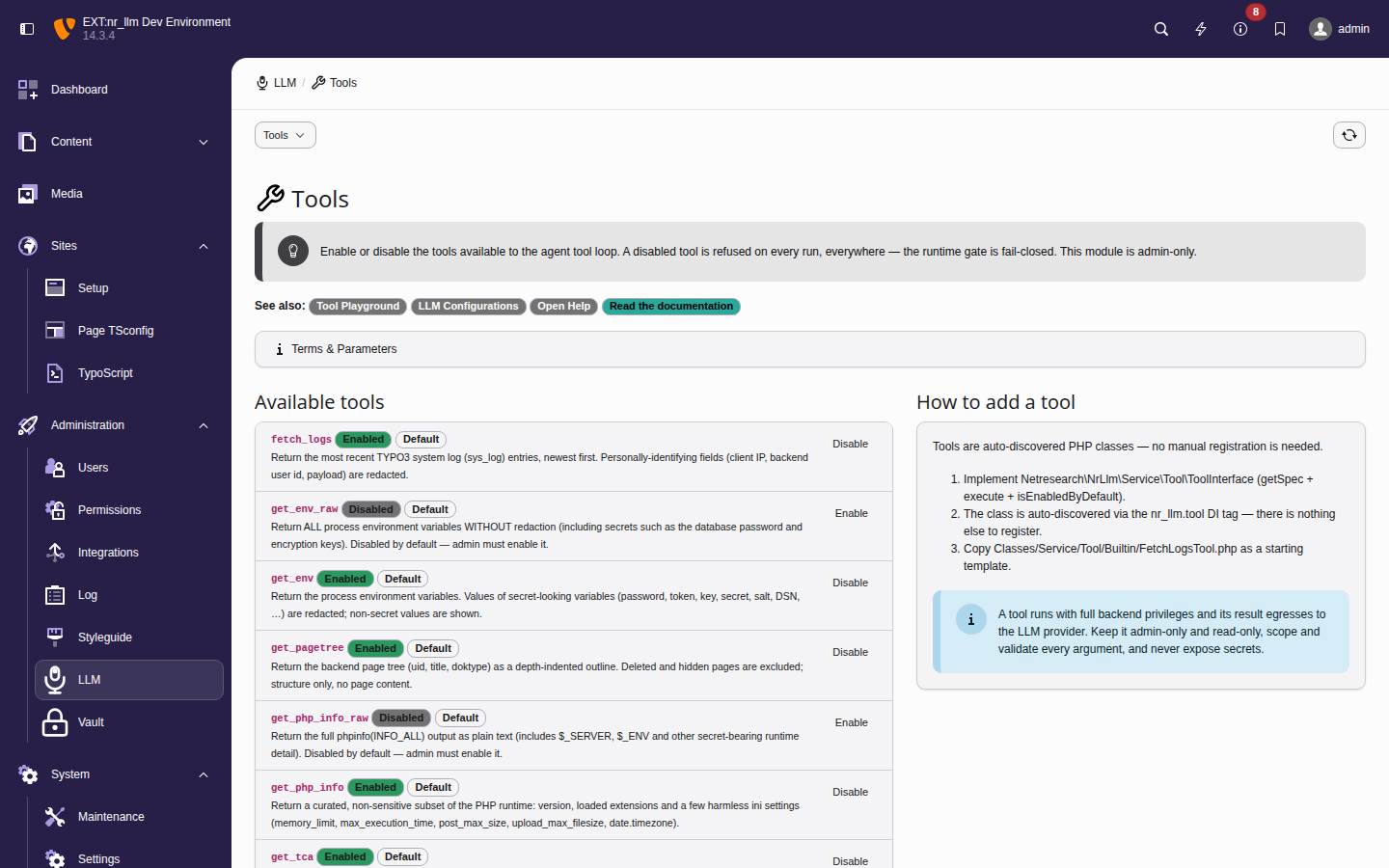
The Tools module — each registered tool with its global enable state and a
toggle. The _raw variants show as Disabled, the redacted
tools as Enabled; the Default badge marks a tool
sitting at its shipped state.
A tool that carries an editor action declaration (ADR-152) reads differently in that list: it shows an icon, its translated name, one sentence written for a human, and the record types it addresses — instead of the wire name and the description written for the language model. All five writing tools declare one, and the wire name stays visible as the technical detail the toggle acts on. A read-only tool is unchanged.
The declaration is presentation only. It does not decide whether a tool writes — that is the tool's declared effect — and it changes nothing about how a call is fenced, approved or audited.
What editors see
The declaration is what the Editor Action Center (ADR-158) renders. It lives in the editor module Web > AI tasks and appears in two places: as an AI actions catalogue reachable from that module, and as an AI actions entry in the context menu of a record — a page or a content element — which opens the catalogue narrowed to the actions that address that record.
An editor is offered an action only when all of the following hold, and every one of them is an administrator's decision:
- the writing tool is enabled in this module (all five ship disabled);
- its group —
editing— is enabled, and where the default LLM configuration restricts tool groups,editingis among them; - the tool's data class is within the configured provider's trust-zone ceiling;
- the backend user holds
tasks_useand has the module ticked in their group; - the backend user may use the default LLM configuration itself — where that configuration restricts Allowed backend groups, the user is in one of them (see Backend user permissions).
That last point is checked again when the action is started, so an editor outside those groups cannot start a run by naming the action directly either.
Starting an action creates an ordinary agent run restricted to that one tool. Because the tool declares a write, the run suspends before it touches anything and the change appears on an approval card with its preview — the editor is redirected straight to that inbox. Nothing is written until someone approves.
The record an action is offered on is the record its arguments name, which is not always the record it writes: Create content element draft is offered on a page, because the page is what it must be told, and the element it creates is the result. Where an action needs something the selected record cannot supply — Move content element needs a target page — the editor names it in the note, and the approval card shows the destination that was resolved from it.
Files have no context-menu entry yet: the file list identifies a file by its combined identifier rather than by uid, so Set alternative text is listed in the catalogue but has no per-record entry point.
Several records at once
Once a record is selected — that is, when the catalogue was opened from a record's context menu — each action there also offers Run this on several records (ADR-162). The catalogue opened from the module menu has no record and therefore no bulk entry point either; an action needs a subject, and this module picks none. That page takes a list of record numbers from the same table, seeded with the record that was selected, and shows, before anything starts, which of them the action can run on, which are skipped and why, and what the batch is expected to cost in requests, tokens and money.
At most 100 entries of that list are read at all. A longer paste is cut there and the page says so, because everything past the cut would otherwise become a table row and a record number in a message no one can read.
Starting it creates one ordinary run per record. There is no bulk mode: each record gets its own approval card with its own preview, and an approver decides them one at a time. At most 20 records are started in one press, because the runs execute inside the one backend request.
The AI budget is checked once per run, so a batch can run out of budget partway through. When that happens the batch stops and names the records the stop kept from starting — the record it stopped on was run, and is reported separately. Nothing is left half-written: the runs that did start are proposals awaiting approval, not changes.
Runs that ended for some other reason are reported by kind — failed, stopped by a guardrail, cancelled, or simply finished without proposing a change — so a batch in which everything failed does not read like one in which nothing needed changing.
The estimate on that page is deliberately rough and says so: it does not count
the system prompt and skills the runtime adds, and its upper price assumes every
request returns the configured token ceiling. It shows no price range at all
unless the model record carries both an input and an output price and the
configuration sets an output ceiling — an absent range means "unknown", which
0.00 would not. Treat it as an order of magnitude, not an invoice.
Tool groups
Every tool belongs to a group (its getGroup() value). The built-in
groups carry a translated name in the module header beside their identifier; a
group a third-party extension brings has no translated name and shows its
identifier alone. The built-in taxonomy:
| Group | Tools |
|---|---|
content | search_records, get_page_content, read_records,
get_record_history |
structure | get_pagetree, get_tca, read_fal_asset_meta,
get_full_tca, get_table_schema, get_flexform_schema,
resolve_url, validate_tca |
system | get_env (+ raw), get_php_info (+ raw),
fetch_logs, probe_url, list_extensions,
list_scheduler_tasks, get_system_status,
list_deprecations, list_middlewares |
accounts | list_be_users (+ raw), list_be_groups |
configuration | get_typoscript, get_tsconfig, fluid_resolve,
check_typoscript, get_site_config |
code | get_last_exception, read_source, search_code |
files | list_fal_storages, browse_fal_folder,
search_fal_files, get_fal_references,
find_missing_files |
rag | site_rag_query, site_fetch_source |
editing | update_page_metadata, set_file_alternative_text,
move_content_element,
create_content_element_draft,
create_translation_draft — the only WRITING group |
Groups can be switched on three levels, and the result cascades fail-closed — a tool is offered only when every level permits it:
- Centrally in the Tools module: each group header carries an Enable/Disable group toggle. A disabled group refuses all of its tools — including same-group tools installed later — and a per-tool override can not re-enable a tool inside a disabled group (predictable, fail-closed). Per-tool toggles keep working but take effect only once the group is enabled again.
- Per configuration: the Allowed tool groups field on an
LLM configuration restricts agent runs with that configuration to tools of
the selected groups (empty = all groups). This intersects with a skill's
allowed-toolsdeclaration. - Per run in the playground: the tool checkboxes are grouped, and each group checkbox (de)selects its children.
Third-party extensions declare their own group per tool; the recommended value is the extension key, so an admin can disable an extension's whole tool family with one toggle. The design is recorded in ADR-043.
Network egress policy per group
Network egress is governed per tool group and is fail-closed (ADR-061). Each group has a declared egress scope; a group with no declaration may make no outbound request:
| Scope | Meaning |
|---|---|
none | No outbound network request (the default for every group). |
own_site | Only the instance's own configured site hosts, resolved
through SiteFinder — the exact allow-listing probe_url
applies, now lifted to the group boundary. |
Only the system group (which carries probe_url, the one built-in that
fetches over the network) is granted own_site; every other group is
none. There is no "any host" scope, so a newly installed or mis-declared
tool group can never egress to an arbitrary target. The diagnostics tools that
share the system group (get_env, fetch_logs …) never make a network
request, so the grant does not loosen them.
Using the Tool Playground
The playground lives in Admin Tools > LLM > Playground and is admin-only. It is a sibling of the Tools management module: the playground runs the loop, while the Tools module governs which tools exist and are enabled.
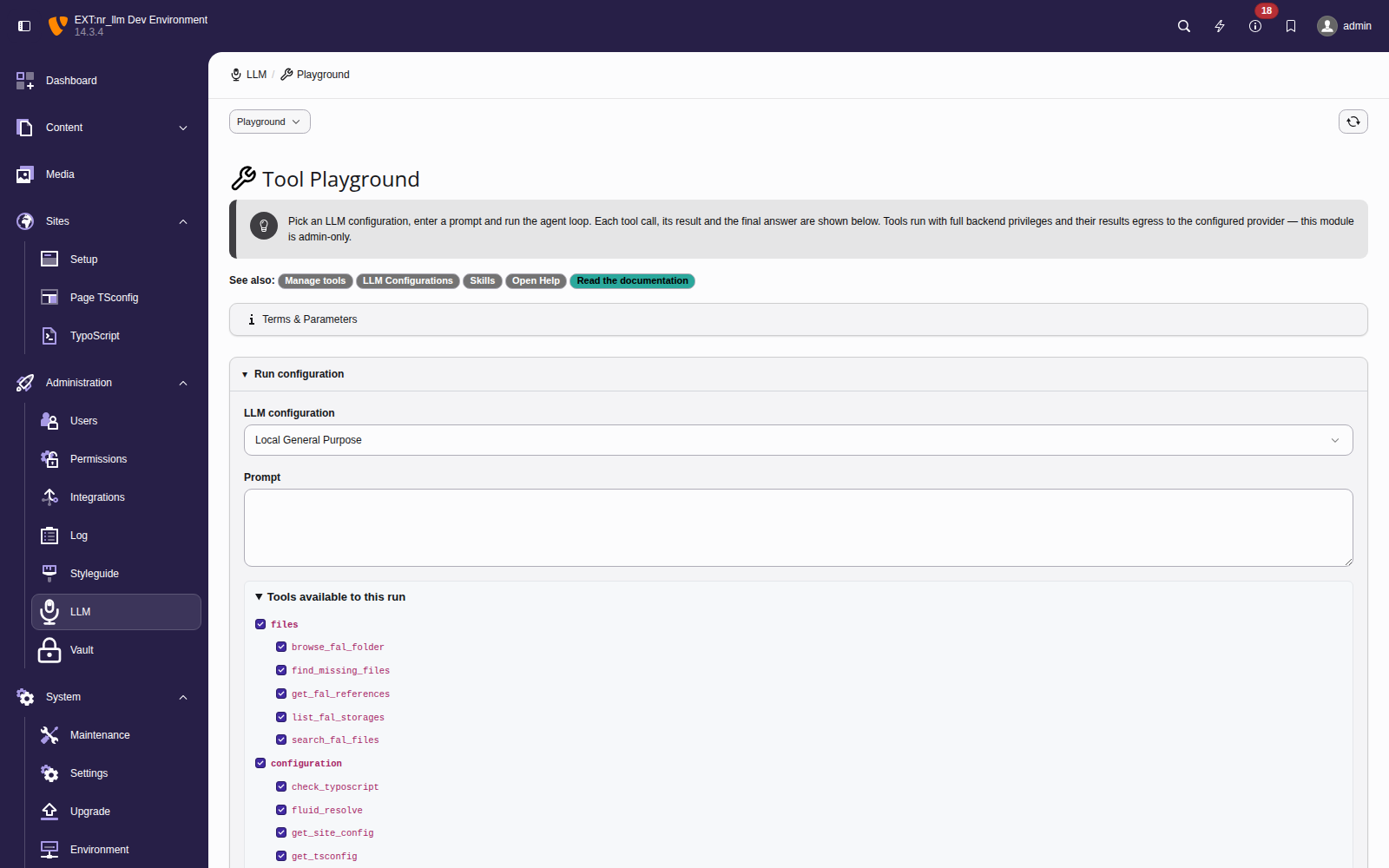
The playground shell — the configuration picker, prompt box and the
Tools available to this run panel, which lists every
registered tool with the default-enabled ones pre-checked and the
disabled _raw variants unchecked.
Tip
Small local models work best with a narrow tool set. With every
group enabled, the model is offered every enabled tool declaration at
once (several dozen). Small models such as the seeded qwen3:4b
often fail to pick the right tool from a set that large, or reason
past the token budget without calling any. Untick the groups that are
irrelevant to the question — restricted to one or two groups, the same
model picks the right tool. Larger hosted models cope with the full
set.
- Pick an LLM configuration from the dropdown. Its vault-stored API key, model, temperature and system prompt are what the loop actually runs on — the playground never falls back to a default model.
- Type a prompt. Optionally open the override panels to force-inject skills (added on top of the configuration's own), force-add snippets (inserted as leading system messages), override the system prompt, cap the max rounds, or tick capture raw provider response.
- Click Run — or Dry run to assemble the prompt and inspect exactly what would be sent without calling the model.
- Read the inspector — live from the moment you click Run. A summary strip reports rounds, tool calls, the prompt/completion token split, estimated cost, wall time and status. The step list is the nr_llm ↔ LLM dialog in order: each round opens with a Context budget step, then its outbound request (the messages sent and the tools offered) appears the instant it goes out, a waiting indicator shows while the model works, then the response and each tool execution stream in. Select a step to open its detail — requests carry Messages sent and Tools offered; responses carry Structured, Raw JSON and Thinking. The model's final answer closes the run.
-
The Context budget step says where the window went for the round that follows it, so you can act on the component that is yours to change rather than only learn that history was dropped. It has two tabs:
- Where the window went
- The window, the output reserve, the safety margin and the resulting budget, then four component lines — transcript, tool schema, system prompt (incl. snippets) and skills — that sum to the estimated total, plus what is left. On this surface the system-prompt line always reads counted in the transcript and the skills line always reads 0: the agent loop builds both into the transcript before the fit measures it, so their content is already on the transcript line. The table says so under the figures. A send whose reserve exceeds the whole window is handed to the provider unmeasured, and the step reports no accounting instead of a window of zero.
- Injected context
- Every snippet and skill this run injects, by name only, with the data class it declared (ADR-144) or not classified, and the strictest class across all of them. The list covers the snippets and skills you force-injected for this one run as well as the configuration's own — the input-context gate itself still answers for the configuration alone, so a forced source is shown here and is not gated.
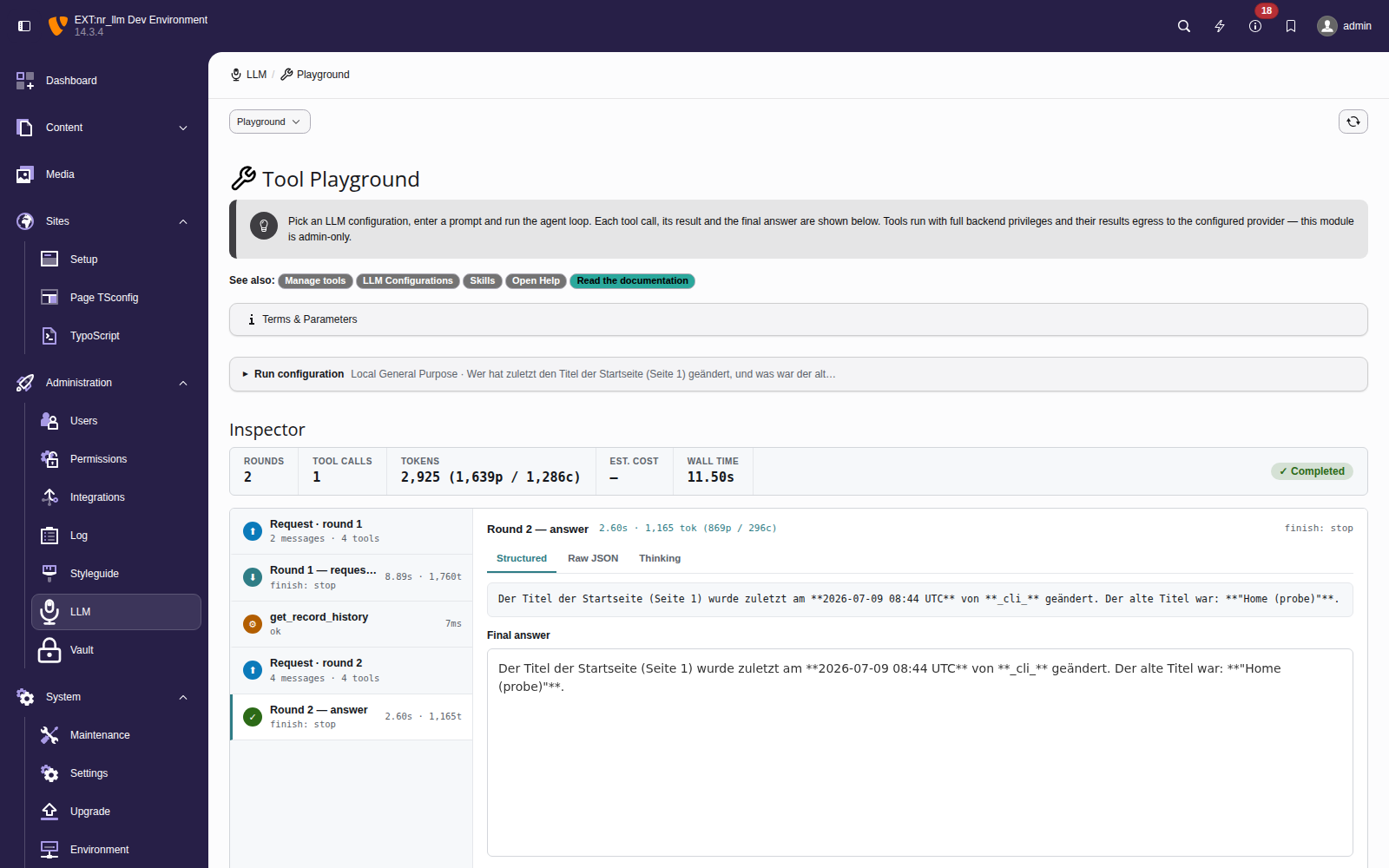
A completed run — the summary strip (rounds, tool calls, token split, wall
time, status), the ordered step list of the nr_llm ↔ LLM dialog, and the
selected step's detail: here round 1 requested the list_be_users tool,
whose result is fed back so round 2 can answer.
The Tools available to this run list lets you narrow a single run
to a subset of the globally-enabled tools (the full list and the global
enable/disable controls live in the Tools module). Raw-response capture is off unless you
tick it, so ordinary runs never retain the provider's raw payload. Every
displayed string — tool arguments, tool results (which may include
sys_log content), and the final answer — is rendered escaped; HTML is
only ever shown inside a sandboxed preview, never injected into the page.
Each run is bounded by the iteration cap (default 5) and, when the configuration's backend user has a budget, by the per-iteration budget pre-flight. If the cap is hit with tools still pending, a final tool-free completion synthesises a closing answer and the run is marked truncated. The aggregated token usage is reported; the monetary cost is recorded in the usage table by the middleware pipeline.
Ollama model-capability dependency
Tool calling depends on the model, not just the provider. For Ollama,
only function-calling-capable models — for example llama3.1,
mistral, qwen2.5 — return tool calls. A model without function-calling
support simply answers the prompt directly and never calls a tool; the
loop ends gracefully on the first plain answer. If a configured Ollama model
never seems to use the available tools, verify it is one of the
function-calling models for your Ollama version.
Gating tools with allowed-tools in a skill
A skill's SKILL.md front-matter may carry an allowed-tools key that
gates which tools the skills attached to a configuration (or task) grant for a
run. The resolution is fail-closed on declaration, computed over the
configuration's effective skills (enabled, non-orphaned, at or above the
instance trust floor, deduped):
- Absent (no skill declares
allowed-tools) — no opinion; all registered tools are offered. - Declared list — the union of the declared lists across the effective skills; only those tools are offered (intersected with what is actually registered, so an unknown name is dropped).
- Declared empty (
allowed-tools: []) — declares zero tools; if no other effective skill widens the set, the run gets no tools and is a single plain completion.
A disabled or orphaned skill never grants tools. The allow-list is enforced both when the tools are offered to the model and again when a tool call is executed, so a prompt injection cannot reach a tool the skills did not grant.
The effective set is not the same as what ends up in the prompt. The
skill-block byte budget (skills.maxBytes, see
Managing skills) is applied after the
allow-list has been computed, while the block is assembled. A skill dropped
for the budget therefore still contributes its allowed-tools, but its
usage rules never reach the model. That order is deliberate: a budget-aware
union would let the drop of the last declaring skill collapse the allow-list
to "no restriction" — every registered tool — which is a looser gate, not a
tighter one. Keep skills.maxBytes above the composed size of the skills
you rely on if you want their prose to arrive alongside the tools it
describes; every drop is logged as a warning.
See ADR-038 for the runtime design and security rationale.