

Console
Developers usually have the browser console open anyway. This indicator prints a styled environment badge to the console on every page load — more subtle than the visible Frontend Hint, but unambiguous for the "developer view", and it never covers page content.
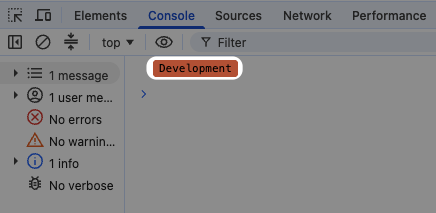
Console badge
DEVELOPMENTThe badge is printed in the frontend and in the backend, so the environment stays identifiable while working in a module as well.
You can register the indicator in your ext_:
use KonradMichalik\Typo3EnvironmentIndicator\Configuration\Handler;
use KonradMichalik\Typo3EnvironmentIndicator\Configuration\Indicator;
use KonradMichalik\Typo3EnvironmentIndicator\Configuration\Trigger;

Handler::addIndicator(
    triggers: [
        new Trigger\ApplicationContext('Development*')
    ],
    indicators: [
        new Indicator\General\Console([
            'color' => '#bd593a',
        ])
    ]
);Additional optional configuration keys:
text(string): The badge text. Default is%context%, which is replaced with the current application context. An empty text disables the badge.color(string): The badge background color. Default is#767676. The text color is derived automatically for optimal contrast.
Note
The indicator is part of the default configuration presets for the non-production contexts, using the same colors as the Frontend Hint.
Note
Both scopes are rendered from the same source, so the badge cannot look
different in the frontend than in the backend. Only the delivery differs:
the frontend uses an external JavaScript file that reads the badge from
data attributes, the backend an inline script registered through
Page.
Note
Both work under an enforced, nonce-based Content Security Policy. The
frontend script tag carries a CSP nonce, and the backend — which enforces
a nonce-based policy by default — gets its nonce from
Page.
Note
A percent sign in the badge text is escaped automatically. Without that,
the browser console would read it as a format directive and drop the
styling of everything after it — relevant when using
instance.label values such as
TEST 100%.
The console badge can be disabled per scope via the extension configuration: frontend.console and backend.console.